Category: Blogging

  • “Robust Ethics and the Autonomy Thesis” Now Online

    Recently, Philosophia Christi published Matt’s article “Robust Ethics and the Autonomy Thesis: A reply to Erik Wielenberg”. This article consisted of some critical commentary and responses to Erik Wielenberg’s bookdefaul1 Robust Ethics: The Metaphysics and Epistemology of Godless Normative Realism.

    Since then Matt’s article has received a little bit of unexpected attention. One of my arguments was discussed in a dialogue between William Lane Craig and Erik Wielenberg that took place at North Carolina State University earlier this year, and on the back of this, we have received several received requests to read the paper. It is now available here: Flannagan Robust Ethics PC 19 2 (1)

    Permission has been granted from the Editor of Philosophia Christi to upload this contribution. Learn more about the Journal by going to www.epsociety.org/philchristi.

  • “Robust Ethics and the Autonomy Thesis” published in Philosophia Christi

    Matt’s article, “Robust Ethics and the Autonomy Thesis: A reply to Erik Wielenberg” has been published in the wiPhilosophia Christinter issue ( Vol 19 Num. 2 – Winter 2017) of Philosophia Christi.  An overview of the contents of the full issue can be found here.  The editor has given Matt permission to upload the article in a couple of months. For now here is the abstract:

    In his monograph, Robust Ethics: The Metaphysics and Epistemology of Godless Normative Realism, Erik Wielenberg offers arguably one of the most sophisticated defenses of the autonomy thesis to date. Wielenberg argues that (I) the divine command theory is problematic because it cannot account for the moral obligations of reasonable unbelievers; (II) Godless normative robust realism (GRNR) can be formulated in a way that avoids the standard objections to the autonomy thesis; and (III) GRNR provides a better account of intrinsic value. In this paper, I will argue Wielenberg’s defenses of the autonomy thesis fails. I will argue that his objection to divine command theories fails, that he fails to address two standard challenges to the autonomy thesis adequately, and, finally, that Wielenberg fails to show that GRNR better accounts for the intuition that certain things are intrinsically good than various forms of theistic alternatives.

  • Update

    Last year I gave an address on Contemporary Philosophy of Religion and NCEA Religious Studies to the New Zealand Association of Philosophy Teachers. This paper has now been published on the website of the Presbyterian Church schools resource office. Enjoy.

  • An Interesting Comparison

    This from Occupy Democrats:

    12647129_1058653647561022_4746717199189857381_n

    This from the Unites States Founding Fathers:

    When in the Course of human events, it becomes necessary for one people to dissolve the political bands which have connected them with another, and to assume among the powers of the earth, the separate and equal station to which the Laws of Nature and of Nature’s God entitle them, a decent respect to the opinions of mankind requires that they should declare the causes which impel them to the separation.

    We hold these truths to be self-evident, that all men are created equal, that they are endowed by their Creator with certain unalienable Rights, that among these are Life, Liberty and the pursuit of Happiness.–That to secure these rights, Governments are instituted among Men, deriving their just powers from the consent of the governed, –That whenever any Form of Government becomes destructive of these ends, it is the Right of the People to alter or to abolish it, and to institute new Government, laying its foundation on such principles and organizing its powers in such form, as to them shall seem most likely to effect their Safety and Happiness. Prudence, indeed, will dictate that Governments long established should not be changed for light and transient causes; and accordingly all experience hath shewn, that mankind are more disposed to suffer, while evils are sufferable, than to right themselves by abolishing the forms to which they are accustomed. But when a long train of abuses and usurpations, pursuing invariably the same Object evinces a design to reduce them under absolute Despotism, it is their right, it is their duty, to throw off such Government, and to provide new Guards for their future security…

    We, therefore, the Representatives of the united States of America, in General Congress, Assembled, appealing to the Supreme Judge of the world for the rectitude of our intentions, do, in the Name, and by Authority of the good People of these Colonies, solemnly publish and declare, That these United Colonies are, and of Right ought to be Free and Independent States; that they are Absolved from all Allegiance to the British Crown, and that all political connection between them and the State of Great Britain, is and ought to be totally dissolved; and that as Free and Independent States, they have full Power to levy War, conclude Peace, contract Alliances, establish Commerce, and to do all other Acts and Things which Independent States may of right do. And for the support of this Declaration, with a firm reliance on the protection of divine Providence, we mutually pledge to each other our Lives, our Fortunes and our sacred Honor. (emphasis mine)

    Oceania is at war with Eastasia. Oceania has always been at war with Eastasia.

  • Matt Elected to the Executive Board of the Evangelical Philosophical Society

    Evangelical Philosophical SocietyCongratulations to this blog’s Matthew Flannagan who was just elected to the executive board of the Evangelical Philosophical Society. Congratulations also to Frank Beckwith, Paul Franks who were also just elected to the board.

    Matt, Frank and Paul will join the existing board, who can be seen at the above link. Their first meetings are in Atlanta next week. As far as I can tell, Matt seems to be the first kiwi scholar to hold the position.

  • On Judging Books by their Covers: A Fisk of the Secularist Outpost’s book review of Did God Really Command Genocide?

    You should not judge a book by its cover, unless you are a secularist… then it is okay.

    In a post entitled “Books Like This Should be a Warning Signal to Inerrantists“, published on 26 September 2014, The Secular Outpost’s Jeffery Jay Lowder refers to Paul Copan and this blog’s Matthew Flannagan’s, then forthcoming, book Did God Really Command Genocide? Coming to Terms with the Justice of God.

    crystal ballAfter making an acknowledged assumption as to whom authored the publisher’s description, Lowder then moves to confidently asserting that his assumption was correct, and leaps from there to critiquing the then-not-yet-published-or-available to-Lowder-to-actually-read content of the book. Yes folks, it is a live example of judging a book, quite literally, by its cover.

    Lowder wrote: [note: that bold, underlined, italics are my emphasis, any other emphasis is original. My comments are in italics]

    “So they admit that the relevant passages are among “the most confusing and uncomfortable passages of Scripture,” passages which make even hardened inerrantists like Copan and Flannagan “squeamish.”

    This is the bit wrongly attributed to Paul and Matt that I referred to above.

    “But, being the faithful believers that they are, Copan and Flannagan will argue that, yes, a “good, kind, and loving deity” would command (and, in fact, has commanded) “the wholesale slaughter of nations.””

    Apparently Lowder is a clairvoyant secularist. Either that or he is really good at cover interpretation.

    “How will they reconcile God’s goodness, kindness, and love with genocide? The book’s subtitle suggests that they will argue that “justice” is the answer.”

    See?

    “The fundamental problem with books like this is that they fly in the face of what seems obvious to everyone else who doesn’t already hold the a priori belief that everything the Bible says must be true,”

    Ah, so not being a Christian is what gives secularists the ability to boldly state the “obvious” about the content of books they have only had access to the covers of. I thought that maybe I just lacked the confidence to make such bold assertions about the content of books I have not read. (…Well, that, and the fact that, unlike Lowder, I do have access to the manuscript by virtue of my sleeping with one of the authors [whom I am married to] and I know for a fact that this is *not* actually what Paul and Matt argue. Small details, I know.)

    “just because the Bible says it.””

    That is actually not what inerrantists of Matt and Paul’s ilk believe;  this is actually a strawman (small detail, again, I know).

    To paraphrase something Nick Trakakis wrote in another context, “Defenses of genocidal behavior by the OT god turn a blind eye to what seem clear and obvious to everyone else — that such behavior makes a mockery out of what any person would consider morally justifiable behavior.””

    This would be a good ending if the book actually did defend “genocidal behavior by the OT god.” Again, small detail.
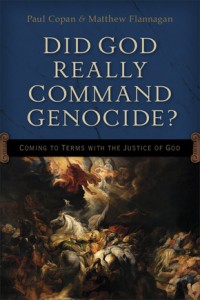
    Did God Really Command Genocide?Advice to Lowder: try, I don’t know, reading it. It got released today so you finally can. Did God Really Command Genocide? is now available from the following book providers:

    Baker Books
    Amazon
    Kindle
    Book Depository