Category: Blogging

  • State of the Nation: Some Voting Considerations

    With each of us feeling pulled, guilt tripped, bribed, confused over not only who to vote for and how to decide Glenn does it again; read his analysis of the state of our country and where exactly we have gone wrong in our thinking.

    Extract from New Zealand: Land of greed, envy and political stupidity (the election blog, part 2):

    The New Zealand political environment is one of very strong statism and government intervention, wealth redistribution and disincentives for many people to work hard and try to get ahead. “Share the wealth” might sound like a nice idea, only in this case it’s not a case of someone saying “why don’t you share your wealth,” but rather a case of the state saying “I am going to share your wealth – with everybody else.”

    There’s more to it than just this. The involvement of the state with our finances is part of the intervention into private lives, but it’s not the only form of such intervention. Marriage in New Zealand is now essentially a legal construct, and as such those who make the laws inevitable end up telling people what does and does not count as marriage. We’ve recently been told (by lawmakers) that we must – regardless of our own views on the matter) treat same sex couples as having a relationship that is the same as a married relationship, if they have a civil union. Now, you might personally think that’s fine. The point here is that it wouldn’t be an issue if the state didn’t own marriage. If marriage was a private affair, perhaps accompanied by a private contract, there would be no “same sex marriage” controversy. Let churches marry who they are prepared to marry, and let anyone have a public gathering to celebrate what they will. But as soon as the state gets involved and starts bestowing its blessing, they have started forcing other people to endorse forms of relationships.

    Take another example: The notorious (at least in new Zealand) “anti-smacking” law. Assault is a crime in New Zealand, however there have always been exceptions – scenarios where you are permitted to use force against other people (within reason). You can use reasonable force in self defense, the captain of a ship can use reasonable force to subdue and contain a passenger who poses a risk to other passengers, and up until recently, a parent could use reasonable force in the course of disciplining a child. The has always said that the force must be reasonable, so you couldn’t injure your child, for example. But you could use force – for example – to place your child in confinement (which would normally be illegal – I can’t confine another person under normal circumstances), or to smack your child (again, with the proviso that the force is reasonable and not harmful), or any other kind of force along those lines. However, section 59 of the Crimes Act, which allowed for this exception in the case of disciplining children, has now been repealed. The state can use force against you if you need correction, but you cannot use force against a child if that child needs correction. As has frequently been noted, this as the unambiguous consequence that any person who uses any amount of force on a child for any reason is a criminal. If you place your child in “time out” when he doesn’t want to be there – you’ve commit a crime, and a crime for which there is literally no legal defense. If you did this and the police laid charges, you’d be guilty, no matter what the circumstances, because the law has been changed so that absolutely no amount or type of force can be considered reasonable. When challenged with this fact, the member of parliament who proposed this law change, Sue Bradford, explained that yes, it’s true that nearly all parents would technically become criminals, but we should trust the police to use discretion. It’s sometimes hard to convict people who physically abuse children, she explained, so this way everyone is prosecutable, meaning that the genuine abusers can be successfully prosecuted without hindrance like pesky defences of “reasonable force.” Think I’m exaggerating? Not even close. I was physically present (and almost physically sick) at Bradford’s public meeting here in Dunedin when she happily explained this.

    Another example is the Electoral Finance Act, which I discussed recently here. This is, in effect, an attack on the free speech of political spokespeople who do not wish their personal address to be provided to the new Zealand public.

    Another example is Labour’s re-write of the Immigration Act. The new version gives immigration personnel (not even police officers) powers to invade private property, seize belongings and detain people, without the need of a warrant. Oh, and the detainees do not have to be given the specifics of why they are being detained, either.

    Then of course there was the notorious Seabed and foreshore Act. The government, one side of a dispute over ownership and governance of parts of New Zealand coastline, decided by legislation that the dispute could never be taken to court, and it declared by fiat that the state owned all of the disputed pieces of land. Case closed. No compensation required (oh, and no due process either).

    And then there’s the general all-powerful thuggish behaviour of Labour’s members of parliament over their last few terms of government, including the Prime minister herself, to whom ordinary laws and principles of conduct simply don’t apply – whether it’s the leaked fabrications she used to end the career of the Police Commissioner, the artwork she falsely signed for an auction, the speeding that she apparently required of her driver to get to a rugby game on time – and then let him take the fall for it, as well as the more general reputation she has earned for being a controlling bully who allows no dissent (or free thought). Then there are the cabinet ministers (note: not just members of parliament but cabinet ministers) who, the police agreed, had prima facie cases to answer for assault, but against whom the police, for some reason, chose not to press charges. And then there was the cabinet minister who abused police power by literally calling them up to go and advise a citizen of a request to pay damages (i.e. a civil matter, and even before a civil suit had been filed). The Prime Minister did literally nothing about any of this. There was also the case where an application to build a marina in Whangamata was approved by the environment court, after much effort and expense by the applicants. But then cabinet minister Chris Carter overturned the decision. Again, no due process, no separation between the legislature and the courts, just heavy handed intervention to overthrow the normal process because a government minister didn’t like the outcome of the court.

    There’s little doubt that Clark has had a clear vision for the type of society she wishes to engineer. The society towards which the policies of Clark’s Labour government are geared is a society that eschews traditional morality, sees solo parenting as normal and provides financial support to make it no more difficult than two parent parenting, a society where “sexual norms” is a judgemental term and same-sex unions are absolutely no different from traditional marriage between a man and woman, where authority and to some extent, responsibility, are transferred out of the family home into into the hands of the state (it is the state’s role to discipline, educate, or use force to punish, etc), a society where it is fundamentally the role of the state to see that your family is provided for, a society where healthcare and educational choices are made by the state and funded by the taxpayer whether they use those options or not, a society where the type of free expression that finds acceptance is that which upholds all these norms, and expression that call into question the moral acceptability of these things is frowned on, a society where the idea of promiscuity as something abnormal or unhealthy is itself seen as something abnormal, unhealthy and oppressive, a society where the defence of all these values is described as tolerance, and the defence of different values is presented as intolerance. Of great importance, amidst all this, is that the wise, benevolent state faces no opposition to its decisions, and if there is ever public opposition to its intentions (as was the case with the Civil Unions Bill and the Anti Smacking Bill), these complications are simply ignored.

    Why, exactly, would a Christian vote for a government like this? I’ve asked a few, and I think that, unfortunately, the reason some Christians might vote for a party like this is that “if they become the next government, they will give me X.” What about their impact on laws relating to marriage, or prostitution, or their immoral solutions to land disputes, or their threat to free speech, or their thuggish and unaccountable influence over civil servants, or their disregard for human rights, whether in its treatment of immigrants or in other cases (such as their rejection of the freedom of association for students)? Don’t any of these give my fellow Christians pause before voting them back into power? “They’ve going to give me X.” Whether that X is a cash payout via some sort of state welfare, or a bonus for people working in the state sector, or something else, how in the world could anyone be so short sighted as to snap at a cash carrot and to ignore the wider picture of what is happening?

    One answer has to do with the basic human condition: I’m greedy and envious. If the government gives me money, then regardless of whether I deserve it, my first inclination is to take it and enjoy it. Other people make much more money than I do, so why shouldn’t I be able to get my snout to the trough as well, right? And if the way to get this present is to vote for a particular party, then that party will get my vote.

    There are less cynical ways of looking at welfare payouts, of course. Perhaps the Christian voter might think that the state is being kind to the poor by having these programmes (which should, hopefully, make them wonder why they payouts are made to families that earn salaries over $60,000). Maybe they believe that “social justice” just means distributing wealth so that nobody ends up at the bottom of the heap. I’ll say more about this in my next post, but my experience tells me that the main reason some Christians have for voting for Labour is that Labour will give them something, and they don’t want to lose it.

    Here’s a question I put to any who think this way: Aside from the fact that you like getting free money, what would be wrong with you not getting that free money? Now I know – when you write conversations yourself you get to determine the outcome, but look at it this way:

    Jerry: Hey Perry, who are you voting for?

    Perry: I’m voting for Labour.

    Jerry: Really? Wow. I wouldn’t have seen that coming. You’re a Christian, right?

    Perry: Yes – what does that have to do with anything?

    Jerry: Everything, I would have thought. I mean Labour is totally pro-abortion rights, they created same-sex marriage in this country, they made parents into criminals, they forced people to publish their address when they make political comment, they ride roughshod over human rights, they take incredible amounts of tax, they-

    Perry: Woah, woah, slow down!

    Jerry: Well, you do realise that Labour did all those things, right?

    Perry: Well, maybe. I’m not sure. But still… won’t that other party take away the money Labour is giving us? And I work in the state sector, I mean, my future there is more secure with Labour, right?

    Jerry: You’ve got to be kidding me.

    Perry: What?

    Jerry: Do you really think that your personal finances and security in a government job is more important than matters of right and wrong?

    Perry: No, no of course not. It’s not just about me. What about all those other families out there? They get family assistance from the government too!

    Jerry: And you point is?

    Perry: Well isn’t it obvious? Getting money from the government makes it easier for them to get by, so of course I want to vote for a party that will keep giving them that money.

    Jerry: Well firstly, pretty much every party is going to give them that money. It would be political suicide not to now that they’re already getting it. But there’s a much more important question here.

    Perry: And what’s that?

    Jerry: Should the government take my money and give it to you?

    Perry: Oh come on, let’s not make it personal….

    Jerry: OK fine – should the government take my cousin Bob’s money and give it to you?

    Perry: Well it helps the families who get it, right?

    Jerry: Oh, so if it helps families then the government can do it?

    Perry: Well, I guess. The government is here to help us.

    Jerry: Let’s see where that takes us. How would you feel if you worked hard to save up and buy a car, and then some agents from the government burst into your garage tonight and stole it, and gave it to my cousin Bob.

    Perry: Come on, that’s ridiculous. Nobody is saying that the government should be allowed to do that.

    Jerry: Well Perry, the thing is, Bob can’t afford a car, and having a car would really help his family. He could take them on holiday, and his wife could take them to soccer practice. Do you have any idea how handy a car is in today’s world for a family, Perry?

    Perry: But the fact that they would find it helpful doesn’t give someone the right to just take it from me and give it to them! I worked to buy that car. I earned it!

    Jerry: So what? Remember, it helps families. I thought you said a second ago that the government can do something if it helps families. In fact while we’re at it, some families struggle to pay for good healthy food. I hope you don’t mind if your local MP comes and raids your fridge for some food for them.

    Perry: This is getting silly. OK, the government can’t do just anything because it helps families.

    Jerry: Why not?

    Perry: Because that stuff is mine! That wouldn’t be just!

    Jerry: Just?

    Perry: Right. Taking my car or my food would be unjust!

    Jerry: That’s interesting Perry. Last time I heard, you were all in favour of this thing you call “social justice.” Am I right?

    Perry: You bet! As a Christian, issues of social justice are so crucial to me.

    Jerry: I see. So what are some of the fundamental issues of social justice?

    Perry: Well probably the biggest one is our attitude to the poor. We should share the vast wealth of society with them, redistribute those resources to see that nobody misses out.

    Jerry: OK, so why can’ the government redistribute your car and your food?

    Perry: Like I said, that’s unj- [the penny drops]

    Jerry: Unjust?

    Perry:… yeah. Unjust.

    Jerry: I think we need to take a big step back here. I’m all in favour of me sharing my wealth or you sharing your wealth. But what do we normally call someone who takes it upon himself to share other people’s wealth?

    Perry: Yeah, yeah, a thief, I know. But look, you can’t say that just because it would be wrong for an individual person, it would also be wrong for the government. Governments can do all sorts of things that an individual can’t do. They can make laws, they can change taxes, heck they can even declare war!

    Jerry: OK, now we’re really getting to the heart of it. What can the government do, and what can’t it do? What’s it’s job in the first place? There’s no way we can even begin to ask if it’s all right for the government to take my money and give it to you if we don’t even know what the role of the state is in the first place. Is it the government’s job to redistribute wealth at all? Exactly what rights do I have to the money I earn and the property I possess? How much authority does the government rightly have?

    Perry: There you go, getting all academic. Why doesn’t anyone just think of the children….

    Perry is a moron. Not in every way, of course, but when it comes to voting and politics, he’s pretty dim. That’s not measured by who he wants to vote for, don’t get me wrong. There are politically smart people who will vote for Labour. They are politically smart because they realise what they are doing: They are giving their support to a particular vision of the role of the government in society. When they debate politics, they realise that they are not debating individual policies, they are really involved in a clash of ideologies: Different political philosophies altogether. Two people might both support the same policy, but on the basis of very different political outlooks. Take the civil unions act that created a kind of same-sex marriage here in New Zealand. One person might support it because they firmly believe that it is the role of state to create by law all the formal types of relationships that adults enter into because they support a big government statist ideology, and if all relationships are covered by law, they can be regulated. Another person might support it in the (mistaken, I think) belief that this law generates more liberty and gets the government out of the lives of consenting adults.

    What grates me horribly, however, is the fact that so many Christians (like so many people in general) don’t even ask the big questions. Questions of principle like “should the government be taking and redistributing people’s earned money in this way – is that its job?” are replaced with much more selfish questions like “how much will I get,” or “how will this benefit my profession,” or even more benevolent sounding questions like “what will they give to families,” and people who dissent are not challenged intellectually on whether or not their political philosophy make sense, rather they are targeted with guilt trips like “but you’d be taking [taxpayers’] money away from ________ [insert some group here].” Never mind asking if the government should be giving them other peoples’ money at all, or if the government should be doing anything to benefit those in your profession. What about those not in your profession, or those from whom the money would be taken to give to you?

    Let me put some flesh on the bones: I know a person (nobody who would be reading this blog) who is a Catholic believer, who would vote for a pro-abortion rights pro same-sex-marriage party on the grounds that his taxpayer funded job would be less likely to get funding if another party came to power. I have known Christians – high profile ones at that – who have stood up in public and said “when you cast your vote, just ask one thing: What are they going to do for _______,” and he then named the Christian institution that employed him. In short, Christians get tangled up in some pretty ugly political messes, supporting parties – some of them self consciously Christian parties – that are struggling to impress people by how much they are going to give people or do for them, and they are not once engaging in high-level discussion about why anyone should care that those parties are going to do those things. “He says he’ll get the government to promote heterosexual marriage in law! I’ll vote for him!” Or “they want to give cash payouts to married couples who stay together! He gets my vote!” Not “he consistently advances policies on the basis of a good understanding of private property rights,” or “He really understands the role of the state and the limits of its authority.”
  • Statism and Wealth Re-Distribution

    A post by Glenn caught my eye the other day and I have not been able to stop thinking about it as despite knowing that Glenn knows what he is talking about in this field, I just am struggling to believe his numbers. It really is proof-positive of the socialist extent of Labour’s policies in practice and should serve as a warning to anyone tempted to vote Labour because they think the criticims levelled at Labour’s attempts to turn as many working people into beneficiaries dependant on the state as possible are exaggerated.

    I have reproduced some of it below as it warrants further exposure.

    Extract from New Zealand: Land of greed, envy and political stupidity (the election blog, part 1)

    Wealth re-distribution is at an almost unbelievable level at present. Take a family with one income earner. At current taxation levels, with an annual income of $40,000, that income earner will pay $7770.00 in PAYE (“pay as you earn”). This includes income tax plus 1.4% ACC (socialised accident compensation insurance). On the whole, that’s about 19.43%. If the earner works more hours or gets a more skilled job that pays more and the income is $70,000, the total PAYE is $18,090. That’s about 25.84%. It gets worse if you earn more than that.

    But it does not end there. Let’s add this to the mix: This family has four children below the age of 12. This means that this family will qualify for state welfare for those children. Use the calculators at www.workingforfamilies.govt.nz to check the figures for yourselves. Let’s imagine that there are two families with one earner in each, one earning 40K and the other earning 70K. I’ll be taking into account the payments received from the “working for families” welfare scheme as well as the accommodation supplement each of these families will qualify for. I’ve arbitrarily hypothesised that these two different families live in the same city that I live in, and pay the same amount of rent that my family pays. Taking all of the above into account, here is the weekly combined income from all sources – after tax – for these two families.

    Family 1, earning $40,000:
    Total after tax weekly income (including welfare payments) of $1018.27
    This family will pay $7770 in PAYE and receive $19,916 in state welfare. No, that is not a typo. Nineteen thousand, nine hundred and sixteen dollars of untaxed welfare payments.

    Family 2, earning $70,000:
    Total after tax income of $1208.27
    This family will pay $18,090 in PAYE and receive $10,920 in state welfare.


    Take a few moments to take this in: Family 2 earns $576.92 more than family 1 each week. For their extra effort or skill, they end up just $190 better off each week.

    The level of wealth re-distribution to minimise the difference in income between these two families is staggering. And yet, each of these families is a recipient of a sizable chunk of the re-distributed wealth of others. The first family effectively pays no tax at all and then receives a further cash bonus of $12,146. But even the higher earning family still receives well over half of the earner’s PAYE payments back.

    Who are the benefactors here? The benefactors are those without children who are trying to get by on $30,000 per year and not receiving a penny from working for families (but still qualifying for an accommodation supplement of about $60 per week). The other benefactors are those who receive none of these taxpayer funded handouts but who fund a huge proportion of them: those who contribute more tax because they earn more.

    Essentially, the financial landscape this creates is one where a family on a low to medium income with several children has little incentive to increase their salary/wages beyond around $36,000 (the level at which state handouts start to decrease). Even if they had a salary of $70,000, the difference in financial positions would not reflect this increase in earnings.

    That’s what I’m talking about when I talk about statism and wealth redistribution. It’s not just rhetoric without substance. It’s a real system that demonstrably penalises the high achievers, and for everyone else it serves as the great equaliser, making it seem like nobody’s earning more than anyone else. When everyone gets ahead – nobody gets ahead, nor is there any incentive to do so.

  • Exams Loom: Signing Out for Now

    My last lecture of the year was taped yesterday, my first final exam in 8 years is on Thursday (whatever happened to study week?) so I am signing out of the blogosphere until my last exam on 5 November. My Labour weekend will be nothing but intense study.

    I am not stressed though as I got my final essay grade yesterday and it was the highest mark I have pulled since studying at University: 97.5%!!!!! – yay! totally made my day ! With all my grades in I now know I am going into exams sitting higher than the class average in both subjects (not bad given I have had an 8 year break from study, have completed the year pretty much absent from class due to my injury, have battled said injury and have 4 kids, a job, a blog, etc). Anyway, I would have to bomb in a spectacularly bad way to pull a fail overall – which I know I won’t.

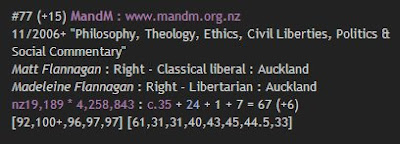
    Speaking of things that made my day yesterday, we climbed 15 spots on the NZ blog rankings for September.

    If Tim had had our correct uniques for September we would have officially climbed 26 spots to the number 69 spot (conservatively) but I recently upgraded our stats counter, so I could not provide him the data in the correct form; hence, we got guestimated – such are the rules. Tim does a great job so I won’t complain. The new position moves us to the number 4 spot of blogs formally identifed as Christian.

    So, I will leave the blog to Matt to manage, try to avoid the news, the computer and generally talking to people so I can focus purely on the books!

  • New Zealand Christian Blog Rankings for September 2008

    Extrapolating from Tumeke’s Semptember 2008 stats, the top 10 Christian Blogs* in New Zealand are:

    1. NZ Conservative (24)
    2. The Briefing Room (30)
    3. Something Should Go Here, Maybe Later (36)
    4. MandM (77)
    5. Samuel Dennis (80)
    6. Gavin Knight (91)
    7. Contra Celsum (94)
    8. Put up Thy Sword (115)
    9. Say Hello to my Little Friend (a.k.a Beretta Blog) (128)
    10. Section 59 Blog (147)

    (Numbers in brackets show the overall NZ ranking of each blog)

    *This list does not include Christians who blog but whose blogs are not identifiably Christian and is based on Tumeke’s classification and ranking methods.

    If you think your blog should be on the rankings click here.

  • Guest Post: Laidlaw College’s Mark Strom Responds to Critics

    Some weeks ago I wrote a review on the launch of Laidlaw College. I commented on the new vision for the future and my own reflections and frustrations of studying at its previous incarnation, Bible College of New Zealand.

    The comments section of this post saw the eruption of strong sentiment and criticism of Laidlaw College. The level of tension evident in what was said and the volume of readers concerned about the issue was quite surprising; our site stats record that this entry is one of our most read and most commonly Googled-for blog posts. Under fire was the seriousness of Laidlaw’s commitment to its new stated vision, its ability to commit to it and the employment process around the appointment of one of the new heads of department.

    As we are not party to the hiring practices of Laidlaw and as I was an unsuccessful candidate for the position that came under fire, we did not feel it appropriate to participate in the discussion. However, given the nature of some of the claims made, we have granted Dr Mark Strom, Principal of Laidlaw College, a right of reply.

    Matt

    Mark Strom’s Response:


    I’m delighted that the changes at Laidlaw have drawn so much interest. I’m also amazed that so many people (claim to) know (alleged) relationships between institutions, the intentions of board members, the processes of faculty appointments, my motives, the extent of faculty members’ knowledge, and so much more.


    Perhaps I can clarify one or two things.

    First of all, a big thanks to Matt and Madeleine for their very fair and balanced comments on Laidlaw. I personally appreciate encouragement and support from fair-minded friends able to be constructively critique and provoke us to push on.

    Second, people are right that Laidlaw still has a very long way to go. Our best over 86 years has been very significant. But did we become somewhat captive to a dualistic piety and its attendant culture(s)? Yes. Was this true of everyone and everything at college? No. Are we genuinely imagining, articulating, designing and making concrete something more holistic and engaged? Yes. Are there gaps between what we espouse and what we deliver? Yes. Is the trajectory clearly toward teaching, researching and championing real integration of thought and culture around a critically-informed evangelical theology at the highest standards of academic quality, intellectual rigour and serious faith? Yes, yes, and yes. This is our commitment. Piece by piece we are rethinking things and taking decisions that move us toward this. And we’ll take all the constructive criticism we can get from people who can imagine what a difference Laidlaw College could make to New Zealand and beyond, and who will give us room to try, to fall short, to grow and just maybe to succeed.

    Third, a few comments on details raised by respondents.

    Matt is right to note that evangelical organisations sometimes do not follow through on significant reforms. Like every other western institution, two legacies shape us: a Classical tradition that (for the greater part) censured change; and a Judeo-Christian tradition that introduced the appalling innovation (to classical minds) that one could break with conformity and be transformed by a radically changed mindset. Centuries of dialogue, intrigue, enmity and plagiarism between the traditions, overlaid by wave upon wave of Christian convention, has bequeathed an uneasy juxtaposition of conformity and innovation to evangelical institutions and leaders. I know this only too well within myself.

    I am loathe to comment on a colleague (and Rod will be appalled that I have defended him). Were there other candidates? Yes. Were some better qualified as per degrees and writings? Yes. Were these the only criteria for the appointment? No. The following competencies were crucial. First, an ability to see the disciplines of theology through the lens of the Bible’s own narrative structures and in particular the NT witness that the story and its great themes have reached their culmination in Jesus Christ. In other words, to read Christology not as one of many loci of Christian theology, but as that which makes theology Christian. [Barth surely had that right.] Second, an ability to model the teaching of theology as engaged in matters of historical, intellectual and public discourse, ie. worldviews and their impact on society. Third, an ability to inspire teaching around these themes. Fourth, an ability to model a realistic and effective mentoring of students as they seek to choose patterns of personal and public response to God and his world that reflect an integrated faith grounded in the historic gospel. Fifth, the maturity and gifts to nurture a relational culture between academics. Rod was a very strong choice on all these criteria.

    Has Laidlaw reached its full potential as an academic institution? Not by a long shot. Do we have some fine scholars with impressive PhDs and publishing records? Yes. Do we need more of both? Absolutely, and we will seek them. Respondents may be interested to know that earlier this year we completed a faculty restructure process. Three faculty chose not to apply for new roles. All others were rehired under improved conditions for the express purpose of completion of PhDs and the generation of peer-reviewed research publications. Eleven already have PhDs. Six are underway on their PhDs (some nearing completion). Two have begun advanced studies (with highest grades) to progress into PhD studies: one in philosophy at the University of Auckland, and one in ancient history at Macquarie University. We have set the bar high for ourselves, and we have embarked on an ambitious programme of making good on these aspirations. These things do not happen overnight.

    The conspiracists may be interested to know that the Laidlaw board represents a very healthy mix of theological perspectives (within a broad evangelical consensus) and political and economic perspectives, and we enjoy spirited banter and debate on these things. The board ‘relationship’ with Maxim amounts to a few friendships. And why wouldn’t there be?! Many respondents have noted there are far too few individuals and groups in NZ prepared to engage in serious thought and action on matters that shape society. So when you find some, you engage. Do we always agree? Far from it. Do you shun the dialogue because someone has caricatured your dialogue partner (even in this blog)? I choose not to. Ignorant caricatures are one thing, but when someone writes “that Laidlaw, like many other NZ Christian organisations has been captured by Maxim institute and appointments are being made not on academic ability but from the approved Maxim checklist”, this is a stupid comment. Plain stupid…and offensive. If it were naming an individual, it might be considered defamatory. There is no agenda. There is no captivity. There is no list. This comment is ignorant, untrue and offensive to the good people of Laidlaw and of Maxim. [On a personal note, had I voted in the last Australian election (I’m an Aussie), I would have voted for Rudd – I doubt that fits the assumptions of the conspiracists.]

    The question has been raised about whether “we really need a Christian liberal arts college”. I am on record as being against the idea. Like doctoral mentor, Emeritus Professor Edwin Judge of Macquarie University, I always read the early Christians’ distinctive innovations and interactions with Greco-Roman society and thought as evidence for arguing against the idea of a distinctively Christian educational institution. Our forebears showed no sense of need nor ambition to establish Christian structures as alternatives to those of their societies. That evidence and line of inference is still suggestive to me for the modern context. Personally I have long argued against the establishment of university type programmes in Christian colleges. In my opinion, a public university education has afforded both a better education (greater breadth and less cloistered) and a stronger platform for progression into places of influence.

    However, more recently I have come to a different place. Since 2006 I have found myself arguing in favour of this College offering a small number of first class qualifications equal to or better than the best New Zealand universities (yes that is an audacious goal – but closer than some might think in some areas; yes we have a long way to go). My shift of argument has 3 pillars:

    1. I am alarmed at the loss of faith among undergraduate students (some student workers estimate it is as high as 70-80% of students by the end of their programmes). This trend includes Maori and Pacific Island students. I have come to believe the College can and should address this tragedy through the provision of first class tertiary education grounded in a biblical worldview.

    2. I believe the reductionism of knowledge in university programmes has diminished their intellectual and academic rigour and integrity (not of course in every case). I believe in time this diminishes public discourse to the detriment of the nation. I have come to believe Laidlaw can offer a credible alternative education capable in time of influencing public discourse through literate and articulate graduates. Are we there? No. This is an audacious goal that will not come quickly, easily or cheaply.

    3. I believe Laidlaw should prepare (particularly young) women and men more deliberately for leadership in society, as well as in the churches. I have come to believe Laidlaw can equip such leaders for society most effectively through first class qualifications in education and the humanities (we are moving towards a School of Humanities with a PPE style BA degree: philosophy, politics, economics). I believe these qualifications offer appropriate ‘generalist’ educations for placing leaders of faith within education, media, business, health, social services, arts, politics and community leadership as well as continuing to serve the churches. My experience advising heads of corporations (commercial and government) confirms the sense that many employers are frustrated by the narrowness of many bright young university graduates of law, accountancy, commerce, business and engineering. Many are looking for classics and PPE grads. [This was confirmed earlier this year by the global managing partner of one of the world’s highest profile consultancies when I spoke at their global partners conference.]

    My argument for Laidlaw becoming such a College is not a reaction to ‘liberal’ humanism, nor an apologetic for a retreat into a Christian ghetto. On the contrary, I want to argue for a turning of the tables on the assumed hegemony of public universities over higher education. Most of the famed European and American universities began as colleges teaching a breadth of knowledge unified by theology as the core discipline. In short, they started like us. Over time almost every one of these institutions abandoned this theological and epistemological core. In the USA in particular this has prompted the rise of the Christian liberal arts college. [Yes, you may well hear echoes of Wolterstorf, Plantinga and others, as well as my own teacher of many years ago, Cornelius Van Til (and no, I am not a card-carrying VanTillian). By the way, Nick Wolterstorf enthused with me about the vision of Laidlaw when I visited him last year. And yes, that is name-dropping to counter some respondents’ assertions that no one knows or has read anyone.]

    The current education situation seems unnecessarily polarised: it seems we either accept the hegemony of the public university over intellectual discourse; or we retreat into the parallel universe of the Christian college. I no longer accept these as the only options. The time may be propitious for quietly, slowly building a credible alternative to university education on behalf of a nation: an alternative grounded in the theological worldview of historic Christianity, free of the dualistic legacies of traditional piety, and genuinely world-engaging and world-serving in the quality and openness of its teaching, mentoring and research and its contribution to public discourse. As Madeleine points out, this will require and make possible new engagements between Laidlaw College and the public universities.

    To all this talk of excellence I hasten to add our gospel commitment to strength-in-weakness and wisdom-in-foolishness. God delights in nullifying the “things that are” by the “things that are not”. Personally, I am a university drop-out who went on to consult to CEOs of major commercial and government institutions; I am a labourer who earned a PhD in the history of ideas; I am a spare parts salesman who become a principal. Some of the finest young men and women whom we seek as our students dropped out of school, did poorly at school, and generally do not think themselves capable of the kind of academic and personal formation we are seeking to make a reality. So in all our plans for “lifting the bar” we are working hard to establish a dignified, high-quality, effective pathway for those who would otherwise be overlooked.

    We don’t for one moment think any of this can be done easily or quickly. If this is a worthy task, it is a commitment to a generation.

    The notes about William Lane Craig are a bit of a mystery to me. I certainly know who he is (recall my VanTillian heritage). So do others at Laidlaw. I do recall hearing about it late. That happens. It had far more to do with poor communication (perhaps by us) than with ignorance or reluctance. We will endeavour not to make another “academic faux pas of this magnitude”.

    This has ended up a lot longer than I intended when I started. I’d like to frame my final comments (for now) around a thought I muse upon:

    I wonder how many respondents have lead significant institutions and been charged with effecting large-scale structural and cultural change? Or let me put it another way: a lot of people who point out our inadequacies, nonetheless join us in longing for high calibre Christian scholarship that has broken with the captivity of dualism to play a significant role in influencing a nation, society and church, with the gospel. I wonder if these people have the foggiest idea what it takes to position a traditional institution to deliver on such a desire.

    In other words, the ease with which people offer their opinions on what we should or shouldn’t have done at Laidlaw to this point is remarkable. Having been charged with being naïve, it seems only fitting to turn the table.

    Changing an 86 year old institution takes imagination, courage, humility and patience. Fortunately I am surrounded by people with far more of each than I possess. The pace at which we have instituted change has been mind-bogglingly fast for some, and too slow for others. One must honour a heritage and its continuing rich contributions even as one frames a vision that calls for radical changes. You cannot go from financial uncertainty to fully funded PhDs, new faculty and facilities overnight. Governance must be tightened. Financial reporting must be reworked. Deficits must be turned into surpluses. Assets must be reexamined. Accrediting and funding agencies must be given time to appraise and support the new directions. Cultures must begin to shift.

    Those expecting overnight adoption of the conventions and facilities of fine public universities will be deeply disappointed. Public lectures putting theological reflection on the table for the first time for hundreds of people will be viewed as populism. Hiring people with outstanding capacity to forge new trust and integration of gospel, culture and faith will be viewed as far less important than getting impressive CVs. Those with an eye to the long term will recognise strategy; the laying of further foundations (in addition to the fine existing legacies) upon which a great institution can be reimagined and redesigned by people in whom is combined an acuity and humility that will welcome scholars and students who exceed them.

    Can Laidlaw “see past their discovery of the basics”? I think so.

    Will people who read theology and philosophy beyond the popular, and who long for change within churches and evangelicalism and academies and public discourse in New Zealand, give us room to try, to fail, to grow, and just maybe to succeed? Time will tell.

    The Tall Poppy Syndrome is a pernicious, cowardly trait. Laidlaw College seeks an end to its hold over the imaginations and wills of New Zealanders. The fact that we have named a big vision makes us a target. We welcome the support of those with the faith, heart and guts to back something that just might make a difference.

    RELATED POSTS:
    Laidlaw College


  • Situation Vacant at Beretta

    Glenn is advertising for a partner in crime:

    SITUATION VACANT

    Are you the straight shooter that I’m looking for? I’m looking for someone to join the Beretta team – a team currently consisting of one.

    You’ll become an author here at Say Hello to my Little Friend, you’ll be an occasional co-host on the SHTMLF podcast too. You’ll have at least a Master’s degree in theology or philosophy, or be working towards one, and basically I have to like your style and you can’t be someone who thinks all the material at this site is crazy. I don’t ask much, do I? Here’s another thing: I’m not part of any EEO agreement, so I can say this: I’d actually prefer a female to come on board (but that’s not an ironclad rule). Basically I think a woman would make a great addition to the podcast show, and I don’t want to encourage the outlook that conservative and serious theology or philosophy are men’s territory. If you’d be interested in being involved, or you know someone who you think would be great for this, let me know!

    Oh, and I promise: You’ll get paid twice the amount I do.

    Well he doesn’t ask for much and the pay sucks but Glenn is pretty cool and his blog is almost as cool as ours.

  • MandM go Private

    Two years on from our very first post, In Remembrance of the Religious Right, the MandM blog has come to a place where it is officially grown up enough to warrant its own domain name.

    Our readership has grown considerably since we started. We now feature on the top 100 New Zealand blogs – we moved up 8 places last time and I expect us to improve on that in the next lot of stats due out soon.

    Despite the claims in this comment:

    “this blog is in the top 100 most read New Zealand blogs and ranks as the the most read (non-Catholic) and best Christian blog in the country”

    It is not correct that we are the most read (non-Catholic) Christian blog in New Zealand as The Briefing Room deserves that honour, however, we have been increasingly climbing the alexa stats; we are up 279% in our global reach in the past 3 months.

    [Since moving to our own domain Alexa is counting our stats seperately so the real figure is a combination of mandmandmandm.blogspot.com stats and mandm.org.nz stats – I am not sure how long it will take to truly transition to the new domain only.]

    We are increasingly gaining speaking engagements and being contacted by journalists for comment purely from this blog.

    We actually get stopped occasionally by strangers who hear our names and say “do you write for the MandM blog?”

    In the past year the average numbers of comments per blog post has steadily climbed as more people interact with our points of view which we love – keep commenting!

    The number and range of blogs that link to us steadily grows. Please consider linking to us, you don’t have to agree with us to link, one blog which links to us under the heading Philosophy (we are the only Christian blog under this heading) has this caveat:

    “I don’t like what they have to say but I might be prepared to defend some of the sentiments they express”

    Finally, despite two years of blogging neither of us have managed to memorise our blogspot url. When people ask what’s the address of your blog? We have to reply, go to google and type in MandM Flannagan – which has worn kinda thin.

    Anyway, our new url is: http://www.mandm.org.nz/

    Old links will continue to work as we will run a permanent re-direction from our old blogspot address.