Category: God and Morality

  • Dr Glenn Peoples on Science and Morality, Sam Harris & the Claims of the New Atheism @ Auckland Uni

    Christian philosopher and blogger Dr Glenn Peoples is coming to Auckland to give a public talk entitled “Science and Morality: Is there a Naturalistic Basis of Moral Truth?” This talk will examine the claims of the new atheism, particularly the work of Sam Harris. Dr Peoples will ask, can the natural world tell us what is right and wrong, without need for God? Can moral facts be grounded scientifically? He will argue that the attempt to ground morality outside of God ultimately fails. An opportunity for questions and answers will follow the talk.

    Science and Morality

    The talk will be held at the University of Auckland on Monday 6 September from 7-9pm in LIB 15 (in the main campus library basement at 5 Alfred St, Auckland City). Admission is free and is open to anyone. We do advise that you arrive early to locate parking and to obtain a good seat.

    If you enjoyed the panel discussions and the debate we organised earlier this year on Auckland’s campus, you should enjoy this event.

    Dr Glenn Peoples is a graduate in theology (BD) from the Bible College of New Zealand and has a masters degree (MTHeol) and a doctorate in philosophy from the University of Otago. For over ten years he has been writing and speaking, both in New Zealand and abroad, on intellectual issues that Christians face, including the place of faith in the public square, justice and human rights and the reasons for Christian belief. He lives in Dunedin with his wife Ruth and their four children and he blogs at “Say Hello to my Little Friend: The Beretta Blog and Podcast“

    This event is brought to you by Thinking Matters, in association with Evangelical Union. Here is the event’s Facebook Page.

  • Matthew Flannagan’s Opening Statement: Bradley v Flannagan Debate

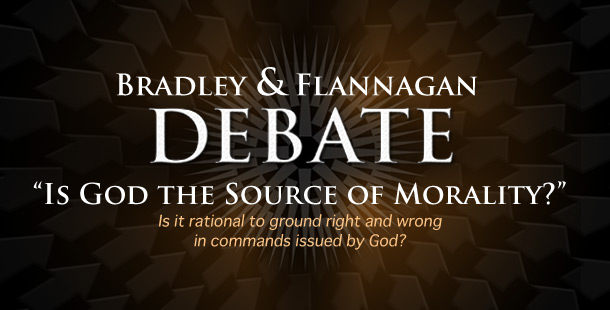
    On Monday 2 August at the University of Auckland Emeritus Professor of Philosophy Dr Raymond Bradley and Dr Matthew Flannagan (of this blog) debated the topic “Is God the Source of Morality? Is it rational to ground right and wrong in commands issued by God?” For the benefit of those who could not be there, who are awaiting the editing and uploading of the video of the debate, we will be running a blog series where we bring you some of the debate in written form.

    DR CHRIS TUCKER’S INTRODUCTION

    Published here with permission

    Dr. Matthew Flannagan is quickly becoming a respected scholar on issues related to the philosophy of religion, ethics, and theology.  His articles and book chapters cover such weighty topics as, whether the Bible condones genocide, the ethics of holy war, abortion and tonight’s topic, the relationship of God and morality.  The importance of Dr. Flannagan’s work has led to many speaking engagements all over New Zealand and also in the United States.  Two of these speaking engagements were public debates, including one against Dr Bill Cooke, an erstwhile President of the New Zealand Association of Rational Humanists.  Dr Flannagan received his PhD in Theology from the University of Otago.  From the University of Waikato, he received his Master’s in Philosophy with First Class Honours.  You can follow Dr Flannagan’s work at mandm.org.nz, the blog that he co-authors with his wife, Madeleine Flannagan.  When he is not working, he enjoys spending time outdoors with his wife and four children. Please join me in welcoming Dr. Matthew Flannagan

    DR MATTHEW FLANNAGAN’S OPENING STATEMENT

    Is it defensible to ground right and wrong in the commands of God? In this debate I will defend an affirmative answer to this question. I will defend the position that moral rightness and wrongness consist in agreement and disagreement, respectively, with Gods commands1– this is what Philosophers call a divine command theory. In defending this thesis I will do two things. First I will argue the standard arguments against a divine command theory fail. Second I will argue that Ray’s attempts to refute this theory fail. God is the source of morality.

    1. Standard Arguments Against a Divine Command Theory

    Divine command theories are frequently said to suffer a debilitating problem, they make morality arbitrary – anything at all could be deemed ‘right’ as long as God commanded it, even torturing other people for fun. This objection assumes that it is possible that God could command atrocious things like torturing people for fun. This assumption, however, seems very dubious. We need to remember that we are not talking about right or wrong as being based on the commands of just anyone, we are talking about God defined by Ray as “omnipotent, omniscient, and morally perfect.”

    So, as the terms are defined, the claim that it is possible for God to command people to torture others for fun is true only if it is possible for a morally perfect person to command such an atrocious thing. But this is unlikely. The very reason critics cite examples such as torturing people for fun is because these actions are paradigms of conduct that no morally good person could ever entertain or endorse.

    A predictable rejoinder to this response is that if some action is wrong because God prohibits it then God cannot be said to be good in any meaningful sense. The claim ‘God is good’ turns into no more than the claim that God obeys his own commands, if this is so, can God be said to have any duties at all?

    The suggestion that if God has no duties then he cannot be said to be good in any meaningful sense, has a grain of truth to it. If we are going to understand God’s goodness in terms of God having duties that he consistently fulfils then a divine command theory cannot account for God’s goodness. However, why must the phrase ‘God is good’ be understood in terms of God having duties? I do not see why it should?

    Many theologians and philosophers have suggested an alternative, God’s goodness should be understood in terms of God having certain character traits. To claim God is good is to claim that he is truthful, benevolent, loving, gracious, merciful, that he is opposed to certain actions such as murder, rape, torturing people for fun and so on. Now, even if God does not have duties, it does not follow that he cannot have character traits such as these. It is true that God is not under any obligation to love others or to tell the truth or what have you, but that does not mean he cannot love others or tell the truth. God does not have to have a duty to do something in order to do it.

    So the standard criticisms of a divine command theory fail.

    2. Raymond Bradley’s Moral Argument

    Ray attempts a different tack. Ray argues the divine command theorist is committed to five inconsistent propositions:

    1. What God proposes for our belief–including beliefs about what we ought to do–is what we ought to believe or do.

    2. In his holy scripture God proposes for our belief that he has caused, committed, condoned, or laid down commands for us to obey, every one of the four types of crimes of types A, B, C, and D.

    3. It is morally wrong to cause, commit, condone, or command any of the crimes of types A, B, C, D.

    4. God is omnipotent, omniscient, and morally perfect.

    5. A morally perfect being would not do anything that is morally wrong.

    In response to this I will make three lines of criticism.

    I

    The first line of criticism is that even if Ray’s argument is sound it does not show that a divine command theory is false. Ray has argued that the Bible presents an indefensible picture of God. However, the question of biblical infallibility is not the topic of our debate tonight. While many divine command theorists believe in biblical infallibility, some do not. A divine command theorist could, for example, claim that the wrongness of an action is determined by God but we know what is right and wrong from our conscience and not from a written revelation. The Philosopher Philip Quinn suggested a theory like this.2 Alternatively he or she could accept some other revelation such as the Talmud or the Koran. So strictly speaking, Ray’s argument does not address the moot of the debate tonight. One could accept everything Ray says about the Bible and still defensibly embrace a divine command theory, the claim that God is the source of morality is untouched.

    II

    This brings me to my second line of criticism. Ray’s third proposition [3] is formulated as:

    3. It is morally wrong to cause, commit, condone, or command any of the crimes of types A, B, C, D.

    This claim is ambiguous; there are two ways it could be interpreted. The first is:

    [3a] It is morally wrong for human beings to cause, commit, condone or command any of the crimes of types A, B, C, D.

    or Ray could mean:

    [3b] It is morally wrong for any person (including God) to cause, commit, condone or command any of the crimes of types A, B, C, D.

    To be valid Ray’s argument needs to be interpreted in terms of [3b]. Ray argues that God, engages in wrongdoing when he causes, commits, commands and condones A B C and D. There are two problems with this interpretation.

    First, Ray’s argument does not justify this conclusion. Ray states “to deny (3) would be to … ally oneself with moral monsters like Ghenghis Khan, Hitler, Stalin, and Pol Pot.” This is false: Genghis Khan, Hitler and Stalin are human beings to condemn them we only need to accept [3a] not [3b].

    Second, Ray’s argument is circular, [3b] assumes that God has duties; however, on my view the wrongness of an action consists in its being forbidden by God. Given that God does not issue commands to himself it follows that he has no duties. To propose [3b] Ray has to assume that my view is unjustified, which is what he is supposed to be proving. He is reasoning in a circle.

    III

    My third line of criticism concerns Ray’s second proposition,

    2. In his holy scripture God proposes for our belief that he has caused, committed, condoned, or laid down commands for us to obey, every one of the four types of crimes of types A, B, C, and D.

    Actually none of the passages Ray cites contain commands to us. He cites some of God’s actions and he cites some commands God gave to Israel and to Joshua but one cannot directly infer from these that these are commands issued to us.

    We have to keep in mind that the Bible is a collection of Ancient Near Eastern (ANE) texts. It was written centuries ago in three different languages, none of which were English. The cultural methods of written communication back then differ significantly from what we are used to when we pick up the latest ‘new atheist’ book at Whitcoulls. Further, the Bible is made up of various books written in various literary genres. To interpret it correctly one needs to take what it says in context – as a whole – and in accord with the literary conventions governing ancient texts translated from foreign languages. Ray fails to do this,

    Instead he uses a selective, out of context, and excessively literalistic interpretation of these passages.

    let me cite some examples.

    1. The Slaughter of the Canaanites

    The first is the slaughter the Canaanites. Ray claims God “orders the slaughter, without compassion, of hundreds of thousands of women, children, and suckling babes.” Ray here alludes to the book of Joshua’s record of the conquest of the Canaanites. Critics, like Ray, are quick to point out that this text states Joshua “totally destroyed all who breathed”, left “no survivors” in “the entire land”, went through the land “exterminating them without mercy” at God’s command.

    What they do not note is that the text proceeds after this to state that the Canaanites were, in fact, not literally wiped out. Over and over the text affirms that the land was still occupied by the Canaanites, who remained heavily armed and deeply entrenched in the very same regions and the very same cities that Joshua was said to have “destroyed all who breathed” and left “no survivors” in. In light of this, it is unlikely that the author intended the language in question to be taken literally.3

    This conclusion is confirmed by research into Ancient Near-Eastern history writing. In a comprehensive comparative study of Ancient Near-Eastern historiography. Old Testament scholar, K Lawson Younger concludes that the Old Testament uses the same literary conventions as other Ancient Near-Eastern conquest accounts. He also establishes that within this genre the rhetoric of total conquest, complete annihilation, destruction of the enemy, killing everyone, leaving no survivors, and so on are frequently used as hyperbole4: the language functions like a person watching David Tua in a boxing match, yells, “Knock his block off! Hand him his head! Take him out!” or hopes that the All Blacks will “annihilate the Springboks” or “totally slaughter the Wallabies.”5 Now, sports fans do not actually want David Tua to decapitate his opponent or the All Blacks to become mass murderers. Understood in a non-literal sense, the phrases probably meant something like, attack them, defeat them, drive them out; not literally kill every man, woman, child, donkey, etc.

    2. Capital Punishment.

    My second example is Ray’s reference to at least 34 offences for which God prescribes the death penalty. (Actually there are only 15 such offences). Ray contends that these passages constitute literal commands to the courts to execute people. This is dubious. The Torah is is written according to the literary and rhetorical conventions of Ancient Near-Eastern legal writing. J J Finkelstein notes that capital sanctions in such texts,

    [W]ere not meant to be complied with literally even when they were first drawn up, [But rather they] serve an admonitory function. If one would be bold enough to restate Hammurabi’s 230 as a direct admonition it might run to this effect: “woe to the contractor who undertakes construction and in his greed cuts corners”.6

    One of the leading experts on Ancient Near-Eastern legal texts Raymond Westbrook states they “reflect the scribal compilers’ concern for perfect symmetry and delicious irony rather than the pragmatic experience of the law courts.”7 The method used was “to set out principles by the use of often extreme examples.”8 In Ancient Near-Eastern legal practice a person who committed a serious crime would be legally considered to have forfeited their life or limb – this, however, did not mean that they were executed or mutilated. Instead they could ransom their life or limb by making a monetary payment decided by the courts “the death sentence is mostly hyperbole,” a literary device designed to under underscore the seriousness of the crime.9

    A careful reading of the Torah confirms this. The clearest example occurs in Numbers 35. After laying out clearly and repeatedly that a person who kills in pre-meditation “shall surely be put to death” the text goes on to state “Do not accept a ransom for the life of a murderer, who deserves to die. He must surely be put to death… .” Unless there was an assumed practice of “ransoming” the lives of those under a capital sentence, this comment seems superfluous. Old Testament scholar Joe Sprinkle notes, “The availability of ransom seems to have been so prevalent that when biblical law wants to exclude it, as in the case of intentional murder, it must specifically prohibit it.”10

    3. Hell

    My third example is Ray’s discussion of hell. Ray cites the book of Revelation’s reference to “the lake of fire” where “they will be tormented with burning sulphur in the presence of the holy angels and of the Lamb, and the smoke of their torment ascendeth for ever and ever”. He maintains this text teaches God will torture people forever merely for not having the right religious beliefs.

    This is dubious, Revelation is apocalyptic literature. Apocalyptic literature is highly metaphorical and uses stock symbols drawn from the Old Testament. If one looks at how the symbols Ray refers to are actually used in the Old Testament, they do not support Ray’s conclusion. The imagery of sulphur being poured upon people and smoke rising is regularly used in the Old Testament to symbolise the destruction of various nations.(Deut 29:23; Job 18:15-17; Ps 11:6; Isa 30:33, Isa 34-8-11). Similarly the “lake of fire” is drawn from Daniel, where it symbolises the destruction of various world empires. In Rev 18, a few chapters later, the destruction of a city, named Babylon (probably a reference to Rome or Jerusalem) is symbolised by the city being tormented by fire and onlookers watch the rising smoke. The message is that Babylon has been judged and destroyed, not that it continues to be tortured forever.

    The same is true of Ray’s references to the Gospels; the phrase the “weeping and gnashing of teeth” occurs many times in both the Old Testament and the New Testament, and in almost every instance signifies hatred or rage and envy at God or the righteous – not the agony of pain and torture.(Job 16:9; Ps 35:16, Psalm 112:10, 36:16, 37:12; Lam. 2:16, Acts 7:54) In one instance, in fact, it states “they will gnash their teeth and waste away.” Similarly, the phrase “unquenchable fire” is used nine times in the Old Testament. There it refers not to a fire that tortures but one that consumes what it devours because it is never put out. (see Isa 1:31, 34:10, 11; Jer 4:4, 7:20, 17:27, 21:12; Ezek 20:47, 48; Amos 5:6).

    Ray cites from the King James version of 2 Thessalonians 1:7-8, “the Lord Jesus Christ shall be revealed from heaven with his mighty angels, in flaming fire taking vengeance on them that know not God.” He, however, snips the end off the quote, the full text states,

    God is just: He will pay back trouble to those who trouble you and give relief to you who are troubled, and to us as well. This will happen when the Lord Jesus is revealed from heaven in blazing fire with his powerful angels. He will punish those who do not know God and do not obey the gospel of our Lord Jesus. They will be punished with everlasting destruction and shut out from the presence of the Lord and from the glory of his might.

    In context the reference to fire clearly means destruction and not torture.

    Ray’s claim that the Bible teaches that people will be condemned ‘merely for having the wrong religion’ is equally dubious. An in context examination of the passages he cites show that the basis of judgement is a person’s actions not merely their beliefs.

    Conclusion

    First, even if Ray’s case is sound, at best it only amounts to an attack of the doctrine of biblical infallibility, the denial of which is perfectly compatible with a divine command theory of ethics.

    Second, his argument for proposition (3) commits the fallacy of equivocation and assumes the very thing the argument is trying to prove.

    Finally, Ray’s argument for (2) consists of citing a series of passages, often selectively, out of context and without regard for literary genre or literary conventions that are found within the texts itself.This might might be a sure-fire way to make the best-seller list at Whitcoulls but it is obviously not the way any serious biblical scholar should read a text.

    Divine command theorists are not committed to all of the five inconsistent propositions he refers to and so are not required, on pain of contradiction, to deny that God is the source of morality.

    1. Robert M Adams “Moral Arguments for Theism” in Robert Adams The Virtue of Faith (New York: Oxford University Press, 1987) 145.
    2. Philip Quinn “Divine Command Theory” in Blackwell Guide to Ethical Theory ed Hugh La Follette (Malden MA: Blackwell Publishing House, 2000) 67.
    3. See Nicholas Wolterstorff’s “Reading Joshua” in Divine Evil ? The Moral Character of the God of Abraham eds Micheal Rea, Michael Murray and Michael Bergmann (New York: Oxford University Press, 2010) forthcoming.
    4. K Lawson Younger Jr Ancient Conquest Accounts: A Study in Ancient Near Eastern and Biblical History Writing (Sheffield: Sheffield Academic Press, 1990).
    5. This example is adapted from Alvin Plantinga “Reply to Fales” and Nicholas Wolterstorff “Reading Joshua” in Divine Evil ? The Moral Character of the God of Abraham eds Micheal Rea, Michael Murray and Michael Bergmann (New York: Oxford University Press, 2010) forthcoming.
    6. J. J. Finkelstein The Ox that Gored (Philadelphia: American Philosophical Society, 1981) 35.
    7. Raymond Westbrook, “The Character of Ancient Near Eastern Law,” in A History of Ancient Near Eastern Law, Vol. 1, ed. Raymond Westbrook (Boston: Brill Academic Publishers, 2003) 74.
    8. Ibid.
    9. Walter Kaiser, “Gods Promise Plan and his Gracious Law,” Journal of the Evangelical Theological Society 35:3 (1992) 293. Joe M Sprinkle “The Interpretation of Exodus 21:22-25 (Lex Talonis) and Abortion,” Westminster Theological Journal 55 (1993) 238.
    10. Joe M Sprinkle “The Interpretation of Exodus 21:22-25 (Lex Talonis) and Abortion,” Westminster Theological Journal 55 (1993) 238.

    Please note that this series is not a transcript of the debate. Each post in this series is effectively a very close approximation of what was said on the night and has been put together from the papers and notes each speaker prepared and spoke from plus any additions each recalled making.

    RELATED POSTS:
    Video: Bradley v Flannagan “Is God the Source of Morality?
    The Podcast: Bradley v Flannagan
    Joint Communique: Bradley v Flannagan Debate
    Raymond Bradley’s Opening Statement: Bradley v Flannagan Debate
    Bradley’s Reply to Matt: Bradley v Flannagan Debate
    Flannagan’s Reply to Ray: Bradley v Flannagan Debate
    Glenn Peoples’ Review: Bradley v Flannagan Debate

    William Lane Craig, Raymond Bradley and the Problem of Hell Part One
    William Lane Craig, Raymond Bradley and the Problem of Hell. Part Two.
    Sunday Study: Joshua and the Genocide of the Canaanites Part I
    Sunday Study: Joshua and the Genocide of the Canaanites Part II
    Capital Punishment in the Old Testament: 1
    Capital Punishment in the Old Testament: 2

  • Raymond Bradley’s Opening Statement: Bradley v Flannagan Debate

    On Monday 2 August at the University of Auckland Emeritus Professor of Philosophy Dr Raymond Bradley and Dr Matthew Flannagan (of this blog) debated the topic “Is God the Source of Morality? Is it rational to ground right and wrong in commands issued by God?” For the benefit of those who could not be there, who are awaiting the editing and uploading of the video of the debate, we will be running a blog series where we bring you some of the debate in written form.

    PROFESSOR ROBERT NOLA’S INTRODUCTION

    Published here with permission

    It gives me great pleasure to introduce Ray Bradley to you.

    Ray was a student of philosophy at this university in the early 1950s. He also attended the Auckland Teachers’ Training College and become a school teacher.  But then he won scholarship to the ANU to do advanced research in Philosophy where he wrote a PhD thesis entitled ‘Free Will and Logic’.  One of his papers that emerges from this research is on fatalism ‘Must the Future be what it is going to be?”. This paper has been anthologised and it is a pretty good read about what is wrong with fatalism.

    After the ANU Ray spent a year at Oxford and then returned to teach philosophy in Australia.  He was appointed to the Chair of Philosophy at This University in 1964 at the very young age of 33 – he is most likely the youngest professorial appointment at this university. It was at this time that I first met Ray as a student in the Dept.   He was an energetic shaker of a number matters from the organisation of the dept and its courses to protesting against the Viet Nam war. And also debating about religion; he took on the professors of Botany and Classics in a series of about 20 debates.

    Unfortunately he left Auckland at the end of 1969 for a professorship at Simon Fraser University. There he produced many papers and two books: the co-authored ‘Possible Worlds’ and ‘The Nature of all Being’. When Ray retired from Simon Fraser he returned to NZ to live in Northland by the sea.

    Living in Canada gave Ray his chance to realise one of his great passions – skiing. He has won over 60 medals in National and International events, including three World Championships in the speed event known as Super G. You can read about this in the recent Sunday Times article on Ray: they devoted more space to Ray as a skier than Ray as a philosopher.

    One of Ray’s other abiding passions has been to combat religion. In his youth he was a believer but he gave this up in his teens. As a professional philosopher he entered into debates with a range of people from local advocates of religion in Auckland and those elsewhere such as William Lane Craig and Anthony Flew who had a late life conversion from atheism to religion. There are many of Ray’s papers on religion around, – you can find some of them on the web. One of the finest is Ray’s exposition of the claim by David Hume that the rivalry between religions discredit them all, that is, their rivalry shows that each is highly improbable. – see Ray’s paper ‘The rivalry of religions’.

    Tonight Ray is on one of his favourite themes – the connection, more strictly the lack of a connection, between God and morality.

    As I have indicated, Ray has debated issues about God at this University for over 50 years – tonight is yet another stage in Ray’s long engagement with the atheism and his presentation of it.

    Welcome to Ray Bradley.

    PROFESSOR RAYMOND BRADLEY’S OPENING STATEMENT

    Published here with permission

    I come not to praise God but to bury him along with the dead gods of now forgotten religions. Not to praise him as the source of all that’s good in the world, and hence the ultimate guide to human morals, but to indict him as the self-confessed source of all that’s wrong with it. When the Christian God says in his Holy Scriptures, that he is the creator of evil, I am prepared to take him at his word.

    I will assume the role of prosecutor in providing grounds for agreeing with God’s self-indictment. And having conducted God’s trial in accord with the principles of morality and logic, I will hope to see him put, first, into a straightjacket, and then forever in his grave, no longer to command the belief of men.

    Matt will act on God’s behalf as counsel for God’s defence, what theologians call an “apologist”.

    THE DEITY IN THE DOCK

    I’m going to indict God on four categories of charges. Each category has scores, if not hundreds or thousands of instances. If God is guilty of even one of these instances, that alone would be grounds for his conviction. Drawing upon evidence provided by God himself in his so-called Holy Scriptures, I hold that he’s guilty of them all.

    A. Crimes against Humanity

    The pagan religions typically invoked various gods as supernatural causes of natural phenomena: earthquakes, volcanic eruptions, floods, lightning, plagues, famines, and so on. The biblical god takes over the same sort of role, only he claims to be responsible for the lot. He boasts of repeatedly using natural events such as these to injure, maim, starve, drown, and in other ways kill off millions upon millions of people. Disease and disaster are God’s weapons of mass destruction.

    B. War Crimes

    This god is guilty of the crime of genocide. According to the story of Noah and the flood he wipes out “every living thing on the face of the earth”. In his role as Commander-in-Chief of his chosen people, God is guilty of ethnic cleansing. He orders the slaughter, without compassion, of hundreds of thousands of women, children, and suckling babes. He condones the taking of orphaned virgins for use as sex slaves by his conquering soldiers. He threatens, too, to have unborn children ripped out of their mothers’ wombs; and seems to relish the prospect.

    C. Licensing Moral Mayhem and Murder

    This God prescribes the death penalty for at least 15 alleged offences. These include being a stubborn and rebellious son (Deuteronomy 21:18-21), hitting or cursing one’s father and mother (Exodus 21:17, Leviticus 20:8), desecrating the Sabbath (Exodus 31:14), being a woman who cannot prove she was a virgin prior to marriage (Deuteronomy 22:20-21), being a woman who did not protest loudly enough when she was being raped (Deuteronomy 22:23-24), being a blasphemer (Leviticus 24:16), being an adulterer (Leviticus 20:10-12), worshipping some other gods (Deuteronomy 13:6-9), and being a homosexual (Leviticus 20:13). God’s recommended penalty? Stoning, usually.

    God tells us unambiguously that he’s committed all these crimes and countless more. And he never says sorry for any of them or even shows a trace of regret.

    But all of these crimes pale into insignificance compared with that for which I’m now about to indict him. For all of these are finite in duration, whereas the next is supposed to go on and on for all eternity.

    D. Crimes of Torture

    This god, in the person of his son, Jesus, commits the vilest of all crimes: torture of infinite duration in the fires of hell. For whom and why? The majority of the human race for the simple alleged offence of not having the right religious beliefs.

    There are at least thirteen passages in Matthew alone in which Jesus talks about the fate of those who will go to hell—a fate that he describes as “eternal”, as “fiery”, as a place of “unquenchable fire”, as a place where there will be “weeping and gnashing of teeth”. The apostle Paul (2 Thessalonians 1:8-9) looks forward to the time when, in his words, “the Lord Jesus Christ shall be revealed from heaven with his mighty angels, in flaming fire taking vengeance on them that know not God.” And the author of Revelation paints a picture of hell in all its voyeuristic obscenity when he reports that all whose names were not written in the book of life would be “cast into the lake of fire” (Revelation 20:15), a place where all non-believers will, in his words, “be tormented with burning sulphur in the presence of the holy angels and of the Lamb, and the smoke of their torment ascendeth for ever and ever” (Revelation 14:10-11). The expression “the Lamb”, scholars and theologians agree, refers to Jesus. Nice to know that Jesus will watch the eternal tortures of the damned, i.e., of many like me, and hosts of unbelievers like some of you.

    Is it any wonder that Christians who take God at his word have tortured themselves with fear about their own eternal prospects, have burned heretics at the stake so as to save their souls from eternal perdition, or have dashed infants’ brains out on the stones so they wouldn’t have a chance of becoming non-believers? Yet God, by virtue of his omniscience, knew all this.

    Is it any wonder that televangelists are able to use the fear of hellfire to bring money into their coffers?

    Who today, you may ask, would take this sort of moral primitivism seriously? Well, many Muslim fundamentalists certainly do: the Taliban, for instance. Arguably, the moral laws they and other Islamic fundamentalists seek to enforce are little more than the Islamic versions of the Old Testament, which Mohammed drew upon freely.

    Ditto with many Christian fundamentalists—the Christian Reconstructionists, for instance. Comprising a sizable and increasingly influential proportion of the Southern Baptist Convention—itself the most potent force for evangelical Christianity—the extreme Christian Right, like their Muslim brethren, demand their country become a theocracy and unflinchingly acknowledge that implementing God’s commands would inevitably result in the death of tens of millions of their fellow citizens: over 45 million, on one estimate. Welcome to a replica of Sharia Law.

    It’s not just the ultra-fundamentalists of theistic religions that take God’s precepts seriously. Even the relatively liberal branch of the Christian church–as represented by the Church of England and its Episcopalian offshoot–are troubled enough by God’s word to agonise over some of them, what he has to say about homosexuals in particular: that they are an “abomination” who should be killed in this world and spend the next in hell. Hence the prospect of another great schism in Christianity, and the pathetic excuse by gay bishop, Bishop Gene Robinson that the church is “still trying to figure out God’s will” on the subject. Robinson and Archbishop Rowan Williams (who’s on the other side of the debate), should read the Bible. It reported God’s will long ago.

    Has God changed his mind about any of his moral dictates? If so, he has kept it to himself. Yet acclaimed Christian philosopher and apologist, William Alston, claims God still communicates with sincere Christians. Could it be that all those sincere Christians who–for about two thousand years–have gone on crusades with God’s word on their lips, are listening to themselves, not God.

    Why don’t any ever report having heard God say clearly “Stop! You’ve got me wrong.”

    The biblical god is not what Saint Anselm thought he was: that than which no greater, no more morally perfect, can be conceived. Out of his own mouth God condemns himself as that than which no viler, no more evil, can be conceived.

    “God is love” is a sick joke. The pleasantry, “Do unto others as you would have others do unto you”, is little more than propaganda to cover up God’s true nature. The Golden Rule we might applaud, as a rough rule of thumb. But it’s a bit rich, don’t you think, coming from the mouth of someone, Jesus, who would send most of us to hell? No moral reciprocity there!

    How do God’s depictions of his own behaviour square with the belief that he’s perfectly good? Or that he’s the source of what some call “The Moral Law”? They don’t.

    Putting God and his Defenders in a Logical Straight-Jacket

    The fact that God himself chronicles all his crimes–often in graphic and gruesome detail–falsifies the belief that he is omnipotent, omniscient, and perfectly good. His self-revelation places both God and his followers, such as Matt, in a logical straightjacket. For there is no way of escaping from the following set of five mutually inconsistent propositions:

    1. What God proposes for our belief–including beliefs about what we ought to do–is what we ought to believe or do.

    2. In his holy scripture God proposes for our belief that he has caused, committed, condoned, or laid down commands for us to obey, every one of the four types of crimes of types A, B, C, and D.

    3. It is morally wrong to cause, commit, condone, or command any of the crimes of types A, B, C, D.

    4. God is omnipotent, omniscient, and morally perfect.

    5. A morally perfect being would not do anything that is morally wrong.

    Theists believe in all five. The trouble is that these five statements form an inconsistent set such that from any four one can validly infer the falsity of the remaining one. Thus, one can coherently assert (1), (2), (3) and (4) only at the cost of giving up (5); coherently assert (2), (3), (4), and (5) only at the cost of giving up (1); and so on.

    The problem is to decide which of these five statements to give up in order to avoid contradiction.

    To deny (1) would be to deny that we ought to do what he says we should believe as to matters of morals, or matters of fact. It would be to deny, for instance, that we ought to obey God’s commandments, such as those instanced in category C. It would be to deny that God is the ultimate authority on what is true or false, right or wrong.

    To deny (2) would be to deny the authority of scripture. It would be to say either (a) that God didn’t know how to say what he meant or (b) that he really meant what he so clearly said. But the first alternative would entail denying his linguistic competence and hence his omniscience. On the other hand, the second alternative would entail that we have to rely on human interpreters to tell us what he really did mean. That’s where the art of apologetics comes in. But in that case, the so-called Word of God becomes the word of man subject to rival, subjective, interpretations. All pretence of objective moral truth is then abandoned. We would then place ourselves in the same sort of position as primitives who wait on witch doctors to tell them what the chicken entrails really mean.

    To deny (3) would be to assert that it is morally permissible to cause, commit, condone, or command some of the vilest crimes imaginable. It would be to ally oneself with moral monsters like Ghenghis Khan, Hitler, Stalin, and Pol Pot.

    To deny (4) would be to deny that the god we are talking about has the properties that theologians regard as the defining, and distinguishing, properties of the Christian God. In short it would be to deny the core belief of theism.

    Finally, to deny (5) would be to deny a virtual truism. To deny it would to license the use of the word “good” so as to mean the equivalent of “evil”. It would be to play word games, like Humpty Dumpty who thought he could make words mean whatever he wanted them to mean–including their opposites.

    Which, I wonder, will Matt deny so as to avoid contradiction?

    Let’s wait and see.

    I’ll also challenge him to discuss the false scientific presuppositions of the story of God’s genocide by means of Noah’s Flood, and the dubious historical presuppositions to the stories about Jesus condemning unbelievers to eternal torment in Hell.

    Please note that this series is not a transcript of the debate. Each post in this series is effectively a very close approximation of what was said on the night and has been put together from the papers and notes each speaker prepared and spoke from plus any additions each recalled making.

    RELATED POSTS:
    Video: Bradley v Flannagan “Is God the Source of Morality?
    The Podcast: Bradley v Flannagan
    Joint Communique: Bradley v Flannagan Debate
    Matthew Flannagan’s Opening Statement: Bradley v Flannagan Debate
    Bradley’s Reply to Matt: Bradley v Flannagan Debate
    Flannagan’s Reply to Ray: Bradley v Flannagan Debate
    Glenn Peoples’ Review: Bradley v Flannagan Debate

  • Contra Mundum: Did God Command Genocide in the Old Testament?

    Perhaps the most perplexing issue facing Christan believers is a series of jarring texts in the Old Testament. After liberating Israel from slavery in Egypt, the Israelites arrived on the edge of the promised land. The book of Deuteronomy records that God then commanded Israel to “destroy totally” the people occupying these regions (the Canaanites); the Israelites were to “leave alive nothing that breathes.” The book of Joshua records the carrying out of this command. In the sixth chapter it states “they devoted the city to the LORD and destroyed with the sword every living thing in it—men and women, young and old, cattle, sheep and donkeys.” In the tenth and eleventh chapters the text states that Joshua “left no survivors. He totally destroyed all who breathed, just as the LORD, the God of Israel, had commanded.” The text mentions city after city where Joshua, at God’s command, puts every inhabitant “to the sword” and “left no survivors.” If these passages are taken in a strict, literal fashion then it is correct to conclude that they do record the divinely authorised commission of genocide. In light of this critics of Christianity often ask how a good and loving God could command the extermination of the Canaanites?

    In response, I want to suggest that this strict, literal reading is mistaken. Reading these texts in isolation from the narrative in which they occur risks a distortion of the authors intended meaning. Consider the book of Joshua, critics are quick to point out that in chapters ten and eleven the text states that Joshua “totally destroyed all who breathed”, left “no survivors” in “the entire land”, went through the land “exterminating them without mercy”.

    The problem is that chapters fifteen to seventeen record that the Canaanites were, in fact, not literally wiped out. Over and over the text affirms that the land was still occupied by the Canaanites, who remain heavily armed and deeply entrenched in the cities. Astute readers will note that these are the same regions and the same cities that Joshua was said to have “destroyed all who breathed”, left “no survivors” in just a few chapters earlier.

    This continues through into the next book in the Old Testament. The first two chapters of the book of Judges record that the Canaanites lived in the very same regions and cities that Joshua was said to have put every inhabitant “to the sword” in and “left no survivors” in. Moreover, again we see that they occupied these cities and regions in such numbers and strength that they had to again be driven out by force, which chapter one of Judges declared was very difficult.

    Read in context then, it is difficult to see how the language of total genocide in chapters ten and eleven of the book of Joshua could have been intended to be taken literally by the authors.

    This phenomena is not limited to the books of Joshua and Judges. The book of Deuteronomy in chapters seven and twenty contain commands to the Israelites to “destroy them [the Canaanites] totally” and “not leave alive anything that breathes.” The books of Deuteronomy and Exodus, in numerous places, state that the Canaanites are to be slowly driven out and expelled from the land, which is not the same thing as killing them. In fact, legislation is cited in the texts which clearly assumes that the Canaanites will survive Joshua’s the invasion. Immediately after stating that the Israelites should “destroy them totally” the text reads, “make no treaty with them, and show them no mercy. Do not intermarry with them. Do not give your daughters to their sons or take their daughters for your sons.” If they were all supposed to be dead then why bother issuing instructions regarding treaties and intermarriage?

    When read in context, it is unlikely that the author of these texts intended the language “destroy totally”, “do not leave alive anything that breathes”, destroy “men and women, young and old”, and so on, to be taken literally. How then should these passages be understood? At a recent conference at the University of Notre Dame, Philosopher Alvin Plantinga suggested a possible solution is to take this language hyperbolically. He suggested phrases such as, “destroy with the sword … men and women … cattle, sheep and donkeys” are phrases to be understood more like we understand a person who, in the context of watching David Tua in a boxing match, yells, “Knock his block off! Hand him his head! Take him out!” or hopes that the All Blacks will “annihilate the Springboks” or “totally slaughter the Wallabies.” Now, the sports fan does not actually want David Tua to decapitate his opponent or for the All Blacks to become mass murderers. Plantinga suggests that the same could be true here; understood in a non-literal sense the phrases probably mean “something like, attack them, defeat them, drive them out; not literally kill every man, woman, child donkey and the like.” If this is correct then the differences between the different texts is easily explained and more significantly, the texts do not teach that God commanded genocide or that Joshua carried it out.

    Interestingly, research into Ancient Near-Eastern history writings bear Plantinga’s idea out. In a comprehensive comparative study of Ancient Near-Eastern conquest accounts, Old Testament scholar, K. Lawson Younger documents stylistic and literary similarities between Joshua and reports of wars written by the some of these surrounding cultures. He concludes that the Old Testament uses the same literary conventions. He notes, “the composition and rhetoric of the Joshua narratives in chapters 9-12 are compared to the the conventions of writing about conquests in Egyptian, Hittite, Akkadian, Moabite, and Aramaic texts, they are revealed to be very similar.” He substantiates with numerous examples in his book.

    In addition, when one examines the literary conventions of such accounts it is evident that the rhetoric of total conquest, complete annihilation and destruction of the enemy, killing everyone, leaving no survivors, etc, is a common hyperbolic way of describing a victory in the manner Plantinga suggests. Renowned Egyptologist Kenneth Kitchen notes,

    [T]he type of rhetoric in question was a regular feature of military reports in the second and first millennia, as others have made very clear. … In the later fifteenth century Tuthmosis III could boast “the numerous army of Mitanni, was overthrown within the hour, annihilated totally, like those (now) non-existent” –- whereas, in fact, the forces of Mitanni lived to fight many another day, in the fifteenth and fourteenth centuries. Some centuries later, about 840/830, Mesha king of Moab could boast that “Israel has utterly perished for always” – a rather premature judgment at that date, by over a century! And so on, ad libitum. It is in this frame of reference that the Joshua rhetoric must also be understood.

    Some examples will illustrate this. The Merneptah Stele states “Yanoam was made nonexistent; Israel is laid waste, its seed is not.” here the Egyptian Pharoh Merneptah describes a skirmish with Israel in which his armies prevailed, hyperbolically, in terms of the total annihilation of Israel. The Assyrian king Sennacherib uses similar hyperbole, “The soldiers of Hirimme, dangerous enemies, I cut down with the sword; and not one escaped.” Mursili II records making “Mt. Asharpaya empty (of humanity)” and the “mountains of Tarikarimu empty (of humanity).” Similarly, The Bulletin of Ramses II, an historical narrative of Egyptian military campaigns into Syria, narrates Egypt’s considerably less than decisive victory at the battle of Kadesh with the rhetoric, “His majesty slew the entire force of the wretched foe from Hatti, together with his great chiefs and all his brothers, as well as all the chiefs of all the countries that had come with him” [Emphasis added]. The examples could be multiplied but the point is that such language was hyperbolic and not intended to be taken literally.

    Consequently, if one does not read the texts in isolation and is sensitive to the genre of Ancient Near-Eastern writings then a literal reading is far from obvious. As Egyptologist James K. Hoffmeier notes, such a reading commits “the fallacy of misplaced literalism … the misconstruction of a statement-in-evidence so that it carries a literal meaning when a symbolic or hyperbolic or figurative meaning was intended.” This underscores an obvious but often neglected point, the bible is not written in accord with the conventions of 21st century English. It was written in ancient foreign languages and in the conventions that governed historical, legal, epic, etc writings of that time. To understand what it teaches accurately one needs to ask what it teaches given these factors. When one does this, it seems probable that the Old Testament does not teach that God commanded or that Israel carried out the genocide or extermination of the Canaanites.

    I write a monthly column for Investigate Magazine entitled Contra Mundum. This blog post was published in the Aug 10 issue and is reproduced here with permission. Contra Mundum is Latin for ‘against the world;’ the phrase is usually attributed to Athanasius who was exiled for defending Christian orthodoxy.

    Letters to the editor should be sent to:
    editorial@investigatemagazine.DELETE.com

    RELATED POSTS:
    Contra Mundum: Fairies, Leprechauns, Golden Tea Cups & Spaghetti Monsters
    Contra Mundum: Secularism and Public Life
    Contra Mundum: Richard Dawkins and Open Mindedness
    Contra Mundum: Slavery and the Old Testament

    Contra Mundum: Secular Smoke Screens and Plato’s Euthyphro

    Contra Mundum: What’s Wrong with Imposing your Beliefs onto Others?
    Contra Mundum: God, Proof and Faith
    Contra Mundum: “Bigoted Fundamentalist” as Orwellian Double-Speak
    Contra Mundum: The Flat-Earth Myth
    Contra Mundum: Confessions of an Anti-Choice Fanatic
    Contra Mundum: The Judgmental Jesus

  • Middleton Grange, Free Exercise and the Gay Rights Movement UPDATED

    Over at GayNZ.com’s Proclamations of the Red Queen blog, Craig Young is in a celebratory  mood. Middleton Grange, a Reformed Evangelical Christian school has been forced by law to pay reparations and have their management undergo “human rights education” because they dismissed a netball coach on the grounds that he openly engaged in homosexual conduct.

    Middleton Grange is a school based in Christchurch. The school’s aim’s, as stated on its website, show that its first aim as a educational facility is to “Help pupils know and understand God and His ways and respond to Him in obedience, love and service.” The website further states,

    The school rests on a Reformed and Evangelical interpretation of Scripture which informs all aspects of governance and management. The Christian Schools’ Trust is responsible for safeguarding the Special Character of the school.

    Now it should be no surprise to any educated person that a reformed evangelical interpretation of scripture usually includes, among other things, the contention that sex between people of the same sex violates God’s commands. Nor should it be a surprise that, given the school’s stated purpose is to inculcate these beliefs, it will not hire or retain people whose example or teaching contradicts this purpose.

    The only question that really needs to be asked then is whether it should be legal for religious groups like this to set up such schools and teach these things and engage in these sorts of hiring practices. Should reformed evangelical Christianity be a tolerated religion? The alternative is, of course, to ban such schools, force parents to send their children to schools that will teach that their parents religious beliefs are false  – essentially not allow adults to propagate these values to their children. This is known as religious persecution.

    In fact by ruling that the school must hire/retain staff whose actions are inconsistent with the schools purpose and then requiring the staff to undergo “human rights education.” the Human Rights Commission (HRC) goes one step further. It states that not only must such schools not exist but it maintains that the adults running them must undergo compulsory re-education into the secular liberal way of thinking. Am I the only one who finds this sort of thing a tad draconian?

    Mr Young, however, seems to think otherwise, he states,

    Frankly, I’m surprised that this sort of collision between lesbian and gay teachers and backward fundamentalist enclaves has taken so long to materialise. I suspect that it’s because we shun such neurotic and hermetically sealed enclaves unless there is good reason to do otherwise

    Apparently the biggest problem in all this is that this sort of religious persecution and re-education has not happened sooner. As to why such schools should be persecuted, Young gives three reasons.

    First because it is a “malignant Christchurch fundamentalist” school. In other words, Young considers this school to expound fundamentalism and he considers such a religion to be “malignant.” This really is not the issue, the issue is whether the state should persecute such religious groups and subject the people within them to compulsory re-education. There are many religious perspectives I disagree with, some I find highly offensive yet this does not mean that the state should intervene in this way.

    Young’s second reason is,

    Founded in 1964, it was host to Graham Capill, Christian Heritage Party leader. His dad Don was Vice Principal until the eighties. I was a one-time inmate there. It served as a nexus for the abortive campaign against homosexual law reform in the mid-eighties.

    There are three reasons here (a) Young attended the school and did not like it, (b) a political leader Young is known to immensely dislike and who was convicted for sexual molestation once attended the school and this man’s father was once Principal; and, (c) the school promoted political views at odds with the secular liberal mainstream on issues like abortion and homosexuality.

    It is hard to see how any of these reasons justify the HRC’s actions. Is Young saying any school he does not like should be legally punished? Is Craig suggesting that if an old boy of a school is convicted of a crime years after leaving that the whole school should be held responsible? Does Young support a return to collective and vicarious punishments perhaps?

    The last reason Young gave is perhaps the most telling; schools should be subject to legal sanction if their politics are disagreeable. Again, am I the only one who finds it odd that this sort of crap is proposed by one of the voices for “tolerance” and “respect for diversity”?

    Craig then gives the usual red herrings; he states “Should it end there? Well, no. If Middleton Grange refuses to employ lesbian and gay teachers, then what about issues like LGBT suicide prevention? Or homophobic bullying?” While I agree that bullying of any human being is wrong (it being assault) and suicide of any person is tragic, the reasoning here lacks cogency. Suppose a fundamentalist Christian was severely bullied at school, the kids picked on him because they considered him to be an intolerant bigot or suppose that his refusal to have pre-marital sex or drink alcohol made him a social outcast? I take it that Young would support fundamentalist teachers coming into this school and teaching a fundamentalist interpretation of the bible to their students so as to re-educate those bullying him? Perhaps the HRC should force the management of any secular school that does not do this to attend church…

    The only remotely sensible comment Craig makes is a rhetorical question, “Should fundamentalist private schools be penalised by withheld operational funding if they refuse to obey mainstream New Zealand anti-discrimination laws?” Indeed that is the core question. Should private religious schools be allowed to teach and freely exercise their religion? Some segments of the gay rights movement and their supporters need to be honest and just outright admit that they support religious persecution instead of talking about “tolerance” and “the celebration of diversity” – values they clearly do not believe in.

    UPDATED BY MADELEINE

    In the comments below Joel, a blogger from the US, writes:

    There is no liberty in New Zealand, I take it, nor equality.

    And what about the human rights violated against the Christian school?

    I have chosen to respond this here as originally Matt and I had toyed with looking at this in this post anyway and so I don’t want it getting lost in the comments, which I anticipate will be prolific in number (just a hunch).

    New Zealand does not have an entrenched constitution, its Bill of Rights is a simple statute which is ultimately subordinate to any other statute it clashes with, see section 4:

    4.  Other enactments not affected
    No court shall, in relation to any enactment (whether passed or made before or after the commencement of this Bill of Rights),—

    (a) Hold any provision of the enactment to be impliedly repealed or revoked, or to be in any way invalid or ineffective; or

    (b) Decline to apply any provision of the enactment—

    by reason only that the provision is inconsistent with any provision of this Bill of Rights.

    Although, to be fair, for any clash the clashing rule, law or policy must be read in the way most conducive to it being consistent with the Bill of Rights, see section 6:

    6. Interpretation consistent with Bill of Rights to be preferred
    Wherever an enactment can be given a meaning that is consistent with the rights and freedoms contained in this Bill of Rights, that meaning shall be preferred to any other meaning.

    If a consistent reading cannot be achieved then the courts will either deem a policy inconsistent with the Bill of Rights or deem it a justified limitation,

    5. Justified limitations
    Subject to section 4 of this Bill of Rights, the rights and freedoms contained in this Bill of Rights may be subject only to such reasonable limits prescribed by law as can be demonstrably justified in a free and democratic society.

    The reality is that due to the fact the courts cannot strike statutes down or refuse to apply them and that there are no penalties for Bill of Rights breaches either beyond the stigma of being in breach of it, which only works if society values the right in question, if it is an unpopular group or cause being violated who cares right?

    So that is the context freedom of religion sits in in New Zealand, which is covered in the section on democratic and civil rights:

    13. Freedom of thought, conscience, and religion
    Everyone has the right to freedom of thought, conscience, religion, and belief, including the right to adopt and to hold opinions without interference.

    14. Freedom of expression
    Everyone has the right to freedom of expression, including the freedom to seek, receive, and impart information and opinions of any kind in any form.

    15. Manifestation of religion and belief
    Every person has the right to manifest that person’s religion or belief in worship, observance, practice, or teaching, either individually or in community with others, and either in public or in private.

    Now at a glance at these sections our US friends must be wondering how the tale Matt told above and the story in the newspaper article he linked to could happen; it appears that New Zealand requires the state to allow its citizens and private organisations the right to form any belief they like, impart it and act on it.

    The reason you are momentarily lulled into this false sense of reality is because you have not factored in the Human Rights Act. Remember earlier when I said the Bill of Rights is subject to other laws? Let’s take a look at section 22, I have highlighted the key bits to take note of in italics:

    22. Employment
    (1) Where an applicant for employment or an employee is qualified for work of any description, it shall be unlawful for an employer, or any person acting or purporting to act on behalf of an employer,—

    (a) To refuse or omit to employ the applicant on work of that description which is available; or

    (b) To offer or afford the applicant or the employee less favourable terms of employment, conditions of work, superannuation or other fringe benefits, and opportunities for training, promotion, and transfer than are made available to applicants or employees of the same or substantially similar capabilities employed in the same or substantially similar circumstances on work of that description; or

    (c) To terminate the employment of the employee, or subject the employee to any detriment, in circumstances in which the employment of other employees employed on work of that description would not be terminated, or in which other employees employed on work of that description would not be subjected to such detriment; or

    (d) To retire the employee, or to require or cause the employee to retire or resign,—

    by reason of any of the prohibited grounds of discrimination.

    Let’s take a look at the “prohibited grounds of discrimination” shall we? The definitions section states “prohibited ground of discrimination has the meaning given to it by section 21″. Section 21 is long so I have only included the relevant bits for our purposes,

    21 Prohibited grounds of discrimination

    (1) For the purposes of this Act, the prohibited grounds of discrimination are—

    (m) Sexual orientation, which means a heterosexual, homosexual, lesbian, or bisexual orientation.

    So there you have it, freedom of thought, conscience, religion, expression and the manifestation of those beliefs are trumped by the Human Rights Act (and the Education Act which permits private schools to educate and manage themselves along the lines of the special character of the school).

    Joel is right, New Zealand’s commitment to liberty and equality is lacking as is respect for freedom of religion.

  • Bradley v Flannagan Debate @ Auckland Uni “Is God the Source of Morality?”

    Raymond Bradley and Matthew Flannagan will debate the topic “Is God the Source of Morality? Is it rational to ground right and wrong in commands issued by God?”

    The debate will be held at the University of Auckland on Monday 2 August from 7-9pm in “The Centennial” 260 – 098 OGGB (the bottom level of the Business School) on 12 Grafton Rd, Auckland City.

    Raymond Bradley v Matthew Flannagan "Is God the Source of Morality"

    If you enjoyed the 2008 debate at Auckland University between William Lane Craig and Bill Cooke, you should enjoy this debate.

    Raymond BradleyBradley is an Emeritus Professor of Philosophy with areas of specialty in Philosophical Logic, Metaphysics, Logical Atomism; he has previously debated William Lane Craig, Edward Blaiklock and many other Christian scholars and describes himself as an older generation “new atheist”.

    Matthew FlannaganFlannagan is an Auckland based Philosopher and Theologian with areas of specialty in Philosophy of Religion, Ethics and Theology; he has previously debated Bill Cooke, Zoe During and, of course, writes for this blog.

    The format of the debate will be as follows:

    Dr Bradley: Opening Comments [20 min]
    Dr Flannagan: Opening Comments [20 min]
    Dr Bradley: Reply to Dr Flannagan [10 min]
    Dr Flannagan: Reply to Dr Bradley[10 min]
    Dr Bradley: Closing Comments [7 min]
    Dr Flannagan: Closing Comments [7 min]
    Questions from the floor: [30 min]

    The moderator for the debate will be John Bishop.

    Bradley will be introduced by Robert Nola.

    Flannagan will be introduced by Chris Tucker.

    Both Bradley and Flannagan are experienced and engaging public speakers who are practiced at pitching their topics to suit their audiences. So, invite all your friends, and block out the evening of Monday 2 August from 7-9 pm now and make sure you get to the debate early to locate parking and grab a good seat.

    This debate is brought to you by the Evangelical Union and the Reason and Science Society as part of the University of Auckland’s Jesus week/Atheist week, with support from Thinking Matters.

    The event will be videoed and will be published on this blog. Entry is free and any and all are welcome.

    There is even a Facebook page you can rsvp on and use to invite your friends.