Category: God and Morality

  • There’s Probably No God? Fisking Atheist Billboards

    On the way back from Bloggers drinks we drove past one of the controversial atheist advertising billboards, put up by NZ Atheist Campaign, The Humanist Society and NZARH, which have appeared around Auckland. This appears to have come on the back of the Richard Dawkins inspired bus advertising that made headlines earlier this year. It is worth fisking them a bit.

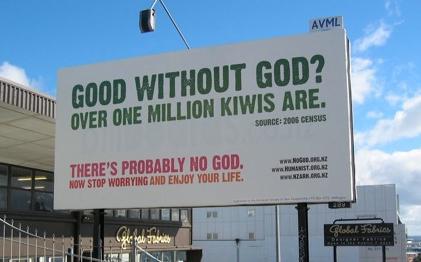
    Here is a pic of the first one.

    Good Without God? Over One Million Kiwis Are.

    Here we are told one million kiwis are good without God because the census says so. This, however, is fallacious. What the census shows is not that one million kiwis are good without God, it shows that one million kiwis are good (although this is granting a lot for the sake of argument) without believing in the existence God. But to say one can be good without believing in God is not the same as saying one can be good without God. Many people throughout history have been able to live and breath without believing in the existence of hydrogen and oxygen atoms, it does not follow that they could live without water.

    Moreover, it is hard to tell what the point of this sociological fact is anyway. Why does the fact that people do not need to believe in something to do good deeds mean that the belief is false? For centuries people have done good deeds and lived good lives without believing in evolutionary theory or quantum mechanics, should we conclude that these theories are therefore ‘probably false’? Surely these atheists are not suggesting that our beliefs should be based on what is useful or helpful as opposed to what is true or false?

    Perhaps the atheists here mean to convey something else. Some Christian thinkers such as William Lane Craig, Robert Adams, Stephen Layman, Alvin Plantinga, John Hare, Philip Quinn have argued that moral properties such as right and wrong depend on God for their existence. Atheist writers such as Paul Kurtz and Christopher Hitchens retort that this claim is falsified by the existence of morally upright atheists. I suspect something like this is behind the slogan on the billboard, it repeats Hitchens and Kurtz’s retorts as though they said something insightful or clever.

    The problem is, as any one familiar with this discussion should know, this retort misses the point (as I pointed out in On a Common Equivocation). Craig, Adams, et al are not claiming that one needs to believe in God to be good (a point made several times in the literature and particularly made so many times to Kurtz that it beggars belief that he keeps repeating it) rather their claim is that moral properties, such as right and wrong, depend on God for their existence.

    This is a fairly basic and elementary distinction in the literature. How exactly expressing a common philosophical confusion counts as reason for thinking “there probably is no God” is hard to see.

    Let’s look at the next one.

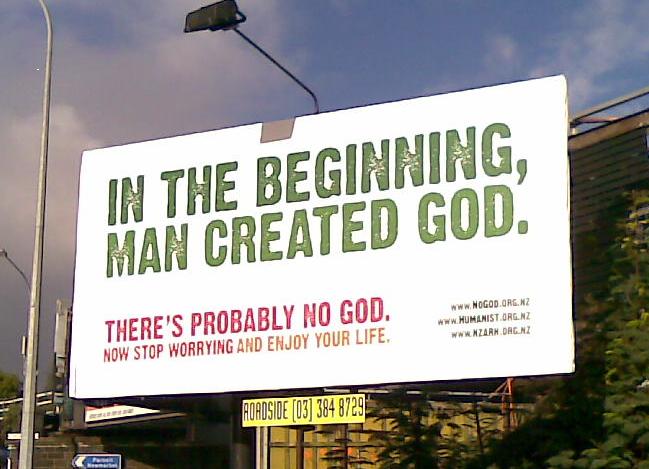
    In the Beginning, Man Created God.

    What is asserted here? That man created God. This, however, is clearly absurd. God is typically defined as an all-powerful, all-knowing, immaterial, necessarily-existent being who created the world. Now if one is going to claim that humans actually created an all-powerful, all-knowing, immaterial, necessarily-existent who created the world, then they are contradicting themselves.

    Humans are part of the world and therefore cannot have created the being that created the world – otherwise humans would have to exist prior to their own existence.

    Similarly, one cannot create a necessary being, this would entail it is possible for a necessary being to not exist, in which case it would not be a necessary being. Taken in a straight-forward, literal manner (the way freethinkers are so fond of taking every passage in the Bible) this billboard simply asserts contradictions.

    Of course, the authors of this billboard probably do not mean to say humans actually created God, they do not think he exists after all. Their claim is that humans created the idea or concept of God and developed it. This is undoubtedly true. Of course, humans also invented the idea or concept of atoms as well, ancient Greek philosophers came up the basics of this concept millennium ago. This trivial fact tells us nothing about whether or not the idea or concept humans developed actually corresponds to anything in reality. To assume that it tells us something about whether the idea or concept is true or false is a fairly obvious case of the genetic fallacy.

    So the second billboard either asserts a contradiction or it is a clear case of a logical fallacy.

    The last one is my favourite.

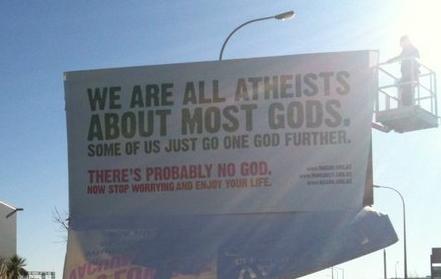
    We are all atheists about most gods. Some of us just go one god further.

    I am inclined to think the argument on this sign is invalid. To see why let’s take out the term “God” in the sign and replace it with some other term such as “non-Christian perspective.” When we do this we get: “We all reject most non-Christian perspectives, some of us just reject one more.” This argument has true premises, do we now have, a knock-down argument for Christianity?

    Similarly, an analogous argument form with true premises gives us an argument for nihilism, the total denial of the existence of morality. “We are all nihilists about some conceptions of morality, some of us are just nihilistic about one more.”

    The same argument for also furnishes a refutation of secularism, “we all reject some secular perspectives on reality, some of us just reject one more.” I could go on.

    Taking a stand on any issue of philosophical substance, whether by affirming, denying or simply being sceptical of it, is to put oneself in opposition to any number of other people and groups who take a contrary stance. That is life. Such pluralism hardly provides a reason for thinking “there probably is no God” any more than it gives us a reason to doubt any other perspective on the world.

    So what do the atheist billboards do? Well the first one tells us that some atheist groups conflate basic philosophical distinctions and don’t really understand the debate they are contributing to. The second shows us that these groups think contradictions and obvious fallacies are some how savvy and smart. The last shows us that they think that invalid argument forms, forms from which you could infer the denial of anything and everything by substituting one true premise with another, are avant-garde.

    All in all, pretty accurate advertising for these groups.

    Hat tip: MCAS

  • Inter-Continental Developments: Matt to Speak in the US

    When Matt wrote his blog series Joshua and the Genocide of the Canaanites Part I and Part II he had no idea just how far clicking the ‘publish’ button would end up taking him. It turns out that it will be taking him quite far;  half-way around the world from Auckland, New Zealand to Atlanta, Georgia in the United States to be precise.

    What’s in Georgia? Well it is this years location for the annual conferences and meetings of the  Evangelical Theological Society (ETS), the Evangelical Philosophical Society (EPS) and the Society of Biblical Literature (SBL). Each organisation’s events dove-tail the others so that they all run between 17-23 November 2010 in pretty much the same location.

    Anyway, in addition to the  Canaanite blog series being the catalyst to Matt’s receiving invitations to co-author chapters in edited books with Philosophers of Religion and Old Testament Ethicists  working at the top of the international field on the subject of Old Testament Ethics (see the upcoming publication list on Matt’s profile page) Matt will also be speaking on this topic in Atlanta.

    At the EPS Apologetics Conference, Matt will speak on “God and the Genocide of the Canaanites” (full details here). The following day he will join Palm Beach Atlantic University Professor of Philosophy  and Ethics and EPS President Paul Copan, Denver Seminary Professor of Old Testament and Semitic Languages Richard Hess and Taylor University Associate Professor of Historical Theology Randal Rauser at the SBL Annual Meeting for a panel discussion entitled “Navigating Old Testament Ethics” (full details here). He’ll also be attending bits of the ETS conference too.

    This is an incredible opportunity for Matt. Not only does he get to go somewhere where most of the Philosophers and Theologians at the top of his field will all be gathered in one place and meet them all but he gets to present his work to them and speak alongside them. The potential for Matt to obtain more research and speaking opportunities coupled with the fact that attending the EPS is seen in the evangelical academic world as one of the best ways to obtain employment makes this an opportunity that we are determined for Matt to take up.

    The problem is cost. Almost every other speaker in attendance has institutional backing. Financially this translates to their respective academic departments funding most of their attendance. Matt does not have institutional backing. EPS President Paul Copan, who personally invited Matt to take up these speaking opportunities, is aware of this and has generously offered to help Matt out with accommodation and to and fro conference travel. This brings the total cost down considerably but we are still chasing a total of $2,481.55 NZD ($1746.52USD) to get Matt there.

    From simply talking to friends about this opportunity we are aware that people who are able to would like to help Matt get to these conferences so we have decided to take a step of faith by accepting the speaking offers and purchasing the tickets. Given our employment woes and battle with ACC over my injury compensation being wrongfully discontinued, this has made things rather tight but we have faith we will get through.

    If you would like to help, our support page has various donation options. We would also greatly appreciate the word being spread, so if you are a blogger or you have website, please consider linking to this page.

  • SBL Annual Meeting: Navigating Old Testament Ethics

    Matt has been invited to participate in a panel discussion at the annual Society of Biblical Literature (SBL) Annual Meeting in Atlanta, Georgia, which runs 20-23 November 2010. He will join leading Christian academics Paul Copan, Richard Hess and Randal Rauser in a segment entitled “Navigating Old Testament Ethics.” Matt’s contribution to the panel discussion will be on Divine Commands and Old Testament Ethics.

    Society of Biblical Literature Annual Meeting

    The SBL Annual Meeting is the largest gathering of biblical scholars in the world. Each meeting:

    • showcases the latest in biblical research,
    • fosters collegial contacts,
    • advances research, and
    • focuses on issues of the profession.

    At this meeting, scholars benefit from sessions on religion, philosophy, ethics, and diverse religious traditions.

    You can register here.

    If you would like to donate to help Matt get to America to speak at the SBL Annual Meeting please visit our support page.

  • EPS Apologetics Conference: God and the Genocide of the Canaanites

    Matt has been invited to speak at the annual Evangelical Philosophical Society (EPS) Apologetics Conference in Atlanta, Georgia, USA which runs 18-20 November 2010. He will be speaking alongside some big names in contemporary Christian philosophy including Alvin Plantinga and William Lane Craig.

    Evangelical Philosophical Society Apologetics Conference

    Experience seasoned teaching by Alvin Plantinga, William Lane Craig, Gary Habermas, Greg Koukl, Randy Newman, Frank Beckwith, Craig Evans, Craig Blomberg, Mike Licona and over twenty other influencers in Christian apologetics as they equip you about the issues facing contemporary Christian witness.

    The full line up of speakers is here.

    You can register here.

    Matt’s talk is entitled “God and the Genocide of the Canaanites,”

    How could a just and loving God command Joshua to genocide the Canaanites as is apparently taught in the Old Testament? Is God really a moral monster as Christianity’s critics use these passages to claim? Matthew will re-examine these passages in light of the context they were written in showing that the skeptics’ case against God relies on a questionable reading of the Old Testament.

    This talk will be based on Matt’s blog series, Joshua and the Genocide of the Canaanites Part I and Part II, his Contra Mundum column, “Did God Command Genocide in the Old Testament?” (forthcoming August 2010) and his chapter, co-authored with Paul Copan, “Ethics of ‘Holy War’ for Christian Morality and Theology” in Old Testament ‘Holy War’ and Christian Morality: Perspectives and Prospects (forthcoming 2011).

    If you would like to donate to help Matt get to America to speak at the EPS Apologetics Conference please visit our support page.

  • Contra Mundum: Secular Smoke Screens and Plato’s Euthyphro

    In “Religion: A Barrier to Clear Thinking,” the final article in the award winning series of lay philosophy articles published in the Christchurch Press, Canterbury based Philosopher Simon Clarke addressed the question, “what is the biggest obstacle to thinking clearly about social and political issues?” Predictably he answered “Several answers suggested themselves but time and again I came back to the same thing: religion.” Clarke explained that “the fallacy of grounding morality upon religion was pointed out by Plato over two thousand years ago.” [1]

    Clarke was appealing to a famous argument that purports to show that ethics (what is right and wrong) is independent of religion. This argument is known by professional ethicists as “The Euthyphro Dilemma” or “Plato’s Euthyphro” and is named after a dialogue Plato wrote. The current version used against mono-theistic religions, such as Christianity, Islam and Judaism, is an adaptation (the original applied to poly-theistic religions, those religions that believe in many gods).

    The argument is usually framed in terms of a rhetorical question ‘are actions wrong because God prohibits them or does God prohibit them because they are wrong?’ As the question is framed, there are only two possible answers a person can offer.

    The first is to contend that actions are wrong because God prohibits them. This answer is said to suffer a debilitating problem, it makes morality arbitrary – anything at all could be deemed ‘right’ as long as God commanded it. Philosopher Michael Tooley has suggested this, “if God had commanded mankind to torture one another as much as possible, then it would follow that that action was obligatory. … many people, including many religious thinkers, are very unhappy with that consequence.” Therefore, the critics conclude, actions are not wrong just because God issues commands against them.

    The failure of the first answer means that the only possible way out is to claim that God prohibits actions because they are wrong; they are not wrong just because he prohibits them. This answer does not have the problems of the former. However, as Clarke points out, it entails that “there are independent standards for what we should do, independent that is of the dictates of religion.” Actions are wrong before God prohibits them. His commands simply tell us what is already wrong, quite independently of what he prohibits.

    This argument is something of a cliché in contemporary secular ethics and is found in almost every secular text book I have read (and will undoubtedly make its way into the Ethics section of the new NCEA Philosophy course). Typically “religious ethics” is mentioned and then dismissed with a short rendition of Plato’s Euthyphro. When I studied Philosophy Plato’s Euthyphro was one of the first things I was taught in first year Ethics. The lecturer spelled out the argument, contended that it showed “religious ethics” was mistaken/confused/ muddle-headed/whatever and from there would went on with the serious business of offering secular perspectives on topics such as abortion, affirmative action, euthanasia, homosexual rights and so on.

    Philosopher Peter Geach noted “In modern ethical treatises we find hardly any mention of God; and the idea that if there really is a God, his commandments might be morally relevant is wont to be dismissed by a short and simple argument that is generally regarded as irrefutable.” The short, simple argument he mentioned was, of course, Plato’s Euthyphro.

    Given this backdrop it is perhaps not so surprising that Clarke, after mentioning Plato’s argument, stated “… Plato’s pretty convincing demonstration has been ignored by the vast majority of people in the intervening millennia. Why are appeals to religion so common?”

    Despite the popularity of making claims like this, I still find them somewhat puzzling. Perhaps secular ethicists assume that theological ethicists have never read Plato or that, if they have, they have ignored him. In fact, the opposite is true. The last 40 years, in fact, has seen sustained defences of theological ethics including thorough refutations of Plato’s Euthyphro. These have been published in the philosophical literature at the highest levels – off the top of my head I can rattle off over 22 different articles and monographs which have offered rebuttals to Plato’s Euthyphro – yet secular ethicists and many textbooks blithely continue as though these answers had never been offered.

    I maintain that there is an answer to the Euthyphro dilemma, one that many have pointed out; it is to adopt the first of the answers I mentioned above, to contend that an action is wrong because God prohibits it. Contrary to popular claims, this option can succeed. The objections raised against it are not as debilitating as they are made out to be.

    The primary objection is that morality is made arbitrary; anything at all could be deemed ‘right’ as long as God commanded it – even atrocious commands. What is important to note here is that the objector assumes that it is possible that God could command atrocious things like ‘torturing people as much as possible.’ This assumption, however, seems very dubious. We need to remember that we are not taking about right or wrong as being based on the commands of just anyone, we are talking about these things being based on the commands of God. In the mono-theistic tradition that this line of argument seeks to criticise, God is typically defined as a being who is all knowing, all powerful, and is morally perfect.

    So, as the terms are defined, the claim that it is possible for God to command people to “torture one another as much as possible” is true only if it is possible for a morally perfect person to command such an atrocious thing. But this is unlikely. The very reason critics cite examples such as “torturing others as much as possible,” is because these actions are paradigms of conduct that no morally good person could ever entertain or endorse. The situation the critic envisages then is a situation which is impossible.

    Of course the critic could contend that he or she does not accept the existence of a being who is all knowing, all powerful, and is morally perfect. However, because those the critic is criticising do believe in such a being and also if the dismissal of theological ethics is to be based on an accurate understanding of what the various theological traditions actually believe and teach, and is not based on a caricature, then the sceptic must address what these traditions actually affirm.

    This answer typically generates a rejoinder. If some action is right or wrong because God permits or prohibits it then God cannot be said to be good in any meaningful sense. This answer renders the claim ‘God is good’ into no more than the claim that God obeys his own commands, if this is so, can God be said to have any duties at all?

    Philosopher William Lane Craig argues that “[duties] are not independent of God nor, plausibly, is God bound by moral duties, since He does not issue commands to Himself.” William Alston drew the same conclusion, “we can hardly suppose that God is obliged to love his creatures because he commands himself to do so!” William Wainwright suggests “the notion of commanding oneself to do something … is incoherent.”

    The rejoinder that, if God has no duties then he cannot be said to be good in any meaningful sense, has a grain of truth to it. If we are going to understand God’s goodness in terms of God having duties or obligations that he consistently fulfils then theological ethics, of the sort envisaged, has problems. However, it is not clear to me why the phrase ‘God is good’ should be explicated in terms of God having duties that He follows.

    Many theologians have suggested that one should not understand God’s goodness in this way. When God’s goodness is explicated in sacred texts like the Psalms or in official creedal statements such as the Westminster Confession of Faith it is often explicated in terms of God having certain character traits. To claim God is good is to claim that He is truthful, benevolent, loving, gracious, merciful, that He is opposed to certain actions such as adultery, murder and rape and so on. Now, even if God does not have duties, it does not follow that he cannot have character traits such as these. It is true that God may not be under any obligation to love others or to tell the truth or what have you, but that does not mean that He cannot love others or tell the truth. God does not have to have a duty to do something in order to do it.

    So there seems, on the face of it, nothing incoherent about contending that God is good, that he has certain attributes like being truthful, benevolent, loving and so on. It is not that theological ethicists have never read Plato or that they have ignored him – they have read him, found his arguments wanting and published responses explaining why – it is that some sceptics have never read the responses or they have chosen to ignore them.

    Perhaps these rebuttals do not work (though I think that they do) but even if I am wrong the onus is surely on the sceptic to demonstrate why. Simply ignoring them, misrepresenting the situation and then dismissing religion “as a barrier to clear thinking” is simply not good enough.


    [1] Clarke’s series “Clear Thinking” was awarded the Australasian Association of Philosophy Media prize in 2006.

    I write a monthly column for Investigate Magazine entitled Contra Mundum. This blog post was published in the March 10 issue and is reproduced here with permission. Contra Mundum is Latin for ‘against the world;’ the phrase is usually attributed to Athanasius who was exiled for defending Christian orthodoxy.

    Letters to the editor should be sent to: editorial@investigatemagazine.DELETE.com

    RELATED POSTS:
    Contra Mundum: What’s Wrong with Imposing your Beliefs onto Others?
    Contra Mundum: God, Proof and Faith
    Contra Mundum: “Bigoted Fundamentalist” as Orwellian Double-Speak
    Contra Mundum: The Flat-Earth Myth
    Contra Mundum: Confessions of an Anti-Choice Fanatic
    Contra Mundum: The Judgmental Jesus

  • Sunday Study: Joshua and the Genocide of the Canaanites Part II

    In my previous post, Joshua and the Genocide of the Canaanites Part I, I mentioned the position suggested by Alvin Plantinga and endorsed by Nicholas Wolterstorff that the passages in Joshua that appear to record the carrying out of genocide at God’s command, such as, “putting all the people to the sword”, “leaving no survivors”, “totally destroying”, “striking all the inhabitants with the edge of the sword” are not intended to be taken literally but rather as hyperbole.

    Plantinga suggests that such phrases should “be understood more like a person who in the context of a boxing match states, “knock his block off, hand him his head” or in a football or baseball game where it is stated that the team should “kill the opposition” or that “we totally slaughtered them.”[1] In reading Joshua, Wolterstorff defends the thesis that the relevant passages are hyperbolic. He argues essentially that:

    (a) the picture of total conquest and annihilation of populations is incompatible with what is said elsewhere in Joshua and Judges;
    (b) this is obvious to anyone who reads the narrative straight through without artificially dividing the text into chapter divisions and verses;
    (c) the redactors or authors would not have been so mindless as to accidentally put obviously contradictory accounts into one narrative;
    (d) the annihilation language appears stereotyped and formulaic whereas the other passages read like more down-to-earth history.[2]

    On the basis of these points Wolterstorff argues that texts are hyperboles, similar to a football player who says “we slaughtered the opposition just like Coach told us to”[3]

    In my previous post I addressed (a); I argued, in some detail, that the picture of Joshua conquering all southern and northern Canaan, killing every inhabitant of the relevant cities and regions and leaving no survivors, if taken literally, contradicts what is affirmed in the rest of the book of Joshua and what is affirmed in Judges. I also agree with Wolterstorff about (b); to any person who reads the text straight through, not breaking it artificially into chapters and verses, and who then reads the book of Judges, these contradictions are fairly obvious. These two points alongside (c) make it improbable that the text should be read in a literal fashion.

    I think Wolterstorff understates (c). If, as Wolterstorff believes, the primary author of scripture is God then obviously the author of the text is an intelligent person who is unlikely to have deliberately (or accidentally) authored an obviously contradictory narrative.

    Now it may be contended that an appeal to divine authorship in this way begs the question, however, I think this is mistaken. As I understand the objection, the sceptic who claims that God commanded genocide is offering a reductio ad absurdium; he or she starts by assuming that whatever God commands is right and that scripture is the word of God and then derives from these assumptions the absurd conclusion that genocide is not wrong. The question then is whether, granting these assumptions, such a conclusion does, in fact, follow.

    Taken together, (a),(b),(c) and (d) do make a hyperbolic reading probable. If the text cannot sensibly be taken literally, and if there is some evidence of formulaic, ritualistic language in the text, then that would suggest some kind of non-literal reading and a hyperbolic one certainly makes sense of the data.

    Wolterstorff’s case has some merit, however, I think it can be considerably strengthened. Wolterstorff limits his case to what I call internal evidence, evidence from within the text itself. I think, however, there is some interesting external evidence, evidence from how particular terms and language is used in other ancient near eastern histories of conquests and battles, which could be added to Wolterstorff’s argument to make it significantly more plausible. Here I will cite three lines of such evidence.

    The first is that rhetoric of total conquest, complete annihilation and destruction of the enemy, killing everyone, leaving no survivors, etc, is a common hyperbolic way of describing a victory in ancient near eastern histories of the same period. Kenneth Kitchen notes,

    [T]he type of rhetoric in question was a regular feature of military reports in the second and first millennia, as others have made very clear. … In the later fifteenth century Tuthmosis III could boast “the numerous army of Mitanni, was overthrown within the hour, annihilated totally, like those (now) non-existent” –- whereas, in fact, the forces of Mitanni lived to fight many another day, in the fifteenth and fourteenth centuries. Some centuries later, about 840/830, Mesha king of Moab could boast that “Israel has utterly perished for always” – a rather premature judgment at that date, by over a century! And so on, ad libitum. It is in this frame of reference that the Joshua rhetoric must also be understood.[4]

    In a comprehensive comparative study of ancient near eastern conquest accounts K Lawson Younger documents stylistic and literary similarities between Joshua and reports of wars written by the Hittites, Egyptians and Assyrians including this kind of hyperbole. Merenptah’s Stele describes a skirmish with Israel as follows, “Yanoam is nonexistent; Israel is wasted, his seed is not.”[5] Here a skirmish in which Egypt prevailed is described hyperbolically in terms of the total annihilation of Israel. Sennacherib uses similar hyperbole, “The soldiers of Hirimme, dangerous enemies, I cut down with the sword; and not one escaped.”[6] Mursilli II records making “Mt. Asharpaya empty (of humanity)” and the “mountains of Tarikarimu empty (of humanity).”[7] Mesha (whom Kitchen cited as stating “Israel has utterly perished for always”) describes victories in terms of him fighting against a town, taking it and then killing all the inhabitants of the town.[8] Similarly, The Bulletin of Ramses II, an historical narrative of Egyptian military campaigns into Syria, narrates Egypt’s considerably less than decisive victory at the battle of Kadesh with the following rhetoric,

    His majesty slew the entire force of the wretched foe from Hatti, together with his great chiefs and all his brothers, as well as all the chiefs of all the countries that had come with him, their infantry and their chariotry falling on their faces one upon the other. His majesty slaughtered and slew them in their places; … He took no note of the millions of foreigners; he regarded them as chaff.[9] [Emphasis original]

    The hyperbolic use of language similar to that in Joshua is strikingly evident.

    Second, comparisons between the book of Joshua, and other ancient near eastern conquest accounts from the same period, demonstrate some important stylistic parallels. Commenting on the structure of the campaigns mentioned in Joshua 9-12, Kitchen notes;

    This kind of report profile is familiar to readers of ancient Near Eastern military reports, not least in the second millennium. Most striking is the example of the campaign annals of Tuthmosis III of Egypt in his years 22-42 (ca. 1458-1438). … the pharaoh there gives a very full account of his initial victory at Megiddo, by contrast with the far more summary and stylized reports of the ensuing sixteen subsequent campaigns. Just like Joshua against up to seven kings in south Canaan and four-plus up north.[10] [Emphasis added]

    Kitchen adds,

    The Ten Year Annals of the Hittite king Mursil II (later fourteenth century) are also instructive. Exactly like the “prefaces” in the two Joshua war reports (10:1-4; 11:1-5), detailing hostility by a number of foreign rulers against Joshua and Israel as the reason for the wars, so in his annals Mursil II gives us a long “preface” on the hostility of neighbouring rulers and people groups that lead to his campaigns.[11] [Emphasis added]

    Kitchen adds other examples. He observes that the same formulaic style found in Joshua is also used in the Amarna letters EA 185 and EA 186.[12] Similarly, before his major campaigns, “Joshua is commissioned by YHWH not to fear (cf. 5:13-15; 10:8; 11:6). So also by Ptah and Amun were Merenptah in Egypt, and Tuthmosis IV long before him: and likewise Mursil II of the Hittites by his gods (10T-Year Annals, etc.), all in the second millennium besides such kings as Assurbanipal of Assyria down to the seventh century.”[13]

    Younger notes similarities in the preface, structure and even the way the treaty with the Gibeonites is recorded between Joshua and various ancient near eastern accounts.[14] Like Joshua, The 10 Year Annals of Mursilli and Sargon’s Letter to the God record a divine intervention where the God sends hailstones on the enemy.[15] Tuthmosis III has a similar story regarding a meteor.[16] Joshua follows ancient near eastern convention in describing numerous battles occurring in a single day or within a single campaign.[17] Ancient near eastern accounts also, like Joshua, repeatedly make reference to the enemy “melting with fear.”[18] Even the way post-battle pursuits are set out and described shows similarities with similar pursuits in ancient near eastern literature.[19] I could mention more examples; the point is that “when the composition and rhetoric of the Joshua narratives in chapters 9-12 are compared to the the conventions of writing about conquests in Egyptian, Hittite, Akkadian, Moabite, and Aramaic texts, they are revealed to be very similar”.[20]

    Finally, both Kitchen and Younger note that such hyperbolic language is used in several places within the book of Joshua itself. In Joshua 10:20, for example, we are told that Joshua and the sons of Israel had “finished destroying” and “completely destroyed” their enemies. Immediately, however, the text, affirms that the “survivors went to fortified cities.” In this context, the language of total destruction is clearly hyperbolic.

    When these lines of external evidence are conjoined with the internal evidence that Wolterstorff proposes (and that which I elaborated on in my previous post) seven things are evident:

    (a) the picture of total conquest and annihilation of populations is incompatible with what is said elsewhere in Joshua and Judges;
    (b) this is obvious to anyone who reads the narrative straight through without artificially dividing the text into chapter divisions and verses;
    (c) the redactors or authors would not have been so mindless as to accidentally put obviously contradictory accounts into one narrative;
    (d) the annihilation language appears stereotyped and formulaic whereas the other passages read like more down-to-earth history;
    (e) the kind of formulaic language used in Joshua is a common form of rhetorical hyperbole for describing a victory in ancient near eastern accounts;
    (f) Joshua is written in accord with the literary and rhetorical conventions typical of such ancient near eastern accounts;
    (e) the rhetorical use of “finished destroying” and “completely destroyed” is attested to elsewhere in the book of Joshua.

    In light of these seven lines of evidence, I am inclined to think that the case for the reading that Wolterstorff defends is compelling.

    While space prevents me exploring all the implications of this conclusion, it is worthwhile commenting on one. Wolterstorff argues,

    On the assumption that Deuteronomy and Joshua are part of the same sequence of books then I submit that this interpretation of Joshua forces a back interpretation of Deuteronomy. If ‘struck down all the inhabitants with the edge of the sword is a literary convention when used to describe Joshua’s exploits then it must, likewise, be a literary convention when used by Moses in his instructions to Israel in general and to Joshua in particular. Remember this is one sequence edited just before the end of captivity.[21]

    I think Wolterstorff is correct here. The same point can be seen from the text of Joshua itself,

    So Joshua subdued the whole region, including the hill country, the Negev, the western foothills and the mountain slopes, together with all their kings. He left no survivors. He totally destroyed all who breathed, just as the LORD, the God of Israel, had commanded. (Joshua 10:40 NIV) [Emphasis added]

    Similarly we see,

    Everyone in it they put to the sword. They totally destroyed them, not sparing anything that breathed, and he burned up Hazor itself. Joshua took all these royal cities and their kings and put them to the sword. He totally destroyed them, as Moses the servant of the LORD had commanded.” (Joshua 11:11-12 NIV) [Emphasis added]

    Also,

    So that he might destroy them totally, exterminating them without mercy, as the LORD had commanded Moses (Joshua 11:20b NIV) [Emphasis added]

    As the LORD commanded his servant Moses, so Moses commanded Joshua, and Joshua did it; he left nothing undone of all that the LORD commanded Moses. (Joshua 11:15 NIV) [Emphasis added]

    The text of Joshua clearly and explicitly states that what Joshua did fulfilled the command that Moses had given regarding the Canaanites in Deuteronomy. If the language of “putting all the people to the sword”, “leaving no survivors”, “totally destroying”, “striking all the inhabitants with the edge of the sword”, and so on, is hyperbolic (as the evidence suggests it is) then the command cannot have been intended to be taken literally.


    [1] Alvin Plantinga “Comments on Evan Fales’ Satanic Versus: Moral Chaos in Holy Writ” a paper presented to My Ways Are Not Your Ways: The Character of the God of the Hebrew Bible Conference at the centre for Philosophy of Religion, University of Notre Dame, Friday 11 September 2009.
    [2] Nicholas Wolterstorff “Reading Joshua” a paper presented to My Ways Are Not Your Ways: The Character of the God of the Hebrew Bible Conference at the centre for Philosophy of Religion, University of Notre Dame, Saturday 12 September 2009.
    [3] Ibid.
    [4]
    Kenneth Kitchen On the Reliability of the Old Testament (Grand Rapids MI: Erdmans Publishing Co, 2003) 174.
    [5] K Lawson Younger Jr Ancient Conquest Accounts: A Study in Ancient Near Eastern and Biblical History Writing (Sheffield: Sheffield Academic Press, 1990) 227.
    [6]
    Ibid 228.
    [7] Ibid.
    [8]
    Ibid, 227.
    [9]
    Ibid, 245.
    [10]
    Kitchen, note 4, 170.
    [11] Ibid, 170.
    [12]
    Ibid, 172.
    [13] Ibid, 174-175.
    [14]
    Younger, note 5, 200-204.
    [15] Ibid, 208-211.
    [16] Ibid, 217.
    [17] Ibid, 216.
    [18] Ibid, 258-260.
    [19] Ibid, 220-225.
    [20] Ziony Zevit The Religions of Ancient Israel: A Synthesis of Parallactic Approaches (London and New York: Continuum, 2001) 114.
    [21]
    Wolterstorff, note 2.

    RELATED POSTS:
    Sunday Study: Joshua and the Genocide of the Canaanites Part I
    William Lane Craig, Raymond Bradley and the Problem of Hell Part One
    William Lane Craig, Raymond Bradley and the Problem of Hell Part Two
  • Van Inwagen, Divine Duties and the Deontological Argument from Evil

    In Tooley, Plantinga and the Deontological Argument from Evil Part I and Part II, I discussed Michael Tooley’s deontological argument from evil. In The Problem of Evil Peter Van Inwagen makes a reference to the type of argument I proposed. In this post I intend to make some critical commentary on Van Inwagen’s comments.

    Tooley states, “most contemporary formulations of the argument from evil … are formulated in terms of axiological concepts – specifically, in terms of the goodness or badness, the desirability or undesirability, of states of affairs.”[1] [Emphasis original]

    Tooley then argues that axiological formulations of the argument from evil are problematic. Any attempt to argue that a perfectly good being would not fail to prevent some evil or undesirable state of affairs will rely on “controversial ethical claims” that are “within ethical theory, deeply controversial, and likely to be rejected by many theists, and others.”[2]

    In response to this problem Tooley proposes, instead, a deontological formulation of the argument from evil; “rather than employing concepts that focus upon the value or disvalue of states of affairs, one instead uses concepts that focus upon the rightness and wrongness of actions, and upon the–rightmaking or wrongmaking–properties that determine whether an action is one that ought to be performed or ought not to be performed.”[3]

    Tooley summarises, “the basic idea involved in a deontological formulation of the argument from evil” as follows,

    The basic idea involved in a deontological formulation of the argument from evil is then as follows. First, it is claimed that the world contains certain states of affairs such that any action of allowing any of those states of affairs to obtain would involve one or more known wrongmaking characteristics that would outweigh the sum total of known rightmaking characteristics that the action would have. If this is right, then any such action is prima facie wrong, relative to the total information that one presently has concerning the action’s rightmaking and wrongmaking characteristics. Secondly, the crucial question is then whether there is any sound inductive argument that will take one from the conclusion that such an action is prima facie wrong to the further conclusion that the action is probably wrong all things considered. If there is, one will then have an ‘inductively sound’ version of the evidential argument from evil.[4] [Emphasis original]

    What is crucial for my purposes is the claim that “any action of allowing any of those states of affairs [will possess] wrongmaking characteristics.” [Emphasis added] By “any action” Tooley means to include not just actions by human beings or other creatures sufficiently like human beings but also actions performed by God. Tooley’s argument then assumes that both human and divine actions can possess wrongmaking properties, and hence, both humans and God have duties.

    I argued in Tooley, Plantinga and the Deontological Argument Part II that this assumption is questionable. I noted that, on a divine command theory of ethics, “an action or kind of action is right or wrong if and only if and because it is commanded or forbidden by God.”[5] It follows then that God’s own actions can have wrongmaking properties only if God issues commands to himself to refrain from these actions and then violates his own commands. It is dubious that God would have the kind of weakness of the will this picture suggests, and hence, if a divine command theory is true it is dubious that any of God’s actions have wrongmaking properties or that God has duties.

    I also noted that many leading theists have offered sophisticated and rigorous defences of a divine command theory so it remains a serious option for theists in ethical theory. Tooley’s own deontological argument from evil relies on “controversial ethical claims” that are, “within ethical theory, deeply controversial, and likely to be rejected by many theists.” Given this, Tooley’s position is no better than the axiological formulation that he rejects.

    In The Problem of Evil Peter Van Inwagen makes some comments in a footnote that address this line of argument. In formulating the problem of evil Van Inwagen states, “I’m going to assume that there is an objective moral standard, that this standard applies to both God and to creatures.”[6] By objective standard here I will assume that Van Inwagen is referring to the existence of duties, and hence, is contending that God has deontological obligations to act in certain ways. Van Inwagen is aware that some theists “resist the idea that there is an objective moral standard that ‘applies to God’.”[7] In response to this position he offers two important responses, which I will address in turn under the headings God and Moral Perfection and Non-Deontological Arguments from Evil.

    God and Moral Perfection

    Van Inwagen suggest the idea that if God has no duties then “presumably, there is no such property or attribute as “moral perfection”. … If there is no such attribute as moral perfection, the aliquid quo nihil maius cogitari possit will not be morally perfect–and not because it will be morally imperfect, but because there will not be any such thing for it to be.”[8]

    Van Inwagen seems to hold that unless there is “an objective moral standard, that … applies to both God and to creatures” it follows that God cannot have the property of being morally perfect. On the face of it, it is unclear why Van Inwagen thinks this. Earlier in the same book he defines moral perfection as follows:

    God has no moral defect whatever. It follows that he is in no way a subject of possible moral criticism. If someone says something of the form, ‘God did x and it was wrong of God to do x‘, that person must be mistaken: either God did not in fact do x or it was not wrong of God to do x.”[9]

    It is unclear why the absence of divine duties entails, according to this definition of moral perfection, that God would not be morally perfect. If there is no “moral standard that applies to God” then God will not display any moral defect by disobeying such a standard as one cannot disobey a standard that does not exist. Similarly, if God has no duties then it is impossible for him to act contrary to these duties, and hence, impossible for God to do wrong. On the face of it then, the absence of divine duties is compatible with Van Inwagen’s definition of moral perfection.

    That said, I think Van Inwagen means to assert something a bit different here. He is proposing is that a person can be morally perfect, in the sense he defines these terms, only if there is an objective moral standard that applies to that person and if they perfectly conform to that standard. This is what he means when he says, “God has no moral defect whatsoever,” God never goes against the standard of right and wrong that applies to him;  God has duties and acts in accord with them. Similarly, when he affirms, “If someone says something of the form, ‘God did x and it was wrong of God to do x‘, that person must be mistaken: either God did not in fact do x or it was not wrong of God to do x”,9 he is suggesting that God has duties and never, in any possible world, acts contrary to them. If moral perfection is understood in this deontological fashion, it follows that if God has no duties he cannot be morally perfect. Of course he cannot be morally imperfect either; to be morally imperfect there would have to be a moral standard that applies to God that God acts contrary to. On the deontological conception of moral perfection, the property of moral perfection simply does not apply to God.

    Van Inwagen is correct that, according to the deontological conception of moral perfection he sketches, the denial of divine duties entails that God is not morally perfect. However, divine command theorists have contended that this really does not amount to much of a criticism because there seems no reason as to why God’s moral perfection has to be spelled out deontologically. If God does not have duties, it does not follow that he does not or cannot have certain character traits such as being loving, truthful, benevolent, compassionate, long-suffering, just, that he cannot possess hatred of actions that are, in fact, unjust and various other attributes that are traditionally attributed to God. Van Inwagen is aware of this point,

    But no doubt anyone who felt compelled to remove “moral perfection” from the list of properties a “something” must have if it is to be something than which a greater cannot be conceived (having been convinced by some argument or other that there was no objective moral standard) would want to “replace” it with some attribute whose existence did not presuppose an objective moral standard: “benevolent in the highest possible degree”, perhaps, or “exhibiting perfect love toward all creatures.[10]

    If God is not “morally perfect” in the deontological sense that Van Inwagen defines this term, this does not preclude attributing goodness in some non-deontological sense to God in a meaningful way, hence, in the absence of any argument as to why God’s goodness must be construed in a deontological sense, it is hard to see any cogent objection here.

    Non-Deontological Arguments from Evil

    Van Inwagen’s second response to those who “resist the idea” that God has duties is to note that denying divine duties does not provide an answer to all versions of the argument from evil. Suppose that one adopts a non-deontological account of God’s goodness, such as those mentioned above, and understands God’s goodness not in terms of fulfilment of duties but in terms of certain character traits then non-deontological versions of the argument from evil are still available that do not rely on the assumption that God has duties. He states,

    No doubt, the existence of vast amounts of truly horrible evil raises problems for those who believe in an omnipotent being who is benevolent in the highest possible degree (or whose love for all creatures is perfect) that are essentially the same as the problems it raises for those who believe in an omnipotent and morally perfect being.10

    On this point Van Inwagen is correct. Denying that God has duties does not constitute a rebuttal to all forms of the argument from evil. It does, however, offer a rebuttal to the specifically deontological formulations of the argument, such as those proposed by Michael Tooley, and this is an important conclusion. Tooley formulated a deontological version precisely because he believed that other more axiological formulations of the argument are problematic. He believed that formulating it in deontological terms improved the argument and made it more plausible. If a divine command theory of ethics is a correct or defensible theistic account of obligation then this particular attempt to improve the argument fails.


    [1] Michael Tooley “Does God Exist?” in The Knowledge of God eds Michael Tooley and Alvin Plantinga (Malden, M A: Blackwell Publishers, 2008) 70-147, 105.

    [2] Ibid.

    [3] Ibid 106.

    [4] Ibid 116.

    [5] W K Frankena Ethics 2nd edn (Englewood Cliffs, NJ: Prentice-Hall, 1973) 28.

    [6] Peter Van Inwagen The Problem of Evil: The Gifford Lectures Delivered in the University of St Andrews in 2003 (New York: Oxford University Press, 2006) 161.

    [7] Ibid.

    [8] Ibid, aliquid quo nihil maius cogitari possit is Latin for “something greater than which nothing can be conceived” referring to Anselm’s famous definition of God in the Proslogion.

    [9] Inwagen, supra n 6, 26-27.

    [10] Ibid, 161.

    RELATED POSTS:

    Tooley, Plantinga and the Deontological Argument from Evil Part I

    Tooley, Plantinga and the Deontological Argument Part II