In his article, “Why Traditional Theism Cannot Provide an Adequate Foundation for Morality”, Walter Sinnott-Armstrong argued that a “Divine command theory makes morality childish.”[1]
In my response to Armstrong, “Is Ethical Naturalism more Plausible than Supernaturalism?”[2] I made two points. First, I addressed a tangential point: that Armstrong’s argument caricatures divine command theory (“DCT”) by tacitly assuming that divine command theorists believe actions are wrong because God will punish us for doing them. Second, I called into question the analogy Armstrong draws between a child following one’s parents and humans following God.
Richard Carrier, in his reply to my article, “On the Facts as we Know them, Ethical Naturalism is all there is”,[3] objects to both these responses.
The motivation of punishment
Carrier dismisses my first point as “disingenuous” stating,
(a) that he is “not aware of any DCT advocate who is actually a universalist”; and
(b) “Every time a DCT advocate has ever threatened or warned anyone of hell (or even just the loss of heaven) in reference to their behaviour, they expose what they really think the ground of Morality is: the fear of consequences.”[4]
Neither argument is cogent. Let us look at (a) first. The philosopher most responsible for developing and defending DCT in the last fifty years, Robert Merrithew Adams, is a universalist. Given that Adams’ discussion is definitive, and most of the literature in the last thirty years discusses his arguments, Carrier’s claim that he is “not aware of any DCT advocate who is actually a universalist” speaks only to his lack of reading and knowledge of the subject.
Premise (b) expresses a non-sequitur. Even if, as is true, many divine command theorists are not universalists and even if some have warned people about divine punishment, then it does not follow that those people believe that fear of punishment is the ground of morality. At most it shows that those people believe in divine judgement and they see it as one reason to avoid wrongdoing.
An analogy might illustrate the mistaken logic here. All people I know believe that prisons exist and I have known some of them warn others that if they commit a crime they will go to jail. It does not follow from this that that these people believe that jail is the only reason one should not commit crimes.
Straw manning Armstrong and missing the real target
Carrier’s response to my second point fares little better. He makes two objections:
(i): “[Armstrong’s] point about infantilization is not the point Flannagan is responding to. Flannagan thinks he means something to do with children obeying parents (and therefore we can build a comparable analogy to adults obeying God that does not infantilize).”
(ii) that Armstrong’s real point, that “Adult moral reasoning is based on actually caring about the people affected by our actions and thus wanting to do good, as opposed to actually not wanting to do good but begrudgingly doing it anyway to avoid punishment” remains untouched.[5]
Once again, both objections fail. In respect of (i), contrary to Carrier’s protestation, Armstrong does speak of children obeying parents and does draw an analogy between adults obeying God and children obeying their parents. Here is what Armstrong says:
“A second objection is that the divine command theory makes morality childish Compare a small boy who thinks that what makes it Morally wrong for him to hit his little sister is only that his parents told him not to hit her and will punish him if he does. As a result, this little boy thinks that if his parents leave home or die then there is nothing wrong with hitting his little sister. Perhaps some little boys think this way but surely we adults do not think that Morality is anything like this.”[6]
This section of Armstrong’s work was directly quoted in my article.
This brings us to (ii), even if Armstrong was making the point Carrier attributed to him in this section of his paper, it is mistaken to conclude that I never addressed this (more…)

 When Matt was in San Diego for the Evangelical Theological Society (ETS) and Evangelical Philosophical Society (EPS) meetings in November 2014, Randal Rauser interviewed him for his Podcast, The Tentative Apologist.
 Over lunch I met with Paul Copan and a representative from Baker Academic to discuss the launch of Copan’s and my book,
 I think his reasoning on both points is mistaken, before getting into why, I note that this article proposes to be about whether belief in God is essential to morality; it is not about the related, though separate, question of whether the existence of morality depends on the existence of God.
 Jason Thibodeau over at The Secular Outpost has written
 After making an acknowledged assumption as to whom authored the publisher’s description, Lowder then moves to confidently asserting that his assumption was correct, and leaps from there to critiquing the then-not-yet-published-or-available to-Lowder-to-actually-read content of the book. Yes folks, it is a live example of judging a book, quite literally, by its cover.
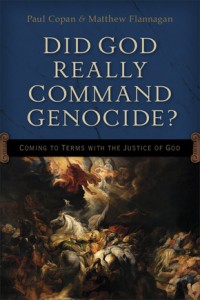 Advice to Lowder: try, I don’t know, reading it. It got released today so you finally can. Did God Really Command Genocide? is now available from the following book providers: