
Category: Talks

  • Matt to speak at the 2014 Evangelical Philosophical Society in San Deigo

    Evangelical Philosophical SocietyThis blog’s Matthew Flannagan has had his paper “Mackie’s Answer to the Error Theory: A Reply to Joyce″ accepted for the National Annual Meeting of the Evangelical Philosophical Society (“EPS”) in San Diego, USA, from 19-21 November 2014. The abstract for Matt’s paper is as follows:

    Abstract
    Richard Joyce has argued that the “real problem” with divine command theories of ethics is not the euthyphro dilemma, but rather that such theories cannot account for the platitude that moral obligations have inescapable moral authority. In this paper I reply to Joyce’s contention.

    First, I look at Joyce’s objection in the context of Joyce’s own defence of John Mackie’s error theory. Joyce interprets Mackie as arguing that moral obligations are queer precisely because, if they existed, they would have inescapable authority and no sense can be made of such authority.

    Then I note that Mackie himself argued that a divine command theory was an exception to his thesis. Mackie contended that naturalistic theories face this challenge but a divine command theory does not. I argue that Joyce’s own reconstruction of Mackie’s argument confirms this conclusion.

    Finally, I examine some objections that Joyce raises to this kind of response. I argue they fail. Mackie and Joyce’s error theory, if sound, is an objection to naturalistic or secular accounts of moral obligations and not to divine command theories.”

    This year’s conference theme will be “Ecclesiology”. The Plenary Speaker is Paul Helm of Regent College, Vancouver Canada. The draft copy of the ETS-EPS program is available here.

    (Matt has also had a paper accepted for the Evangelical Theological Society’s Annual Meeting, which is also in San Diego around the same time.)

    As with previous years, we will need to fundraise to raise the $2,500 NZD shortfall in our budget needed to get him there. Family life on one modest, full-time income with a special needs child, who is unable to go to school, makes it very hard. Almost all of Matt’s philosophical and theological work on this blog is the result of his unpaid commitment to the field. Donations, no matter how modest, are greatly appreciated.
  • Matt to speak at the 2014 Evangelical Theological Society in San Deigo

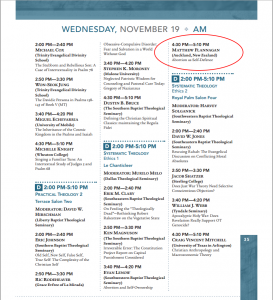
    ETS ProgramThis blog’s Matthew Flannagan has had his paper “Abortion as Self Defence” accepted for the 66th Annual Meeting of the Evangelical Theological Society (“ETS”) in San Diego, USA, from 19-21 November 2014. The abstract for Matt’s paper is as follows:

    Abstract
    Eileen McDonagh has proposed an ingenious argument for abortion rights; she concedes, for the sake of argument, that a fetus is a human being but argues that a fetus’ presence inside the womb of a woman who does not consent to pregnancy constitutes unjust aggression. Consequently, the woman has a right to expel and kill the fetus in self-defence.

    In this paper I will sketch a critique of this line of argument suggested decades ago by Alan Donagan. Donagan argues that, in cases where a woman has not been raped, the woman is has acquired parental obligations to the fetus. Parental obligations are acquired through the act of begetting. If  a person brings a child into existence through voluntary sexual intercourse then he or she has a duty to provide the necessities of life for that child. The fetus is, therefore, not an unjust aggressor.

    I will defend this argument against two influential objections. First, the objection that a woman who does not consent to getting pregnant cannot have parental obligations to her offspring. Second, the objection that, even if  a woman does have parental obligations to her offspring, these obligations do not include a duty to provide bodily life support. I will argue that both objections fail.

    This year’s Annual Meeting theme is “Ecclesiology”. Plenary speakers for this year’s meeting are  Gregg R. Allison (Professor of Christian Theology, Southern Baptist Theological Seminary), Joseph H. Hellerman (Professor of New Testament Language and Literature, Talbot School of Theology, Biola University) and Miroslav Volf (Henry B. Wright Professor of Systematic Theology, Founding Director of Yale Center for Faith and Culture, Yale Divinity School).

    (Matt has also had a paper accepted for the Evangelical Philosophical Society’s Annual Meeting, which is also in San Diego around the same time.)

    As with previous years, we will need to fundraise to raise the $2,500 NZD shortfall in our budget needed to get him there. Family life on one modest, full-time income with a special needs child, who is unable to go to school, makes it very hard. Almost all of Matt’s philosophical and theological work on this blog is the result of his unpaid commitment to the field. Donations, no matter how modest, are greatly appreciated.
  • Back from Baltimore

    The following is a belated report of my recent trip to Baltimore. I began writing the post in December, but Christmas, New Year, the holidays, and various other things got in the way of me finally completing it.

    On Tuesday 26 November 2013 I flew back to New Zealand having attended the annual conference of the Evangelical Theological Society (ETS), Evangelical Philosophical Society (EPS), and Evangelical Philosophical Society Apologetics (Apologetics) conferences in Baltimore. My trip year was shorter than my month long tour the previous year and a lot more intense, but it was still very rewarding.

    The first session I attended was a panel involving Micheal Bird, Al Mohler and Peter Enns and Van Hoozer on inerrancy. There were no surprises here. Al Mohler took the line that inerrancy, as defined by the Chicago statement, must be retained and that denying it was a kind of slippery slope to all sorts of doctrinal error. Peter Enns asserted a whole lot of alleged problems with inerrancy; he assumed that the issues he raised were a fait accompli, ignored any critical responses to them and dismissed theological arguments as a priori without engaging the premises. Van Hoozer spelt out his own position in terms of speech act theory.

    Michael Bird was perhaps the exception in terms of stating the expected; he pointed out correctly, in my view, that the debate on inerrancy tended to presuppose a North American context. He argued that the kinds of cultural battles which contributed to the American debate had not played out the same way in evangelicalism outside the USA. This, I think, is entirely correct. Unfortunately there was little engagement between speakers. I would have liked to heard how each responded to the premises and arguments of their opponents.

    The next session of note was David Baggett speaking on “the vices of virtue theory”. Baggett is working on a sequel to the book Good God: The Theistic Foundations of Morality which he co-wrote with Jerry Walls. In this paper Baggett raised some trenchant criticisms of Philippa Foot’s book Natural Goodness. Foot defends a naturalistic account of goodness in terms of the natural flourishing of a species. The gist of Baggett’s criticism was that Foot is unable to really rise above amoral accounts of goodness, such as when we say that a good tiger tears apart its prey well.

    In the afternoon I attended an interesting paper by Christian Milhut about whether resentment can be a virtue. Milhut was critical of the idea that our feelings of resentment and anger at perceived injustices are reliable. This paper elicited an interesting discussion about when such emotions are and are not appropriate in morality.

    The evening saw the EPS reception, where Gary DeWeese gave a thoughtful address on the role of fellowship in Christian philosophy. This was followed by nibbles, socialising and mingling.

    On the Wednesday I began at 8:30 am by attending a paper by Peter Payne on “Objectivity in debates over whether Ethics needs God”. This was followed by a paper by Harry Bunting entitled “Divine Authority A Kantian Perspective”. Bunting’s paper was excellent. He noted that while Immanuel Kant viewed morality’s content as dependent on reason, but maintained Kant believed the moral law was only obligatory on humans because God held human beings accountable to the standards reason laid down. Bunting brought this perspective of God’s authority being linked to him holding humans accountable into dialogue with Mark Murphy’s celebrated position on divine authority in “an essay on divine authority”. Bunting’s paper was extremely interesting and I hope to get a copy of this paper in the future as (more…)

  • Leaving on a Jet Plane

    At 7.15pm New Zealand time today I will depart New Zealand for Baltimore, Maryland, USA. I am going for a week where I will give 3 talks on the following topics:

    Feticide: “Boonin’s Defense of the Sentience Criterion: A Critique” to the Annual Meeting of the Evangelical Theological Society

    God and Morality: “Divine Commands and Biblical Authority: The Problem of Gen 22″ to the Annual Meeting of the Evangelical Philosophical Society

    God and Morality: “Morality and God’s Commands” to the EPS Apologetics Conference

    This Friday morning Madeleine will fly to Wellington to do 1 talk and 1 panel discussion for the ACTIV8 Pro-Life Training Day:

    “How to Refute Pro-Choice Arguments”

    “Abortion Apologetics Q&A” (with Brendan Malone)

    Will give Apologetics, Law and Philosophy papers for food, lodging & transportBoth of us will miss opportunities to work, Madeleine will take Friday off (being self-employed that will mean she will not be earning but will still need to pay her staff), I will not be preaching this Sunday. Our younger children will have to cared for by their older sister who lives in another part of Auckland. Logistics for Madeleine will be extra difficult since she developed epilepsy this year and is not allowed to drive due to her condition.

    I say these things not to complain, both of us are very much looking forward to doing these talks, we have both had a passion for defending the faith since we met some 17 years ago, but to simply draw attention to the reality that doing these things costs a little more than we can handle.

    While my wife might be a practicing lawyer, she does a fair amount of legal aid work as well as some pro-bono work – she has a heart for those facing injustice who lack means to do anything about it. I work part-time as a teaching pastor and a researcher. I assume primary care for our two children still at home, one of who has autistic spectrum disorder and pervasive developmental disorder and cannot go to school (I home educate both children). We have a mortgage. Bearing the costs of taking time off work and travelling away from home to teach others how to defend the faith/life is pushing things for us. Any donations, small is welcome, would be gratefully appreciated.

    I have been given most of my accomodation in the USA for free, Madeleine’s flights have been paid for by the organisers of her engagements, we can cover the various transport to and from the airports, accomodation and speaking venues, we can cover our food and personal expenses, we can cover a shortfall, if it is not too big. This means we have Madeleine’s trip covered but aspects of mine are not.

    Now that we have booked everything for my trip, my costs (excluding meals and within US transport) are:

    ETS and EPS Registration $73.93
    US Customs ESTA $17.25
    Flypark – parking for 8 days $40
    Air NZ flights to USA $1,709.98
    Air America flights LAX to BWI and BWI to LAX $368.40
    Hostel – Accomodation 18-19 November $41.30
    Air BnB – Accomodation (hostel booked out) 22-23 November $83.00
    TOTAL: $2333.86
    – $1115.00 (amount donated at the time of this post)
    Shortfall: $1218.86 (not including food, transport on arrival, personal expenses)

    If you are minded to donate the information is in our sidebar. Thankyou. Thankyou to all those who have donated time, money, practical assistance and other means already. Please pray for our endeavours that we might reach hearts and minds and make a difference and that all will run smoothly on our children, home and respective work fronts.

  • Is it Arrogant to Claim Jesus is the Only Way?

    Last week I spoke at Massey Presbyterian Church on the topic “Is it arrogant to claim Jesus is the only way?” The following is an abridged version of the talk I gave.

    ArrogantI was recently on a panel at Auckland University where an audience member raised the issue during the Q&A of religious pluralism. The issue is commonly raised as a rhetorical challenge, “isn’t it arrogant to believe Jesus is the only way?” In a world where there exists widespread religious pluralism, where there are people who are just as intelligent, educated, and ostensibly as sincere as we are who hold to and pratice a different religion to Christianity or no religion at all, how can a Christain maintain that she is right and everyone else is wrong. Isn’t believing that Jesus is the only way simply arrogant?
    In addressing this question I will first make three preliminary comments to identify what the issues are. Then, I will sketch three lines of response.

    First some prelimaries. As a matter of logic, if you affirm some proposition then you must reject the negation or denial of that proposition. Contradictory claims cannot both be true. It follows from this that in so far as one accepts the teachings of a religion like Christianity are true, as opposed to accepting the teachings for purely pragmatic reasons, one is rationally commited to rejecting claims that contradict this teaching. If one accepts God exists then it follows that one will believe that atheism, the denial of God’s existence, is false. If God created the world then the claim the world is not created is false. If Jesus died by crucifixition then the claim he did not exist or he died some other way is false.If there will be a final ressurection from the dead where people are judged for their actions then the claim there is no afterlife is false. So, if one accepts Christianity is true then one has to believe that other religions and perspectives that contradict Christianity are false; failure to believe this would be irrational.

    Second, accepting Christianity is true does not commit one to holding that there is no truth or value or good in other religions but it does commit one to the claim that these religions are mistaken where their teachings contradict the teachings of Christianity. This is signifcant as there are many issues on which different religions agree with Christianity, which makes them compatible with Christian teaching.

    Consider, for example Islam. Muslims believe there is only one God whom they call Allah. Allah is the Arabic word for God and was used by Christians to refer to God before the time of Mohamed. Muslims also believe that God is the creator and sustainer of the world. They believe God is all powerful, all knowing and has certain traits such as being just and merciful. Muslims believe God will judge all people and there will be a general ressurection of the dead. In all these things, Christians agree with them.

    Similarly, there are issues where Islam teaches about the way we should live that are perfectly compatible with Christian teachings, and which are arguably admirable given the standard Christian teachings on the same things. Muslims believe that one should give a third of one’s income to the poor, that one should pray five times a day.

    On the other hand, Islamic theology teaches things that are incompatible with central Christian doctrines. Muslim’s deny the Trinity, deny that Jesus was the son of God, deny that Jesus was crucified and that he rose from the dead. They affirm that Mohamaded is the final and ultimate prophet of Allah. Accepting Christianity commits one to denying these claims but not the former ones.

    What this shows is that Christians can accept that other religions and beliefs, and philosophers and theologians from within those traditions, can gain and appropriate genuine insight into the nature of God and his will for human kind. In fact, the Christian scriptures affirm this. In the first chapter of Romans the Apostle Paul states that “since the creation of the world God’s invisible qualities—his eternal power and divine nature—have been clearly seen, being understood from what has been made, so that people are without excuse.” Paul goes on to observe that this knowledge has been corrupted by Greco-Roman society but the point is that even behind such distortions is geniune insight of which the Pagans are (more…)

  • Why Defend Christianity? Hear Matthew Flannagan speak on Thursday

    Matt is speaking for Thinking Matters on the topic Why Defend Christianity? This coming Thursday, from the Facebook Event:

    Matthew Flannagan“The Christian faith seems increasingly at odds with those in the world around us. From the media, to skeptical teachers and unbelieving peers, the gospel seems irrelevant and out of date. How do we talk to others about God and the Bible? Can we really argue people into the kingdom of God? Or should we just focus on compassion and loving others? Next Thursday, Thinking Matters Auckland is hosting Christian theologian Dr Matt Flannagan to speak on these questions and more. Matt will examine the Biblical and practical evidence for defending Christianity and show why it is vital to knowing and communicating our faith in the 21st Century. The event is free, so come along and bring a friend.

    Matt is a theologian and prominent New Zealand Christian commentator, debater, and blogger. He specialises in applied ethics and the interface between philosophy and theology. Currently, Matt works part-time as a teaching pastor and youth group leader for Takanini Church of Christ while he runs the popular blog MandM with his wife Madeleine.

    Thinking Matters is a New Zealand Christian ministry that exists to encourage the life of the mind in the love of God.”

    Thursday 4 April @ 7.30pm @ Auckland Chinese Presbyterian Church, 105 Vincent Street, Auckland, New Zealand

  • Hear Matt Speak at Stayin’ Alive Pro Life Training Day

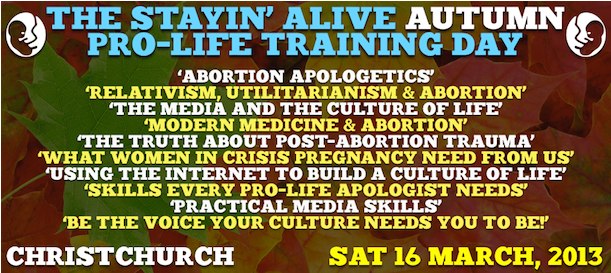
    The Autumn 2013 Stayin’ Alive Pro-Life Training Day will be held in Christchurch this Saturday 16 March 2013. Matt will be speaking twice.

    Stayin' Alive Autumn 2013

    8:15am Rego’s and tea & coffee (YouTube videos in main hall)
    9:00am Introduction, housekeeping, and ice breaker (people bingo)
    09:30am session: ‘Relativism, Utilitarianism and Abortion’ – Dr Matthew Flannagan
    10:30am Morning tea break
    10:50am session: ‘Abortion Apologetics’ – Brendan Malone
    11:50pm Break
    12:00pm session: ‘The media and the culture of life’ – Bob McCoskrie
    12:45pm Lunch Break
    13:30pm WORKSHOPS:

    1. ‘Modern medicine and abortion’ – Dr C. Hallagan
    2. ‘The truth about post-abortion trauma’ – Carolina Gnad
    3. ‘Practical media skills’ – Bob McCoskrie

    14:30pm Break
    14:45pm WORKSHOPS:

    1. ‘What women in crisis-pregnancy need from us’ – Sandra Martin
    2. ‘Using the Internet to build a culture of life’ – Jason McTague
    3. ‘Skills every pro-life apologist needs’ – Dr Matthew Flannagan

    15:45pm Afternoon tea break
    16:15pm session ‘Be the voice your culture needs you to be!’ – Brendan Malone
    17:00pm Small group discussion
    17:15pm Final wrap up
    17:45pm BBQ Dinner
    19:00pm Finish and clean up

    When and where:
    Saturday 16 March, 2013 at:

    Burwood Christian Centre
    54 Bassett Street
    Burwood
    Christchurch

    Registration starts at 8:45am on Saturday 16 March, and the event runs all day finishing with a BBQ dinner at approximately 5:45pm.

    The registration fee is $20 per person (includes lunch and dinner plus morning and afternoon tea).

    More information including how to register is available on the Stayin’ Alive website.