Category: Jurisprudence

  • Why Defamatory Speech is not Free Speech

    The following argument as to why a remedy requiring the removal of defamatory speech from a publication was not a violation of the right to free speech is representative of one I have previously put before the court:

    1. The right to Freedom of Expression is protected by s14 of the Bill of Rights Act 1990 (“BORA”).
    2. The operational provisions of the BORA provide in section 5 that a reasonable limit to Freedom of Expression can be justified in a free and democratic society where that limit is prescribed by law.
    3. Section 5 is subject to section 4, which states in mandatory terms that no court can decline to apply any provision of an enactment on the sole grounds that the provision is inconsistent with the BORA.
    4. Notwithstanding this, section 6 requires the court rule in a manner as consistent as possible with Bill of Rights.
    5. It is submitted that the Respondent’s actions constitute a breach of s4 of the Defamation Act 1992 therefore the remedy sought, removal of the defamatory material from the publication, does not violate the Respondent’s right to Freedom of Expression.

    Freedom of SpeechWhile this is the standard argument it feels wrong to me. There is something unsatisfactory about appealing to a mechanism in the law that, as argued, feels like it is shearing off a part of an important right and freedom, even if the law says that it is ok.

    I find this argument unsettling and lacking something; at the same time defamatory speech is insidious, causes harm, hurts; intuitively it just feels wrong to say that one is morally justified in spreading harmful falsehoods about a person and is not required to account for the wrongs done, because of their right to free speech.

    After discussions with Matt about this I have decided that I prefer the following argument:

    1. Freedom of Expression is defined in the BORA as “the freedom to … impart information and opinions …”.
    2. Defamation is expression imparted to another that lowers the standing of a person in the eyes of their peers and is not true and is not honest opinion which is genuinely held.(I am ignoring the third defence, privilege).
    3. A person who expresses defamation is not engaging in Freedom of Expression as where there is no truth or honest opinion then a person is neither attempting to inform another or attempting to express their opinion.
    4. The basis for this is that to attempt to inform someone is to attempt to increase that person’s repertoire of true beliefs’ and to impart an opinion is to express what one honestly believes to be the case.
    5. Therefore the speech the BORA protects is all speech that is true or honestly held to be true by the speaker.

    That is much better.

    Defamatory speech is not free speech therefore legal sanctions against it proportionate to the harm caused are entirely appropriate in both legal and moral senses.

    RELATED POSTS:
    Pluralism and Being Right
    Of course I think I’m right!


  • Freedom of Religion in a Secular Society @ Auckland University this Monday

    Church and StateAs part of AUSA’s Human Rights week at the University of Auckland, and in association with Thinking Matters, Matt and I will be giving a free public lecture with Q&A on the topic “Freedom of Religion in a Secular Society” on Monday 12 September from 7-8.30pm in Clock Tower Lecture Room 032.

    The Facebook page for this event states:

    The New Zealand Bill of Rights Act states:

    13 – Everyone has the right to freedom of thought, conscience, religion, and belief, including the right to adopt and to hold opinions without interference.

    14 – Everyone has the right to freedom of expression, including the freedom to seek, receive, and impart information and opinions of any kind in any form.

    15 – Every person has the right to manifest that person’s religion or belief in worship, observance, practice, or teaching, either individually or in community with others, and either in public or in private.

    • How should we read these sections alongside idea that New Zealand is a secular society?
    • How should we read them alongside the viewpoint advanced most notably by philosophers such as John Rawls that religion should be privatised?
    • Does Separation of Church and State require Separation of Religion from public life?
    • Can we still have Freedom of Religion in New Zealand and hold to these views?
    • What approach is just and fair in a pluralistic society like ours?

    Analytic Theologian and Ethicist, Dr Matthew Flannagan and Legal Scholar, Madeleine Flannagan (a post-graduate student in Law at Auckland) will give a joint lecture followed by a Q&A session on the topic Freedom of Religion in a Secular Society from 7.00-8.30pm on Monday 12 September 2011 in Clock Tower 032.

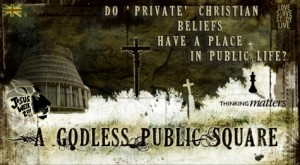
  • A Godless Public Square: Do ‘Private’ Christian Beliefs Have a Place in Public Life? on Video

    Thinking Matters and Evangelical Union hosted an event at the University of Auckland for Jesus Week entitled A Godless Public Square: Do ‘Private’ Christian Beliefs Have a Place in Public Life? This event was essentially a conversation between Theology, Philosophy and Law on the topic of Religion in Public Life. It featured Matthew Flannagan – Analytic Theologian, Glenn Peoples – Philosopher and Madeleine Flannagan – Legal Scholar and was moderated Patt Brittenden. If you missed it you can now watch it on video.

    httpv://www.youtube.com/watch?v=sfnCKFs9DWk&list=PLEB96E8226DC6BA8C&feature=plpp

    Each speaker has published the speeches they wrote for this event:

    Hat tip (and credit for filming and editing this video): Stuart at Thinking Matters.

  • A Godless Public Square: Do ‘Private’ Christian Beliefs Have a Place in Public Life? Part III Madeleine Flannagan – Law

    A Godless Public Square: Do ‘Private’ Christian Beliefs Have a Place in Public Life? A few weeks ago, as part of Jesus Week at the University of Auckland, Thinking Matters and Evangelical Union hosted an event entitled A Godless Public Square: Do ‘Private’ Christian Beliefs Have a Place in Public Life? This event was a conversation between Theology, Philosophy and Law and featured Matthew Flannagan – Analytic Theologian, Glenn Peoples – Philosopher and Madeleine Flannagan – Legal Scholar. The video is still being edited and will be available soon but for now, this 3-part series comprises the written speeches of each speaker.

    Madeleine Flannagan – Law

    Glenn and Matt dealt with moral restraint; the idea prevalent in our society that those of us with religious convictions ought to keep them to ourselves when we participate in public life.

    Often people contend or try to imply that this obligation is required by law. We’ve all heard politicians, people in the media, leaders in our communities, lecturers at university assert that we are a secular nation and that our commitment to freedom of religion requires a secular public square.[1]

    And they are not wrong to a degree. It is evident that something like this ‘obligation’ advanced by the likes of Rawls, Audi, Gaus, et al is present in western jurisprudence – most obviously in that coming out of the United States; you do not need to have studied law to be aware of this, you will have picked up on it if you have watched any American TV.

    Separation of Church and State or Separationism?

    Most people are aware that the US Supreme Court has interpreted America’s Religious Freedom and Free Exercise laws to mean that religious instruction, prayer, references to God, displays of the 10 commandments, nativity scenes — even where participation is totally voluntary — are banned from public institutions.

    This “separationist” reading of the 1st amendment is drawn from US Founding Father Thomas Jefferson’s “Wall of separation Letter” to the Danbury Baptists Association in 1802. But it is unlikely that this reading is what Jefferson meant. At the time he was writing in early nineteenth century America, the common perception of the relationship between church and state reflected a long-standing European tradition.

    Legal scholar Steven Smith wrote in “Separation and the Secular: Reconstructing the Disestablishment Decision” that,

    … At least since the middle ages, scholars and polemicists of all stripes had argued-on both religious and political grounds-that the church should exercise control over the state or-again on both religious and political grounds-that the state should control the church. The common view for centuries had been that an established church was essential to political and social stability.[2]

    He added,

    … In medieval Europe, for example, kings had claimed, and had exercised, the power to appoint bishops and popes. After the Reformation, the British monarch became the official head of the Church of England, and British government assumed control over both the selection of ecclesiastical officials and the formulation of religious doctrine.[3]

    In fact, the Book of Common Prayer, including the 39 Articles, was commissioned and approved by the Crown.

    Smith goes on,

    … medieval popes regularly crowned earthly emperors and kings, and they claimed (and frequently purported to exercise) the authority not merely to excommunicate but actually to depose those kings. Popes sometimes asserted jurisdiction to adjudicate what were essentially political or property disputes. In England, the Church enjoyed-and still enjoys-official representation in Parliament. Immigrants later imported established churches in some form into most of the American colonies.[4]

    The church-state relationship that was familiar to an eighteenth century American was that “governments controlled or directly intervened in the internal affairs of churches, and churches claimed and were formally endowed with governmental powers.”

    At the time Jefferson was writing, many US States had established churches; so when the United States Congress promised to “… make no law respecting an establishment of religion, or prohibiting the free exercise thereof…”[5] they more likely had in mind that Separation of Church and State is simply the idea that the church should not be formally endowed with governmental powers and the state should not try to intervene in or control the church.

    Separation of church and state is not separation of religious beliefs from public life (perhaps this confusion arises because both concepts have the word “separation” in them). The idea that Congress meant something more than mere Separation of Church and State when it passed the first amendment – that Congress meant Separationism — was birthed in the mid to late 20th century – some 200 years later – by the US Supreme Court when it began to hear cases about prayer in schools and the funding of Catholic schools.

    Separationism and Separation of Church and State, as we have seen, are different ideas and one doe not entail the other.

    Comparitive Jurisdictions

    This is not just about the US. Separationist understandings of freedom of religion can be seen in Western jurisprudence elsewhere. There are European cases that exhibit it – even in places like the UK that do have an established church. Many of you will have heard the cases in the media of workers being sent home from their jobs after refusing to follow an instructions from their employers to remove religious jewellery[6] – normal jewellery was fine, just not anything that symbolised God.

    The “Liberty Intervening” case is another UK example; a state-Celebrant refused to perform civil partnerships between members of the same sex. Because of her views on marriage, she was found to have discriminated against those couples. She could not appeal to freedom of religion as the court held that her employer’s requirement she perform same sex civil partnerships did not interfere with her ability to worship.[7]

    Then there is this case, the summary from the head note explains (more…)
  • “Confronting the Challenge of Secularism” Madeleine to Speak at the Notre Dame Center for Ethics and Culture

    The Notre Dame Center for Ethics and CultureNot too long ago I wrote a post entitled We’re Going to San Francisco! In it I announced that in November 2011 Madeleine and I will jointly be giving a paper to the Society of Biblical Literature Annual Meeting, and that I will be giving a paper to the Evangelical Philosophical Association Annual Meeting and also to the Evangelical Philosophical Association’s Annual Apologetics Conference. Well, now we are also going to South Bend, Indiana.

    The Notre Dame Center for Ethics and Culture recently advertised a call for papers for its 2011 Flagship Fall Conference, “Radical Emancipation:  Confronting the Challenge of Secularism.” The stated aim of the conference is:

    “… to bring together a large number of respected scholars representing all the main academic fields, from Catholic, Christian, and secular institutions, to engage in a spirited discussion of this theme from the perspectives of philosophy, theology and religious studies, law, history, the social sciences, literature and the arts, as well as other fields of intellectual inquiry and endeavor.”

    Given that the conference will be held only a few days before the San Francisco cluster of conferences, given that both Madeleine and I work in religion in public life from within our separate disciplines of philosophy of law and analytic theology and both of us draw from the writings of Notre Dame scholars, we decided to both put in papers. It seems that a lot of other people had the same idea as an announcement appeared on the website “Record number of conference abstracts submitted!” This is not surprising given the reputation and calibre of the Notre Dame Center for Ethics and Culture so when we saw this we thought neither of us stood a chance.

    So, you can imagine our delight, and how proud I was of my wife, when she received the following email notification yesterday,

    “I am pleased to accept your paper proposal for presentation at the conference to be held at the University of Notre Dame from November 10-12, 2011. Congratulations! … This year, we turned down an unprecedented number of worthy paper proposals: well over 200 individuals submitted abstracts for consideration.”

    My paper was not successful but I have been invited to chair a session 🙂

    Madeleine wrote a very good abstract:

    “No Privileges, No Penalties” and the De-Privileging of Secularism

    Madeleine Flannagan – University of Auckland, New Zealand

    The dominant Establishment Clause jurisprudence reflects a separationist reading of the First Amendment that advances and protects the hegemony of secular perspectives in public life. Each test, Lemon, Endorsement and Coercion, requires the State to place a restraint on the exercise of religion in public life that effectively privatizes religion and contributes to the radical emancipation of man from God.[1]

    I will argue that the requirement of public conformity to secular perspectives exceeds the traditional understanding of separation of church and state by privileging secular perspectives over religious ones. A clear asymmetry in the way religious beliefs are treated by the State is visible in the requirement that religious believers bracket beliefs they hold as true, important and relevant when they participate in public life while secular citizens are free to utilize the beliefs central to their perspective.

    Vincent Phillip Muñoz has argued for a move away from Separationist jurisprudence and towards a test found in the writings of Founding Father James Madison, a “no privileges, no penalties” test.[2] I will argue that a “no privileges, no penalties” test could uphold freedom of religion and separation of church and state by permitting religion to have a place in public life as long as those who engage in public religious conduct do not gain a privilege for doing so and those who do not wish to participate are both free to opt out and are not penalized for doing so. The adoption of a “no privileges, no penalties” test would ensure that those seeking to bring balance to our secularized culture would not be restrained by the State from doing so.


    [1] The Lemon Test insists that public policy have a valid secular purpose; that a non-religious rationale be offered for all state actions. The Endorsement Test prohibits the state from “endorsing” religion over irreligion. The Coercion Test provides that the state must not coerce religious practice; not only must it not be required, but in Lee v Weisman the application was shifted to what Justice Scalia, in his dissent, termed a “test of psychological coercion”. The Supreme Court held that being one of few (or the only one) to opt out of a religious practice in a public setting is a form of state coercion by peer pressure. (Notably it did not hold that the same is true in reverse.)

    [2] Vincent Phillip Muñoz documents in God and the Founders: Madison, Washington and Jefferson (Cambridge University Press, Ney York, 2009) 33  that when Madison was editing the religious freedom amendment to Virginia’s Declaration of Rights, Madison proposed the following revision: “That Religion or the duty we owe to our Creator, and the manner of discharging it, being under the direction of reason and conviction only, not violence or compulsion, all men are equally entitled to the full and free exercise of it accord[in]g to the dictates of Conscience; and therefore that no man or class of men ought, on account of religion to be invested with peculiar emoluments or privileges, nor subjected to any penalties or disabilities …” [Emphasis mine]

    If you would like to make a donation to assist Madeleine and I in getting to the US for all of the above conferences this November please visit our “Support page” or see our “Donate” button in the side-bar.

    If you would like to book either of us to speak whilst we are in the US please let us know asap as we will be purchasing flight tickets very shortly.

  • Klingon Cloaking Devices Unmasked by Boat People

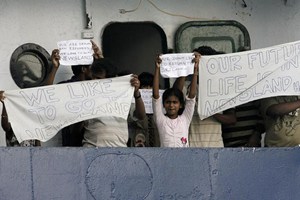
    It was inevitable.  Sooner or later a boat filled with desperate people would set out from India, Sri Lanka, Indonesia, whatever, for New Zealand.  We have been “protected” to date only by an accident of geography–New Zealand’s relative distance.  Australia has faced the problem for decades.

    Sri Lankan Boat PeopleA group of Sri Lankan poor (allegedly Tamils previously caught up in the former civil war) have boarded a boat large enough to make it all the way here.  They have been declaring their intent to sail to New Zealand to seek asylum.  The Prime Minister, Mr Key has made dark hints that he has received intelligence briefings that leave him in no doubt that New Zealand was the intended destination.  Others have accused him of overreacting.  We believe Mr Key in this instance.

    The Commentariat is having conniptions.  The most consistent amongst us are represented by Green MP, Keith Locke and Amnesty International caudillo, Patrick Holmes.  They have urged the desperate plight of the economic refugees.  Doubtless they have suffered grievously, and New Zealand beckons as a wonderland.  Even the poorest in New Zealand would be comparatively rich to them.  They have urged pity as a motivation to accept and welcome these folk. We reiterate: these are the consistent Commentariat members.

    Others in the Commentariat are emphatic in their refusal to have anything to do with the boat people.  Their posturing is empty.  Offensively hypocritical.  The entire ethos of  New Zealand is built upon the principle that  all people,  by right of being human, have a legitimate and just claim to a certain amount of other people’s property.  Call it “a living wage”, a “fair go”, maintaining dignity–whatever.  It’s all the same in the end.  The supreme authority, our semi-divinised state, has both a duty and license to extract property by force from some and deliver it to others who have less.  Everybody believes this.  Except Christians who read their Bibles, but they don’t count.  Sure, the Commentariat maintains an inter-mural argument about how much extraction, and upon which subjects it will be bestowed, and on what terms and conditions, but these are mere details.  Everyone acknowledges the universal principle of the thing.

    Why, then, the emphatic rejection of the boat people?  Why are they “beyond the pale”?  Are they not human?  Do they not have economic rights?  Does not their being human entitle them to a just extraction by force from others better off  to make them more economically equal?  Apparently not.  Why? we wonder.  Out of one side of his mouth our Prime Minister argues vehemently for involuntary seizure of the property of some (via taxation) and for its distribution to others, appealing to justice, rectitude, and rights.  Everybody, everybody agrees–apart from those obnoxious Christians who read their Bibles. But out of the other side of his mouth he brusquely rejects these desperate folk.

    When it’s boat people, the universal principles of human rights are suddenly found to have geographic limitations.  Our gods turn out to be local deities after all. Our self-righteous, simpering notions of justice transform into harsh xenophobia, just like that.  Who would have thought.

    The Commentariat has some explaining to do. If the goose’s sauce is withheld from the gander we smell hypocrisy in the kitchen. Maybe the high faluting principles of Unbelief are worthless and empty, venal and self-serving?  Maybe justice and rights are not universal after all, but have geographical boundaries.  But (more…)

  • Macsyna King, Representative of the Coming Race

    We are simple souls, and so find ourselves “conflicted” (to use pop psych jargon) over the public vituperate venting about one Macsyna King.  How we love a mob.  All heat and no light.  A dirty bomb.

    Macsyna King Breaking Silence: The Kahui CaseMacsyna is coming out of the closet via a book, Breaking Silence: The Kahui Case, written by Ian Wishart.  The mob has called for the book to be banned, via boycott, successfully pressuring booksellers not to carry it.  She was the mother of murdered (or manslaughtered) infant twins, Chris and Cru Kahui.  The court acquitted her then current boyfriend (and father of the twins) of responsibility for their deaths.  No-one else has been charged.  The defence argued that Macsyna herself was their killer.

    If the court evidence is to be believed, King has been both wretched and depraved.

    Asked by Crown lawyer Richard Marchant who was the dominant person in the relationship, Ms King replied “I thought I was”. “I would yell the loudest, I would swear at him (“husband”, Chris) and I just wouldn’t stop till I got my way,” she said. “I’ve kicked him in the shin, I’ve slapped his face before.” Kahui, eight years her junior, was a quiet, softly spoken person who would bottle things up. . . .

    Ms King told the court she had three children to two different fathers prior to meeting Kahui in 2004. All three children were now cared for by their respective fathers and she did not have contact with them. She started living with Kahui shortly after meeting him and quickly fell pregnant, giving birth to a boy, Shayne, in 2005. In September that year, she split with Kahui for several months and went to live with her sister Emily. During that time she got into a relationship with another man but then returned to Kahui. She fell pregnant with the twins soon after her return. . . .

    During her conversation with Ms Ingham, Ms King said she sometimes hit Kahui – but not around the head or face – and occasionally smacked their one-year-old son Shayne with an open hand. She also said she was attending an anger management course. She also said she like to go out with her friends and get drunk but would get the babies “out of her hair” first. . . .

    But, why pick on her? Why the loathing and disgust?  She is hardly atypical.  In fact she accurately and fairly represents the NZ underclass–which is large and growing.  She is a poster girl for the intergenerational welfare dependant.  Maybe that’s why the populist mob is so energized.  It is deeply offended that thousands of people like King, not only exist, not only are the products of New Zealand society, but are funded and paid for by state welfare payments which become more generous according to the number of children one produces.  Their depravity is paid for by the ever generous state.

    Maybe this cuts so bone deep that the mob is having an “I don’t want to know” moment of denial. Disembowelling the messenger is its defensive visceral reaction.

    For our part, the more folk like King get their story out there, the better.  We rely upon Wishart to get the text as close to the truth as possible–but he is rather experienced at it. We would argue for the stories of a hundred of King’s underclass colleagues to be told.

    Most people in New Zealand ardently support state welfare.  We are bored to death by repeated assertions from the Commentariate that the Macsyna King’s of this world simply do not exist.  They are only imaginary febrile figments on the part of beneficiary bashers.  State welfare helps (more…)