Category: Contra Mundum

  • Contra Mundum: The Number of the Beast

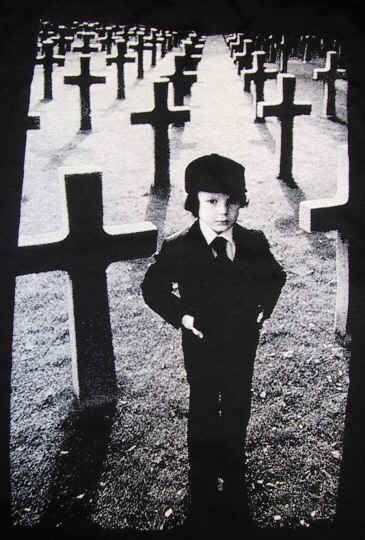
    The OmenRecently TV3 screened The Omen. This classic horror is a about a boy called Damian who is the predicted anti-Christ and appropriately has the number 666 on his head. This film epitomises how the book of Revelation is understood in contemporary culture; apparently it predicts a future person, the beast or the anti-Christ who will take over the world. Associated with this is the number 666 which is literally inscribed into people’s heads or hands.  I think this pop-theology is mistaken.

    The relevant section in Revelation says:

    And the dragon stood on the shore of the sea. And I saw a beast coming out of the sea. He had ten horns and seven heads, with ten crowns on his horns, and on each head a blasphemous name. The beast I saw resembled a leopard, but had feet like those of a bear and a mouth like that of a lion. The dragon gave the beast his power and his throne and great authority… The whole world was astonished and followed the beast. Men worshiped the dragon because he had given authority to the beast, and they also worshiped the beast and asked, “Who is like the beast? Who can make war against him?” (Rev 13:1-2, 3b-4)

    The text proceeds:

    Then I saw another beast, coming out of the earth. He had two horns like a lamb, but he spoke like a dragon. He exercised all the authority of the first beast on his behalf, and made the earth and its inhabitants worship the first beast … He also forced everyone, small and great, rich and poor, free and slave, to receive a mark on his right hand or on his forehead, so that no one could buy or sell unless he had the mark, which is the name of the beast or the number of his name. This calls for wisdom. If anyone has insight, let him calculate the number of the beast, for it is man’s number. His number is 666. (Rev 13:11,16-18)

    Most English translations mention the number 666, (more…)

  • Contra Mundum: Pluralism and Being Right

    Recently I attended a lecture on science and religion at the University of Auckland. As is normal after such talks students stayed and discussed issues raised by the presentation. One student brought up a fairly common chestnut, he objected to the claim made by some Christians that their religion was true and that other religions were false. It was not the first time I have heard someone contend that it is arbitrary, dogmatic, irrational, bigoted, etc to claim that Christianity is true in the face of pervasive religious pluralism. Frequently I have been accused of these things for making similar claims.

    This objection is often exasperated by another stance I hold to. In an earlier column (“God, Proof and Faith,” Investigate, Oct 09) I argued that one is rational in accepting certain Christian beliefs even if one cannot prove that they are true to a sceptical inquirer. The fact that so many other people do not hold these beliefs, and often hold contrary beliefs, often attracts accusations of arrogance. Isn’t it arbitrary for Christians like the student at the talk and me to assume that our particular faith is true and everyone else’s worldview is incorrect?

    I think the answer is no.

    However, before I explain my reasons for this assessment let me first address one assumption that sometimes undergirds it. It is not unusual to hear that affirming that one’s position is right and that those who disagree are wrong is itself arrogant. However, this belief is not only mistaken, it is incoherent. My wife, Madeleine Flannagan, put it well in a blog post entitled “Of course I think I’m right!“

    “The statement, “you think you are right” is always asserted by someone who themselves thinks they are right to assert that I think I am right. However, if their objection is cogent, then I should reject their objection. This is because the person who objects that I think I am right is suggesting that I adopt an irrational stance, that I should believe something that I think is incorrect; but if I think it is incorrect then I am not going to believe it.

    No sane person holds to a belief they think is wrong or inferior to other viewpoints. I mean, why would you? You would hardly rank the differing views and then decide to hold the second or third most plausible view. You hold the view you think is the most plausible – the correct view – and by doing that you tacitly reject the other views.”

    So merely saying you are right and others are wrong by itself is unremarkable, we all do it.  I find though that objectors like those I encountered at the science and religion talk frequently want to say more than this. They contend that it is arbitrary, dogmatic, irrational, bigoted, etc to believe that your position is right, in the absence of proof, if numerous other people do not agree with you.

    I think there are two problems with this contention.

    First, note that the contention itself is one that many people do not hold to; hence, if the claim is true, it is arbitrary, dogmatic, irrational, bigoted, etc to believe it without proof. Further,  the proponent of this contention has not offered any proof  – simply asserting we should adhere to this contention is not proof – so it must be arbitrary dogmatic, irrational, bigoted, etc for the objector to accept this contention.

    Turning to the second problem, suppose I do accept this contention and I (wanting to avoid being arbitrary, dogmatic, irrational, bigoted, etc) cease to believe the Christian faith is correct. In doing so I will be adopting a stance that is contrary to that held by numerous other people – Christians.  It seems that I cannot escape the problem. Unless I can offer proof that Christianity is wrong, I will be being arbitrary, dogmatic, irrational, bigoted and so on.

    The reality is that in the pluralistic world we live in, a person cannot avoid taking a stance on ultimate questions, such as, “does God exist?” “What is the place of human beings in the cosmos?” What is ultimately real?” “Is there life after death?” “Is there such a thing as sin?” “Is there a highest good for human beings?” “What is it?” And so on. Even being agnostic or apathetic is to take up a stance towards these questions, it is to implicitly hold that they are unimportant or if they are important that one has insufficient grounds for getting an accurate answer. Not only is taking a stance unavoidable, it is also unavoidable that any stance taken will differ from that taken by numerous other people, and that any stance taken will be such that one cannot prove it from premises that all people accept. In this respect religious perspectives are no different from secular ones and it is arbitrary, dogmatic, irrational, bigoted to pretend that they are.

    I write a monthly column for Investigate Magazine entitled Contra Mundum. This blog post was published in the Nov 10 issue and is reproduced here with permission. Contra Mundum is Latin for ‘against the world;’ the phrase is usually attributed to Athanasius who was exiled for defending Christian orthodoxy.

    Letters to the editor should be sent to:
    editorial@investigatemagazine.DELETE.com

    RELATED POSTS:
    Contra Mundum: Abraham and Isaac and the Killing of Innocents
    Contra Mundum: Selling Atheism
    Contra Mundum: Did God Command Genocide in the Old Testament?
    Contra Mundum: Fairies, Leprechauns, Golden Tea Cups & Spaghetti Monsters
    Contra Mundum: Secularism and Public Life
    Contra Mundum: Richard Dawkins and Open Mindedness
    Contra Mundum: Slavery and the Old Testament

    Contra Mundum: Secular Smoke Screens and Plato’s Euthyphro

    Contra Mundum: What’s Wrong with Imposing your Beliefs onto Others?
    Contra Mundum: God, Proof and Faith
    Contra Mundum: “Bigoted Fundamentalist” as Orwellian Double-Speak
    Contra Mundum: The Flat-Earth Myth
    Contra Mundum: Confessions of an Anti-Choice Fanatic
    Contra Mundum: The Judgmental Jesus
  • Contra Mundum: Abraham and Isaac and the Killing of Innocents

    Since 9/11 a choir of commentators have claimed that the willingness to murder innocent people in the name of God stems from the progenator of the Abrahamic faiths. Abraham, the father of Christianity, Judaism and Islam is commended for attempting to kill his own son.

    The account of this episode is arguable the most infamous passage in the Hebrew Scriptures:

    Then God said, [to Abraham] “Take your son, your only son, Isaac, whom you love, and go to the region of Moriah. Sacrifice him there as a burnt offering on one of the mountains I will tell you about.” (Genesis 22:2)

    Now, as anyone who has read the story knows, God intervened and prevented Abraham from killing Isaac. In the Mosaic laws that follow this story, the Prophets, Psalms and the historical books, human sacrifice is unequivocally condemned. Notwithstanding these prohibitions, it appears inescapable that Abraham was acting on God’s commands. For this reason, it is not surprising that this story looms large in the criticisms of theological morality. The passage appears to show that God commanded someone to do something clearly and obviously immoral.

    Appearances can be deceiving. There are two issues here: the first is whether the text teaches that God commanded the killing of an innocent child, the second is whether commanding the killing of an innocent child is always immoral. For this objection to have force both these contentions must hold, I will examine each one in turn.

    Turning to the first, did God command the killing of an innocent child? I think the answer is yes, but in a specific context. Let me elaborate. In Gen 12:1-2, Abraham is told, by God, that he will be the father of an entire nation, one that will have its own country. An obvious implication of this is that Abraham believed he would have descendants, he would have a son who would live long enough to have children of his own. The text implicitly teaches here that Abraham knew, on the basis of a reliable source, that his son would live to adulthood.

    This point is reiterated in several other encounters between God and Abraham. In Gen 15 “the word of the LORD” came to Abraham “in a vision.” Abraham’s response was, “You have given me no children; so a servant in my household will be my heir.” God’s answer was emphatic, “This man will not be your heir, but a son coming from your own body will be your heir.” Abraham was told and hence knew, that his heir would be a son from his own body, a biological descendant.

    The text continues, “He took him outside and said, ‘Look up at the heavens and count the stars—if indeed you can count them.’ Then he said to him, ‘So shall your offspring be.’” Again, the narrative implies that Abraham knew that he would both, have a biological son and that this son would live at least long enough to have children. Moreover, the passage continues with God promising, as part of a covenant, that these things will be so. Abraham clearly had assurance that God would see that his son lived into adulthood.

    After this incident, Abraham made the mistake of sleeping with Hagar, which resulted in her giving birth to Ishmael. This lead to various domestic problems including rivalry between Hagar, Ishmael and Abraham’s wife Sarah. Abraham then had another encounter with God (Gen 17:2-14) and here again God promised that Abraham’s descendants would be numerous, again implying, very clearly, that Abraham’s son would live to adulthood. This promise was signified by a covenant marked by circumcision and it was reiterated by God changing his name from Abram (exalted father) as he was called at that point in the text to Abraham (father of many). God again promised and assured Abraham that his son would grow to adulthood.

    More specifics can be found, Gen 17:15-19 makes it crystal-clear that the promise of future descendants came through the line of  Isaac who would be born of Sarah. This seemed impossible to Abraham due to the fact that his wife was barren. God, however, was emphatic and changed his wife’s name from Sarai (my princess) to Sarah (mother of nations). So Abraham was again reassured that Isaac would be born and would live at least long enough to have children of his own. This promise is to be confirmed by a seemingly impossible event, a barren woman bearing a child.

    In chapter 18 the promise is again reiterated. Abraham is visited by three men who appear to represent God himself. The text records in verse 10, “Then the LORD said, ‘I will surely return to you about this time next year, and Sarah your wife will have a son.” Sarah will have Abraham’s child, this is the child that will live on to adulthood to have children of his own.

    If the point has not yet been be-laboured enough, when Isaac is born (Gen 21) God again makes it clear to Abraham on the day Isaac is weaned. Abraham is told in verse 12 “it is through Isaac that your offspring will be reckoned.” Again Abraham is reassured that Isaac will live to adulthood and have children of his own.

    This narrative of several chapters is the backdrop to the events described in Gen 22. To the astute reader reading the whole story as one block of text (note that chapter and verse divisions were not present in the original text, these were added centuries later) by the time a we to get to Gen 22 both Abraham and the reader should know that Isaac is not going to die, both the reader and Abraham know that Isaac will live beyond this day to rear children of his own. The text reminds us in verse 5, just before Abraham goes up the mountain to sacrifice Isaac Abraham states to his servants, “Stay here with the donkey while I and the boy go over there. We will worship and then we will come back to you.” Abraham expected Isaac to return alive.

    Further, the New Testament teaches that this is the correct way to understand this passage,

    By faith Abraham, when God tested him, offered Isaac as a sacrifice. He who had received the promises was about to sacrifice his one and only son, even though God had said to him, “It is through Isaac that your offspring will be reckoned.” Abraham reasoned that God could raise the dead, and figuratively speaking, he did receive Isaac back from death. (Hebrews 11:17-19)

    This is significant because Christians, at least, do not accept any and all interpretations of the Old Testament. Christians accept as authoritative the Old Testament as interpreted by the New Testament. If one attacks a different interpretation of the passage, one is attacking an interpretation Christians (should) reject and hence, one is not attacking anything Christians (should) believe or are committed to believing.

    The text teaches that God commanded Abraham to kill his son in a context where Abraham knew that his son would not die but would live on after the incident. God commanding killing, in this context, needs to be shown as immoral for the objection to gain traction.

    The brings us to the second question, is commanding the killing of an innocent always immoral? Here I think the answer is yes, provided a certain context is assumed.

    The applicability of many moral prohibitions depend in part on certain facts about the world. Hitting someone in the head is wrong because doing so causes pain and risks harming another. However, if the physical structure of the world was different, if hitting someone in the head did not harm people but instead advanced their health and improved their quality of life then it may be permissible to hit someone in the head. Of course, this does not show us that hitting people in the actual world is permissible because in the real world hitting people does cause harm but it does show that prohibitions rely on certain background assumptions about the effects of hitting. If these assumptions are not true then the prohibition will not hold.

    Yale philosopher John Hare develops this point in an interesting way. Hare asks us to imagine a world in which when people of a certain age are killed they immediately come back to life suffering no injury. He opines, quite plausibly, that if this were to be the case then killing people at this age would not be wrong or at least, not seriously wrong. One of the reasons that killing people is wrong in the world we live in is because people stay dead. If they were only unconscious for a split second and came back to life in full health then arguably killing a person would not be the serious wrong we believe it is. The answer to the question, is it wrong to kill an innocent then is yes, provided a certain context is assumed.

    The context where it is plausible to state that killing innocent people is seriously wrong is the very context in which the narrative shows that Abraham knew did not apply to Isaac. God commanded Abraham to kill his son in the highly unusual context where Abraham knew that he would not be deprived of an earthy life but would come down the mountain afterwards and live on to adulthood to father children of his own.

    At this stage I am sure some readers will scoff, they will contend that they do not believe these stories could be literally true, they do not think God appeared to Abraham and told him any of this or that he could not know these things for certain. This complaint is beside the point. Whether one believes the story or not, this is what the story says. If one seeks to argue that the text teaches something immoral or portrays God in a certain way then one needs to accurately portray what the text actually says. Misrepresenting what it says and using that distortion as the basis of an argument to a conclusion is not a valid criticism of the text or the faiths that hold to those texts.

    I write a monthly column for Investigate Magazine entitled Contra Mundum. This blog post was published in the Oct 10 issue and is reproduced here with permission. Contra Mundum is Latin for ‘against the world;’ the phrase is usually attributed to Athanasius who was exiled for defending Christian orthodoxy.

    Letters to the editor should be sent to:
    editorial@investigatemagazine.DELETE.com

    RELATED POSTS:
    Contra Mundum: Selling Atheism
    Contra Mundum: Did God Command Genocide in the Old Testament?
    Contra Mundum: Fairies, Leprechauns, Golden Tea Cups & Spaghetti Monsters
    Contra Mundum: Secularism and Public Life
    Contra Mundum: Richard Dawkins and Open Mindedness
    Contra Mundum: Slavery and the Old Testament

    Contra Mundum: Secular Smoke Screens and Plato’s Euthyphro

    Contra Mundum: What’s Wrong with Imposing your Beliefs onto Others?
    Contra Mundum: God, Proof and Faith
    Contra Mundum: “Bigoted Fundamentalist” as Orwellian Double-Speak
    Contra Mundum: The Flat-Earth Myth
    Contra Mundum: Confessions of an Anti-Choice Fanatic
    Contra Mundum: The Judgmental Jesus

  • Contra Mundum: Selling Atheism

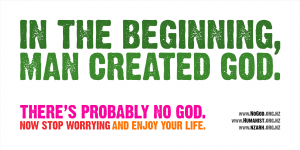
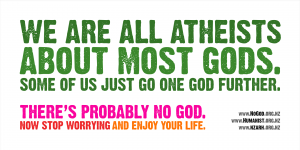
    New Zealand motorists will have noticed a new genre of advertising billboards, those attempting to sell the concept that there is probably no God. These billboards are the collective efforts of the New Zealand Atheist Campaign, The Humanist Society and the New Zealand Association of Rationalist Humanists. Like all advertising campaigns, these billboards offer clever-sounding slogans, which are indicative of the philosophy of the seller – in this case three variants of popular ‘new-atheist’ arguments. Like any consumer, I want to read the product labelling a little deeper before I consider buying. So here I intend to unpack the slogans and take a look at the implicit reasoning behind each.

    Each billboard has the tagline “There’s probably no God. Now stop worrying and enjoy your life.” My first thought on seeing this was that authors must find atheism psychologically liberating. We do not have to worry that there is a God and that means that we can enjoy ourselves but why would the existence of God be something to worry about? Is it the moral accountability that goes with it? If God exists then we might have to worry that He has seen what we have done in secret, and being free from this worry enables us to enjoy our lives. If this is so then prima facie this suggests that guilt is a major motivation behind, at least some peoples, atheism.

    The tagline aside, let’s look at the three slogans currently affronting us as we navigate our cities. The billboard on Auckland’s Newton Rd states, “Good without God? Over One Million Kiwis Are. Source:2006 Census.”

    Good without god?

    Here we are told that one million kiwis are good without God because the census says so. Now a lot could be said about the appeal to the census here, I don’t recall a question on it asking me if I was good and even if it did I am not sure that we should take too much from self-reported assessments of people’s own integrity. Let’s assume, however, that the billboard makes a fair claim. The inference is still is fallacious. What the census shows is not that one million kiwis are good without God, rather, it shows that one million kiwis are good without believing in the existence of God. But to say that one can be good without believing in God is not the same as saying that one can be good without God. Many people throughout history have been able to live and breath without believing in the existence of hydrogen and oxygen atoms yet it does not follow that they could live without hydrogen and oxygen.

    I am still left wondering how the fact that people do not need to believe in something to do good deeds renders the belief false? For centuries people have done good deeds and lived good lives without believing in heliocentricism or quantum mechanics, should we conclude that these theories are therefore ‘probably false’? Surely we are not being asked to buy that the basis of our beliefs should be what is useful or helpful as opposed to what is true?

    Perhaps the sellers mean to convey something else. Some Christian thinkers such as William Lane Craig, Robert Adams, Stephen Layman, Alvin Plantinga, John Hare and Philip Quinn have argued that moral properties such as right and wrong depend on God for their existence. Atheist writers such as Paul Kurtz and Christopher Hitchens retort that this claim is falsified by the existence of morally upright atheists. I suspect something like this is meant by the slogan on the billboard, it repeats Hitchens’ and Kurtz’s retorts as though they said something insightful or clever.

    This retort misses the point. Craig, Adams, et al are not claiming that one needs to believe in God to be good – a point made several times in the literature (and particularly made so many times to Kurtz that it beggars belief that he keeps repeating it) rather, their claim is that moral properties, such as right and wrong, depend on God for their existence. This is not the same thing, we know that water depends for its existence on the existence of hydrogen and oxygen, this does not mean, however, that we need to believe in the existence of hydrogen and oxygen in order to effectively recognise and use water. Ancient and medieval people were drinking, washing in, swimming in and sailing on water centuries before the discovery of contemporary atomic theory.

    This is a fairly basic and elementary distinction in the literature. How exactly expressing a common philosophical confusion counts as reason for thinking “there probably is no God” is hard to see.

    Parnell Rise’s billboard informs us “In the Beginning Man Created God.”

    In the beginning man created god

    This one asserts that man created God. Now if one takes this statement in an absurdly literal manner (the way many sceptical organisations approach parables, hyperbole and poetry in the Bible) we find that atheists are telling us that God actually exists. I have no issue with the slogan at this juncture, however, the idea that God was created by human beings is clearly absurd. God is typically defined as an all-powerful, all-knowing, immaterial, necessarily-existent being who created the world and who sustains everything in it. Now if one is going to claim that humans actually created an all-powerful, all-knowing, immaterial, necessarily-existent who created and sustains the world, then they are contradicting themselves. Humans are part of the world and therefore cannot have created the being that created the world – otherwise humans would have to exist prior to their own existence.

    Of course to interpret this billboard in this way would be uncharitable. The authors of this billboard probably do not mean to say that humans actually created God, they do not think He exists after all. Their claim is that humans created the idea or concept of God and developed it. This is undoubtedly true. Of course, humans also invented the idea or concept of atoms as well – ancient Greek philosophers came up with the basics of this concept millennia ago – but this fact tells us nothing about whether or not the idea or concept humans developed actually corresponds to anything in reality. To assume that it tells us something about whether the idea or concept is true is a fairly obvious case of what logicians call the genetic fallacy.

    The last one is my favourite, “We Are All Atheists About Most Gods. Some of Us Just Go One God Further.”

    We are all atheistsTo see the problems with this slogan take out the term “God” in the sign and replace it with some other term such as “non-Christian perspective.” When we do this we get: “We all reject most non-Christian perspectives, some of us just reject one more.” This argument has true premises, do we now have, a knock-down argument for Christianity?

    Similarly, an analogous argument form with true premises gives us an argument for nihilism, the denial that humans have moral duties, the total denial of the existence of morality. “We are all nihilists about some conceptions of morality, some of us are just nihilistic about one more.”

    The same argument for also furnishes a refutation of secularism, “we all reject some secular perspectives on reality, some of us just reject one more.” I could go on.

    Taking a stand on any issue of philosophical substance, whether by affirming, denying or simply being sceptical of it, is to put oneself in opposition to any number of other people and groups who take a contrary stance. That’s life. Such pluralism hardly provides a reason for thinking “there probably is no God” any more than it gives us a reason to doubt any other perspective on the world.

    So what do the atheist billboards do? Well the first one tells us that some atheist groups conflate basic philosophical distinctions and do not really understand the debate they are contributing to. The second shows us that these groups think contradictions and obvious fallacies are some how savvy and smart. The last shows us that they think that invalid argument forms, forms from which you could infer the denial of anything and everything by substituting one true premise with another, are avant-garde. All in all, pretty accurate advertising for these groups.

    I write a monthly column for Investigate Magazine entitled Contra Mundum. This blog post was published in the Sept 10 issue and is reproduced here with permission. Contra Mundum is Latin for ‘against the world;’ the phrase is usually attributed to Athanasius who was exiled for defending Christian orthodoxy.

    Letters to the editor should be sent to:
    editorial@investigatemagazine.DELETE.com

    RELATED POSTS:
    Contra Mundum: Did God Command Genocide in the Old Testament?
    Contra Mundum: Fairies, Leprechauns, Golden Tea Cups & Spaghetti Monsters
    Contra Mundum: Secularism and Public Life
    Contra Mundum: Richard Dawkins and Open Mindedness
    Contra Mundum: Slavery and the Old Testament

    Contra Mundum: Secular Smoke Screens and Plato’s Euthyphro

    Contra Mundum: What’s Wrong with Imposing your Beliefs onto Others?
    Contra Mundum: God, Proof and Faith
    Contra Mundum: “Bigoted Fundamentalist” as Orwellian Double-Speak
    Contra Mundum: The Flat-Earth Myth
    Contra Mundum: Confessions of an Anti-Choice Fanatic
    Contra Mundum: The Judgmental Jesus

  • Contra Mundum: Did God Command Genocide in the Old Testament?

    Perhaps the most perplexing issue facing Christan believers is a series of jarring texts in the Old Testament. After liberating Israel from slavery in Egypt, the Israelites arrived on the edge of the promised land. The book of Deuteronomy records that God then commanded Israel to “destroy totally” the people occupying these regions (the Canaanites); the Israelites were to “leave alive nothing that breathes.” The book of Joshua records the carrying out of this command. In the sixth chapter it states “they devoted the city to the LORD and destroyed with the sword every living thing in it—men and women, young and old, cattle, sheep and donkeys.” In the tenth and eleventh chapters the text states that Joshua “left no survivors. He totally destroyed all who breathed, just as the LORD, the God of Israel, had commanded.” The text mentions city after city where Joshua, at God’s command, puts every inhabitant “to the sword” and “left no survivors.” If these passages are taken in a strict, literal fashion then it is correct to conclude that they do record the divinely authorised commission of genocide. In light of this critics of Christianity often ask how a good and loving God could command the extermination of the Canaanites?

    In response, I want to suggest that this strict, literal reading is mistaken. Reading these texts in isolation from the narrative in which they occur risks a distortion of the authors intended meaning. Consider the book of Joshua, critics are quick to point out that in chapters ten and eleven the text states that Joshua “totally destroyed all who breathed”, left “no survivors” in “the entire land”, went through the land “exterminating them without mercy”.

    The problem is that chapters fifteen to seventeen record that the Canaanites were, in fact, not literally wiped out. Over and over the text affirms that the land was still occupied by the Canaanites, who remain heavily armed and deeply entrenched in the cities. Astute readers will note that these are the same regions and the same cities that Joshua was said to have “destroyed all who breathed”, left “no survivors” in just a few chapters earlier.

    This continues through into the next book in the Old Testament. The first two chapters of the book of Judges record that the Canaanites lived in the very same regions and cities that Joshua was said to have put every inhabitant “to the sword” in and “left no survivors” in. Moreover, again we see that they occupied these cities and regions in such numbers and strength that they had to again be driven out by force, which chapter one of Judges declared was very difficult.

    Read in context then, it is difficult to see how the language of total genocide in chapters ten and eleven of the book of Joshua could have been intended to be taken literally by the authors.

    This phenomena is not limited to the books of Joshua and Judges. The book of Deuteronomy in chapters seven and twenty contain commands to the Israelites to “destroy them [the Canaanites] totally” and “not leave alive anything that breathes.” The books of Deuteronomy and Exodus, in numerous places, state that the Canaanites are to be slowly driven out and expelled from the land, which is not the same thing as killing them. In fact, legislation is cited in the texts which clearly assumes that the Canaanites will survive Joshua’s the invasion. Immediately after stating that the Israelites should “destroy them totally” the text reads, “make no treaty with them, and show them no mercy. Do not intermarry with them. Do not give your daughters to their sons or take their daughters for your sons.” If they were all supposed to be dead then why bother issuing instructions regarding treaties and intermarriage?

    When read in context, it is unlikely that the author of these texts intended the language “destroy totally”, “do not leave alive anything that breathes”, destroy “men and women, young and old”, and so on, to be taken literally. How then should these passages be understood? At a recent conference at the University of Notre Dame, Philosopher Alvin Plantinga suggested a possible solution is to take this language hyperbolically. He suggested phrases such as, “destroy with the sword … men and women … cattle, sheep and donkeys” are phrases to be understood more like we understand a person who, in the context of watching David Tua in a boxing match, yells, “Knock his block off! Hand him his head! Take him out!” or hopes that the All Blacks will “annihilate the Springboks” or “totally slaughter the Wallabies.” Now, the sports fan does not actually want David Tua to decapitate his opponent or for the All Blacks to become mass murderers. Plantinga suggests that the same could be true here; understood in a non-literal sense the phrases probably mean “something like, attack them, defeat them, drive them out; not literally kill every man, woman, child donkey and the like.” If this is correct then the differences between the different texts is easily explained and more significantly, the texts do not teach that God commanded genocide or that Joshua carried it out.

    Interestingly, research into Ancient Near-Eastern history writings bear Plantinga’s idea out. In a comprehensive comparative study of Ancient Near-Eastern conquest accounts, Old Testament scholar, K. Lawson Younger documents stylistic and literary similarities between Joshua and reports of wars written by the some of these surrounding cultures. He concludes that the Old Testament uses the same literary conventions. He notes, “the composition and rhetoric of the Joshua narratives in chapters 9-12 are compared to the the conventions of writing about conquests in Egyptian, Hittite, Akkadian, Moabite, and Aramaic texts, they are revealed to be very similar.” He substantiates with numerous examples in his book.

    In addition, when one examines the literary conventions of such accounts it is evident that the rhetoric of total conquest, complete annihilation and destruction of the enemy, killing everyone, leaving no survivors, etc, is a common hyperbolic way of describing a victory in the manner Plantinga suggests. Renowned Egyptologist Kenneth Kitchen notes,

    [T]he type of rhetoric in question was a regular feature of military reports in the second and first millennia, as others have made very clear. … In the later fifteenth century Tuthmosis III could boast “the numerous army of Mitanni, was overthrown within the hour, annihilated totally, like those (now) non-existent” –- whereas, in fact, the forces of Mitanni lived to fight many another day, in the fifteenth and fourteenth centuries. Some centuries later, about 840/830, Mesha king of Moab could boast that “Israel has utterly perished for always” – a rather premature judgment at that date, by over a century! And so on, ad libitum. It is in this frame of reference that the Joshua rhetoric must also be understood.

    Some examples will illustrate this. The Merneptah Stele states “Yanoam was made nonexistent; Israel is laid waste, its seed is not.” here the Egyptian Pharoh Merneptah describes a skirmish with Israel in which his armies prevailed, hyperbolically, in terms of the total annihilation of Israel. The Assyrian king Sennacherib uses similar hyperbole, “The soldiers of Hirimme, dangerous enemies, I cut down with the sword; and not one escaped.” Mursili II records making “Mt. Asharpaya empty (of humanity)” and the “mountains of Tarikarimu empty (of humanity).” Similarly, The Bulletin of Ramses II, an historical narrative of Egyptian military campaigns into Syria, narrates Egypt’s considerably less than decisive victory at the battle of Kadesh with the rhetoric, “His majesty slew the entire force of the wretched foe from Hatti, together with his great chiefs and all his brothers, as well as all the chiefs of all the countries that had come with him” [Emphasis added]. The examples could be multiplied but the point is that such language was hyperbolic and not intended to be taken literally.

    Consequently, if one does not read the texts in isolation and is sensitive to the genre of Ancient Near-Eastern writings then a literal reading is far from obvious. As Egyptologist James K. Hoffmeier notes, such a reading commits “the fallacy of misplaced literalism … the misconstruction of a statement-in-evidence so that it carries a literal meaning when a symbolic or hyperbolic or figurative meaning was intended.” This underscores an obvious but often neglected point, the bible is not written in accord with the conventions of 21st century English. It was written in ancient foreign languages and in the conventions that governed historical, legal, epic, etc writings of that time. To understand what it teaches accurately one needs to ask what it teaches given these factors. When one does this, it seems probable that the Old Testament does not teach that God commanded or that Israel carried out the genocide or extermination of the Canaanites.

    I write a monthly column for Investigate Magazine entitled Contra Mundum. This blog post was published in the Aug 10 issue and is reproduced here with permission. Contra Mundum is Latin for ‘against the world;’ the phrase is usually attributed to Athanasius who was exiled for defending Christian orthodoxy.

    Letters to the editor should be sent to:
    editorial@investigatemagazine.DELETE.com

    RELATED POSTS:
    Contra Mundum: Fairies, Leprechauns, Golden Tea Cups & Spaghetti Monsters
    Contra Mundum: Secularism and Public Life
    Contra Mundum: Richard Dawkins and Open Mindedness
    Contra Mundum: Slavery and the Old Testament

    Contra Mundum: Secular Smoke Screens and Plato’s Euthyphro

    Contra Mundum: What’s Wrong with Imposing your Beliefs onto Others?
    Contra Mundum: God, Proof and Faith
    Contra Mundum: “Bigoted Fundamentalist” as Orwellian Double-Speak
    Contra Mundum: The Flat-Earth Myth
    Contra Mundum: Confessions of an Anti-Choice Fanatic
    Contra Mundum: The Judgmental Jesus

  • Contra Mundum: Fairies, Leprechauns, Golden Tea Cups & Spaghetti Monsters

    That belief in God is on par with belief in fairy tales is a fairly common charge levelled at Christianity. Highly regarded atheist Philosopher Michael Tooley argues,

    If there is no evidence in support of the existence of God, then it is reasonable to believe that God does not exist. The essential line of thought which I would hope to develop later on is that if you consider other things like fairies, leprechauns, golden teacups orbiting around Venus, and so on, I would suggest that we have no evidence against the existence of those sorts of things, but if I asked you whether you were agnostic I think the answer would be “no.” You would believe there are no fairies, no leprechauns, no golden teacups orbiting around Venus. That illustrates the general principle in regard to God’s existence that the burden of proof must fall upon the person who is arguing in support of God’s existence. If there’s no positive support for it, then the other side wins by default.

    Something like Tooley’s argument regularly features in popular discussions of religion where fairies, leprechauns and golden tea-cups are substituted for flying spaghetti monsters. The basic idea remains the same, to believe in God without providing compelling arguments or evidence for his existence is on par with believing in fairy tales and this is something no sensible, educated, intelligent person can take seriously.

    To address this argument it is first necessary to unpack it. Three separate claims are being made; first, it is assumed that the rational stance to take towards the existence of fairies, leprechauns, orbiting golden tea-cups and spaghetti monsters is not a stance of agnosticism but one of certain denial. Second, it is contended that the reason why this stance is correct is not because we have reasons for believing such things do not exist, but rather that we lack any positive evidence for the existence of these things. Third, the objector assumes that a person who advocates or defends belief in God, in the absence of compelling evidence for God’s existence, has no principled way of distinguishing the case for God from the case for the existence of fairies, leprechauns, et al. Now I grant the first of these claims, it is obviously silly and irrational to believe in things like fairies, leprechauns, orbiting golden tea-cups and spaghetti monsters. The real issue is whether the second and third claims are correct; I will argue that they are not.

    Turning to the second claim that the reason it is irrational to believe in fairies, leprechauns, et al is solely because we lack evidence for their existence and not because we have reasons for thinking that they do not exist. I am inclined to think this claim is false. Consider another claim for which we also lack evidence for thinking is true, that intelligent extra-terrestrial life (ET’s) exists somewhere in the universe. We lack compelling reasons for thinking this claim is true yet it seems mistaken to infer from this that such beings absolutely do not exist, at best all that we can say is that we do not know. Moreover, even in face of agnosticism, many scientists take the existence of ET’s quite seriously; for example, the SETI research site in California spends millions of dollars sending messages into outer space and searching the universe for signs of intelligent life. I note that they do not do the same in pursuit of the search for signs of fairies, leprechauns, orbiting tea-cups or spaghetti monsters and I cannot find any evidence of an agency anywhere in the world that does.

    This example suggests that the reason it is rational to deny the existence of the stuff of fairy tales cannot be simply the lack of positive evidence for these things, if it was we would take the same stance towards ET’s yet we do not. This is because there are important differences between ET’s and fairies, leprechauns, et al over and above the mere lack of evidence we have for their existence. ET’s are the sort of things that could exist even if we lack evidence that they do. ET’s fit with the picture of the world we hold, we know that intelligent life can evolve on planets. This is not the case with fairies, leprechauns, orbiting tea-cups, spaghetti monsters and so on.

    Leprechaun’s first appeared in fairy tales and folklore; in such tales they store their wealth in pots of gold at the end of rainbows. We know that the genre of fairy tales is fantasy. We know rainbows do not have ends in the way this picture envisages. Similarly tea-cups we know are artefacts made by human beings, seeing humans have not been to Venus it is unlikely that such things orbit Venus – even if they are made of gold. It is not just that we lack evidence for the existence of such things but that we have evidence against their existence. What we do know about the world provides us with reasons for doubting they can exist. With ET’s, on the other hand, we have no such reasons for doubting they can exist. Hence, in the latter case agnosticism is justified whereas denial is required in the former case.

    The insinuation that belief in God is on par with belief in fairies, leprechauns, et al is equally questionable. In the case of these things we have no evidence for their existence. With God, however, the situation is different. It is not that no evidence exists; on the contrary, sophisticated and rigorous arguments for God’s existence have been offered and are still being offered in the literature today, it is that experts in the field are divided on the cogency of these arguments. The best that sceptics can suggest is that the evidence is inconclusive. However, even if we grant this, those who defend belief in God can and have offered principled distinctions between God and things like flying spaghetti monsters.

    Two examples will suffice. The first stems from a tradition going back to William James and Blaise Pascal is that when one cannot avoid making a choice, one can act in hope or faith that a belief is true, even if there is no evidence for it, if the expected benefits of the thing hoped for outweigh the benefits of the alternatives. James Jordan provides an example,

    A castaway builds a bonfire hoping to catch the attention of any ship or plane that might be passing nearby. Even with no evidence that a plane or ship is nearby, he still gathers driftwood and lights a fire, enhancing the possibility of rescue. The castaway’s reasoning is pragmatic. The benefit associated with fire building exceeds that of not building, and, clearly, no one questions the wisdom of the action.

    Pascal argued that if one acts on the assumption that God exists and that assumption turns out to be incorrect then one has lost little but if one acts on the assumption that God does not exist and that assumption turns out to be incorrect the one has lost everything. Modified versions of this line of argument are still defended by philosophers today.

    A second reason is that even if one has insufficient evidence for the truth of some proposition, one can be rational in believing it if it is grounded directly in one’s experience. There are plenty of things we believe which are not based on evidence, our belief in the existence in the past or our belief that it is wrong to rape women, our belief that other people exist or that basic axioms of logic are true are not based on arguments or proofs. These things are true because we experience or see them to be true, for example, I remember the existence of a past event, I intuitively conclude that rape is wrong, I observe that other people exist, I see that basic axioms of logic are self-evident. Philosophers such as Alvin Plantinga argue that belief in God is like these beliefs; it is something a person directly sees as true via direct experience or intuition of some sort as opposed to the conclusion of an evidentiary proof.

    I am not in a short article like this going to be able to develop and defend these lines of argument further. I mention them only to show that according to two standard ways of defending belief in God in the face of inconclusive evidence a principled distinction between belief in God and the stuff of fairy tales can be made. People tend to not directly experience or perceive the existence of these things nor does one risk losing everything by acting on the assumption they do not exist. Moreover, if belief in fairies, leprechauns, orbiting tea-cups and spaghetti monsters did possess these features then it is no longer obvious that belief in such beings is irrational. Suppose that instead of there being no evidence for the existence of leprechauns there was in fact some evidence but it was not compelling, perhaps experts were in disagreement. Suppose also that if I failed to act on the assumption that leprechauns existed and it turned out that they did then I would lose everything but if it turned out that they did not I would gain little. In addition, suppose that I directly perceived a leprechaun in front of me or I remembered clearly seeing one a few days ago and I had no reason for thinking my perception or memory was unreliable. If these conditions were satisfied then it would cease to be obvious that belief in leprechauns was obviously irrational. The claim that believing in God is on par with believing in “fairies, leprechauns, golden teacups orbiting around Venus” and flying spaghetti monsters is then unjustified.

    I write a monthly column for Investigate Magazine entitled Contra Mundum. This blog post was published in the July 10 issue and is reproduced here with permission. Contra Mundum is Latin for ‘against the world;’ the phrase is usually attributed to Athanasius who was exiled for defending Christian orthodoxy.

    Letters to the editor should be sent to:
    editorial@investigatemagazine.DELETE.com

    RELATED POSTS:
    Contra Mundum: Secularism and Public Life
    Contra Mundum: Richard Dawkins and Open Mindedness
    Contra Mundum: Slavery and the Old Testament

    Contra Mundum: Secular Smoke Screens and Plato’s Euthyphro

    Contra Mundum: What’s Wrong with Imposing your Beliefs onto Others?
    Contra Mundum: God, Proof and Faith
    Contra Mundum: “Bigoted Fundamentalist” as Orwellian Double-Speak
    Contra Mundum: The Flat-Earth Myth
    Contra Mundum: Confessions of an Anti-Choice Fanatic
    Contra Mundum: The Judgmental Jesus

  • Contra Mundum: Secularism and Public Life

    Legal scholar Stephen Carter stated,

    One good way to end a conversation – or start an argument – is to tell a group of well educated professionals that you hold a political position (preferably a controversial one such as being against abortion or pornography) because it is required by your understanding of God’s will. In the unlikely event that anyone hangs around to talk with you about it, chances are that you will be challenged on the ground that you are intent on imposing your religious beliefs on other people. And in contemporary political and legal culture, nothing is worse.

    Carter puts his finger on an important perspective which is pervasive in contemporary liberal societies. This is the view that citizens of liberal democracies may justly support the implementation of a law only if they reasonably believe themselves to have a plausible secular justification for that law. Further, they must be willing to appeal to secular justifications alone in political discussion. The upshot of this perspective is that it is perceived to be unjust to support or advocate for laws for theological or religious reasons.

    I will refer to this position as secularism, the commitment to the position that the public square should be secular. The secularisation of political culture is, of course, an implication of accepting this position.  Richard Rorty described it as,

    The happy, Jeffersonian compromise that the Enlightenment reached with the religious. This compromise consists in privatizing religion — keeping it out of … “the public square,” making it seem bad taste to bring religion into discussions of public policy.

    My experience as a New Zealand citizen is that secularism is widely held and taken for granted in our culture by media, politicians and popular culture. I also think, perhaps predictably, that secularism of this sort is questionable.

    Let me begin by pointing out that several writers have observed that prima facie there is something unfair or discriminatory about secularism. Contemporary critics of secularism, Christopher Eberle and Terence Cuneo, note that it entails “There is an important asymmetry between religious and secular reasons in the following respect: some secular reasons can themselves justify state coercion but no religious reason can.”

    Another critic, Philip Quinn, observes that secularists impose “burdens on religious people” that they nowhere suggest “imposing on nonreligious people.” Secularists do “not propose that nonreligious people must be sufficiently motivated by adequate religious reason for their advocacy or support of restrictive laws or policies. The lack of symmetry is striking.”

    This raises an obvious question, why the asymmetry? On the face of it secularism appears to privilege secular ideologies and doctrines in public debate whilst relegating religious or theological perspectives to the private sphere.  What is the basis for this? Two reasons are typically offered and neither is terribly compelling.

    The first is that it is dangerous to allow theological or religious concerns into public debate. Defenders of secularism raise the specter of the wars of religion that tore Europe apart during the 17th century or they mention episodes such as the Inquisition and Crusades, which are said to be consequences of allowing religious reasons to influence public and political life. It is argued that the only way to keep social peace and prevent the kind of violence that Europe witnessed is to ensure religious reasons do not influence public life and that all political discussions take place on secular terms.

    This argument assumes that appeal to religious reasons is the cause of religious wars and appeals to secular reasons protect us against such wars. Writing in the Stanford Encyclopedia of Philosophy, Eberle and Cuneo note that the religious wars of the 17th century were caused not by the appeal to religious reasons per se but rather by the violation of religious freedom. Moreover, they note that even in the 17th century, religious persecution was typically justified on secular grounds. They go on to observe that religious freedom is not necessarily safeguarded by secularising public debate. They note that many “secularists have a long history of hostility to the right to religious freedom and, presumably, that hostility isn’t at all grounded in religious considerations” In addition, they note correctly that some of the most important defences of religious persecution and defences of religious tolerance, such as those proposed by John Locke and Pierre Bayle, appealed to explicitly theological grounds.

    Yale philosopher Nicholas Wolterstorff makes a similar point, he notes that much of “the slaughter, torture, and generalised brutality of our century has mainly been conducted in the name of one or another secular cause–nationalism of many sorts, communism, fascism, patriotisms of various kinds, economic hegemony.” He also stated that “many of the social movements in the modern world that have moved societies in the direction of liberal democracy have been deeply and explicitly religious in their orientation.” Wolterstorff cites examples such as the abolitionist, civil rights and various other resistance movements as examples.

    The assumption that secular reasoning is always tolerant and religious reasoning is always intolerant does not survive scrutiny. Particular types of religious reasons in particular political contexts can lead to wars and abuse, whereas appealing to other types of religious reasons in other contexts can be beneficent. The same is equally true of secular reasons. Certain types of secular reasons can be dangerous in particular contexts and other types of secular reasons are not. To single religious reasons out as being ‘too dangerous to be aired in public’ and insisting on a default to secular reasons seems ad hoc and unjustified.

    The fear of religious wars is not the only argument typically offered for the secular public square. The main reason offered for secularism is that religious reasons are not accessible to all people. Auckland Law Professor Paul Rishworth observes, “some have contended that the nature of religious belief is such that, while it may be integral to individual autonomy and development, it has no proper role in public policy debates and that these ought to be conducted exclusively in secular terms that are equally accessible to all.” [Emphasis added]

    Something like this is also evident in defences of secularism. Leading secular Philosopher Michael Tooley states, “For it is surely true that it is inappropriate, at least in a pluralistic society, to appeal to specific theological beliefs of a non moral sort… in support of legislation that will be binding upon everyone.” Robert Audi, one of the leading defenders of secularism, states “as advocates for laws and public policies, then, and especially for those that are coercive, virtuous citizens will seek grounds of a kind that any rational adult citizen can endorse as sufficient for the purpose.” [Emphasis added]  In essence, because not everyone in society accepts the existence of God or some theological perspective on life then it is unjust to base laws governing their conduct on theological or religious grounds.

    This argument is deeply flawed. If taken consistently it would require not just the exclusion of religious reasons but the exclusion of any reasons that were controversial and not accepted by all people. The problem is that many secular justifications and ideologies are also controversial in the same way. Quinn makes the point,

    If the fact that religious reasons cannot be shared by all in a religiously pluralistic society suffices to warrant any exclusion of religious reasons for advocating or supporting restrictive laws or policies, then much else ought in fairness also to be excluded on the same grounds.

    He goes on to note,

    Indeed, it would seem that the appeal to any comprehensive ethical theory, including all known secular ethical theories, should be disallowed on the grounds that every such theory can be reasonably rejected by some citizens of a pluralistic democracy. And if justification of restrictive laws or policies can be conducted only in terms of moral considerations no citizen of a pluralistic democracy can reasonably reject, then in a pluralistic democracy such as ours very few restrictive laws or policies can be morally justified, a conclusion that would, I suspect, be welcomed only by anarchists. [Emphasis added]

    I agree with Quinn. There is special pleading going on whereby theological beliefs are rejected on certain grounds, while secular ones are not, even though the same grounds and reasons, consistently applied, should lead to the rejection of secular beliefs.

    On examining secularism and the main arguments for it, it certainly is not evident that a just or fair society will have a secularised public square. To insist this is the case prima facie seems to favour secular views of the world for no adequate reason. Contrary to what some maintain, secular reasons, like religious reasons, can be used to justify atrocities and human rights abuses. Further, like religious reasons, secular reasons are frequently controversial and not shared by all intelligent people. Of course, secularists might consider religious views of the world to be false but then, of course, religious people consider secular views of the world to be false and given the diversity of secular moral theories on offer they cannot all be true (some are at odds with each other) so why single out religious views? The question remains as to why morality requires that public discussions privilege secular perspectives by requiring that all such discussions are engaged in on secular terms.  I suspect we will be waiting a long time for an answer.

    [In this article I acknowledge being influenced by my wife Madeleine Flannagan’s supervised research paper “Religious Restraint and Public Policy” which she wrote under the supervision of Professor Rishworth, the Dean of the University of Auckland’s School of Law.]

    I write a monthly column for Investigate Magazine entitled Contra Mundum. This blog post was published in the June 10 issue and is reproduced here with permission. Contra Mundum is Latin for ‘against the world;’ the phrase is usually attributed to Athanasius who was exiled for defending Christian orthodoxy.

    Letters to the editor should be sent to: editorial@investigatemagazine.DELETE.com

    RELATED POSTS:
    Contra Mundum: Richard Dawkins and Open Mindedness
    Contra Mundum: Slavery and the Old Testament

    Contra Mundum: Secular Smoke Screens and Plato’s Euthyphro

    Contra Mundum: What’s Wrong with Imposing your Beliefs onto Others?
    Contra Mundum: God, Proof and Faith
    Contra Mundum: “Bigoted Fundamentalist” as Orwellian Double-Speak
    Contra Mundum: The Flat-Earth Myth
    Contra Mundum: Confessions of an Anti-Choice Fanatic
    Contra Mundum: The Judgmental Jesus