David Simpkin is a Hamilton based lawyer with an interest in church-state issues. He studied law at the University of Auckland and holds a BA majoring in history and political studies. David is married to Susan and has a infant son, Caleb. He attends Whitiora Bible Church in Hamilton. David writes:
As a holiday weekend that coincides with the most significant festival on the Christian calendar, Easter, concludes we should reflect on the freedom of religion we have in this nation. The Human Rights Commission is calling for submissions on a draft statement on freedom of religion and belief that includes the statement:
‘New Zealand has no official or established religion.’
Race relations conciliator Joris de Bres has publicly said that New Zealand’s absence of a state religion is a statement of fact[1]. Former Prime Minister Helen Clark was also quoted as saying there is no state religion, there will be no state religion[2]. These comments may be a surprise to those Kiwis who thought rugby has the role of a national religion!
Given the above comments by influential New Zealanders and the tax payer supported Human Rights Commission it must be clearly correct legally to say that New Zealand has no official religion.
Well, actually, no, it is not.
Does New Zealand Have an Official Religion?
An important distinction needs to be made at the outset. A state with an established religion is one in which a particular religion or church is effectively an arm of the state, and the state identifies with a particular religion. A state with an official religion gives special recognition or privileges to a religion. While an established religion and an official religion are usually found together, that is not always the case.
One of the most (if not the most) important offices in New Zealand is that of our head of state. New Zealand is a constitutional monarchy and the head of state in New Zealand is our monarch, currently Queen Elizabeth II.
The Accession Declaration Act 1910 provides New Zealand’s head of state’s oath of office’ This accession declaration states:
“I … do solemnly and sincerely in the presence of God profess, testify, and declare that I am a faithful Protestant, and that I will, according to the true intent of the enactments which secure the Protestant succession to the Throne of my Realm, uphold and maintain the said enactments to the best of my powers according to law.”
The accession declaration provides that the Queen must claim to be a Protestant. This is inconsistent with the notion that New Zealand has no official religion. It also refers to other laws which “secure the Protestant succession.” These other laws are the Bill of Rights 1688[3] and The Act of Settlement 1700[4]. All these acts of parliament were re-affirmed as part of the law of New Zealand by our parliament as recently as 1988 in the Imperial Laws Application Act (which, curiously given her comments above, Helen Clark voted in favour of passing[5]). The other laws that secure the Protestant succession are intended to ensure that the King or Queen of New Zealand is always a Protestant Christian. These laws are, incidentally, identical to the current law in the now multi-religious United Kingdom. Where New Zealand differs from the United Kingdom is that neither the Anglican nor Presbyterian churches are established.
The legal requirement that New Zealand’s head of state must be a Protestant Christian means that in our constitutional form at least we are a Christian nation. Technically our official religion is Anglicanism[6]. Having an official religion of course in no way requires New Zealanders to profess a particular religion. But does an Official Religion pose a threat to Religious Minorities? To answer this question lets refer to some overseas examples.
Having no official religion and a secular state has been no guarantee that freedom of religion and human rights generally will be respected in North Korea, Cuba and the People’s Republic of China, all of which have woeful human rights records.
By contrast the Lutheran church is the established church in Norway (there is even a minister of church affairs). It would be fair to say that Norway is not known for its suppression of freedom of religion or for having a poor human rights record.
Likewise, the established Anglican Church in England and the Presbyterian Church in Scotland has not led to a lack of freedom of religion. Indeed the tolerant Anglican Church is preferable for religious minorities to intolerant secularism.
It may come as a surprise to learn that there are leading Muslim and Jewish scholars who are actually against disestablishing the Anglican Church in the United Kingdom. To paraphrase their argument, an established but tolerant Anglican Church is preferable to a nation where all reference to the religious or sacred is ruthlessly excluded from the public domain[7].
The intolerant secularism rightly feared by religious minorities has been evident in France recently. France has already banned the Islamic headscarf and outward wearing of the crucifix, and other religious symbols, in state schools[8] and is considering banning the wearing of a burqa altogether, moves which are causing public discord in France[9].
Having an official religion is not necessarily any threat to freedom of religion, and may actually be more beneficial to religious minorities than aggressive secularism. The advancement of the rights of religious minorities and multi-culturalism should not be mis-used as a Trojan horse to advance intolerant secularism.
Conclusion
As a nation we should celebrate our tolerant Christian tradition, not attempt to falsely deny the legal fact that Christianity is a part of our national constitution. Ironically denials that Christianity is our official religion are playing down the Christian religious tradition that bought about the very religious freedom and tolerance the Human Rights Commission is attempting to promote.
We have nothing to fear and will gain by having a National Statement on Religious Diversity in New Zealand and a Draft Statement on Freedom of Religion and Belief that acknowledge the existence of New Zealand’s official religion rather than willfully ignore it.
[1] “There’s No State Religion –De Bres” New Zealand Herald 19 February 2007.
[2] As above.
[3] The relevant section of Bill of Rights 1688 provides:
And whereas it hath beene found by experience that it is inconsistent with the safety and welfaire of this Protestant Kingdome to be governed by a Popish Prince or by and King or Queene marrying a Papist the said Lords Spirituall and Temporall and Commons doe further pray that it may be enacted that all and every person and persons that is are or shall be reconciled to or shall hold communion with the See or Church of Rome or shall professe the Popish religion or shall marry a Papist shall be excluded and be for ever uncapeable to inherit possesse or enjoy the Crowne and Government of this Realme.
[4] Section 3 of the Act of Settlement 1700 states (inter alia) “that whosoever shall hereafter come to the possession of this Crown shall joyn in Communion with the Church of England.”
[5] Hansard, 1988 (4th Labour government 1984-1990).
[6] The Head of State is required to be an Anglican – refer to footnote 4.
[7] Tariq Modood “(Muslim) Establishment, Multiculturalism and British Citizenship,” Political Quarterly 65 (1994) pp.53-73; Rabbi Jonathan Sacks, Ibid at 63-64; also Jonathan Sacks, The Persistence of Faith: Morality and Society in a Secular Age, London, 1991, cited in R Ahdar and J Stenhous et al God and Government The New Zealand Experience, University of Otago Press 2000.
[8] “Party Pushes Burqa Law Despite Public Discord” New Zealand Herald 10 January 2010.
[9] Ibid.
[Wikipedia have a chart showing which countries Queen Elizabeth II is currently head of state of.]
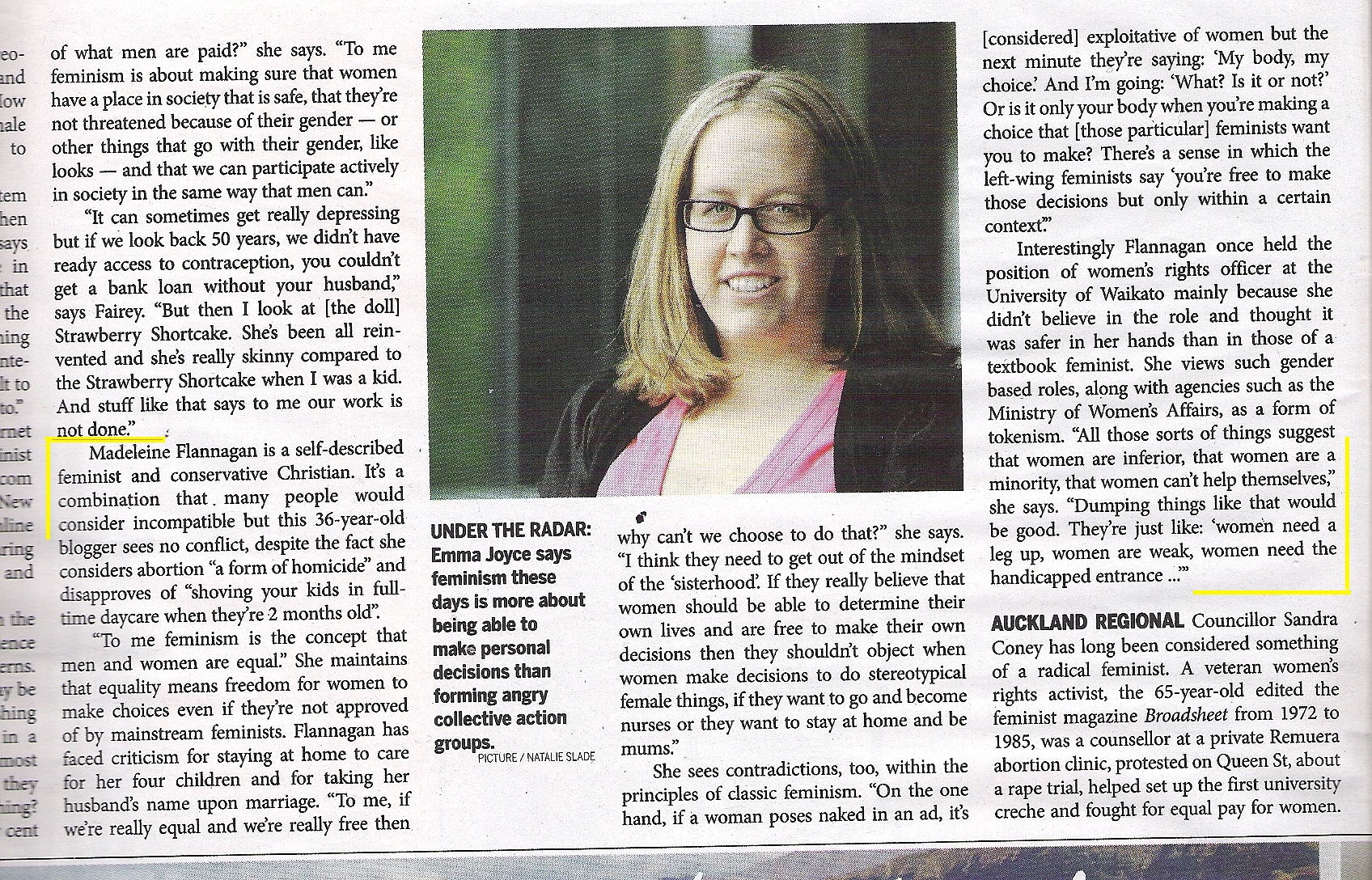
 simply further the image of women as irrational beings who cannot reason consistently. On the one hand we have the mantra “my body, my choice,” which is typically chanted the loudest when the issue is the life giving properties of one’s uterus but apparently when the issue is the life giving properties of one’s breasts the slogan does not apply.