Category: Commentators

  • Michael Huemer on Wokeness

    Political Philosopher Michael Huemer weighs in on the question: what is wokeness?

    I have been known to describe the essence of wokism as “reverse bigotry”. In the past, various forms of bigotry were common: prejudice against blacks, against women, against gays, against transgender people, and more. Wokism proposes, rather than to eliminate bigotry, to reverse the direction of traditional bigotry: replace anti-black racism with anti-white (or pro-black) racism; replace anti-female sexism with anti-male sexism; etc.

    Now you might think this an unfair description of the views listed in section 1. For instance, just because someone thinks that America is systemically racist against blacks, doesn’t mean that they support racism against whites, does it?

    Two things to note:

    One, the people who say that are basically blaming white people for the problems suffered by blacks as a group. They are saying that racism (which is, on their view, one of the greatest evils of the world) on the part of white people is responsible for black disadvantage. Sometimes they say the racism is “systemic”, which means that there need not be any actual racists, but many of them say that the racism is ongoing in the hearts of white people today. Anyway, even the systemic racism was caused by evil white people in the past.

    For a thought experiment, ask yourself what you would think about a person who explained most of the evils of the modern world as the product of wrongful behavior or evil character on the part of the Jews, either now or in the past. There are actually people like this. We call them “anti-Semites”, and they are obviously racists. If you replace “Jews” with “whites”, then you just have a different form of racism.

    The full article is available here at Huemer’s blog Fake Nous.

  • An Interesting Comparison

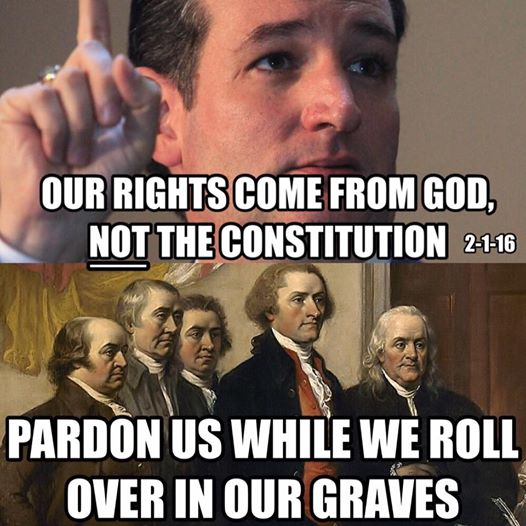
    This from Occupy Democrats:

    12647129_1058653647561022_4746717199189857381_n

    This from the Unites States Founding Fathers:

    When in the Course of human events, it becomes necessary for one people to dissolve the political bands which have connected them with another, and to assume among the powers of the earth, the separate and equal station to which the Laws of Nature and of Nature’s God entitle them, a decent respect to the opinions of mankind requires that they should declare the causes which impel them to the separation.

    We hold these truths to be self-evident, that all men are created equal, that they are endowed by their Creator with certain unalienable Rights, that among these are Life, Liberty and the pursuit of Happiness.–That to secure these rights, Governments are instituted among Men, deriving their just powers from the consent of the governed, –That whenever any Form of Government becomes destructive of these ends, it is the Right of the People to alter or to abolish it, and to institute new Government, laying its foundation on such principles and organizing its powers in such form, as to them shall seem most likely to effect their Safety and Happiness. Prudence, indeed, will dictate that Governments long established should not be changed for light and transient causes; and accordingly all experience hath shewn, that mankind are more disposed to suffer, while evils are sufferable, than to right themselves by abolishing the forms to which they are accustomed. But when a long train of abuses and usurpations, pursuing invariably the same Object evinces a design to reduce them under absolute Despotism, it is their right, it is their duty, to throw off such Government, and to provide new Guards for their future security…

    We, therefore, the Representatives of the united States of America, in General Congress, Assembled, appealing to the Supreme Judge of the world for the rectitude of our intentions, do, in the Name, and by Authority of the good People of these Colonies, solemnly publish and declare, That these United Colonies are, and of Right ought to be Free and Independent States; that they are Absolved from all Allegiance to the British Crown, and that all political connection between them and the State of Great Britain, is and ought to be totally dissolved; and that as Free and Independent States, they have full Power to levy War, conclude Peace, contract Alliances, establish Commerce, and to do all other Acts and Things which Independent States may of right do. And for the support of this Declaration, with a firm reliance on the protection of divine Providence, we mutually pledge to each other our Lives, our Fortunes and our sacred Honor. (emphasis mine)

    Oceania is at war with Eastasia. Oceania has always been at war with Eastasia.

  • Yet Another Lawyer Agrees: Marriage Amendment Act Bill is an Affront to Freedom of Religion and Belief

    Barrister Ian Bassett has given another opinion describing the risks to freedom of religion and belief of Louisa Wall’s Marriage Amendment Act Bill if it is enacted in its presently proposed form, which would include this amendment:

    “Without limiting the generality of subsection (1), no celebrant who is a minister of religion recognised by a religious body enumerated in Schedule 1, and no celebrant who is a person nominated to solemnize marriages by an approved organisation, is obliged to solemnize a marriage if solemnizing that marriage would contravene the religious beliefs of the religious body or the religious beliefs or philosophical or humanitarian convictions of the approved organisation.”

    It is clear that any marriage celebrant exercising their public function who is not covered by the amendment risks being in breach of the New Zealand Bill of Rights Act 1990 and the Human Rights Act 1993 if they refuse to perform their public function as marriage celebrants because it is a same sex couple seeking to be married.

    Injustice

    Church ministers, marriage celebrants, court registrars, church elders, leaders, photographers and caterers and any other person or entity supplying services to the public risks being in breach of the Human Rights Act 1993 if they refuse to supply services to a couple seeking to be married because the couple are same sex. For some this could also mean risking their employment.

    Service providers to the public risk being in breach of the Human Rights Act 1993 if they refuse to supply services to a married couple because the couple are same sex.

    The New Zealand Law Society’s Law Reform Committee headed by Professor Paul Rishworth LLB (Hons) M Jur highlighted the risk to freedom of religion and belief in the Bill in its submission to Parliament:

    “The proposer of the Bill said that the Bill was not intended to compel marriage celebrants to perform marriages contrary to their religious beliefs. However, in the Law Society’s view, Professor Rishworth says it is arguable that marriage celebrants who refuse to perform same-sex marriages will be acting unlawfully under the Human Rights Act 1993, the New Zealand Bill of Rights Act 1990, or both.

    “We want to highlight arguable conclusions which seem to be at odds with the settled intentions of the Bill’s drafters. Whatever the position, the Law Society believes it makes sense to put the matter beyond doubt,” Professor Rishworth says.

    The only thing that the amended Bill puts beyond doubt is that the critics of those raising fears about the Bill’s threat to freedom of religion and belief were wrong. By recommending an amendment the Select Committee are agreeing that a risk existed, as the likes of Ian Bassett, Grant Illingworth have argued, contra to The Human Rights Commission’s claim that all “…religious officials and leaders are free to refuse to perform marriages that are not in accordance with their religious beliefs.”

    Bassett, Illingworth and Rishworth are not alone with their concerns among the legal fraternity.

    Graeme Edgeler, a Wellington Barrister has been quoted in the Herald saying:

    … if an independent celebrant declined to marry a same-sex couple, the couple could then complain to the Human Rights Commission.

    “It’s not about [celebrants] being forced, it’s about people getting in trouble afterwards if they didn’t,” he told APNZ.

    “They’re not breaking any rule in the Marriage Act, but rules in other acts. The main one would be the Human Rights Act, which says you can’t discriminate on the basis on sexual orientation or gender.”

    Auckland Barrister Rachel Wong has raised issues against the Bill.

    This blog’s Madeleine Flannagan LLB, Associate Barrister and Solicitor at Coast Legal, adds her voice:

    “The Bill, in its present form, fails to protect individual freedom of religion and belief (belief being a comprehensive viewpoint not based on religion). The proposed amendment only protects group religious rights, which is little protection at all for most religious celebrants as few denominations hold formal views on marriage, many practitioners of religion do not belong to a group and for those that do they might hold a different personal view on this topic to the group view. The amendment then fails to protect the religious freedom of most religious celebrants just as it utterly fails to protect the freedom of belief of non-religious celebrants who have no group to appeal to to protect their freedom.”

    Ian Bassett’s latest opinion thoroughly analyses the legal effects of the amended Bill, a summary as to whose freedom of religion and belief it protects and whose it does not follows: (more…)

  • Matt on the Waitangi Tribunal, Confessional Confidence on “The Panel” – with Craig Heilmann

    Radio RhemaIf you tuned in to Radio Rhema at 11:45am (NZ time) on 19 July 2012 you would have heard this blog’s Matthew Flannagan and Craig Heilmann discuss topical issues such as the latest with the Waitangi Tribunal and whether priests should disclose crimes to police after confession, among other issues, on “The Panel” on Pat Brittenden mornings.

    You can listen online here.

  • Matt on “The Panel” on Pat Brittenden Mornings – with David Slack

    Radio RhemaIf you tuned in to Radio Rhema at 11:45am (NZ time) on 26 June 2012 you would have heard this blog’s Matthew Flannagan and David Slack discuss topical issues such as the plight of the South African grandmother who may be forced to go back home, and also, the last few days of TVNZ Seven, among other issues, on “The Panel” on Pat Brittenden morning.

    You can listen online here.

  • Contra Mundum: Pacifism and Just Wars

    Comedian Bill Maher recently berated Christians for being hypocrites for supporting military action against terrorists in his “New Rules” segment on the U.S. TV show Real Time (transcript here). Jesus, Maher contended, was a pacifist; “Jesus lays on that hippie stuff pretty thick. He has lines like, “do not repay evil with evil,” and “do not take revenge on someone who wrongs you.” Here Maher was citing from Romans 12, where Paul formulated Christ’s teaching about loving one’s enemies. In this passage Paul commanded people to “bless those who persecute them,” they are forbidden to “repay evil for evil” and are commanded to “not take revenge” but to “leave room for God’s wrath. For it is written, ‘Vengeance belongs to me. I will pay them back’.”

    Maher scathingly contended that this support contradicted Christ’s clear teaching; he said, “nonviolence was kind of Jesus’ trademark. Kind of his big thing. To not follow that part of it is like joining Greenpeace and hating whales.”

    After saying this Maher quipped, “the next line isn’t ‘and if that doesn’t work, send a titanium fanged dog to rip his nuts off.’” The irony is that it Maher clearly had not bothered to actually read the next line; Romans 13 states that the “governing authorities” are “established by God”; one is morally bound to submit to rulers because “rulers do not bear the sword for no reason. They are God’s servants, agents of wrath to execute vengeance upon evil doers”.

    The Greek words for evil, wrath, and vengeance are the same in both Romans 12 and 13. Paul is stating that the very things Christians are forbidden to do with regard to not repaying evil for evil, are precisely what the State has been given the legitimate authority and right to do.

    Paul here elaborates the basic premise that moral theologians appeal to to reject pacifism and to support the claim that war can be just under certain circumstances. The premise is that a government has the right and duty to use force to uphold within the geographical area over which it has jurisdiction. A just war is simply an extension of a government’s power to pass laws and create police powers.

    If a criminal attempts to rape or kill people within the geographical realm over which a government has authority then the government can justifiably use force to prevent this. And it can also use force to try and punish anyone who does these things; hence, the existence of a legislature, police force, courts and prisons. Just War theorists simply note that there seems no reason why this would not extend to when the person committing the offence is a soldier from another country as opposed to a domestic criminal.

    These theorists argue that for a war to be just it must (more…)

  • Easy Dupes: Amina Abdallah Arraf al Omari “Gay Girl in Damascus”

    Free Amina Abdallah Arraf al Omari Narratives are powerful.  They control what we identify as significant data or facts, how we empirically apprehend the data, what interpretations and shades of significance we place upon the evidence, and the conclusions drawn.  Absolute objectivity is impossible.  Only relative neutrality and disinterestedness are possible.  The cut of our jib determines the winds we catch and the sailing progress we make. True objectivity consists only in this: full disclosure of the jib’s cut whilst our sailing exploits narrative unfolds.

    Post-modernism has challenged our culture to face up to the inevitable and intrinsic cant in everyone’s understanding.  That is why it is despised by those still claiming absolute objectivity, operating just by the facts, only the facts.  Every so often we see the pervasive power of narrative on ridiculous display.  It can lead to an easy gullibility and childish credulity.

    “Gay Girl in Damascus” had been lionised by the Commentariate–which, as it happens, relentlessly denies the cut of its own sailing rig–both to itself and its audience.  Therefore it is an easy mark.  The Commentariate is deeply invested in the narrative of secular human rights.  All human beings on the planet basically think the same way about demand rights and civil rights; so much so that if external repressions were to be removed, the people would rise up to claim and enjoy their rights–and the demand rights of others.  To put it crassly, were authoritarian regimes to be removed, a hundred blooms of western-style secular democracy would inevitably and naturally spring forth.

    “Gay Girl” purported to be a lesbian blogger in Syria.  The narrative of the Commentariate has for a long time failed to “see” the evidence of Islamic repression against women.  Certainly it exists–but it is not intrinsic to Islam itself or to the native heart of Islamic people.  It is therefore not really real.  Remove the oppressive regimes and hey-presto, Islam will suddenly look and act like a secular Western culture, complete with nude beaches soaking up loooove and tolerance.  “Gay Girl” became a cause celebre because she described her experience of the natural, easy tolerance of homosexuality in Syria: the oppression against homosexuals was a foreign imposition originating from an oppressive regime.  She also was an enthusiastic supporter of the oppressed Palestinian story, and an astringent foe of Israel.  Once again, she fell neatly into the predispositions of credulity in the Commentariate.

    “Gay Girl” was Amina Abdallah Arraf al Omari, a Syrian-American woman living in Damascus.  According to Jonah Goldberg,

    People desperately wanted to believe in this “hero”: a saucy, sage, left-wing member of the LGBT community who likes to wear the hijab, can’t stand Israel or George W. Bush, and who parrots every cliché about the romantic authenticity of the Arab people and their poetic yearning for democracy, peace, and love. . . .  Amina’s assertions succeeded with little effort. For instance, (more…)