Category: Social Commentary

  • Contra Mundum: Confessions of an Anti-Choice Fanatic

    If current media is to be believed opposition to legal abortion comes from misogynist fundamentalist fanatics who want to impose their religious mores onto others. This string of pejorative terms is amusing; however, it does not actually address the more crucial question of whether laws against feticide (the killing of a fetus) are just. I maintain they are and, unlike most media commentators and politicians who pontificate on the topic, I will argue three points for this thesis.

    The first is that the typical arguments in favour of abortion succeed only if it is assumed from the outset that feticide is not a form of homicide. A couple of examples will illustrate this. It is frequently asserted that women have a right to do whatever they like with their own bodies. This assertion is false. Women do not have a right to do whatever they like with their bodies; no one has such a right. Women cannot use their bodies to rape or commit homicide or set fires. The right to do as we please is limited by the morality of our actions, thus whether abortion falls into the category of an action we are free to choose depends on whether feticide is homicide. If it is, then this argument fails but as currently used it is just assumed that it is not.

    Some might object that such an interpretation is an uncharitable reading of this contention. What is important from this perspective is that all people have a right to control what happens inside or to their own bodies. I have a right to control what happens to mine and you have a right to control what happens to yours. Hence, provided the decision I make does not involve me using your body in a way that you do not consent to then I have a right to do it. However, implicit in this argument is the claim that a fetus, at least until born, is part of a woman’s body, that it is not a separate, bodily-living, human being on its own. However, this claim is erroneous. To suggest that a fetus is part of a woman’s body entails that the mother of a male fetus has two heads, four arms and a penis. Once again this argument is successful only if one assumes a fetus is not a human being from the outset because if the fetus is human then it too has a right to not have its body harmed.

    The infamous illegal “back-street” abortion argument fares no better. The allegation that “hundreds” (I put this in scare-quotes because actually the figures show it was significantly a lot less than this) of women died from illegal abortions can justify legalisation only if feticide is not homicide. If it is homicide then this argument reduces to the bizarre assertion that we should kill eighteen thousand children each year in order to prevent “hundreds” of women from harming themselves by breaking the law.

    Typical consequentialist arguments also fail. Abortion prevents unwanted children who are likely to be poor, abused or engage in crime. It is hailed as a solution to over-population and the existence of more handicapped people. It prevents adult and teenage women from falling into economic hardship and stress. It enables them to complete their education, pursue their careers. However, all this is equally true of infanticide. Infanticide prevents the existence of unwanted children and their associated social costs, lowers the population, prevents the handicapped existing and saves women and teenagers from the economic and emotional stresses of parenthood. Yet infanticide, as convenient as it is, is condemned because it is homicide. Again, all these arguments assume that the fetus is not human without actually arguing for it.

    This is not to say feticide can never be unjustified. Utilising the justification of self-defence, I think a case can be made for feticide where pregnancy constitutes a threat to a woman’s life or perhaps in cases of rape (space prevents me elaborating the casuistry here). Such cases are extremely rare and make up less than 0.5% of all cases (according to figures compiled by the Abortion Supervisory Committee). So, if feticide is homicide, the vast majority of abortions lack justification. To defend permissive abortion laws on these grounds is a bit like allowing people to murder on demand on the grounds that there exist rare cases of justifiable killing in self-defence.

    My second point is the claim that feticide is homicide has considerable prima facie plausibility. Consider this scenario. A hunter is in the woods and notices some rustling in the bushes. Looking through his scope he sees a six-foot high, bi-pedal being with brown hair, blue eyes, wearing a swann-dri. He refrains from shooting. Here, the hunter makes the sensible and reasonable judgment that in firing he would risk engaging in homicide. He bases this on what the target looked like. In the absence of reasons for thinking otherwise he has good grounds for this claim. However, “[there is] a general consensus that the fetus is recognisably human after six weeks, and certainly after eight” (D Boonin A Defense of Abortion (2003) 95). This fact, conjoined with the above illustration, entails that, in the absence of good reasons to the contrary, there are good grounds for thinking that feticide is homicide.

    My final point is that good reasons to the contrary are not forthcoming. Here I will focus on three common examples starting with the fetus not being viable.

    The fact that a fetus cannot survive independently of its mother does not mean it is not a human being. Fetal viability is contingent upon the medical technology of a given culture. A fetus that is not viable in Chad is viable in Los Angeles. If viability is necessary for something to be a human then a woman pregnant with a viable fetus in Los Angeles who flies from Los Angeles to Chad carries a human being when she leaves but this human being ceases to exist when she arrives in India and yet becomes human again when she returns (Peter Singer Writings on an Ethical Life (2000) 148).

    Similarly, while the fetus lacks consciousness, lack of consciousness does not make a being non-human. If it did, then a human being ceases to exist when asleep or unconscious and then pops back into existence upon awakening. Shooting someone would cease to be homicide provided we render him or her unconscious first.

    Appeals to fetal consciousness face other problems. David Boonin notes that those who attempt to ground humanity in the amount of brain development an organism has undergone face a dilemma. “Any appeal to what a brain can do at various stages of development would seem to have to appeal to what the brain can already do. Or to what the brain has the potential to do in the future.” (David Boonin A Defence of Abortion (2002) 125). Either option leads to problems for a defender of the permissibility of feticide who does not also want to endorse infanticide. This is because “by any plausible measure dogs, and cats, cows and pigs, chickens and ducks are more intellectually developed than a new born infant”.(Boonin, 121)

    Suppose, then, that one takes the first horn of the dilemma and appeals to what the brain can already do. However, unless one wishes to affirm that “dogs, and cats, cows and pigs, chickens and ducks” are human beings then “appeals to what the brain can already do” will “be unable to account for the presumed wrongness of killing toddlers or infants.”

    Suppose, then, one takes up the second horn and appeals to “what the brain has the potential to do in the future.” Boonin notes that this will entail that feticide is homicide. “If [such an account] allows appeals to what the brain has the potential to do in the future, then it will have to include fetuses as soon as their brains begin to emerge, during the first few weeks of gestation.”(Boonin, 121)

    Finally, while it’s true that fetuses are not ‘persons,’ where person is defined as “a thinking, intelligent being that has reason and reflection and can consider itself as itself, the same thinking being, in different times and places,” (J Locke Essay Concerning Human Understanding) neither are newborn infants. In fact, a newborn cow is more person-like than an infant is. The price of a cogent pro-abortion argument is the reduction of newborn infants to the ethical level of cows. It is difficult to understand, on this view, why killing a newborn infant is any more problematic than killing a calf.

    In summation, except for a few rare cases, abortion is justified only if feticide is not homicide. However, there are good prima facie grounds for thinking feticide is homicide and these prima facie grounds are not overridden by reasons to the contrary. Jointly, these contentions demonstrate that feticide constitutes unjustified homicide, and, hence, should not be a practice that is tolerated or sanctioned by the state.

    I write a monthly column for Investigate Magazine entitled Contra Mundum. This blog post was published in the January 10 issue and is reproduced here with permission. Contra Mundum is Latin for ‘against the world;’ the phrase is usually attributed to Athanasius who was exiled for defending Christian orthodoxy.

    Letters to the editor should be sent to: editorial@investigatemagazine.DELETE.com

    RELATED POSTS:
    Is Abortion Liberal? Part 1
    Is Abortion Liberal? Part 2
    Sentience Part 1
    Sentience Part 2
    Viability
    Abortion and Child Abuse: Another Response to Farrar
    Abortion and Brain Death: A Response to Farrar
    Abortion and Capital Punishment: No Contradiction
    During, Sherwin & Hutchison on Backstreet Abortion
    Imposing Your Beliefs onto Others: A Defence
    Boonin’s Defense of the Sentience Criterion: A Critique Part I
    Boonin’s Defense of the Sentience Criterion: A Critique Part II
  • New Years Eve Antics: MandM – One News Anchors

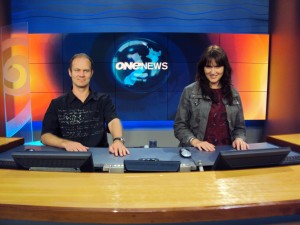
    Last night a friend took us behind the scenes at TVNZ to watch live broadcasts of One News and Channel 7 News. As everyone was too busy partying they threw us in to anchor at the last minute. No one noticed – I mean who watches the 6-o’clock news on New Years Eve  anyway right?

    One News

    One News

    Not really…

    Our friend’s sister works at TVNZ; we were just playing on the set after it went to air.

    We finished up the night with a BBQ with friends, drank wine, margaritas and shots of some stuff that tasted like cough syrup (but wasn’t). We conversed, listened to music and then we wandered up the road to watch the Sky Tower’s 3 minute firework display at midnight. How was your New Years eve?

  • St Matthews in the City: Progressive Irrationality

    It was a typical chilly Dunedin morning. I was standing in line at the Otago University Post Shop, about to send an important document overseas, when the student in front of me, oblivious to his audience, announced to the girl beside him “I’ve got a doll of Jesus in my car, I have tied a noose around its neck and hanged it. It’s hilarious. It really pisses those Christians off.” Laughter ensued. Now I was outwardly restrained but in my mind I contemplated a come back; it went like this, as soon as the guy had spoken I would call him an “asshole” in front of everyone in the line. When he looked bewildered and offended that a complete stranger had insulted him for no reason at all, I would respond, “What’s your problem, you just said that it was funny to insult people for no reason at all other than the fact that you find it funny to piss them off.”

    Now I did not do this, and for good reason. It is generally not a good look for a doctoral student to go around insulting other students simply because they said things about my religion that I disagreed with – people would justifiably be outraged at me and denounce me as bigoted. But, isn’t this the point?

    I recalled this event this morning as I heard that the controversial Christmas billboard, put up by St Matthews in the City, has been taken down. For those outside of Auckland, St Matthews in the City is an Anglican congregation that propounds, what they like to call, “progressive Christianity.” They recently put up a billboard showing Mary and Joseph in bed, not looking too happy, with the line “poor Joseph, God was a tough act to follow.” The billboard implies quite clearly that God not only literally had sex with Mary, was a fantastic orgasmic lover but it also, by implication, entails that God committed adultery, and so did Mary.

    Mary and JosephI am glad the billboard is down (though I will not endorse the  reported method) for the obvious reason that it is insulting to other people and, prima facie, it is wrong to insult other people. Of course, there can be situations, such as where a person does something wrong, that the appropriate response is to insult them but absent such situations, charity dictates that we refrain from doing so. Millions of people world-wide worship God and millions of Roman Catholic venerate Mary, this billboard affirmed that persons they love and adore are adulterers.


    Of course some are saying that this is just a joke and we Christians should get a sense of humour. I always find this response disingenuous. Suppose I, for a joke, put a picture of the vicar of St Matthews, Glyn Cardy and his wife, outside my Church, made both of them look not so happy, and added the phrase “Glyn Cardy is as soft and floppy as his theology,” right there, in public – outside my church let’s not forget – for all to see. Would the response, ‘oh come on it’s only a joke, get a sense of humour,’ wash with anyone? I doubt it. If I were a gambler I would bet we would hear another of Cardy’s little sermons about how this is proof of the narrow-minded intolerance that non-progressive Christians like me expound. But then wouldn’t it be evident that neither Cardy nor anyone else believes that humor justifies making insulting personal comments of this nature?

    Of course in many ways this whole event shows up the intellectual shallowness that so called “progressive Christians” show towards others. Take Cardy’s justification for the billboard according to Stuff, Cardy states,

    St Matthew’s church says the aim is to provoke conversation about spiritual matters by lampooning the literal Christian conception story and inviting people to think again about what a miracle is … He said the idea behind the billboard was to move a debate that was inside the church to outside it ”and certainly people in all sorts of places are talking about it”. He didn’t doubt that some people had been offended by the billboard, but ”the literalness of a male God impregnating Mary needs to be laughed at”.

    Note two things here, first Cardy clearly caricatures the “literal conception story” yet mainstream Christendom, who believes this story, do not hold that God is literally a man and that he had sex with Mary. God in traditional theology is immaterial, he has no sex organs and the story of a virginal conception is just that, a virginal conception. Cardy, of course, being theologically trained, knows this. Second, Cardy on calling for “debate” means that people who hold orthodox Christian views “needs to be laughed at.” So Cardy’s understanding of theological debate apparently involves deliberately distorting and caricaturing the views of other people and then responding, not with reasoned argument, but ridicule.

    I might be a bit too conservative and old fashioned but in my book theological argument involves trying to understand another’s position by trying to grasp the best representative examples of it so one can articulate it accurately and then offer sound arguments or reasons for rejecting it or for showing where and why it is flawed. It also involves treating ones interlocutors with respect. Of course I do not always live up to this ideal but it is one that I think Theologians should aspire to.

    The fact that Cardy and St Matthews thinks otherwise tells us a bit about them and their “progressive Christianity.” People who think it is ok to ridicule and insult people simply because they hold a different religious perspective to them, who will dishonestly distort other’s views and responds to being challenged on this, not by reason, but by self-confident ridicule is not “progressive” and no amount of relabeling it will change this fact.

  • View Episode 2 Pacific Viewpoint TV Panel on Abortion & Parental Consent Here (Feat. Madeleine)

    Episode two of the television panel discussion I participated in on parental consent/notification for abortion is now available for viewing online here at Pacific Viewpoint TV. (Episode one can be viewed here).

    Madeleine on Pacific Viewpoint

    The show runs for 30 minutes; in this episode I appear as a panel member (last time I was an audience member). Panelists are host, Setita Millar, Family First’s Bev Adair, National Party MP Paul Hutchison, Reverend Tavale Matai’a, Ula Sangyum, Cushla McNabb and moi!

    Pacific Viewpoint Panel

    A lot of the dialogue made the editing room floor, some of which was frustrating, and the conversation did stray more onto sex education – state v home – but it was still all good.

    NOTE:
    In this footage I make a comment stating I used the pill as a form of contraception. I wish to make it clear that on learning of the pill’s abortifacient properties (this applies to both the mini and combined pills) I ceased using it some years ago.

    As a protestant I have no issue preventing conception. However, the pill permits conception but prevents implantation (often sneakily worded on your pill packet or by your doctor as “preventing pregnancy” where pregnancy is re-defined as beginning at implantation and not conception).  I reject the common protestant argument that because plenty of conceptuses fail to implant anyway it is ok to actually cause that to happen by taking the pill – if you view life beginning at conception this is like saying it is ok to shoot children in 3rd world countries because plenty will die of hunger and disease anyway.

  • Another Climate Change Science Hockey Stick Graph

    Spotted this over at Hitting Metal with a Hammer in The real climate hockey stick revealed and had to have it:

    Hockey Stick Graph

    It really raises questions of sustainability.

  • Madeleine on TV Tonight on Abortion & Parental Consent

    Part two of the television panel discussion Madeleine participated in on parental consent/notification for abortion airs on Pacific Viewpoint tonight, Wednesday 16 December, on Stratos TV (Freeview 21 & Sky Digital 89) at 8:00 pm. Part one can be viewed online here.

    We’ll put a link up on this blog to the online video of the show when it becomes available tomorrow.

    The panel features Dr Paul Hutchison, MP for Hunua and former member of the Abortion Supervisory Committee; Bev Adair, spokesperson for Family First, Reverend Tavale Matai’a, a couple of other women and Madeleine. In tonight’s episode Madeleine features as a panel member (last week she was an audience member who asked a question) so she gets a lot more speaking time (assuming she makes it past the editing room).

  • Rangiora New Life College, Religion and Discrimination

    On Wednesday I flew to Christchurch for an interview regarding a religious education (RE) teaching position in a Catholic School. On having the interview and receiving the subsequent rejection email, it was clear what the reason I did not get the position was: I am a protestant, the school has a particular Catholic ethos that it was trying to instill in the students; this ethos involved such things as Marian devotions, praying the rosary, prayers for the dead and regular involvement in the Eucharist. As a leader in the school I would be expected to, by my teaching and life, encourage and model this ethos. Given I am an evangelical protestant I could not do this. I could, of course, explain to students what the Catholic teaching was on these issues and respect the special character of the school but due to my religious convictions, I could not truly fit with the ethos of the school because I could not model it, as fact, in my own example.

    Now in no way do I think I was treated unfairly, it was afterall a Catholic School and this was something that was  obvious both from the name on the advertisement in the education gazette and from the website linked to from the same ad. The function of this school was not simply to impart information; it was to imbibe a particular religious way of life, some of it involving what Nicholas Wolterstorff calls “educating for responsible action,”

    The ultimate goal of all education, as Christians see it, is that those who are taught shall live in such a way as to carry out their responsibilities to God and find joy and delight in so doing. … But if responsible action is to ensue, more is necessary than for the students to have knowledge of the relevant matters and the ability to perform the relevant actions. Knowledge and ability are not yet performance. It is also necessary that the students’ tendencies, ranging all the way from their unreflective habits to highly self-conscious commitments, be those of acting in accord with the normative laws for right action. Education, accordingly, must have among its goals to secure–always in morally defensible ways–the formation of right tendencies.[1] [Emphasis original]

    Wolterstorff argues that modelling plays an important role in cultivating tendencies. He notes that a series of studies show that students who view other people resisting the temptation to act in an immoral or inappropriate way fortify their own resistance to temptation.[2] Wolterstorff states, “The evidence seems to be that not only do a model’s low standards influence the student to lower the standards which otherwise he or she would adopt, but also a model’s high standards influence the child to raise his or hers.”[3] [Emphasis original]. An important caveat of this is that studies show “the self-denial induced by a stringent model gives way rather readily when the subject is confronted by another model with lower standards.”[4] Because the school was seeking to train students to internalise a Catholic ethos, and an important part of the pedagogy of internalising such an ethos is modelling, it follows that leaders within communities committed to this goal must themselves follow and be committed to the basic moral teachings of the community. I was not. I am a protestant and so would buck (internally) against many of the tendencies the RE department were trying to teach.

    This does not seem terribly controversial to me. Schools dedicated to inculculating a religious way of life into their students have the right to demand that the leaders in their schools be committed to and reflect this way of life. It is perfectly reasonable for Jewish schools to expect people in positions of leadership to be faithful followers of the Torah. It is perfectly reasonable for Muslim schools to expect leaders in their community to be faithful Muslims; for atheist schools devoted to promoting atheism to expect their leaders to be atheists.

    I reflect on this because of the recent outcry in response to a Campbell Live story that a Christian school in Rangiora, Rangiora New Life School, expelled a student for getting pregnant and subsequently revoked the deputy head-boy status given to her fiancé, the father of her child. Now, in light of what the media has reported, I will say I am not in agreement with everything the school did (I should qualify this by stating that I have very little faith that the media to report events like this terribly accurately – so take that concession with a grain of salt).

    For example, Ollie Sterrit the deputy head-boy and his fiancé Sara Etherington stated that “if we decided not to keep her [abort their daughter] they didn’t support it, and they still didn’t support us if we did keep it. So we were stuck in the middle and couldn’t do anything to please them.” The media reports that the teen couple “are engaged and determined to stay together.” Now, I am inclined to think that if a teenage couple respond to getting pregnant unmarried by taking their responsibilities seriously by refusing to kill their child, getting engaged, making a commitment to stay together and to continue their education they should be supported and commended for doing the right thing. They are of course not yet “legally married” but given their age, in this country, that is impossible; hence it is not clear cut to me that this couple’s choice should not be supported. In fact, I think that a scriptural case could be made that people in this situation can, in certain circumstances, be viewed as being in a constituted kind of common law marriage and that, in fact, it is the duty of the father to marry the woman he has impregnated and to take his responsibilities to her and the child seriously (which is what appears to be happening in this situation).  However, Sara’s parents tell a different story (see the second comment on the Campbell Live link) “We have consistently tried to encourage Ollie and Sara to see the bigger picture (others affected by there decisions) all along, their choice of course. Sara has had every love and support from RNLS  [the school] and her family.“

    Whatever the truth is on the matter of the school supporting the couple, stripping someone of a position of leadership is not the same thing as not supporting them –  though not permitting Sara to finish her education (she was apparently asked to leave the school) might be. Also giving someone a position of leadership, knowing about the pregnancy and then removing it from them, perhaps demonstrated a lack of wisdom in the first place on the part of the school or some dud processes (or bad media reporting).

    However, these issues are not the focus of my concern in this blog post. First, Dave Crampton at Big News seems to suggest that the school had no policy on sex outside of marriage and as such they could not claim that this was part of the ethos they were trying to impart, meaning the school had no right to suddenly make an issue of the sexual conduct of its students, “The schools handbook has no mention of policies on sex, although swearing and alcohol are forbidden in school grounds, as are piercings for males.” If you visit Rangiora New Life’s website a very different picture emerges. First of all, the name of the school  “New Life” immediately suggests it is evangelical or pentecostal. On the front page the school mission states “Providing quality Christian education that equips and inspires all students to reach their life’s potential in order to serve God’s purposes.” There is a clear indication by the use of words such as “their life’s potential” and “serve God’s purpose” that the type of education they are seeking to inculculate is holistic, they hope that it will impact all aspects of the students’ lives. Click through to their Mission, Vision and Values page and you’ll find under the heading “Vision,”

    GODLINESS – Building character in the students that will enable them to lead by example.

    LIFE SKILLS – Equipping students with skills in relationships, home-life and vocation.

    EVANGELISM – Taking every opportunity to share the life changing message of the gospel.

    SERVICE – Impacting our region and beyond through sacrificial service and giving. [Emphasis added]

    Here we see concern with character, leading by example, reference to relationship skills, home-life and vocation tell us they mean more than relationships with their school peers and teachers. Evangelism and reference impacting the region and beyond show, again, the broader ethos of the school. The “guiding values” on this page continue these motifs and among these we find “Ensuring school relationships, procedures and policies reflect Biblical principles and the highest Christian conduct” and “Promoting personal responsibility in learning and conduct, and community responsibility by way of service and leadership skill.” Does anyone really think, on reading these, that banging your fellow teenage school peer and knocking her up is compatible with Rangiora New Life’s understanding of these terms and is the sort of example in leadership or high biblical standard that the school is seeking to promote by example and that this sort of conduct is what the other parents with kids in the school want modelled to their kids?

    Now, as Madeleine points out, when contracts are formed (I’m getting at here Dave Crampton’s contractual suggestion) all aspects of the communication between the parties, the information freely offered about the parties states of mind, intent, etc as well as the surrounding documentation speak to how the minutae of the handbooks and policies should be read and interpreted. The school is clearly a conservative, pentecostal/evangelical bible believing Christian school. Did anyone miss the memo that people with such beliefs tend to frown on pre-marital sex and that such people have high expectations of the example of their leaders – that’s why church leaders being hypocrites is such a big deal.

    Second, what is my concern is the widespread belief of some commentators that a religious school cannot demand that leaders in their community abide by the moral teachings of the religious ethos the school seeks to inculculate. Idiot/Savant of No Right Turn’s comments are typical,

    This is clearly unlawful discrimination on the basis of marital status and family status, in violation of sections 21(1)(b) and s21(1)(l) of the Human Rights Act 1993. It may also constitute discrimination on the basis of religious belief in violation of s21(1)(c). Rangiora New Life School is a religious school, so it has an exemption for the latter – but not for the former. It can not legally exclude or punish students who have children or are in de facto relationships, any more than it can exclude or punish them for being divorced (or the children of people who are divorced).

    Regardless of the merits (or lack thereof as Madeleine insists) of Idiot/Savant’s legal analysis here there is a moral point here worth addressing. Idiot/Savant seems to think that religious schools can discriminate on the grounds of religious belief but not on grounds of sexual behaviour. It is hard to see the sense in this because in many circumstances, and certainly in this case, a person’s religious beliefs include a set of beliefs about sexual morality. If we are to take this line of argument seriously a religious school can discriminate against people who believe that sex outside of marriage is wrong but they cannot discriminate against people who refuse to practice this belief. It is hard to see how such a view could be taken seriously; surely the whole point of these teachings is that they be followed.

    Idiot/Savant continues,

    But there’s another aspect to this: Rangiora New Life School is a state integrated school, and therefore effectively part of the state education system. The New Zealand Bill of Rights Act therefore clearly applies. By discriminating against its students and denying them any involvement in the decisions about them, the school has violated the right to be free from discrimination and the right to justice. And that is something we should not be tolerating from any part of our government. Rangiora New Life School’s board must be told to obey the law, cease its discrimination, and reinstate the student it has excluded. And if they do not, they should be replaced.

    Idiot/Savant here makes heavy weather over the fact that Rangiora New Life is an integrated school. While this is true, it is also a religious school which aims to inculculate a particular religious way of life. Integrated religious schools, with special characters allowing them to promote a particular religion, are extremely common. If Idiot/Savant’s, position is correct none of these schools should be allowed to require leaders in the school or students who attend the schools to uphold a certain religious ethos. This would of course make a mockery out of their mission to promote such a way of life.

    Lurking behind this complaint is, I think, a mindset that schools that promote a particular religious ethos (or at least take the ethos seriously) should not get public funds; only secular schools should get such funds. In practice this means that a school that promotes a secular perspective antithetical to a particular religion will get state funds whereas a school that inculculates certain religious beliefs will not. It’s odd that people like Idiot/Savant who maintain the right to be free from discrimination on the part of the state would support such a policy that clearly discriminates against tax paying parents with religious views.

    Wolterstorff notes a deeper problem,

    there are parents within society for whom it is a matter of religious conviction that their children receive a religiously integrated education. … If those parents are forbidden by law to establish and patronize schools that teach in accord with their religious convictions, then the discrimination is embodied in law. If they not legally forbidden to establish and patronize such schools then the discrimination is embodied in economics. Were those parents to establish and patronize schools that teach in accord with their convictions, they would have to pay for those schools out of their own pockets, while still contributing to the general tax fund for the other schools, obviously there free exercise of religion is thereby infringed upon in a way in which that of others is not. They do not enjoy equal freedom to live their lives as they see fit.[5]

    To insist that schools either forgo public funds or compromise the religious ethos they seek to inculculate is itself discrimination. Wolterstorff notes the only escape from this dilemma apart from privatising education entirely is to “fund equitably all schools that meet minimum educational requirements” and this means allowing schools to take public funding that will require strict standards of sexual morality from student leaders. Of course one could always admit that one does not actually support the right of all to be free from religious discrimination…


    [1] Nicholas Wolterstorff Educating for Responsible Action (Grand Rapids MI: Eerdmans Publishing Co) 14-15.
    [2]
    Ibid 51-55.
    [3]
    Ibid 55.
    [4] Ibid.
    [5]
    Nicholas Wolterstorff “The Role of Religion in Political Issues” Religion in the Public Square

    RECOMMENDED READING:
    Religious Restraint and Public Policy

    While it is not central to my point I cannot ignore the fact that in two places now (see the second comment on the Campbell Live link for one) I have seen the parents express anger at Campbell Live’s intrusion into their home without their consent. They had apparently categorically told the producers that they did not give permission for their property to be used for the interview but Campbell Live ignored their wishes and waited til they were not home to film the piece. Appalling.