Category: Social Commentary

  • View “Marae: The Great Waitangi Debate” Here

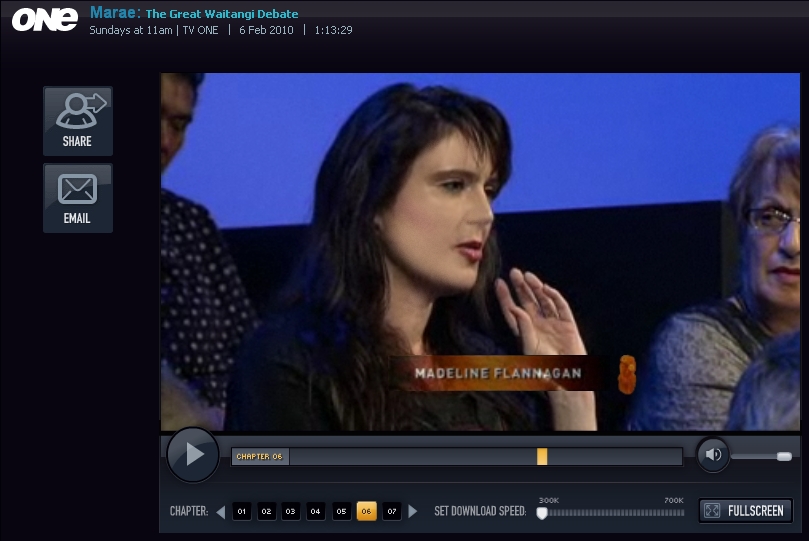
    For those of you who slept in, got the time wrong or who just don’t get TV One because you don’t live in New Zealand, click on the link to watch “Marae: The Great Waitangi Debate,” as screened on national television this morning.

    The debate featured panelists Stephen Franks, Tim Wikiriwhi, Matthew Hooten and Hana O’Regan and an active studio audience, including Matt and I, who were expected to comment and ask questions from the floor (which we did).

    Our thoughts from inside the program are here.

  • Tune in to Marae Tomorrow

    Yesterday Matt and I participated in filming a debate on the Treaty of Waitangi. The moot was “That the Treaty of Waitangi is holding NZ back.” There were four panelists, Stephen Franks, Tim Wikiriwhi, Matthew Hooten and Hana O’Regan and an active audience, of which Matt and I were asked to be members of to represent blogging New Zealand (apparently they considered David Farrar but decided we’d be more interesting on the basis of Matt’s blog post, Maori and Pakeha are Not Partners to the Treaty of Waitangi).

    The audience, who comprised a range of commentators, Members of Parliament and even activist John Minto, were expected to comment and ask questions, which we dutifully did. Who knows if we’ll make the editing room cut, or how what we said will play on screen (it always feels different in the moment to how it looks on air I find)  – one way to find out I guess!

    The debate will screen on Marae tomorrow morning, Saturday, 6 Feb, from 8:00am – 9:30am on TV One.

    Here is a brief rundown of our thoughts:

    • Speaker of the Day goes to Stephen Franks for presenting the best case and for managing to use terms like “fake treaty”, “bogus” and “spurious” whilst still managing to come across calm, pleasant and reasonable.
    • The Most Inflammatory award goes to Tim Wikiriwhi – you can read his transcript at Not PC. The award was for his  student-politician-styled-delivery coupled with claims later on in the debate that there had not been a single past injustice towards Maori, which earned him shocked and awed hissing. (That aside his message was good and his historical claims were fascinating.)
    • Best Impersonation of Peter Dunne award goes to Matthew Hooten for trying to take the middle ground and please everyone whilst effectively saying nothing but sounding profound.
    • The Loonie Leftie Why–Didn’t–Her–Over-Sized–Tiki–Explode? award goes to Hana O’Regan for (and it was hard to pick a winner from the many incoherent and internally inconsistent examples she had on offer) arguing for the confiscation of property  (tax dollars) to support the promotion of Maori language “because it is beautiful” [so too is the NZ countryside] citing the Treaty as justification for said confiscation of property (I kid you not!). We both called her on this in the Q&A.
    • Funniest Moment was when the producer decided that our paper voting forms didn’t look so good on camera so had the audience pretend to push invisible electronic voting buttons and to vote multiple times so that the camera could grab a range of shots. Shane Taurima, the host, completely lost it with laughter when he delivered the instructions to the audience to push the green button for the affirmative and the red button for the negative “on the small electronic device you see before you” and he had to re-shoot it. (Then they decided to have us vote with the paper ballots).

    I must note that at the beginning of the debate the audience was asked for a show of hands as to who was for the motion and who was against it. At the outset less than 5 people were for the motion. This is an important consideration to factor into the voting results announced at the end of the debate. As Stephen said to me afterwards, I think the for’s won it as they gained votes and the againsts lost them.

    RELATED POSTS:
    Maori and Pakeha are Not Partners to the Treaty of Waitangi

  • Contra Mundum: The Judgmental Jesus

    Few things are thought to be more morally pernicious than the practice of judging others. Sometimes this is given a theological spin with people citing the Sermon on the Mount “Do not judge, or you too will be judged. For in the same way you judge others, you will be judged, and with the measure you use, it will be measured to you.” (Matthew 7:1-2).

    It is common for this imperative statement to be used as a kind of rhetorical club to silence moral critique of various cultural practices. When a particular practice is subjected to such critique those who engage in the practice will complain they are being “judged.” If the alleged judgers are Christian, the claim that “judging is contrary to what Christ taught” is typically added to the charge.

    I think this is a misrepresentation of the passage and an affront to common sense. I will address the latter point first. The claim that it is wrong to judge other people is problematic; it is so problematic that it is amazing that anyone gives it credence. For example, if it is wrong to judge other people then since Hitler was another person, it is wrong to say that what he did was wrong. To claim that his actions were wrong is to make a judgment about them and if judging is wrong then it is wrong to judge Hitler. Similarly, Martin Luther King Junior was wrong to criticise racism and doing so judged the actions of racists and William Wilberforce was wrong to make moral judgments about the slave trade as in doing so he was judging slave owners. Taken consistently, the claim that “it is wrong to judge” entails that we should have no legal system, no laws and no courts as all these things involve judging others by deeming certain conduct as wrong.

    The problems with this interpretation of Matthew 7:1-2 do not stop there. A little reflection will demonstrate that the claim that it is wrong to judge other people is incoherent. To claim that it is wrong to judge others is to make a moral judgment; in making the statement one is judging that a particular action is wrong. Moreover, when a person announces this to other people he or she is implicitly making a judgment about other people’s actions. To utter that it is wrong to judge others is to engage in judging others. This kind of thinking can easily induce a kind of intellectual vertigo, it is analogous to the person who states, in English, “I can’t speak a word of English” or a person who tries to convince you of the truth of the claim “there is no truth.”

    Fortunately, one does not need to attribute to Jesus such absurd, incoherent, platitudes because it is doubtful that Jesus meant anything quite so stupid. Several factors bear this conclusion out. First, one should note that the claim, “do not judge, or you too will be judged,” occurs as part of the Sermon on the Mount. In this Sermon, Jesus regularly used hyperbole to vividly illustrate a point. One should note that interpreting these hyperboles too literalistically leads to obvious absurdities. For example, Jesus states, when referring to the act of looking at another person’s spouse with lust, “If your right eye causes you to sin, gouge it out and throw it away” (Matthew 5:9). It is evident that Jesus is not advocating self-mutilation but simply making his point about not lusting in a vivid, hyperbolic fashion. Similarly, he commands people to, “do good deeds before men,” (Matthew 5:16) but a few verses later he tells us, “not to do good deeds before men.” (Matthew 6:1). Taken in a strictly literalistic sense this is a contradiction. However, a reading of the context shows these apparently opposing statements are simply vivid illustrations of the same point; one’s good deeds should be motivated by a desire to honour God, to do the right thing and not by a desire to advance one’s own reputation. In light of such contexts the phrase, “do not judge,” should be seen for what it is, a hyperbolic statement illustrating the point elaborated in the surrounding verses.

    Second, when one seeks out this context one can see quite clearly the point being made. The phrase translated in the NIV as, “do not judge, or you too will be judged,” was originally written by Matthew in Koine (a Greek dialect). The Interlinear Bible gives the literal translation here as, “do not judge that you be judged.” In other words, do not judge others in a way that leads one to put oneself under judgement. The surrounding words support this conclusion,

    For in the same way you judge others, you will be judged, and with the measure you use, it will be measured to you. ″Why do you look at the speck of sawdust in your brother’s eye and pay no attention to the plank in your own eye? How can you say to your brother, ‘Let me take the speck out of your eye,’ when all the time there is a plank in your own eye? You hypocrite, first take the plank out of your own eye, and then you will see clearly to remove the speck from your brother’s eye.″ Do not give dogs what is sacred; do not throw your pearls to pigs. If you do, they may trample them under their feet, and then turn and tear you to pieces. (Matthew 7:2-6)

    Here the qualifications are evident. One is not to judge in a way that brings judgment on oneself. The reason for this (“for”) is that the standard one uses to judge others is the standard that one’s own behaviour will be measured by. Jesus goes on to illustrate, with a sarcastic example, precisely what he is talking about; a person who nit-picks or censures the minor faults of others (taking the speck out of their brothers eye) who ignores the serious, grave, moral faults in their own life (the log in one’s own eye). His point is that such faults actually blind the person’s ability to be able to make competent moral judgments. This suggests that Jesus is focusing on a certain type of judging and not the making of judgments per se.

    In fact, the conclusion that Jesus does not mean to condemn all judging of others is evident from the proceeding sentences in the above quote. Rather than engaging in the kind of judgment Jesus has condemned one should “first take the plank out of your own eye, and then you will see clearly to remove the speck from your brother’s eye.” In other words one should try to rectify the serious moral flaws in one’s own life precisely so one can assist others with theirs. One needs to avoid hypocrisy in order to make constructive and effective moral judgments about others. This would make no sense if Jesus meant to condemn all judging by this passage.

    The reference to “pigs and dogs” in verse 6 further bears this out. Dogs and pigs, to Jews, were unclean animals and the term was frequently used to designate people considered to be of low moral character who were “unclean” before God. In this verse Jesus is simply repeating the Old Testament teaching to “not rebuke a mocker or he will hate you: rebuke a wise man and he will love you” (Proverbs 9:8). The implication, again, is that one should try to make constructive judgments rather than simply provoking anger. Constructive judgments involve making judgments.

    Just in case I have not belaboured the point enough, my interpretation is further reinforced by what follows after these passages. While reading a passage in its context is not the strength of many popular critics of Christianity, immediately after the cited passage Jesus goes on to warn about the dangers of religious charlatans, which he, rather judgmentally, refers to as “ferocious wolves” in “sheep’s clothing” (Matthew 7:15). In the age of Osama Bin Laden, David Koresh and Jim Jones the danger of such charlatans needs little further elaboration.

    In exhorting the requisite discernment, Jesus actually instructs his disciples to make moral judgments about others. He tells his disciples to judge whether a person is a false prophet or not by their “fruit.” Anyone familiar with Old Testament prophetic literature, as Jesus’ hearers were, would know that “fruit” is a metaphor for character. Isaiah’s use of the metaphor is paradigmatic; Isaiah famously described Israel as a vineyard that did not bear fruit. In the metaphor, fruit quite clearly referred to such things as right conduct, justice, morality, etc. Paul uses the same metaphor when he states that “the fruit of the Spirit is love, joy, peace, patience, kindness, goodness, faithfulness, gentleness and self-control” (Galatians 5:22-23a). Jesus makes it clear that he is utilising this metaphor. He goes on to stress that in this context the fruit of a prophet is whether he or she “does the will of my Father” and is not an “evil doer.” It is clear then that Jesus here is exhorting his disciples to make moral judgment about other people, to critically evaluate other people’s lives, choices and actions and to make judgments about their spiritual authenticity based on this evaluation. All of this would be very odd if Jesus thought it was wrong to judge.

    Moral judgment of religious leaders, of oneself, of the organisations one is contemplating joining, of people one considers associating with, of the political leaders one supports at the ballot box and broader issues in wider culture is a task essential to both authentic spirituality and the competent navigation of everyday life.

    I write a monthly column for Investigate Magazine entitled Contra Mundum. This blog post was published in the February 10 issue and is reproduced here with permission. Contra Mundum is Latin for ‘against the world;’ the phrase is usually attributed to Athanasius who was exiled for defending Christian orthodoxy.

    Letters to the editor should be sent to: editorial@investigatemagazine.DELETE.com

    RELATED POSTS:
    Contra Mundum: What’s Wrong with Imposing your Beliefs onto Others?
    Contra Mundum: God, Proof and Faith
    Contra Mundum: “Bigoted Fundamentalist” as Orwellian Double-Speak
    Contra Mundum: The Flat-Earth Myth
    Contra Mundum: Confessions of an Anti-Choice Fanatic

  • Chai Feldblum: “We Should not Tolerate Private Beliefs”

    In “Diatribe: To All Da Haters” (originally entitled “Queers and Destiny: Who Hates Who”) an article published a few years ago in Critic (the student magazine of Otago University) I wrote the following:

    … If teaching that homosexual conduct is wrong is akin to racism or propagation of apartheid, then the aforementioned religious organisations are the moral equivalent of the Ku Klux Klan. Those who propagate such arguments need to reflect on the implications of what they affirm. Imagine a society where the local synagogue or Mosque is treated as though it were the local Klan headquarters. Or where Muslim students are perceived and treated the way we currently relate to white supremacists. It is not difficult to see that the widespread dissemination and acceptance of this argument would lead to an atmosphere of pervasive religious intolerance – such intolerance is the very antithesis to what many of those protesters ostensibly claim to stand for.

    The solution to intolerance is tolerance. Tolerance of those ideas you may fervently disagree with and recognition of another’s right to freely hold and express them. Tolerance requires one to respond to disagreement with rational persuasion, not vilification. This cuts both ways.

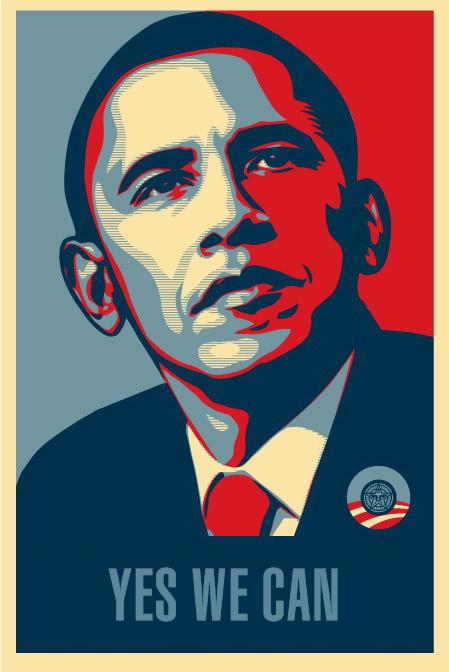
    I was widely vilified and ridiculed for my comments and denounced as hate filled and bigoted. It is interesting to compare what I said with the comments of Chai Feldblum, the Georgetown University law professor nominated by Obama to serve on the Equal Employment Opportunity Commission.

    Just as wYes we can!e do not tolerate private racial beliefs that adversely affect African-Americans in the commercial arena, even if such beliefs are based on religious views, we should similarly not tolerate private beliefs about sexual orientation and gender identity that adversely affect LGBT [lesbian, gay, bisexual, and transgender] people,” the Georgetown law professor argued…

    For those who believe that a homosexual or bisexual orientation is not morally neutral, and that an individual who acts on his or her homosexual orientation is acting in a sinful or harmful manner (to himself or herself and to others), it is problematic when the government passes a law that gives such individuals equal access to all societal institutions.

    Of course those religions that believe homosexual conduct is sinful include Roman Catholicism, Eastern Orthodoxy, evangelical Protestantism, many neo-orthodox Protestants, Islam, Orthodox Jews, Mormons, Jehovah’s Witness’s, Seventh Day Adventists and so on. So presumably, if we are to take Feldblum at her word, none of these groups should be tolerated in Obama’s society and all should be denied equal access to societal institutions.

  • Can State Appropriation of Minerals in Privately Held Land be Justified? Resources Needed

    I am currently undertaking my second-to-last paper in pursuit of my Bachelor of Law (LLB).  Due to a complicated bunch of factors involving the potential staleness of my papers, if I do not apply to the New Zealand Council of Legal Education for a completion certificate with an LLB and a Professional Legal Studies certificate in hand prior to 31 Dec 2010, combined with limitations of my ability to do much more than one paper at the time due to my neck injury and chronic pain issues and due to the fact that with only two papers to go I need to submit three opinion papers (only one of which can be substituted with voluntary community legal service), I had little choice but to choose a summer school paper that had the option of an opinion credit. This set of circumstances has seen me engaged in the project for which I now hope some of our readers can help me with.

    My paper is Mining and Natural Resource Law (there is not much choice at Summer School). As an opinion topic we were allowed to take our budding legal specialty and apply it to any of the topics on the course outline. I like to take a philosophical rights and freedoms approach to most of what I research and write within the field of law so I have submitted and had approved a topic with a bit of a jurisprudential twist. I intend to analyse the justifications given for the state appropriation of minerals in the sub-soil of privately owned property.

    Most articles I have found on state appropriation so far seem to tacitly assume that if the state has legislated that it owns the minerals in the sub-soil of privately owned land then the state’s action is justified or the author simply does not question this, even if he or she acknowledges that a few private property owners had an issue with this at the time, which is not helpful as I intend to question the justification.

    New Zealand philosophical writings from the perspective of classical liberal/pro-property rights/limited state angles are fairly difficult to find. Further international writings on this subject are not commonly cited in New Zealand so they too are hard to find. If any of our readers can point me to any good sources that might help me in the project or even if you can just leave your thoughts in the comments section (if I use your ideas in the work I promise to attribute them back to you) that would be most helpful.

    The following is the gist of the direction I hope to take.

    Since at least the 16th century, the maxim cujus est solum, ejus est usque ad coelum et ad inferos (Latin for for whoever owns the soil, it is theirs up to heaven and down to hell) meant that at common law, minerals in the sub-soil of land belonged to land owner. Such minerals were assumed to be conveyed along with the land on its change of ownership unless wording in the conveyance instrument specified otherwise. Until fairly recently, the last century or so, the only minerals not subject to this rule were gold and silver. The Case of Mines found “that by the law all mines of gold and silver within the realm, whether they be in the lands of the Queen, or of subjects, belong to the Queen by prerogative”. According to Dr Robyn Anderson,[1]

    The Court of Exchequer found in Case of Mines, that base metals – tin, lead, iron, copper, and non-precious minerals – belonged to the owner of the soil, but that the right to gold, silver, and their ores and admixtures, lay with the Crown. That right was not an incident of ownership of the soil, but rather, an attribute of the monarchy. The Elizabethan assertion of the prerogative reflected the pragmatic needs of the developing English state to control the coinage, and finance an army … [1]

    The argument that back in the 16th century the Monarch needed to be able to protect the realm by using coinage to raise an army (there was no standing army) and weapons to arm it, seems, prima facie, a reasonable justification for the state appropriation of gold and silver. However, in the last century or so many of the base metals and minerals deemed non-precious in the Case of Mines are now included in statutory reservations to the crown. This has reached the point in 2010 where, with few exceptions, the state currently owns almost all minerals in territorial New Zealand and has exclusive right to alienate (or grant a licence to alienate) most of those minerals from even those lands held in private ownership. Further, in many circumstances, land owners cannot even refuse consent for prospective, exploration and mining to occur on their land.

    The New Zealand government owns all naturally occurring petroleum (including both oil and gas), radioactive minerals, and gold and silver in New Zealand. Any individual or company wanting to prospect, explore or mine these substances must obtain a permit under the Crown Minerals Act 1991 and pay the specified fees and royalties [to the state]. The same rules apply to coal and all other metallic and non-metallic minerals and aggregates on Crown-owned land.

    Mining of minerals and aggregates other than petroleum, radioactive minerals and gold and silver on privately owned land requires the consent of the landowner together with resource consents from local authorities granted under provisions of the Resource Management Act. [Emphasis added] [2]

    The current state of mineral rights in New Zealand seems to me, prima facie, to be a violation of ad coelum et ad inferos (the right of land ownership “down to hell” or in sub-soil), so the question I want to ask in my opinion is: what is the basis for the state’s appropriation of sub-soil minerals from the lands of private property owners and is it justified? The New Zealand army is not armed with gold and silver these days, further,  I cannot see any legitimate argument for why the state needs to own petroleum and “Nuclear Free New Zealand” does not have a nuclear weapons program (and are,  just a guess here,  highly unlikely to in the future) so what is with the state ownership of radioactive resources?

    Obviously 3,000 words will not give me a lot of space to develop this topic so I will try to keep the topic to more of a general overview but I need resources and fast both directly on this topic and on property rights generally so if you have any thoughts…


    [1] Robyn Anderson Goldmining: Policy, Legislation, and Administration (Rangahaua Whanui Report, Waitangi Tribunal, Dec 1996) RANGAHAUA Whanui NATIONAL Theme N: GOLDMINING: Policy, Legislation, and Administration (Robyn Anderson ed., 1996) 1.
    [2] Simon Nathan “Mining and underground resources – Mining regulation and education” Te Ara – the Encyclopedia of New Zealand, updated 2-Mar-09.

  • The “Three Strikes Bill” Moves Forward

    I am cautiously optimistic at today’s announcement that the Sentencing and Parole Reform Bill a.k.a. the “Three Strikes Bill” will be moving forward as part of the government’s legislative program. In my post Three Strikes: Proportion and Protection, which was published in the New Zealand Law Students Association publication LEX, I argued that the “apparent inconsistency” identified by the Attorney General, per his statutory obligation under section 7 of the New Zealand Bill of Rights Act on the basis that the Bill affronts the proportionality doctrine, was able to be argued around on the basis that criticisms of the Bill along these lines confuse appropriate force for punishment with defensive force.

    Given this, provided the select committee does a good job on assessing submission and making recommendations and parliament carefully considers these we have the potential to finally have much tougher sentences on recidivist offenders of heinous and violent crimes. Regular readers will remember that, as documented in The Deal is Signed: New Zealand Has a New Government, part of the confidence and supply agreement that the National Party made with the ACT Party back in November 08 following New Zealand’s last general election was that National agree to introduce ACT’s “Three Strikes Bill” and support it to Select Committee, so this news was fairly inevitable.

    RELATED POSTS:
    Three Strikes: Proportion and Protection
    Published – Three Strikes: Proportion and Protection
    The Deal is Signed: New Zealand Has a New Government

  • Methodology behind the Real Climate Change Science Hockey Stick Graph

    You’ll recall the groundbreaking announcement we made in our post Another Climate Change Science Hockey Stick Graph where we revealed the alarming hockey-stick shaped incline in the number of climate change scientists practising in the world today. In that post we suggested that if the trends continued the numbers were unsustainable.

    Yesterday we intercepted, stole, had leaked to us, received the following from a climate change expert specialising in the effects of global warming on the passage and speed of projectiles fired from devices styled in the medieval warming period. Speaking to deniers like Jonny King, Murray Hill writes:

    As the author of the graph I can assure all that the methodology was rigorous and pew reviewed by another employee whose job depended on giving the right answer. The so-called “Medieval Learning” was accounted for; however we were able to “adjust” for this by offsetting the aberrant data because of the Medieval “bloody stupid’ period as exemplified by the excommunication of Galileo and the burning of housewives for the excessive use of condiments on the pretext of witchcraft.

    In this manner were able to hide the incline of total climatologist numbers.

    The learning is settled and 99% of graph makers in the direct employ of the Society for Making Graphs That Show What We Want Them To are in agreement that this graph is accurate. The other 1% is on academic probation for independent thought and may need psychiatric evaluation.