Category: Social Commentary

  • Hadouken Punch

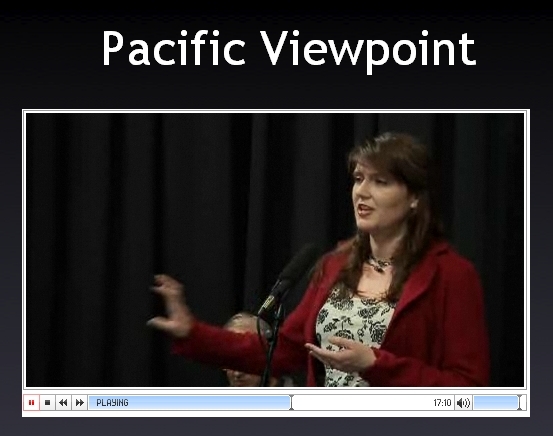
    Online Sid had some fun with my Pacific Viewpoint TV screen-shot. Apparently my question to MP Paul Hutchison on Pacific Viewpoint was so powerful you could see the hadouken punch I hurled at him (or chi blast as my kids tell me the correct term is) when you freeze-framed the video.

    Classic!

    Hat Tip: Online Sid

  • View Pacific Viewpoint TV Panel on Abortion & Parental Consent Here (Feat. Madeleine)

    Episode one of the television panel discussion Madeleine participated in on parental consent/notification for abortion is now available for viewing online here at Pacific Viewpoint TV.

    The show runs for 30 minutes; in this episode Madeleine features as an audience member  (panelists are Bev Adair, Paul Hutchison, Reverend Tavale Matai’a) and she goes a round with the Member of Parliament for Hunua, Dr Paul Hutchison. (Originally she went two rounds with him but her second spiel, where she dealt to his inadequate response to her question, only got as far as the editing room.)

    Madeleine on Pacific Viewpoint

    In the next episode, Madeleine actually is a panel member and she gets a lot more speaking time. The second episode will air Tuesday 15 December at 7:30pm on Triangle TV also on Stratos (Freeview 21 & Sky Digital 89) on Wednesday 16 December at 8pm or you can catch it here next Wednesday.

    Anyway, enjoy and feel free to make use of the button that permits you to make a comment to the show.

  • Madeleine on Pacific Viewpoint TV on Abortion & Parental Consent

    Part one of the panel discussion I participated in on parental consent/notification for abortion airs on Pacific Viewpoint tonight (Tuesday 8 December) on Triangle TV at 7:30pm. Part two will air Tuesday 15 December at 7:30pm.

    The episodes will also be aired on Stratos (Freeview 21 & Sky Digital 89) tomorrow (Wednesday 9 December) at 8pm and the following Wednesday at the same time.

    The panel features Dr Paul Hutchison, MP for Hunua and former member of the Abortion Supervisory Committee; Bev Adair, spokesperson for Family First, Reverend Tavale Matai’a, a couple of other women and me! In tonight’s episode I feature as an audience member and go a round with Dr Hutchison. Next week, I am a panel member.

    I have no idea how it will run. Panel discussions are frustrating because you cannot hit everything and you have to manage to get everything you want to say out cohesively in the little snippets of time you do get but nevertheless is was fun filming it!

    Recommended Reading:
    During, Sherwin & Hutchison on Backstreet Abortion

  • Three Questions for NIWA

    Just in from the Auckland Public Meeting: Climategate, NIWA and the ETS.

    When it came to light last week that NIWA‘s official temperature graph and the data on their website were at odds, the former returning an increasing temperature graph the latter a flat graph, three questions were asked of NIWA by the Climate Conversation Group that they are yet to answer.

    1. Why, of all the temperature stations in New Zealand, were the 7 stated sites chosen to be deemed indicative of New Zealand’s temperatures?
    2. What precise adjustments were made to the temperatures?
    3. What was the methodology of 1 and 2?

    NIWA have talked about how they adjusted temperatures recorded in Wellington. But this does not answer these questions.

    NIWA have had Jim Salinger cite 11 sites that, without adjustment, showed some warming but again this does not answer the questions above and some warming is not the same thing as anthropogenic warming.

    As long as NIWA keep answering questions they were not asked and fail to answer the ones they have been asked, as long as anthropogenic climate change apologists like (more…)

  • Auckland Public Meeting: Climategate, NIWA and the ETS

    In the wake of climategate, the NIWA contraversy and public concern over the effect of the Emissions Trading Scheme (ETS) legislation a public meeting will be held in Auckland on Monday featuring Richard Treadgold, convenor of the Climate Conversation Group, who collated the paper Are we Feeling Warmer Yet? that Matt drew from in NIWA, Climategate and Evasive Fallacious Answers. This data originated from a combined research project undertaken by members of the Climate Conversation Group and the New Zealand Climate Science Coalition.

    Richard will present the findings of the research project and explain why, since New Zealand’s warming comes entirely from the adjustments, they are concerned that the figures have been published without mentioning the adjustments and that they have been used repeatedly to influence national policy, the ETS being case in point. He will also reveal their latest discovery of a contradiction between this official NIWA graph of the past and official predictions for the future.

    The event is free to the public and will also feature member of parliament John Boscawen, ACT Party spokesperson on Climate Change who will speak on the ETS and what he thinks its effects might be on the cost of living for everyday New Zealanders.

    Where: Royal Akarana Yacht Club, 10 Tamaki Drive, Okahu Bay, Auckland
    When: Monday 7 December, 7.30 pm

    For more information
    email karen.bridgman@parliament.govt.nz
    or call 09 531 5531

    Having attended these sorts of meetings organised by John Boscawen’s office previously, I am confident that the organisers would be more than willing to give floor space to a scientist who wishes to speak in defence of NIWA’s graphs, the greater climategate controversy and the theories in support of anthropogenic climate change. I for one would be most interested to hear all sides and as such I will attend the meeting and take this opportunity to encourage any such scientist to contact Karen Bridgman as above.

  • Religious Restraint and Public Policy: Part VI

    In my last posts, beginning Religious Restraint and Public Policy: Part I,  I set out the doctrine of religious restraint and critiqued some of the key arguments in support of it. I looked at the objection that the argument from respect is too thin, that applied consistently it excludes too much and Audi’s response to this. I examined and critiqued Gerald Gaus’ attempt to salvage the argument from epistemic inaccessibility and his idea of open justification. In this post I will look at the dangers of religion as a justification for its asymmetrical treatment within the DRR and conclude the series.

    B          The Dangers of Religion

    One explanation as to why this asymmetry is applied to religious reasons is offered by Quinn; “Some people fear that religious argument is apt to be dangerously divisive.”[82] Audi concurs, “[religious reasons] are special in relation to liberal democracy even by contrast with [secular reasons] … that are not accessible to any normal adult.” [83] He gives five “salient points” to support his case, all based on the idea that religious reasons are dangerous to society. [84]

    First Audi claims that religious reasons are often “directly or indirectly taken to represent an infallible authority”.[85] The second point is that religious people often “believe that anyone who does not identify with [the ultimate divine source] is forsaken, damned, or in some other way fundamentally deficient.”[86] Third, “religious reasons often dictate practices that are distinctively religious in content (such as prayer) or intent (such as preserving the fetus on the ground that it is a gift from God)”.[87] Fourth, with many religious leaders, especially leaders of cults, there is a risk that they are “cloaking their prejudices with absolute authority.”[88] Finally, Audi contends that religious people tend to be “highly and stubbornly passionate about the importance of everyone’s acting in accordance with religious reasons”.[89]

    Again these features are not unique to religion. As McGrew argues, all these features can be equally present in secular people and movements;[90]

    It is sadly amusing to read this list and to consider how well its negative aspects apply to secular people and movements. Communism, for example, is as fanatical as any conventional religion and demands group-think on an unrivaled scale. Contemporary feminism aspires to control worldview, language, and behavior. The New Atheists are exceedingly passionate about making people behave in accordance with their own beliefs (making sure children are taught Darwinism as unquestioned fact, for example), and Richard Dawkins and P.Z. Myers have an inflated sense of self-importance that would make many a Christian megachurch pastor look modest by comparison. Dawkins is infamous for having repeatedly and insistently called a religious upbringing “child abuse,” and while Dawkins has shied away from the obvious legal implications of this accusation, not everyone who thinks as he does is so cautious. Other secularists, self-styled “comprehensive liberals,” have expressly advocated the use of the power of the state to monitor and limit parents’ ability to transmit their religion to their children (see Hitchcock, 2004). As for the vicious condemnation of children who do not fully conform to their parents’ secular ideology, a good example of this phenomenon is the strange story of Rebecca Walker, daughter of feminist icon Alice Walker. And, on the other hand, there are plenty of religious people who do not display such negative characteristics. It simply does not appear to be true that we reduce fanaticism, self-important leadership, attempts at thought control, and the like in society by reducing the role of religion in public life.

    McGrew suggests there are secular analogues of even Audi’s third reason, that religious reasons often dictate practices that are distinctively religious in content or intent;[91]

    It would certainly be undesirable if people were being coerced to pray to any God, even the true God. But then, secular ideology can and sometimes does demand that we do homage to itself—in the form of changing our language to make it politically correct, for example, or treating two men or two women as “married” in all of our business activities. The problem with forcing people to pray to the true God is that the true God is not truly worshiped in that fashion. The problem with forcing people to pray to false gods and to pledge allegiance to false ideologies is that they are false. You will not avoid the problem of the coercion of conscience by limiting the role of religion in public life. You will only shift that problem so that the unreasonable coercion comes from some quarters rather than others.

    Audi’s first point invites a parallel rejoinder. He defines infallible propositions as those that are “impossible that they be both endorsed or accepted by God and false”.[92] On this definition of infallibility every proposition is infallible. God, as Audi understands him, is omniscient. God only believes true propositions. It follows then that any proposition God accepts cannot be false; this is true whether it is a religious proposition or a secular one.

    Audi’s main concern is that a person who believes an action is commanded by God believes that an omniscient, infallible being has endorsed that action. Appeals to purported divine commands are therefore problematic. However, some secular ethical theories face precisely the same problem.  One of the most influential secular theories, endorsed by ethicists as diverse as David Hume, Adam Smith, Henry Sidgwick, Richard Hare, Roderick Firth, John Stuart Mill, Tom Regan, Richard Brandt, Immanuel Kant and others, is the ideal observer theory. On this theory an action is wrong, if and only if, it would be proscribed by an ideal observer, by a person who is perfectly impartial and perfectly informed on all the relevant facts. A hypothetical ideal observer is no less infallible than religious believers take God to be. It is hard to see how invoking religious reasons is not acceptable but invoking the secular reasons is.[93]

    C         Argument from Religious Wars
    A more forcible danger of religion argument invokes the spectre of religious wars. Audi states “if religious considerations are not appropriately balanced with secular ones in matters of coercion, there is a special problem: a clash of Gods vying for social control. Such uncompromising absolutes easily lead to destruction and death”[94] Wolterstorff articulates the concern;[95]

    One reason which liberals have offered ever since the emergence of liberalism in the seventeenth century is that it’s just too dangerous to let religious people debate political issues outside of their own confessional circles, and to act politically, on the basis of their religious views. The only way to forestall religious wars is to get people to stop invoking God and to stop invoking canonical scriptures when arguing and determining politics.

    The adequacy of this argument can be contested on several grounds. First, Quinn, Greenwald and Wolterstorff note that while it was true of 17th century England, “social peace did depend on getting citizens to stop invoking God, canonical scriptures, and religious authorities when discussing politics in public”,[96] it is not plausible that such a danger exists in 21st century Western countries like New Zealand, Australia and the United States. Quinn notes, “current political debate in the United States exhibits failure to comply with Audi’s principles on a massive scale and yet shows no tendency to reignite the Wars of Religion of the early modern era.”[97]

    Wolterstorff makes two other related points. He notes that “the slaughter, torture, and generalised brutality of our century has mainly been conducted in the name of one or another secular cause–nationalism of many sorts, communism, fascism, patriotisms of various kinds, economic hegemony.”[98] Second, he notes that “many of the social movements in the modern world that have moved societies in the direction of liberal democracy have been deeply and explicitly religious in their orientation”[99] He cites the abolitionist movement, the civil rights movement and movements resisting communism, facism and apartheid as examples. The invocation of religious reasons risks war and civil strife when certain types of religious reasons are invoked in particular socio-political contexts. This is equally true of secular reasons; certain types of secular reasons can be dangerously incendiary in particular socio-political contexts. There seems no basis for an asymmetry between secular and religious reasons on these grounds.

    Eberle and Cuneo add that 17th century “confessional conflict … [was] typically rooted in egregious violations of the right to religious freedom, when, for example, people are jailed, tortured, or otherwise abused because of their religious commitments.”[100] Given that few, if any, who appeal to religious reasons advocate such violations or could plausibly bring them about, such appeals are unlikely to have tumultuous effects.

    In terms of protecting freedom of religion from these kinds of abuses it is not obvious that secular reasons fare any better, “secularists have a long history of hostility to the right to religious freedom and, presumably, that hostility isn’t at all grounded in religious considerations”.[101] Moreover when[102]

    religious believers have employed coercive power to violate the right to religious freedom, they themselves rarely have done so in a way that violates the DRR … when such rights have been violated, the justifications offered, even by religious believers, appeal to alleged requirements for social order, such as the need for uniformity of belief on basic normative issues. One theological apologist for religious repression, for example, writes this: ‘The king punishes heretics as enemies, as extremely wicked rebels, who endanger the peace of the kingdom, which cannot be maintained without the unity of the faith. That is why they are burnt in Spain’.

    Similarly, Aquinas, in a Rawlsian vein, famously justified the suppression of heretics by appealing to the accepted political culture of his day which required that counterfeiters be executed.

    Consequently, the religious wars of the 17th century were caused, not by the appeal to religious reasons per se but rather by the violation of religious freedom; this violation has often been defended on secular grounds. It is unlikely that the DRR provides a bulwark against such abuses.

    III        Conclusion

    On examining the DRR it appears that there is no good reason for singling out religious reasons for a particular restraint and limiting discourse to secular reasons. The grounds offered for doing so, the golden rule, the epistemic accessibility of religious premises, the dangers of religion and the potential for religious wars all apply with equal force to secular beliefs. Hence, the restriction appears arbitrary. Moreover, as applied, the DRR is often incoherent and if applied consistently would render most substantive coercive laws unjustified. The current practice of equating secularism with neutrality is flawed.

    As Carter eloquently puts it,[103]

    What is needed is not a requirement that the religiously devout choose a form of dialogue that liberalism accepts, but that liberalism develop a politics that accepts whatever form of dialogue a member of the public offers. Epistemic diversity, like diversity of other kinds, should be cherished, not ignored, and certainly not abolished. What is needed, then, is a willingness to listen, not because the speaker has the right voice but because the speaker has the right to speak. Moreover, the willingness to listen must hold out the possibility that the speaker is saying something worth listening to; to do less is to trivialize the forces that shape the moral convictions of tens of millions of Americans.

    This series was written as a supervised research paper in pursuit of my LLB.


    [82] Phillip Quinn “Political Liberalisms and Their Exclusions of the Religious” (1995) 69:2 Proceedings and Addresses of the American Philosophical Association 35, 143.
    [83]
    Robert Audi “Liberal Democracy and the Place of Religion in Politics” in Nicholas Wolterstorff & Robert Audi (eds) Religion in the Public Square: The Place of Religious Convictions in Political Debate (Rowman and Littlefield Publishers Inc, Lanham Md, 1997) 1-66, 31.
    [84]
    Ibid 31-32.
    [85]
    Ibid 31.
    [86]
    Ibid.
    [87] Ibid.
    [88]
    Ibid 31-32.
    [89]
    Ibid 32.
    [90]
    Lydia McGrew “The Irrational Faith of the Naked Public Square” (2008) 1 The Christendom Review (at 2 October 2009).
    [91]
    Ibid.
    [92]
    Audi, above n83, 63.
    [93]
    I am grateful to Matthew Flannagan for the development of this point.
    [94]
    Robert Audi Religious Commitment and Secular Reason (Cambridge University Press, New York, 2000) 103.
    [95]
    Nicholas Wolterstorff “Why we should Reject what Liberalism tells us About Speaking and Acting in Public for Religious Reasons” in Paul Weithman (ed) Religion and Contemporary Liberalism (University of Notre Dame Press, Notre Dame IN, 1997) 167.
    [96]
    Nicholas Wolterstorff “The Role of Religion in Decision and Discussion of Political Issues” in Nicholas Wolterstorff & Robert Audi (eds) Religion in the Public Square: The Place of Religious Convictions in Political Debate (Rowman and Littlefield Publishers Inc, Lanham Md, 1997) 67-120, 79.
    [97]
    Quinn, above n82, 39.
    [98]
    Wolterstorff, above n96, 80.
    [99]
    Christopher J. Eberle and Terence Cuneo “Religion and Political Theory” (2008) Stanford Encyclopedia of Philosophy (at 9 August 2009).
    [100]
    Ibid.
    [101]
    Ibid.
    [102]
    Ibid.
    [103]
    Stephen Carter The Culture of Disbelief: How American Law and Politics Trivialise Religious Devotion (Basic Books, New York, 1993) 230.

    RELATED POSTS:
    Religious Restraint and Public Policy: Part I

    Religious Restraint and Public Policy: Part II

    Religious Restraint and Public Policy: Part III

    Religious Restraint and Public Policy: Part IV

    Religious Restraint and Public Policy: Part V

  • NIWA, Climategate and Evasive Fallacious Answers

    Climategate has been all the rage on the blogosphere of late and judging by the emails we’ve received in the past few days from our international readers, New Zealand’s own climategate has gone global. The fuel providing the heat is a recent criticism of New Zealand’s National Institute of Water and Atmospheric Research (NIWA) by the New Zealand Climate Science Coalition (NZCSC).

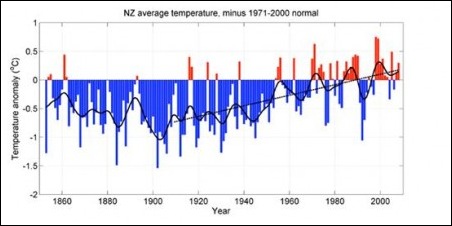
    The coalition released an 8-page report that compares the figures on NIWA’s website with the official graph NIWA has constructed that purports to show that New Zealand’s temperatures have steadily risen since 1909.

    Official New Zealand Average Temperature According to NIWA

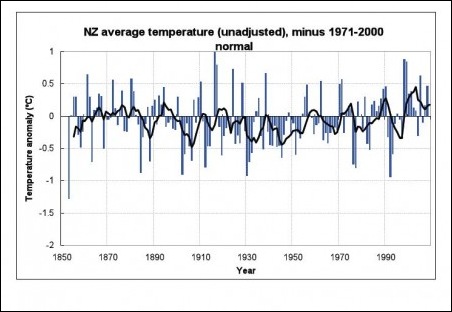
    The problem is that the two sets of figures do not match. When one graphs NIWA’s own websites figures the graph shows a constant steady rate of temperature.

    Unadjusted New Zealand Average Temperature According to NIWA

    The climb in temperature in the official graph is due to the fact that NIWA adjusted the raw data, in almost all cases, upwards. It is these adjustments, and not the raw data itself, which leads to the incline on the official graph. NZCSC have cried foul, Ian Wishart, author of best seller Air Con: The Seriously Inconvenient Truth About Global Warming, got hold of it, the blogosphere followed suit.

    In response NIWA have argued that they had good reasons for adjusting the raw data in this fashion. They maintain that over a hundred years the sites where measurements have been taken have changed and so they have needed to adjust their figures upwards to correct for the distortions these changes would have made.

    I am aware that not being a climatologist or someone that familiar with the relevant data to any great extent makes it difficult to arrive at an informed position in this debate. However, it seems to this lay person that two things are evident.

    From what I have seen from NIWA’s response, the raw data does not support their conclusions and the method of collecting the raw data was flawed and inaccurate to begin with.

    The issue then is whether one is justified in adjusting the data to fit what one thinks it would have been if these inaccuracies did not exist, and, if we are, how confident we can be of the results based on counter-factual speculations of this sort. I myself have no idea of the answer but certainly I think that it is fair for people to ask questions of this sort. Especially with the backdrop of the international climategate emails and memos and when serious political policies such as the Emissions Trading Scheme (ETS), which restricts people’s life, liberty and property, are being passed on the basis of the legitimacy of climate change science.

    Scientific debates aside, it seems that as a point of justice the burden of proof must fall on those who wish to impose severe restrictions on other people’s lives, liberty and property; those advocating restrictive policies, like the ETS and those under discussion at Copenhagen, must be able to show that their polices are defensible. This is simply an implication of the idea that people have a prima facie right to liberty and property. A prima facie right is one that holds as a default position in the absence of sufficient reason to the contrary. It seems to me fairly self-evident that if one is going to restrict people’s freedom or property one needs good reasons for doing so. A principle that suggests we could enslave, coerce and confiscate people’s property for no reason, trivial reasons or simply when we unsure there were any reasons would clearly be wrong – much more so when the question hangs over the reason as to whether or not the justification has been faked.

    One thing that did interest me in this whole debate, however, is how some scientists have defended NIWA against its critics. What I have observed does not inspire confidence.  A good example occurs over at MacDoctor. MacDoctor had raised questions about NIWA’s data, the response from Gareth Renowden, author of Hot Topic.

    I think you are giving far too much weight to the CRU email hack. Here’s a few reasons why:

    1: The emails were stolen. Those released amount to under 2% (pers comm) of the total stolen, and have clearly been selected to support the storylines being run by the “right wing blogs” you mention. The editorial selection has been made by a bunch of crooks.

    2: Many of the mails being talked about have perfectly innocent explanations (see RealClimate). They are the private conversations of a bunch of working scientists, not the science itself. We see that they can be rude about each other and their rivals — that only proves that scientists are human. However, the climate sceptic network is making all sorts of outrageous claims about what they say. Sadly you seem to have bought those interpretations, rather than the somewhat more mundane truth.

    3: Our body of scientific knowledge is found in the peer-reviewed literature, not in a careful selection of emails. Not one peer-reviewed paper is called into question by these emails.

    4: Timing is everything. These emails were “released” a couple of weeks before the Copenhagen conference, and while a major emissions reduction bill is before the US legislature. They were immediately trumpeted from the rooftops by the usual suspects – those campaigning against action on climate change. Coincidence, or part of a campaign?

    If I was a climatologist, I would be very angry at this point, not because I have to go back and redo any work, but because those seeking to delay or prevent action on climate change are resorting to vicious personal attacks against my colleagues. After all, if you can only make a case by stealing and lying, what sort of case have you got?

    There are some things about this response that deserve comment. Consider the points raised in 1: here Gareth’s response is to attack the character of those who took the emails. He notes that they are crooks, that the data has been used to support a particular line of interpretation put forward by “right wing blogs.” Similarly, in 4: he suggests that the timing of the information was politically motivated.

    These arguments commit the ad hominem fallacy; whether or not the material put forward by climate change sceptics is true or false depends on the empirical evidence for it and not on the motives of those who put it forward. One can see the point better by simply reversing it, suppose a body of scientific data is appropriated by left-wing bloggers and is released just before an important political meeting. Does it follow that the studies themselves are worthless? Gareth seems to be suggesting that because the people had particular political leanings or particular political motivations that one should reject their research without actually examining the evidence. Far from showing that the sceptics claims are unfounded, this very line of argument suggests that the scientists are letting political commitments dictate the lines of inquiry they will consider from the outset.

    Gareth’s points 2: and 3: have more merit. He suggests correctly that the nasty rude character of individual scientists does not mean their research is flawed. This is correct; it makes the valid point that whether an individual scientist has a good character is in fact a different question as to whether his arguments are sound. Of course this observation actually rebuts most of what he has said in 1: and 4:.

    Moreover, Gareth suggests that what matters is what the peer reviewed studies show and these are not called into question by anything in the leaked (stolen) emails and memos at the centre of climategate and goes on to suggest that there are innocent explanations of the conversations in question. These latter claims, if correct, do provide a valid response to the questions people raised.

    MacDoctor responds to this as follows:

    Those released amount to under 2% (pers comm) of the total stolen

    No. You can access all the emails. The ones being discussed in blogs and the media amount to about 2%.

    Many of the mails being talked about have perfectly innocent explanations

    I’m sure you are right. However, many of the e-mails have meanings that cannot be interpreted in any way except that they reveal severe selection bias. Even Monbiot thinks that they show more politics than science.

    Our body of scientific knowledge is found in the peer-reviewed literature

    Apparently not, according to the emails. There appears to have been a concerted effort made to keep certain articles out of the peer reviewed literature. The smothering of dissenting views makes for a flawed, truncated science that is all but worthless.

    Timing is everything

    Indeed. CRU timed plenty of scary statistics to be brought forth just before the Copenhagen conference – now all suspect. The timing works both ways.

    Here MacDoctor addresses both the valid and invalid arguments. In response to the issue of peer review, MacDoctor notes that the climategate emails and memos provide evidence that the process of peer review has been corrupted. He also notes that not all of the emails and memos can be plausibly explained away in the fashion Gareth suggests.

    At this point I was interested in seeing if Gareth had an adequate response to these points. I was disappointed. Gareth’s response is as follows,

    Selection bias! In the cherry-picking of stuff to feed into right wing attack lines, yes.

    The “concerted effort” was to deal with crap – papers that should never have got through peer review. Note that the perversion of peer review was actually being conducted by sceptics – notably Chris de Freitas, who as an editor at Climate Research was responsible for passing several papers from his sceptic mates for publication without proper peer review. Six editors resigned in protest. Full story here from one of the editors who resigned.

    CRU “timed” no scary statistics for release, and none of their normal products are now suspect.

    I must say I’m astonished that someone who (presumably) relies on evidence-based should be so partial when it comes to work in another field. Your choice. Your loss.

    What we see here is not a valid response to MacDoctor’s concerns but rather a series of tu quoques. He responds by noting that right wingers have selection bias. That may or may not be true but that was not the question. The question was whether the scientists at the heart of climategate had selection bias. You do not show that one person is not biased by pointing out that someone else is or might be. In the same way, pointing out, as Gareth does, that some sceptics of anthropogenic global warming (AGW) have tried to manipulate peer review does not actually tell us anything about whether defenders of AGW have also manipulated peer review.

    If anything, Gareth’s remaining comments tend to suggest that they did try to do this but were justified because the work of sceptics is “crap.” This shows us that, at the crucial point, his defence degenerates to denigration and name-calling. The rest of the response is to insinuate that those who do not disagree with these obviously fallacious arguments do not follow “evidence based research.” Strange, I though evidence based research involves actually providing evidence for your claims, not raising red herrings and making evasions.

    After reading the exchange I am left wondering; here scientists are defending their position by using clear-cut obvious examples of fallacious reasoning but surely scientists of all people know not to do this don’t they?

    For those like myself who are lay people the questions remain. Governments advocate using the force of law, with policies such as the ETS, to restrict peoples freedom, confiscate their property and raise the price of food, petrol and power. We are told this is because a “consensus” of scientists thinks certain facts about climate change and AGW are the case and that these facts justify certain action. Apart from the obvious is ought fallacy employed in such reasoning (empirical research by itself cannot answer moral questions about what we ought to do) and putting aside the question of whether scientific consensus are always reliable guides to truth, it is disconcerting, in such a politically charged context as we find ourselves in amidst climategate, that when people discover that data has been adjusted on the basis not of what it actually showed but what they think it should have shown under non-existent ideal conditions and they ask questions about this that at least some defenders of science respond with evasions. People who are trained in scientific thinking must know that such responses are fallacious and inadequate. When  I witness this, especially when some of it seems premised on the idea that views can be dismissed out of hand if the conclusions are “right wing,” it makes one, at the very least, a bit suspicious that we are dealing with politics and agendas as much as science.