*** Walter Sinnott-Armstrong discusses the following objection: “Harming others is sometimes in some people’s best interest, even considering probable costs. In those cases, some theists say that only a divine threat of Hell provides a reason to be moral. Since atheists and agnostics do not believe in God, they do not believe in divine retribution […]
Entries Tagged as 'Theology'
Sinnott-Armstrong on God, Secularism and “reasons” to be moral. Part two: Do unselfish reasons answer the question, “Why be moral?”
September 8th, 2025 Comments Off on Sinnott-Armstrong on God, Secularism and “reasons” to be moral. Part two: Do unselfish reasons answer the question, “Why be moral?”
Tags: Dualism of Practical Reason · Hell · Mark Murphy · Walter Sinnott-Armstrong · Why be Moral?
Sinnott-Armstrong on God, Secularism and “reasons” to be moral. Part One:
September 3rd, 2025 Comments Off on Sinnott-Armstrong on God, Secularism and “reasons” to be moral. Part One:
In his book Morality Without God, Walter Sinnott-Armstrong argues that a secular account of the nature of moral properties—namely, that wrongness is constituted by the property of harming others—is preferable to a theistic account, in which wrongness is identified with the property of being contrary to God’s commands Chapter 6 is entitled “Why be moral?” In […]
Tags: Dualism of Practical Reason · God and Morality · Walter Sinnott-Armstrong · Why be Moral?
To Judge or not to Judge: Part Two
August 27th, 2025 Comments Off on To Judge or not to Judge: Part Two
Below is the second part of a talk I delivered at Crossroads Presbyterian Church. 3. What Did Jesus Mean So if Jesus did not command us to refrain from judging others, what does he teach in this passage? I think Jesus is not, in this passage, telling us to “not judge.” He is instead telling […]
Tags: Judging · Sermon on the Mount · Sermons
To Judge or not to Judge?: Part One
August 25th, 2025 Comments Off on To Judge or not to Judge?: Part One
Below is part one of a sermon I presented at Crossroads Presbyterian Church in Pokeno. “Do not judge, or you too will be judged. 2 For in the same way you judge others, you will be judged, and with the measure you use, it will be measured to you. 3 “Why do you look at […]
Tags: Judging · Sermon on the Mount · Sermons
“Is Jesus the only Way?” talk at Newhope Community Church
November 8th, 2022 Comments Off on “Is Jesus the only Way?” talk at Newhope Community Church
www.youtube.com/watch?v=supnuxvRXZc
Recently, I gave a talk at New Hope Community Church in East Auckland. This talk was on the topic “Is Jesus the only way? I attach it here.
Tags: Exclusivism · Faith and Reason · Pluralism
Thinking Matters Talk: Does Morality Need God? Part Three:
September 8th, 2022 3 Comments
This year the New Zealand apologetics organization Thinking Matters ran a “Confident Christianity Conference” in Auckland. I was asked to speak at this conference on the topic. Does Morality Need God? Below is a slightly streamlined version of the talk I gave. This brings me to my second contention: If God exists, a divine command theory […]
Tags: Anything goes Objection · Arbitrariness Objection · Divine Command Theory · Euthyphro Dilemma · God and Morality · Graham Oppy · Nathan L King · Plato
Thinking Matters Talk: Does Morality Need God? Part One
August 24th, 2022 Comments Off on Thinking Matters Talk: Does Morality Need God? Part One
This year the New Zealand apologetics organization Thinking Matters, ran a “Confident Christianity Conference” in Auckland. I was asked to speak at this conference on the topic. Does Morality Need God? Below is a slightly streamlined version of the talk I gave. “If God does not exist, then everything is permissible.” These words from Ivan […]
Tags: Divine Command Theory · God and Morality · John Stuart Mill · Peter Singer · Robert Adams

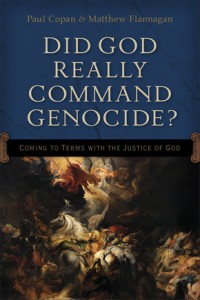 A common objection to belief in the God of the Bible is that a good, kind, and loving deity would never command the wholesale slaughter of nations. In the tradition of his popular Is God a Moral Monster?, Paul Copan teams up with Matthew Flannagan to tackle some of the most confusing and uncomfortable passages of Scripture. Together they help the Christian and nonbeliever alike understand the biblical, theological, philosophical, and ethical implications of Old Testament warfare passages.