Category: Uncategorized

  • Coming Events Reminder: JP Moreland on Faith and Reason

    I trust those of you who started back at Uni today survived the shock. Now that you have your thinking caps back on, make sure next week’s event is in your diary.

    Next Tuesday come to our Thinking Matters Auckland DVD screening:DVD Screening

    What: Dr JP Moreland on Faith and Reason
    When: Tuesday 28 April – 7:00pm
    Where: Lecture Room 2, Laidlaw College, 80 Central Park Drive, Henderson, West Auckland
    Format: DVD followed by discussion (Matt will be available to fire questions at)
    Cost: Free!

    Dr Moreland is distinguished professor of Philosophy at Talbot School of Theology in California. In this DVD, he will talk about the importance of truth in religion, the evidence for monotheism and his own personal experience in coming to the Christian faith. … more
  • Walter Sinnott-Armstrong, William Lane Craig and the Argument from Harm Part II

    In my last post, I discussed Walter Sinnott-Armstrong’s argument from harm. I concluded by suggesting that his conclusion missed the point and failed to address the conditional, defended by William Lane Craig that, if theism is true then there exists a sound foundation for moral duties. In this post I will argue that the same problem afflicts Armstrong’s two major arguments for his harm-based account of wrongness.

    Armstrong’s Arguments for the Superiority of the Harm-Account
    The same failure to actually address the contention at hand is evident in the two main arguments Armstrong musters in favour of the harm-based foundation. These arguments are

    (a) The harm account is more economical than a divine command theory;
    (b) The harm account makes moral obligations more objective than a divine command theory does.

    Economy and Simplicity
    Of his first argument, Armstrong writes,

    The secular view is also preferable on grounds of simplicity. Like the secular view, the divine command theory must recognise harm and its relevance to morality. Then the divine command view adds a new supernatural level to its theory of morality. That added complication brings no benefits for the objectivity of morality, as I have just argued. We should prefer simpler views when we have no reason to complicate matters. Hence, we should prefer the secular view.[1]

    Armstrong appeals to Ockham’s razor, multipicandum sunt praetor necessitatem, entities should not be multiplied beyond necessity. The idea is that if two theories can explain the phenomena equally well then the one that postulates the least entities is the preferred one.

    This principle is the basis of Armstrong’s critique. He notes that both his own secular view and the divine command theory both explain the objectivity of moral obligation equally well. The divine command theory, however, does so by adding “a new supernatural level [God]” and so the harm based account is preferable.

    “there are cases where rape is gravely wrong and yet no one is harmed or if they are, the harm is minimal and yet the action remains gravely and seriously wrong”In response to this argument I will make two points. First, even if the divine command theorist does add “a new supernatural level” his theory does not follow that Ockham’s razor automatically means it is a less preferable theory. Ockham’s razor tells us that if two theories can explain the phenomena equally well then the one that postulates the least entities is the preferred one. For Armstrong’s objection to be cogent, he needs to argue that his own harm based account explains the existence and nature of moral obligations better than a divine command theory. Armstrong does not do this; all he does s show that both theories explain the objectivity of moral properties equally well. However, objectivity is only one feature of moral obligations that a viable ontological foundation must explain. Showing your theory explains one feature as well as a rival theory does is a long way from showing it explains all features as well.

    This is important, because one of the arguments made by defenders of divine command theory, such as Robert Adams, is that it can explains all the features of moral obligation better than its rivals. Adams maintains divine commands “best fill the role assigned to wrongness by the concept”.[2] He notes that divine commands explain, not just the fact, that “wrongness is an objective property of actions,”[3] they also account “for the wrongness of a major portion of the types of action that we have believed to be wrong,”[4] and “play a causal role … in their coming to be regarded as wrong.”[5] In addition, Adams argues that they account for the intuition that our moral duties comprise, “a standard that has a sanctity greater than that of any merely human will or institution”.[6]

    In other articles Adams has noted that divine commands capture the intuition that moral properties such as rightness and wrongness are “non-natural in the sense that they cannot be stated entirely in the language of physics, chemistry, biology, and animal or human psychology,”[7] and also, the idea that “having an obligation to do something consists of being required (in a certain way, under certain circumstances), by another person or group of persons, to do it”.[8]

    Stephen Layman has argued that theism explains the overriding nature of moral obligations, that to have a duty to do something entails that one has decisive reasons for doing it; reasons that override any non-moral reasons to the contrary. Moreover, Layman argues that secular views do not explain this feature of moral obligation anywhere near as well as theism does.[9] Now these arguments may not be successful but given that theists have made them, Armstrong owes us an argument showing they are not; especially if he is going to conclude that his arguments call into question, not just Craig’s arguments, but the “arguments for a religious view of morality” of “other theists” and that these other theists cannot “avoid all the problems in Craig’s account without leaving traditional Christianity far behind.”

    There is a second, more important problem, with Armstrong’s appeal to Ockham’s razor. This is that when one takes into account the dialectical context of Armstrong’s argument it is not clear that the divine command theory does violate Ockham’s razor. Plantinga articulates this point in a recent paper he presented before the American Philosophical association; he argued

    Suppose we land on a planet we know is inhabited by intelligent creatures. We come across something that looks exactly like an arrow-head complete with grooves and indentations apparently caused by the process of shaping and sharpening it. Two possibilities suggest themselves, that it acquired these features by erosion or that it was intentionally fashioned by the inhabitants. Someone with a couple of courses in philosophy might suggest that the former hypothesis is to be preferred because it posits fewer entities than the latter. He’d be wrong of course, since we already know that the planet is inhabited by intelligent creatures, there is no additional Ockhamistic cost in assuming these structures were designed.[10]

    Plantinga’s insight is correct. He goes on to note that if we did not know the planet was inhabited by intelligent beings and the erosion hypothesis was not significantly less probable then an appeal to Ockham’s razor, in favour of the erosion hypothesis, would have “teeth”. However, if one already knows that the planet is inhabited by intelligent beings then we do not violate Ockham’s razor by appealing to the existence of these beings to explain the existence of grooves and indentations on what appears to be an arrow-head.

    Something analogous occurs here. Craig is arguing that if theism is true then there is a plausible ontological foundation for moral obligation in divine commands. He is not, then, proposing the theory in a context where people do not know whether God exists, nor is he proposing it in a context where people do not know that divine commands exist that are co-extensive with moral duties. Rather, he is proposing it in a context where one assumes, for the sake of argument, that theism is true and asks what theory best explains the nature of moral obligation given these assumptions.

    Once this is realised, however, it is far from clear that the theist is adding “a new supernatural level.” Rather, the existence of a supernatural element is already granted. The question, then, is how best to understand this element’s relationship to morality.

    Armstrong’s appeal to Ockham’s razor seems to presuppose a dialectical context whereby both theist and non-theist start from an agnostic perspective and try to work out the best foundation for the nature of moral obligation given the shared information available to both of them. The problem is that Craig was not arguing for his theory in that context. His argument is that if theism is true then a sound foundation exists. To rebut the contention that Craig actually defends, Armstrong needs to show that if God exists such a foundation does not exist. This, however, is precisely what he does not do.

    Objectivity
    The same problems afflict Armstrong’s appeal to objectivity. Armstrong states,

    This secular foundation makes morality objective. If what makes rape morally wrong is the harm to rape victims, then whether rape is wrong does not depend on whether I or rapists believe that rape is wrong. It also does not depend on whether any one wants to rape. Regardless of any-one’s desires and moral beliefs, rape causes harm to the victim, and that harm makes rape wrong. This secular foundation, thus, makes morality every bit as objective as the divine command theory.[11]

    Armstrong here shows that with regard to the objectivity of duties the harm-based account and the divine command theory are on par. However, he then argues that, in fact, the divine command theory fails to explain the objectivity of moral duties.

    If God did not think that rape was morally wrong, then God would not command us not to rape, and then rape would not be morally wrong, according to this theory. … In contrast, the secular harm-based view makes morality independent even of what God thinks. If God somehow thought that rape was not morally wrong, and if God forgot to command us not to rape, or even if God commanded us to rape, none of that would make any difference. Rape would still be morally wrong, because it would still harm rape victims.[12]

    I think Armstrong is mistaken here. Theism, as Craig defines it, includes the claim that God is omniscient; hence, even if rape is wrong in virtue of the harm it causes and not because of any divine commands, it still would be impossible for rape to be wrong independently of God thinking it is wrong. An omniscient being only believes true propositions and never believes false propositions; hence, it is impossible for rape to be wrong and God to not believe that it is wrong.

    Once this is realised, it is clear that Armstrong’s examples assume that theism is false. He puts forward situations where God forgets to issue commands or where God mistakenly believes rape is not wrong. This can only occur if God is not omniscient and, hence, theism is false. However, Craig is not arguing that a divine command theory is plausible if theism is false. His claim is that if God exists then there is a sound ontological basis for moral duties.

    Does Harm Explain the Wrongness of Rape?
    My final criticism directly challenge the harm account. Throughout his critique, Armstrong, contends that rape is wrong because of the extreme harm it causes rape victims. Despite its initial plausibility, I am inclined to think this account of the wrongness of rape fails. This is because there are cases where rape is gravely wrong and yet no one is harmed or if they are, the harm is minimal and yet the action remain gravely and seriously wrong.

    Take the following case, a doctor is performing surgery on a woman. He puts her under general anaesthetic and she falls unconscious. Then, prior to performing surgery, he has intercourse with her. He does so using a condom. He takes care to be gentle. The physical harm to his patient is minimal. The patient is unconscious; she is unlikely to ever be aware of what has occurred; the risk of psychological trauma is not present. Hence, it is implausible to suggest that the doctor has caused extreme harm to the patient, yet his actions are clearly rape and it is also clear that what he has done is gravely and seriously wrong. Hence, what makes the action wrong cannot be the extreme harm done to the rape victim.

    This example can be strengthened when we compare it to another proposed by Robert Adams.[13] Adams asks us to imagine the case of a person whose doctoral dissertation is destroyed by a computer hacker. We would consider the sabotage of the computer a reprehensible act but nowhere near as serious a crime as the rape committed by the doctor in the previous example. Despite this, it is not implausible to suggest that the person who has had their doctoral research destroyed suffers more “discernible harm” than the person who awakes from surgery never knowing she has been raped and continues on with life oblivious to it.

    What this shows is that the grave wrongness of rape does not depend on the extreme harm it causes, because even when there is no extreme harm present the act remains gravely wrong. Rape remains a very serious wrong, relative to other wrongs, even when the harms of these other wrongs outweigh it. For this reason, I am inclined to think that far from being “obviously correct” Armstrong’s harm-account of moral obligations is implausible.

    [1] Ibid, 107.
    [2] Robert Adams “Divine Command Meta-Ethics Modified Again” Journal of Religious Ethics 7:1(1979) 74.
    [3] Ibid, 74.
    [4] Ibid, 74.
    [5] Ibid, 75.
    [6] Ibid, 75.
    [7] Robert Adams “Moral Arguments for Theistic Belief” 117-18.
    [8] Robert Adams “Divine Commands and the Social Nature of Obligation” 262-63.
    [9] C. Stephen Layman “God and the Moral Order” Faith and Philosophy 19 (2002) 304-16; “God and the moral order: replies to objections” Faith and Philosophy 23 (2006) 209-12; “A Moral Argument for The Existence of God” Is Goodness without God Good Enough: A Debate on Faith, Secularism and Ethics eds Robert K Garcia and Nathan L King (Lanham: Rowman & Littlefield Publishers, 2008) 49-66.
    [10] I transcribed this from Plantinga’s paper to the American Philosophical Association, “Science and Religion: Where the Conflict Really Lies” http://www.mandm.org.nz/2009/04/alvin-plantinga-v-daniel-dennett.html.
    [11] Walter Sinnott-Armstrong “Why Traditional Theism Cannot Provide an Adequate Foundation for Morality” 106.
    [12] Ibid, 107.
    [13] Robert Adams Finite and Infinite Goods 107.

    RELATED POSTS:
    Walter Sinnott-Armstrong, William Lane Craig and the Argument from Harm Part I
    Tooley, The Euthyphro Objection and Divine Commands: Part I
    Tooley, The Euthyphro Objection and Divine Commands: Part II
    Maverick Philosopher on the Historical Atrocities Argument

  • Walter Sinnott-Armstrong, William Lane Craig and the Argument from Harm Part I

    This is the first of a two-part series where I examine a recent argument criticising religious ethics by Walter Sinnott-Armstrong.

    In many of his publications and debates William Lane Craig has defended the contention that if theism is true then there exists a sound foundation for moral duties. In a recent article, Walter Sinnott-Armstrong has criticised this contention. Armstrong has claimed that his criticisms do not just call into question Craig’s argument for a theistic based system of ethics, he contends that his arguments are conclusive against any theistic account of ethics which is compatible with Christianity. He states, “Other theists might try to give better arguments for a religious view of morality. I don’t see how they could avoid all the problems in Craig’s account without leaving traditional Christianity far behind.”[1]

    Before discussing Armstrong’s critique it is important to define a few key terms; this will become important later on. First, by theism, Craig means, belief in a necessarily existent, all powerful, all knowing, perfectly virtuous, immaterial person who created the universe. By foundation, he means, an ontological or meta-physical foundation. The ontological grounding he has in mind is that of “informative identification;”[2] an example of this is the way “we explain the nature of water by identifying it with H20 or explain the nature of heat by identifying it with molecular motion.”[3] Craig argues that if theism is true then one can informatively identify moral obligations with divine commands; hence, providing a plausible and defensible foundation for moral obligations.

    “his arguments display a conflation of epistemic and ontological questions”Armstrong’s critique begins by noting that Craig defends “traditional divine command theory.” Armstrong contends that such a position is “incredible”[4] and subject to a “cavalcade of devastating objections.”[5]

    Two initial points are worth making. First, the position Craig defends is not a “traditional divine command theory” but rather a version of the modified divine command theory defended by Robert Adams,[6] more recently by William Alston[7] and Stephen Evans[8], also I have defended it here.

    This theory affirms that the property of being wrong is identical with the property of being contrary to God’s commands in much the same way that water is identical with H20. Second, many of the “devastating objections” consist simply of a repetition of the tired old lines always used against divine command theories; most of these objections have been subjected to rigorous criticism in the literature on divine commands over the last 30 years by people such as Philip Quinn,[9] Edward Weirenga,[10] Robert Adams,[11] William Wrainwright[12] and again by me[13]. Armstrong does not address any of these criticisms; he merely repeats the standard arguments without even mentioning, much less, addressing the problems noted by these authors. In fact, in several places, his arguments display a conflation of epistemic and ontological questions which is a common error as I have argued here.

    Armstrong’s Argument from Harm
    Putting these niggles to one side, however, Armstrong’s main line of argument is fairly novel.[14] He states,

    There is a much more plausible foundation for morality. It seems obvious to me, and to everyone who does not start with peculiarly religious assumptions, that what makes rape morally wrong is the extreme harm that rape causes to rape victims.[15]

    Armstrong suggests that Craig’s conditional, if theism is true then there exists a sound foundation for moral duties, is mistaken because a more plausible foundation exists for our duties, one that is independent of God’s commands. The wrongness of actions can be founded in the harm caused by immoral actions such as rape. Armstrong provides two arguments as to why this harm-based or secular account of the nature of wrongness is superior to a divine command theory.

    (a) The harm account is more economical than a divine command theory;
    (b) The harm account makes moral obligations more objective than a divine command theory does.

    In my next post I will address arguments (a) and (b). I will leave you with the thought that it is worth noting that Armstrong’s conclusion misses the point. He contends that everyone who does not start with peculiarly religious assumptions will see that the harm-based foundation is more plausible than a divine command theory. Nothing in Craig’s contention contradicts this. Craig’s contention is that if God exists then there is a sound basis for moral obligations. The sound basis he identifies is divine commands. Craig, then, was not arguing that a divine command theory was the most plausible theory in the absence of religious assumptions, Craig argues that in the absence of religious assumptions it is Nihilism, not divine command theory, which is the most plausible account of moral obligation. Craig’s contention is that a divine command theory is plausible if one grants such assumptions. Armstrong’s conclusion actually has no bearing on the contention he is attempting to refute.

    [1] Walter Sinnott-Armstrong, “Why Traditional Theism Cannot Provide an Adequate Foundation for Morality” in Is Goodness without God Good Enough: A Debate on Faith, Secularism and Ethics, eds. Robert K Garcia and Nathan L King (Lanham: Rowman & Littlefield Publishers, 2008) 114.
    [2] Mark C Murphy “Theism, Atheism and the Explanation of Moral Value” in Is Goodness without God Good Enough: A Debate on Faith, Secularism and Ethics, eds. Robert K Garcia and Nathan L King (Lanham: Rowman & Littlefield Publishers, 2008) 127.
    [3] Ibid.
    [4] Walter Sinnott-Armstrong “Why Traditional Theism Cannot Provide an Adequate Foundation for Morality” 106.
    [5]Ibid, 108.
    [6] Robert Adams Finite and Infinite Goods (New York: Oxford University Press, 1999); “Divine Command Meta-Ethics Modified Again” Journal of Religious Ethics 7:1 (1979) 66-79; “Divine Commands and the Social Nature of Obligation” Faith and Philosophy 4 (1987) 262-275. [7] William Alston “Some Suggestions for Divine Command Theorists” in Christian Theism and the Problems of Philosophy ed. Michael Beaty ( Notre Dame, IN: University of Notre Dame Press, 1990) 303-26.
    [8] C. Stephen Evans Kierkegaard’s Ethic of Love: Divine Commands and Moral Obligations (Oxford: Oxford University Press, 2004).
    [9] Philip L Quinn Divine Commands and Moral Requirements (Oxford: Clarendon Press 1978); “Divine Command Theory” in The Blackwell Guide to Ethical Theory ed Hugh LaFollette (Malden MA: Blackwell Publishing Co, 1999) 53-73; “Theological Voluntarism” in The Oxford Handbook to Ethical Theory Ed David Copp (New York: Oxford University Press, 2006) 63-90.
    [10] Edward Weirenga, The Nature of God: An Inquiry into the Divine Attributes (Ithaca, NY: Cornell University Press, 1989) 215-27. See also, “Utilitarianism and the Divine Command Theory,” American Philosophical Quarterly 21 (1984) 311-318; and “A Defensible Divine Command Theory” Nous 17 (1983) 387-408.
    [11] Robert Adams “A Modified Divine Command Theory of Ethical Wrongness” in Divine Commands and Morality ed Paul Helm (New York: Oxford University Press, 1981) 83-108; “Divine Command Meta-Ethics Modified Again” Journal of Religious Ethics 7:1 (1979) 66-79; Moral Arguments for Theistic Belief” in Rationality and Religious Belief ed C F Delaney (Notre Dame, Indiana: University of Notre Dame Press, 1979) 116-140.
    [12] William Wrainwright Religion and Morality (Aldershot: Ashgate Publishing, Ltd, 2005).
    [13] Matthew Flannagan “The Premature Dismissal of Voluntarism” in Colloquium: The Australasian Theological Review (forthcoming).
    [14] I say “fairly novel” because a very similar objection was raised in Don Marquis’s seminal essay, “Why Abortion is Immoral” The Abortion Controversy: 25 Years after Roe v Wade, A Reader eds Louis Pojman and Francis Beckwith (Belmont, CA: Wadsworth Publishing Company, 1998) 345.
    [15] Walter Sinnott-Armstrong “Why Traditional Theism Cannot Provide an Adequate Foundation for Morality” 106.

    RELATED POSTS:
    Walter Sinnott-Armstrong, William Lane Craig and the Argument from Harm Part II
    Tooley, The Euthyphro Objection and Divine Commands: Part I
    Tooley, The Euthyphro Objection and Divine Commands: Part II
    Maverick Philosopher on the Historical Atrocities Argument

  • Guest Post: The Virtue of Christian Dogma

    The following is authored by Dominic Bnonn Tennant, of the blog Dominic Bnonn Tennant – Developing the Mind of Christ. Please support Bnonn by clicking through to his site. Bnonn writes:

    Damian over at ‘And Slaters Go Plop’ has recently written on Dogma, arguing against its intellectual legitimacy, and asking how we can avoid it. He says,

    By ‘dogmatic’ I am describing an absolutist kind of belief that, if I could summarise in my own words, boils down to the fact that you would really rather hold to what you believe than accept an alternative even if the alternative is true. Dogma is the belief you refuse to interrogate.

    Dogma in Christianity
    “I consider my dogmatism an intellectual virtue”I’d like to note, for the record, that this is not how dogmatism is typically perceived in Christianity. Dogma is a mainstay of biblical Christianity, and where it is rejected the religion crumbles. Dogma is there whenever a doctrine is taken as authoritative, or presupposed as true—such as when we treat the Bible as the word of God. So, for the sake of avoiding confusion, let it be noted that Christians do not define dogma in such a negative way. That is not the primary meaning of the word, as most dictionaries reflect. William Shedd’s Dogmatic Theology, for instance, is a seminal and highly positive dissertation on the theoretical truths of faith concerning God and his works.

    Why is dogmatism bad anyway?
    As regards this colloquial, negative view of dogmatism, however, some questions need to be asked. Damian seems to be taking absolutism in one’s beliefs as inherently undesirable, assuming we do want truth. But this doesn’t seem a very sustainable attitude if he wishes to be consistent and avoid special pleading.

    A dogma, he says, is the belief you refuse to interrogate. But what of beliefs which are not readily interrogatable? Presumably, for instance, we all believe that our sense perception correlates accurately to a real, external world. Is that belief undesirable or unlikely merely because it cannot be readily interrogated? In fact, since we resist attempts to interrogate that belief, and don’t take them seriously, are we acting in a poor or intellectually shoddy manner? It certainly doesn’t seem so. Thus, there look to be at least some beliefs we may hold quite rightly and properly as being basically unquestionable, without shirking our philosophical responsibilities. Why is it, then, that Christians should not take the divine inspiration of Scripture as such a belief? Damian needs to make a better case as regards the negative nature of dogmatism, spell out just when it does and does not apply, and why.

    “should he jump up in dismay and hire a private detective to find me and stake out my home to verify that, indeed, I am a real person who makes real blog posts?”Similarly, what of beliefs which are held on good grounds? Damian presumably thinks he has good grounds for believing that I am a real person and not, say, an advanced computer program writing posts in a convincingly human way. Should he be condemned for resisting the compulsion to interrogate his belief in my existence as a real person on every possible occasion? Were someone to say to him: Your belief in that chap Bnonn Tennant is dogmatic because you refuse to interrogate it! should he jump up in dismay and hire a private detective to find me and stake out my home to verify that, indeed, I am a real person who makes real blog posts? In fact, is he not being entirely rational to refuse to interrogate this belief, in the absence of any good evidence that it is false? If so, why should a Christian be criticized for refusing to interrogate his belief in God, when he has no good reasons to think that it’s false?

    Good reasons
    And what, indeed, would constitute a good reason for thinking that God doesn’t exist? No doubt Damian believes there are many. But on the other hand, a delusional out-patient from the halfway house down the road might think that there are good reasons for believing I don’t exist and am in fact a complicated artificial intelligence. He could probably find all sorts of evidences which, if looked at the right way and with the right mindset, seem quite compelling; and he might produce all sorts of arguments showing that Damian really has the burden of proof. Should Damian be persuaded—should he even look at these evidences or accept this burden of proof—if he already knows that the fellow is a schizophrenic who reverts to believing that Christian bloggers are really internet-capable AIs whenever he’s off his meds? If not, why should a Christian act differently when he knows from Scripture that atheists are self-deceiving fools who deny the existence of God because of their sin?

    The skeptic’s false humility
    The last point I’d like to make is as regards Damian’s assertion that if we refuse to honestly put our beliefs to the test then we ought to show a little more humility when telling others what we ‘know’ to be true. As I’ve already suggested above, this is a perfectly silly attitude to knowledge—its implication being that a belief which is not tested cannot constitute knowledge in any proper sense.

    Even ignoring his obvious imposition of a scientific method of knowledge-acquisition onto religious or philosophical matters, where it doesn’t belong, is this reasonable? Does Damian need to verify my existence, for example, before he can say that he knows I’m not an artificial intelligence? Is this the way he really operates in terms of making knowledge claims? Or take another example: say he sees an acquaintance, Roger, at the supermarket. He doesn’t speak to Roger for whatever reason, and no one else at the supermarket knows him, so Damian is the only one to recognize him. Say Roger is arrested the next day on some charge. Damian thinks Roger can’t be guilty, because he saw him at the supermarket at the time the crime was committed. Is Damian really going to say that he does not know Roger was there, since he did not (and no longer can) test that belief? Is it reasonable for me to get up before the jury when he is testifying in Roger’s defense, and say that he ought to show a little more humility when telling them that he ‘knows’ Roger is innocent? Or imagine the situation is reversed, and Damian ‘knows’ Roger is guilty on a similar basis. Is this sort of stringent view of things really sensible? How would it cash out in the real world?

    Maybe Damian means to confine this constraint on knowledge to religious claims. This seems arbitrary, but it doesn’t get him anything in any case, since Christian beliefs enjoy far better attestation than the trivial amount of support in the example above. In fact, Christians have excellent grounds for saying that they know certain things—so why should they shuffle and slink and pretend false humility, as if they really aren’t certain when they are? A Christian grounds his beliefs in God’s word—does he then need to interrogate these beliefs, or find ways to test them, in order for them to constitute knowledge? Of course not.

    The plain fact that they are God’s own testimony is all the justification required. Thus, rather than being commendable, this “humility” of which Damian speaks is despicable. Imagine a Christian who knows the gospel witnessing to someone as follows:

    I don’t presume to say I know this, but, well, I believe you’re under God’s wrath and liable to judgment if you don’t repent and trust in the work of Jesus. And…well, I don’t know that Jesus really existed…but I’m sure you should believe anyway!

    This is certainly an ignoble way of witnessing. If we, in fact, have good reasons for believing the gospel—if we indeed know the gospel to be true—and then do not urgently entreat others to heed it, attempting to persuade them of its truth as well, we aren’t being “humble”. We are being cads. It doesn’t matter if we have tested our knowledge, or if we can defend it against attack. Speaking for myself, I can—but some Christians can’t for whatever reason. That doesn’t invalidate what they know. Christians don’t accept Damian’s views on epistemology, and neither should they.

    So let’s not throw around the “dogmatism” charge too hastily. I am proud to be a dogmatic Christian, and I consider my dogmatism an intellectual virtue. Saying that I am dogmatic is essentially the same as saying that I am a presuppositionalist in my Christian philosophy—a position which I’ve defended on many occasions. If Damian or other atheists would like to dogmatically oppose that, let them start by showing that it even makes sense to do so.

    If you are interested in guest posting on MandM see our guest posting policy.

  • The Foundations of the Alexandrian Argument against Feticide Part VI

    This post marks the conclusion in my series on The Alexandrian Argument. Having addressed whether Exodus 21:22-25 deals with a miscarriage or premature birth, whether the harm mentioned in verses 22 and 23 refers to the woman or the fetus and whether the punishments in the relevant clauses are qualitatively different, I will return to the original question which motivated this investigation.

    Does the Septuagint Mistranslate the Hebrew?
    Harrison claims that the Septuagint is a mistranslation that transforms a text that condemns killing pregnant women into a text condemning feticide. I have already disputed her reading of the MT. However, her third claim raises the question of the relationship between the two texts.

    In referring to the LXX as a translation, Harrison’s comments are unobjectionable. The LXX does not render the wording of the MT accurately and introduces a distinction that is not part of the text. However, this does not mean that the LXX misinterpreted the text; translation and interpretation are not the same thing. Mark Scott writes,

    It is commonly recognized that, in many passages, the Septuagint presents, in the Greek lingua franca, a gloss or commentary rather than a literal rendering of the Hebrew text, as the translators were attempting to embody — in a widely accessible form — then-current applications of the Scriptures.[1]

    If the interpreters of the LXX were trying to render an accurate commentary and faithful application of the law as opposed to a literalistic translation, then the pertinent question is not whether they translated it accurately but whether the LXX faithfully articulated its teachings and correct applications of them. I think that it did.

    There are three major differences between the LXX and the MT. First, the MT does not explicitly specify the number of men in the brawl. It opens with, “if men (plural) are fighting and they strike a pregnant woman”. However, the LXX explicitly mentions that there are “two” men fighting. Second, the LXX renders the final clause of v 22 as “according to an assessment”, whereas many English translations of the M.T. interpret this “as the judge determines”. Finally, the MT mentions harm done to the woman and the appropriate punishment. The LXX introduces the distinction between a formed/unformed conceptus.

    None of these appears straightforwardly to involve an error in interpretation. The first is of little significance when one realises that

    A careful examination of the relevant Hebrew biblical texts reveals that when the verb n.sh is used with the basic meaning “to contend”, or “to strive”, as opposed to “to fall into ruins”, no more than two adversaries are involved.[2]

    The difference between the Hebrew for “men strive” and the Greek “two men fight” appears to be merely semantic. I addressed the second difference earlier where I noted that the LXX’s rendition of the final clause as “according to an assessment” is a correct rendition of the Hebrew. This leaves the final two, the omission of harm to the mother and the formed/unformed distinction. These are clearly the most important.

    The LXX’s teaching about an assault upon a woman does not contradict the MT’s teaching on this question. While the LXX does not mention harm to the mother in this passage, causing harm to the mother falls readily under the other laws dealing with assault where an assailant is required to compensate his victim for damages suffered. Hence, its teaching on this question is essentially the same as the MT’s even if the presentation of it differs.

    Nor does the teaching of the LXX regarding feticide contradict the teaching of the MT. The MT states that if a person kills a fetus he or she must pay a fine based upon an assessment. While the mode of assessment is not specified, evidence suggests that there existed a practice that based it upon the age of the fetus. The LXX does not contradict this. It states that if a person kills a fetus he or she must pay an assessment and it bases the assessment upon the age of the fetus.

    The difference between the two is that the LXX specifies exactly how this assessment is to be carried out. It claims that when the conceptus is formed the payment must be a payment for homicide. The Hebrew is silent as to how the assessment is to be carried out so it does not deny that this is the correct way to carry out the assessment. Hence, the LXX is entirely compatible with the Hebrew here. As Scott notes, “This Greek interpretation of the passage reveals how the law had come to be applied over centuries of use, at least in the Alexandrian, Jewish community”.

    The distinction made between a formed and unformed conceptus strengthens this conclusion. The distinction appears to be drawn from Greek natural philosophy. Kapparis notes, “Formation was a crucial concept in connection with the human identity of the unborn in Hippocratic medicine”. [3] He adds,

    In the understanding of many, [Hippocratic doctors] the acquisition of human identity was not something that happened at birth but well before that, when the foetus was sufficiently formed to be considered a human being.[4]

    Kapparis draws attention to numerous examples of the formed/unformed distinction in numerous, ancient, embryological writings. Galen for example noted that two contemporary studies, The Commentaries on the Demonstration and On the views of Hippocrates and Plato, defended the view “That what is in the womb is already a living being when it is formed in all its members”.[5] Similarly, the Hippocratic study On the Nature of the Child, affirms that a conceptus “becomes a child” when it attains form.[6] A similar view appears to be expressed by Socrates in Platonic dialogues.[7]

    The formed/unformed distinction appears in numerous other works. Soranus mentions the distinction and suggests that abortions should be performed only when the conceptus is unformed.[8]

    Interestingly, authors who mentioned the formed/unformed distinction tended to place its occurrence at roughly the same time, though they differed on the precise details. Diogenes Laertius informs us of the Pythagorean view.

    This first creation [the conceptus] is formed in forty days, and then, in accordance with the law of harmony, the baby is perfected and born after seven, or nine, or maximum ten months.[9]

    Empedocles similarly argued that formation started on the 39th day and was completed on the 49th.[10] Asclepiades noted the formed/unformed distinction and suggested that for males formation occurred between the 26th and 50th days and females were formed around 60 days.[11] The tract, On the Nature of the Child, states a male fetus is formed after 30 days and female fetuses were formed on the 42nd day.[12] The author of On Seven Months Child, states a male conceptus is formed at 40 days while a female is formed after this.[13]

    Perhaps the most influential of Greek biologists was Aristotle. Aristotle developed the Hippocratic views with more sophistication. He argued that the soul was the life principle of the body. A conceptus began with a vegetative soul and then gradually acquired a sensitive soul. It became fully human when it achieved form, which occurred 40 days after conception for a boy or 90 for a girl.[14] Aristotle’s views were based on empirical investigations. Other biologists from the period also based their views on empirical observation either from miscarriages and abortions that had occurred in humans or on analogy with the embryological development with animals.[15]

    There appeared then to be an established distinction in ancient Greek embryology between a formed and unformed fetus. The similarity between the Hippocratic/Aristotelian position and the LXX can hardly be a coincidence. It appears Alexandrian Jews utilised the biological information of their day, concluded that a formed conceptus was a human being and hence applied the law accordingly. In many ways this is unsurprising because even with Palestinian Rabbinical Judaism, Aristotelian embryology was often appealed to by Jewish scholars. Several examples bear this out.

    The first comes from Nid. 3:2-7. Here the question arises about how the cleanliness laws recorded in Leviticus 12 apply to a woman who has miscarried. The law prescribes that a woman who has given birth to a child is unclean for forty days if the child born is a boy and eighty days if it is a girl. The question raised is when does miscarrying a fetus constitute giving birth to a child?
    The answer given is that a miscarriage qualifies as the birth of a child if the conceptus has the form of a human being. It is stated that this happens on the forty-first day after conception. The justification provided for this ruling is precisely the kind of empirical studies that Greek biologists had appealed to.[16]

    A second example occurs in Ker. 1:3-5. The law requires that after a woman has undergone her post-birth period of uncleanness she is required to make a sacrifice. The question is asked, does this apply if she miscarries a fetus? The answer is the same as in the previous case, after forty-one days the conceptus has form. At this stage, a miscarriage is considered the birth of a child.

    The third example comes from Bek. 8:1. Here the issue is the application of Exodus 13:12 where it states that a woman must redeem her first-born son with an offering. The question arises as to whether a child born to a woman who had miscarried previously is considered the first-born son. The answer is yes but only if the miscarried conceptus had not been formed which occurs at forty-one days after conception.

    Four things then are evident. Firstly, in translating the LXX Alexandrian scholars aimed at “a gloss or commentary rather than a literal rendering of the Hebrew text”.[17] They were “attempting to embody — in a widely accessible form — then-current applications of the Scriptures”.[18] Secondly, it was common practice even in Rabbinical Judaism to utilise Greek natural philosophy in applying the Torah to various issues. Thirdly, the dominant, Greek, natural philosophy placed an important stress upon form in determining the human status of a conceptus. Fourthly, the LXX appears to utilise this distinction in applying the Torah to the question of feticide.

    The best explanation appears to be that Alexandrian Jews utilised Greek embryology in an effort to apply the Torah to the question of feticide. The law told them that if a person killed a fetus they had to be punished based on an assessment of the maturity of the fetus. The science of the day taught them that a conceptus was human when it attained human form around 40 days post-conception. Hence, they concluded that if a person killed a formed conceptus this was homicide

    Consequently, the LXX is perhaps best seen as simply complementing the MT and offering an interpretation as to how to apply the law that it prescribes.[19] The scribes behind the LXX did not so much attempt accurate translation of the text but rather faithful interpretation of it to explain its requirements to others. The Hebrew text taught that if a man killed a fetus one was to base the punishment upon an assessment based upon its level of development. This is precisely what the Alexandrian Jews did. Utilising the empirical information of the day they made such an assessment and concluded that early in the pregnancy it constituted homicide. In order to determine if their conclusion were mistaken or correct, the time of hominisation must be assessed. It is not determined by examining the text. The text simply demands that the assessment be made. The question is whether it was made correctly. Are there good grounds for holding that a formed conceptus is a human being? If there are then the LXX does propose a faithful application of the law.

    [1] Mark Scott, “Quickening in the Common Law: The Legal Precedent Roe Attempted and Failed to Use,” Michigan Law and Policy Review 1 (1996) 204.
    [2] Nina Collins, “Notes on the Text of Exodus 21:22,” Vetus Testamentum 63: 3 (1993): 299.
    [3] Konstantinos Kapparis, Abortion in the Ancient World (London: Gerald Duckworth and Co, 2002), 44.
    [4] Ibid.
    [5] Galen cited in Kapparis, Abortion in the Ancient World, 46.
    [6] Kapparis, Abortion in the Ancient World, 46.
    [7] Ibid., 87.
    [8] Soranus I, cited in Kapparis, Abortion in the Ancient World, 43.
    [9] Kapparis, Abortion in the Ancient World, 39.
    [10] Ibid., 45.
    [11] Ibid.
    [12] Ibid.
    [13] Ibid.
    [14] Ibid., 17-18.
    [15] Galen sums the method up, “[t]his is apparent in abortions and in the dissection of pregnant animals” Galen cited in Kapparis, Abortion in the Ancient World, 44. Similarly, the author of On the Nature of the Child, cited in Kapparis, Abortion in the Ancient World, 45 wrote, “many women aborted a boy shortly before the 30th day and it looked unformed, but those who aborted on the 30th day or afterwards, looked formed. On a girl, after the abortion, the formation of members is accordingly visible after the 42nd day”.
    [16] Nid. 30b.
    [17] Scott, “Quickening in the Common Law,” 205.
    [18] Ibid.
    [19] It is worth noting that this conclusion about the LXX being compatible with the MT would follow even if one accepts the variant reading that pllm means “as the judges determine”. On this reading it is still the case that there is a monetary fine based on some objective assessment; one made by the courts. The LXX simply specifies how the assessment is to be made. Moreover, even if, contrary to what has been argued above, one holds to the view that the law does prescribe a harsher penalty for killing the woman than it does for the miscarriage it does not follow that the law considers a fetus to be less than a human.
    I noted in previously, that there is an important evidentiary difference between the two cases. In the case of the woman, an ancient Israelite judge could tell that the blow caused the death. In the case of a miscarriage, he could not. Hence, there would be a basis for a difference in punishment even if the fetus and woman were both considered human.

    RELATED POSTS:
    The Foundations of the Alexandrian Argument against Feticide Part I
    The Foundations of the Alexandrian Argument against Feticide Part II
    The Foundations of the Alexandrian Argument against Feticide Part III
    The Foundations of the Alexandrian Argument against Feticide Part IV
    The Foundations of the Alexandrian Argument against Feticide Part V

  • The Foundations of the Alexandrian Argument against Feticide Part V
    Having previously addressed whether causing the death of a woman is a capital offence, I will now examine how Exodus 21:22-25 views feticide.

    Is Feticide Condemned as a Minor Offence
    Harrison argues that the reference to a fine in v 22 suggests that the law considers feticide did “not constitute a major crime at that time”.[1] The text of v 22 provides no justification for this observation.

    The word translated as fine in the N.R.S.V. has a broader meaning than our understanding of fine. Rather it means punishment in general.[2] It is used in this text with an emphatic infinitive absolute, hence it is rendered, ‘the one responsible shall be strictly punished.’ This is not the language of a trivial offence.[3]

    Further, the text goes on to refer to the punishment. The offender must pay whatever the husband “demands”. This phrase certainly does not suggest compensation for a trivial offence. The very same phrase is used only nine verses later in the case of a goring ox. If the owner has been warned of the bull’s habit for goring and he does not keep it penned up, the punishment if the ox gores someone is “that the owner shall also be put to death, however, if payment is demanded of him, he may redeem his life by paying whatever is demanded”.[4] The reference to paying a fine “demanded of him” in this verse is to money paid in compensation for homicide.

    A final point to be noted is that this text punishes the destruction of a fetus. It explicitly states that a person who kills a fetus should be punished strictly. Punishment was only warranted if the action was a crime. Hence, under Jewish law killing a fetus was a crime. There is little justification for any inference from this passage to the conclusion that feticide was lawful.

    Moreover, it appears that it is considered unlawful because of the moral status of the embryo/fetus. There are several reasons for thinking this is the case. Perhaps the most significant one is seen by examining the phrase “and he shall pay as the judges determine”.[5] This rendition of the Hebrew phrase by the N.R.S.V. is widely conceded to be problematic.

    Firstly, the word rendered as judges by the N.R.S.V. is pllm. Whilst the verb of this root does refer to judging, the lexical meaning of judge for pllm is not very well established from its other occurrences in Scripture. Moreover, Speiser notes that even if pllm did mean ‘judges’ it could not carry the whole force of “as the judges determine”. He suggests that rendering pllm as ‘judges’ is an error analogous to interpreting the English word judicious as having the same meaning as judicial or interpreting justice as judgement.[6]

    Secondly, not only is the meaning of judges not well established for pllm, rendering it as judges in v 22 does not fit the context. The phrase as “the judges determine” introduces a tension into the text. It affirms that the offender shall pay what the husband determines and then immediately states he shall pay what the judges determine. This problem is exacerbated by Sprinkle’s observations that as a stylistic matter the case law in Exodus 21:20-23 does not directly mention judges.[7]

    A third reason for doubting the meaning of judges for pllm is that it contradicts other translations such as the LXX. The LXX rendition of the clause is not “as the judges determine” but rather “according to assessment”. In and of itself this is not decisive. I noted earlier that the LXX does at times differ from the MT. This fact alone does not automatically make such interpretations of the MT suspect. However, it does appear decisive when combined with the other reasons already cited. It is one thing to translate the MT in a way that contradicts the LXX when the meaning one is translating is well attested but when one is using a meaning that is not well attested, which does not fit the context and in a way that contradicts other ancient translations, it is problematic, especially because, as I will discuss shortly, pllm does have an attested meaning that does fit the context that agrees with the LXX.

    Loewenstamm suggests that pllm may be translated as “an objective assessment”. Citing a study by Yalon, he notes that in Talmudic Hebrew the word pllm has the idea of ‘investigate or assess.’[8] Speiser, who suggests the word means “estimate, assessment, calculation”, makes a fuller argument for this conclusion.[9] Applying this idea, the text would read, “the one who is responsible shall be strictly punished, he shall pay whatever the husband lays upon him according to an assessment”. This interpretation is preferable to the RSV for several reasons.

    Firstly, as the studies of Speiser and those mentioned by Loewenstamm make clear, this meaning is well attested. Examining the several occurrences of this phrase and its various derivatives in scripture, Speiser notes, “every single reflex of the base form of pll finds its natural and at times the only possible and hitherto absent, explanation in the same underlying concept of ‘assess’.”[10]

    Secondly, this meaning fits the context. I noted that “as the judges determine” renders the text contradictory, whereas the phrase “the one who is responsible shall be strictly punished, he shall pay whatever the husband demands according to an assessment” does not. This interpretation also fits the context well when one considers its overall structure.

    The text begins with a case that has two protases; one where there is no harm and another where there is harm. Each protasis is followed by a subsequent apodasis rendering a judgement. The second apodasis renders a judgement and then spells out a method for assessing the penalty, the lex talionis. It makes sense then that the first apodasis would mention an assessment.

    Thirdly, this translation makes sense of the LXX in two ways. First, it explains adequately why the LXX renders v 22 as “according to an assessment”. Second, as I will argue in my next post, the phrase “according to an assessment” also provides a plausible explanation as to why the LXX translators introduced the distinction between a formed and unformed conceptus into the text.

    Verse 22 then is rendered, “the one who is responsible shall be strictly punished, he shall pay whatever the husband demands according to an assessment”. The text denotes that the person shall be punished by an assessment. The evidence we have suggests that this assessment was not based upon the value of the fetus to the woman but upon the age and level of development of the fetus.

    Two lines of evidence suggest this. First, this was how contemporary legal codes of the time punished feticide. The ancient Hittite Law stated,

    16. If anyone causes a free women to miscarry- if (it is) the 10th month, he shall give 10 shekels of silver, if it is the fifth month he shall give 5 shekels of silver and pledge his estate as security. 17. If anyone causes a slave-women to miscarry, if (it is) the 10th month, he shall give 5 shekels of silver.[11]

    The Hittite Law has a close geographical, temporal and literary relation to the Mosaic Law. The Hittites lived in the same area as the Hebrews and Scriptural texts showed they mingled with the Hebrews. This Hittite legal code was in place at the same time and in roughly the same area.

    This shows that at around the same time and place as the Mosaic Law was drafted the legal practice determined the gravity of feticide by assessing the developmental level of the fetus. It is in this social and legal context that the Mosaic Law noted that the one responsible shall pay by an assessment. The most natural way of understanding this phrase is to understand it as referring to this type of method, one that Moses’ hearers would be familiar with.

    The second line of evidence comes from the LXX. The LXX interprets the law in a manner very similar to that of the Hittite code except it draws the line at the time of formation as opposed to 5 months gestation. As I will argue in my next post, the reference to formation displays Hellenistic influence. Nevertheless, a mode of assessment based upon fetal age would explain why the interpreters drew the conclusion they did. If the law prescribed that the penalty is based on the age of the fetus and contemporary Hellenistic biology teaches that formation is a crucial stage in development where the conceptus is hominised, then one would interpret the law in the way the LXX does.

    The above exegesis is reinforced when one notices how the law is presented in the Torah. The key contrast between v 22 and vs. 23-25 is over who the victim is and how the damages will be assessed. Verse 22 deals with a case where it is explicitly stated that there is no harm to the woman. It is mentioned that the fetus is killed and the damages are assessed, not based on harm to the woman but on an objective judgement about the status of the fetus. In contrast, vs. 23-25 specify that if the woman is harmed damages are to be based upon the amount of damage to her. Therefore, the law does not appear to view the induced miscarriage as merely an offence against the woman. The law bases the seriousness of the offence not on how much anguish the woman has suffered but on objective judgements about the moral status of the embryo or fetus. This status is based on the level of development the conceptus has undergone, a feature it possesses independently of its mother. This means that it was wrong to induce a miscarriage because the embryo/fetus has moral status.

    In my final post I will revisit Harrison’s claim that the Septuagint mistranslates the Hebrew in light of my series.

    [1] Harrison, Our Right to Choose, 68.
    [2] Kline, “Lex Talionis and the Human Fetus,” 196.
    [3] Ibid.
    [4] Ex. 21:31, N.I.V.
    [5] Ex. 21:22, N.I.V.
    [6] Speiser, “The Stem Pll in Hebrew,” 301-306.
    [7] Sprinkle, “The Interpretation of Exodus,” 9.
    [8] Samuel E. Loewenstamm, “Exodus XXI: 22-25,” Vetus Testamentum XXVII (1970), 359.
    [9] Speiser, “The Stem Pll in Hebrew,” 303.
    [10] Ibid., 304.
    [11] Hoffmeier, “Abortion and the Old Testament Law,” 44-45.

    RELATED POSTS:
    The Foundations of the Alexandrian Argument against Feticide Part I
    The Foundations of the Alexandrian Argument against Feticide Part II
    The Foundations of the Alexandrian Argument against Feticide Part III
    The Foundations of the Alexandrian Argument against Feticide Part IV
    The Foundations of the Alexandrian Argument against Feticide Part VI

  • Half April HalfDone Stats: MandM 6th Most Read Blog in New Zealand

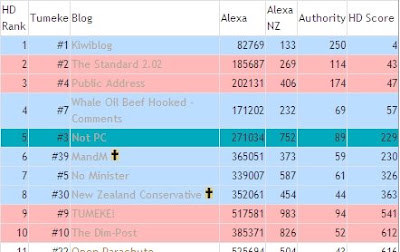
    These rankings are not the official results for April, just an indication of the lay of the land and how the month is progressing for everyone.

    The top 10 New Zealand blogs on public discourse are shown below, the other 250 or so that made the rankings are over here.

    We have climbed 1 spot from last month and are now only 1 point away from number 5, watch out Not PC. We are still holding the number 1 Christian blog position.

    Tomorrow marks 6 months since we switched to our own domain so we finally have the full 6 months worth of Technorati authority, meaning that from now on, when our Technorati score is compared to another blog’s, it is a fair comparison.

    Blog Rankings
    As always, thank you for your blogroll links, backlinks, comments and visits!