On Wednesday 21st May at the University of Waikato retired Philosophy and Political science lecturer Dr Ron Smith and Dr Matthew Flannagan (of this blog) debated the resolution “Morality Does not need God”. Here is the video of that debate.
On Wednesday 21st May at the University of Waikato retired Philosophy and Political science lecturer Dr Ron Smith and Dr Matthew Flannagan (of this blog) debated the resolution “Morality Does not need God”. Here is the video of that debate.
 I recently participated in a dialogue on the UK radio show Unbelievable?, which is hosted by Justin Brierley. The dialogue was with Ryan Bell, a former Seventh Day Adventist pastor who made headlines recently when he announced that he is trying atheism for a year . The show aired in the UK on Saturday and is now online here.
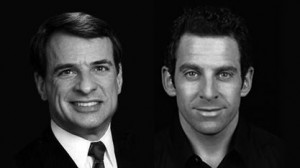 In Sam Harris on Divine Commands Part I I criticised Harris’ characterisation of divine command meta-ethics. I refuted Harris’ contention a divine command theory is pscyopathic in Is a Divine Command Theory Pscyopathic? Sam Harris on Divine Commands: Part II. In this last post in this series, I will address Harris’s contention that a divine command theory reflects a “psychotic moral attitude”. Harris says a divine command theory is “psychotic because this is completely delusional. There’s no reason to believe that we live in a universe ruled by an invisible monster called Yahweh.”
Harris’s argument in this regard seems to involve four premises. [1] A person can accept a divine command theory only if her or she believes in the existence of an invisible monster called Yahweh (which Harris earlier identifed as an “iron age God of war”); [2] there is no evidence for an invisible monster called Yahweh; [3] to believe something without evidence is delusional; [4] to be delusional is to be psyhcotic.
Turning to [1], a divine command theorist holds that the most plausible account of the nature of moral obligations is that moral obligations are constituted by, or are identical with, God’s commands. God is understood by the theorist to be a being worthy of worship, a necessarily existent, essentially loving and just, omniscient, omnipotent, personal being who created, sustains and providentially guides the universe. Holding this position does not commit one to believing in an invisible monster or a stone-age God of war for two reasons.
First, a divine command theory is compatible with being an athiest. Plantinga has noted that a person could argue that moral obligations are best accounted for in terms of God’s commands and then conclude from this that if God does not exist then moral obligations do not exist either. In this sense a divine command theory could be a premise in an atheistic argument for nihilism. Interestingly, when I was a grad student in the 90’s I attended a conference where one of the presenters offered an argument for nihilism very much along these lines.
Second, most divine command theorists accept the existence of moral obligations. Most would accept, for example, that moral claims such as that it is wrong to torture children purely for entertainment are true, and that, the action of torturing children in this way actually has the property of being wrong, further, that it does so independently of whether we or our society believe that it does.
A divine command theorist does not have to identify this God with Yahweh. Obviously, divine command theorists who are Jews or Christians will do this, but that’s in virtue of their Judaism or Christianity, it is not in virtue of their belief in divine command meta-ethics. Strictly speaking a divine command theorist could reject the identification and still maintain that moral obligations are best identified with the commands of God.
Third, even if one does identify God with Yawheh, it is evident that such an identification would rule out construing God as “an invisible monster” who is, according to Harris, ” a stone-age God of war”. If Yahweh is identified as a loving and just, invisible person, then he is neither an invisible monster or a stone-age God of war. Of course, a person who held this view might grant that at one piont in history, perhaps in the late Bronze Age or early Iron Age, various people groups believed that Yahweh was a God of war, but by identifying God as Yahweh, such a person is explictly rejecting this conception. The fact that people once concieved of something a certain way tells us nothing about whether that thing is, in fact, that way. Harris may as well castigate contemporary atomic theory by pointing out that ancient greek atomists held scientifically indefensible understandings of an atom.
So Harris’ [1], the contention that a person can accept a divine command theory only if they believe in the existence of an invisible monster is false.
Turning then to [2], the contention that there is no evidence for the existence of an invisible monster called Yahweh. Harris’s argument is circular. Suppose, for the sake of argument, (more…)
In my last post, Sam Harris on Divine Commands: Part I, I criticised Sam Harris’ characterisation of divine command meta-ethics. In this post I want to turn to his second line of criticism of a Divine Command Theory. In Harris’ debate with William Lane Craig at Notre Dame, transcript here, Harris stated:
“I’m glad he raised the issue of psychopathy—we are being offered a psychopathic and psychotic moral attitude. It’s psychotic because this is completely delusional. There’s no reason to believe that we live in a universe ruled by an invisible monster Yahweh. But it is, it is psychopathic because this is a total detachment from the, from the well-being of human beings. It, this so easily rationalizes the slaughter of children. Ok, just think about the Muslims at this moment who are blowing themselves up, convinced that they are agents of God’s will. There is absolutely nothing that Dr. Craig can s—can say against their behavior, in moral terms, apart from his own faith-based claim that they’re praying to the wrong God. If they had the right God, what they were doing would be good, on Divine Command theory.”
Here, Harris suggests a Divine Command Theory expresses both a psychopathic and a psychotic moral attitude. I will address the charge of a Divine Command Theory being “psychotic” in a later post. Here, I want to address what I think is Harris’ main concern: a Divine Command Theory is psychopathic. It involves a “total detachment … from the well-being of human beings” and “so easily rationalizes the slaughter of children”. Why does Harris think this? “Because, at this moment Islamic terrorists are blowing themselves up convinced they are agents of God’s will, and a divine command theory can say nothing against their behavior in moral terms except the faith based claim that they are praying to the wrong God.”
A lot could be said about this argument. First, note that even if it were sound, it does not show the Divine Command Theory is false. Harris is, in fact, offering pragmatic arguments against the theory: it is dangerous, or is easily misused – but there are many things which are dangerous and easily misused that are nevertheless true.
More importantly, the argument is unsound. A Divine Command Theory contends that an action is obligatory if God actually commands that action. It does not contend that an action is obligatory if someone claims, or believes that God commands it. Obviously, simply believing something is the case does not mean that it is true. Harris, as an atheist, surely recognises this; many people believe and are convinced God exists yet Harris thinks they are mistaken.
Hence, the mere fact an Islamic terrorist believes God has commanded him or her to “blow themselves up” does not commit the divine command theorist to supporting terrorism. All a divine command theorist needs to say in response to Islamic terrorists is that (more…)
In a previous post, Divine Commands and Pyschopathic Tendancies, I said I would look in more detail at Sam Harris’ charge that Divine Command Theories (“DCT”) of meta-ethics are psychopathic. In this, and in several forthcoming posts, I will attempt to deliver on that promise.
In Harris’ debate with William Lane Craig at Notre Dame, transcript here, Harris offered three direct lines of argument against a DCT. (I say direct lines because many of Harris’ rebuttals did not address DCT at all; rather he engaged popular objections to Christian doctrines about exclusivism and hell.) The first direct argument was as follows:
“According to Dr Craig’s Divine Command theory, God is not bound by moral duties; God doesn’t have to be good. Whatever he commands is good, so when he commands that the Israelites slaughter the Amalekites, that behavior becomes intrinsically good because he commanded it.”
Here Harris makes three claims. First he argues that according to a DCT God does not “have to be good”. Second, he infers from this that God can therefore make any action at all intrinsically good. Third, he alludes to an incident in the book of Samuel where, on the face of it, God commands the killing of the Amalekites.
Turning to Harris’s first claim, according to DCT a person has a duty to a person to do some action only if that person is commanded by God to do it. As God does not issue commands to himself he is not bound by moral duties. Harris infers from this that “God doesn’t have to be good”.
Whether this is inference is sound depends on what Harris means by “have to be good”. There are at least two possible things he could mean by this.
Sometimes when we say someone does or does not “have” to do something, we mean they are not morally obligated to do it. When I tell my children they have to tell the truth, for example, I am saying they have a duty to tell the truth. In other contexts however, when we say that someone does or does not “have” to do something we mean it is possible for them to do it.
If Harris, in saying “God does not have to be good”, means God is not under an obligation to be good then his inference is sound; if God is not bound by duties then he obviously does not have an obligation to be good. This, however, does not entail that it is logically possible for God to lack goodness.
If, on the other hand, Harris’ claim that “God does not have to be good” carries the implication that it is possible for God to do evil then it is a a flat out straw man.
Craig’s position is that (more…)
On Tuesday 2 October 2012 Matt participated in a debate on the moot “This House supports the legalisation of same-sex marriage in New Zealand” at the University of Auckland along with:
The video of that debate is now available.
 Matt has accepted an invitation from the Auckland University Students Association (AUSA) to participate in a public debate on the Same Sex Marriage Bill to be held at 7pm at the University of Auckland on Tuesday 2 October 2012 in Library Basement 28.
The moot is: “This House supports the legalisation of same-sex marriage in New Zealand”
The Marriage (Definition of Marriage) Amendment Bill just passed the first reading in the New Zealand Parliament but the debate continues. Its full passage would allow unrelated same sex couples to marry.
This debate is open to the public so mark it in your calendars now!
Confirmed speakers are: