Tag: Robert Adams

  • Contra Mundum: Is God a 21st Century Western Liberal?

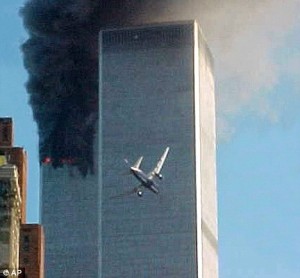
    World Trade Centre Terrorist AttackOn 11 September 2001 Islamic terrorists flew two planes into the World Trade Centre killing thousands of innocent people. Ostensibly they did this because they believed God commanded them to do so. This event has invigorated a fear latent in the Western psyche since the 17th century when wars of religion tore Europe apart, the fear of religious fanaticism, of people willing to murder hundreds in the name of God. These fears were centre-stage recently at a Conference held by the Centre for Philosophy of Religion at the University of Notre Dame. Sceptics presenting at the conference argued passionately that the God of the bible issues commands which are at odds with contemporary modern understandings of morality. Adultery is punished with death; on some occasions, God is portrayed as commanding the killing of non-combatants in “holy wars” against the local Canaanite population.

    There is a lot that can be said about these concerns and in a short column I cannot say everything. In many instances I think the sceptics fail to appreciate the context and genre of the passages they cite. They fail to appreciate, for example, that Ancient Near Eastern conquest accounts employ highly figurative rhetoric, which hyperbolically describe victories in terms of total annihilation of the enemy. They fail to appreciate that Ancient Near Eastern legal texts, as noted by Raymond Westbrook, “reflect the scribal compilers’ concern for perfect symmetry and delicious irony rather than the pragmatic experience of the law courts.” Or that, as JJ Finkelstein points out, they “were not meant to be complied with literally” but to “serve an admonitory function” and so probably do not command execution for the crimes mentioned. Sceptics can fail to grasp that claiming the bible is God’s word does not mean it did not come to us mediated through the writings of human beings who wrote in a particular time and place using the language, rhetoric and literary conventions of their time and so and frequently they fail to appreciate the bible is a Canon and that passages need to be read in their broader context i.e. taking into account the whole bible. A full articulation of these points, however, would take more space than I can here muster.

    Instead I will address another feature of this issue which concerns the general method in play here. In each case the sceptic takes a purported divine command and compares it to a moral belief that he takes to be correct. The conclusion he draws is that the purported command is inauthentic. This is of course a possibility; there is, however, another possibility that on at least some occasions, moral statements these sceptics are relying on are mistaken.

    This feature of the dialectic became clear to me after a public debate I had on these issues in August. A sceptic wrote to me claiming that (more…)

  • God, Morality and Abhorrent Commands: Part III Philip Quinn

    In this three-part series I look at some different ways of adjudicating conflicts between apparent divine commands and moral beliefs. I started with Immanuel Kant, I then looked at Robert Adams’ defence of Kant’s position. Now I will complete the series by exploring Philip Quinn’s alternative view.

    In “God, Morality and Abhorrent Commands: Part II Robert Adams” I mentioned Phillip Quinn’s observation that theists can face a particular dilemma,

    “[I]t seems possible that a theist should have both good reasons for believing that God has commanded him to perform a certain action and good reasons for believing that it would be morally wrong for him to perform that action. Thus a theist can be confronted with moral dilemmas of a peculiar sort.”

    Quinn’s point is that a theist might find himself believing all three of the following propositions:

    [1] Whatever God commands is morally permissible;

    [2] God commands X;

    [3] It is wrong to do X.

    Adams and Kant argued that one should resolve dilemmas of this sort by affirming [3] and denying [2].  I argued in Part I Kant and Part II Robert Adams that this conclusion is unjustified. What Adams does show is that one cannot “accept a theological ethics that ascribes to God a set of commands that is too much at variance with the ethical outlook that we bring to our theological thinking.” [Emphasis added] His position, in fact, suggests that in many cases we should accept divine commands at variance with our moral beliefs. Hence, there may well be times when it is rational to reject [3] and embrace [2].

    In this last post I will elaborate Quinn’s answer to this question. Quinn’s position can be seen by contrasting two approaches he takes to specific examples of the kind of dilemma he cites.

    The first is Quinn’s response to the dilemma posed by “the sins of the patriarchs” (more…)

  • God, Morality and Abhorrent Commands: Part II Robert Adams

    In this three-part series I will look at some different ways of adjudicating conflicts between apparent divine commands and moral beliefs. I started with Immanuel Kant, now I will look at Robert Adams’ position.

    In “God, Morality and Abhorrent Commands: Part I Kant” I mentioned Phillip Quinn’s observation that theists can face a particular dilemma,

    “[I]t seems possible that a theist should have both good reasons for believing that God has commanded him to perform a certain action and good reasons for believing that it would be morally wrong for him to perform that action. Thus a theist can be confronted with moral dilemmas of a peculiar sort.”

    Immanuel Kant argued that when faced with such a dilemma the theist should reject the belief that God has commanded the action and accept the moral belief. This was due to his belief that moral beliefs are more certain that theological beliefs. I contested this claim. More recently Robert Adams has defended Kant’s conclusion. Consider the structure of the kind of dilemma Quinn cites,

    [1] Whatever God commands is morally permissible;

    [2] God commands X;

    [3] It is wrong to do X.

    These three claims contradict each other; like Kant, Adams suggests that the rational person should reject [2]. However, his reasons are somewhat different. Adams persuasively reasons that [1] is true only if God is understood as perfectly good, in the sense of being loving, just and so on. If God were evil or morally indifferent then it would be possible for him to command wrongdoing and so [1] would be false.  This means that a person who accepts [1] must presuppose that God is good.

    Adams argues that God cannot be meaningfully said to be good if what he commands drastically departs  from what we consider to be right and wrong. Human beings have some grasp of what constitutes goodness and some grasp of what constitutes right and wrong and it is part of our concept of what is good that a good being does not command wrong doing. Moreover, to call a being good is to attribute to it a character trait that is incompatible with certain other actions, attitudes and so on. Raymond Bradley made the point succinctly in his debate with William Lane Craig “Can a Loving God Send People to Hell?“

    “If we were to describe someone such as Hitler as perfectly good despite all his evil doings, we’d be playing word games which are intellectually dishonest as they are morally pernicious. … it would be to deprive the word “holy” of its ordinary meaning and make it a synonym for “evil.”

    This supports Adams’ conclusion that one cannot rationally accept [1] as one implicitly assumes that God does not issue commands at variance with our conception of morality. In Finite and Infinite Goods: A Framework for Ethics he concludes,

    “Our existing moral beliefs are bound in practise, and I think, ought in principle, to be a constraint on our beliefs about what God commands. We simply will not and should not, accept a theological ethics that ascribes to God a set of commands that is too much at variance with the ethical outlook we bring to our ethical thinking.” [Emphasis original]

    As with Kant there is a lot of truth to this; however, Adams’ position has certain limits.  As critics of Adams have pointed out his conclusion is limited. In the paragraph above Adams concludes that “our existing moral beliefs” must be a constraint on our beliefs about what God commands. His justification for this is that we “should not, accept a theological ethics that ascribes to God a set of commands that is too much at variance with the ethical outlook we bring to our ethical thinking.” The phrase “too much” suggests that one can accept ascription of a set of commands that is somewhat at odds with the outlook we bring to our ethical thinking.

    Two points Adams makes elsewhere in Finite and Infinite Goods suggest that this limitation on his conclusion is necessary. First, while we do have some grasp of what is good and some grasp of what is right and wrong it is evident that our moral judgements are fallible. Adams calls this the “transcendence” of the good. He states,

    “All of God’s commands and judgments are right; God is the ethical standard. But our beliefs (even the most cherished) about them must be distinguished from God’s commands and judgments themselves. To fail to make that distinction is idolatry.”

    Adams is surely correct here. While God does not command wrongdoing. It is quite likely that a perfectly good omniscient being would command something contrary to what we think is wrong.  Our moral intuitions are fallible, hence it is possible that some of God’s commands would clash with our own moral judgements. In fact to suggest that God would never command something which we consider to be wrong expresses an incredible hubris. It is to dogmatically assume that we are such good judges of morality that God could never disagree with us. It is to put our own moral judgements beyond question. The existence of some commands that strike us as strange or immoral does not count for much.

    Second, our concept of goodness and our judgement about particular cases can be and sometimes is subject to revision. We change our opinions about the goodness and rightness of certain things without “playing word games which are intellectually dishonest” or depriving “the word ‘holy’ of its ordinary meaning and make it a synonym for ‘evil.’”  If this were not the case, one could never honestly or rationally change ones mind on an ethical issue. Nor could people coherently disagree with or persuade one another about moral issues. Adams’ notes this when he writes that he accepts “the possibility of a conversion in which one’s whole ethical outlook is revolutionized, and reorganized around a new center” but “we can hardly hold open the possibility of anything too closely approaching a revolution in which, so to speak, good and evil would trade places”.

    These points, however, quite evidently limit Adams’ conclusion. What his argument, in fact, shows is not that “our existing moral beliefs must serve as a constraint on our beliefs about what God commands” but rather that certain types of our existing beliefs do this, those so central to our concept of goodness that accepting them would be “approaching a revolution in which, so to speak, good and evil would trade places.” In “A Psychological Constraint on Obedience to God’s Commands: The Reasonableness of Obeying the Abhorrently Evil” James Rissler notes,

    “In such an instance, obedience requires that one give up everything one previously believed about morality… one has been commanded to relinquish everything one understands about the nature of goodness, one will have no concept of the good with which to identify Gods command, there will be complete breakdown of between everything one currently affirms about goodness and everything one is asked to believe about goodness.”

    Rissler gives two examples; the first is where God issues a command to reverse one’s conception of right and wrong or issues a set of commands, each one of which negates every moral imperative one currently accepts. Second, he suggests that a moral belief might be “sufficiently integral to one’s conception of morality” that abandoning it would force such a radical revision as to destroy one’s concept of goodness all together. Imagine a command to kill everyone around you purely for entertainment or a command that said harming, hurting and inflicting suffering on people for no reason at all is permissible. Consider a command to hate God and despise all other human beings. One cannot accept a system of divine commands where every duty we believe in is declared false nor can we accept a system which suggests that the vast majority of our moral beliefs are mistaken. This would come too close to the problematic revolution Adams talks of.

    To sum up, in Part I and II, I have looked at the Kantian approach to the kind of dilemma Quinn sketches. Neither Kant or Adams, I think, establish the claim that in “our existing moral beliefs must serve as a constraint on our beliefs about what God commands.” They did, however, lend support for a weaker thesis. Kant’s argument, for example, does suggest that those moral claims about which we are certain, should serve as such a constraint and I mentioned several beliefs which I consider to be fairly certain as examples.

    Adams’ argument on the other hand suggests that we cannot coherently “accept a theological ethics that ascribes to God a set of commands that is too much at variance with the ethical outlook we bring to our ethical thinking.” He argues that we cannot coherently or defensibly accept a theological ethics which, in effect, makes good and evil trade places and which so radically transforms our concept of goodness so that good becomes a synonym for what we call evil or calls our concept of goodness so radically into question that it breaks down. Certain beliefs such as it is prima facie wrong to inflict pain and suffering on others or it is prima facie wrong to treat others with contempt” or it is prima facie wrong to lie, steal and kill are so central to our account of goodness that we cannot coherently accept that a perfectly good being has issued commands that negate them.

    In my next post I will look at Philip Quinn’s alternative.

    RELATED POST:
    God, Morality and Abhorrent Commands: Part I Kant
    God, Morality and Abhorrent Commands: Part III Philip Quinn

  • God, Morality and Abhorrent Commands: Part I Kant

    In this three-part series I will look at some different ways of adjudicating conflicts between apparent divine commands and moral beliefs starting with Immanuel Kant.

    In “Commonsense Atheism and the Canaanite Massacre” I addressed a question put to me by Luke from Commonsense Atheism,

    “If Matt did think these events happened literally as described in the Bible, would he then conclude that God was an evil monster to command them? Or would he, in the end, agree with Bill Craig that genocide is okay as long as God feels like it?”

    In my response I pointed out Craig claims that killing non-combatants in war is permissible if a loving and just God commands it (which is an implication of a divine command theory). This conditional is arguably true. Either it is possible for a just and loving omniscient person to command genocide or it is not. If it is then genocide would only be commanded in situations where a just and loving person, aware of all the relevant facts, could endorse it; under these circumstances it is hard to see how genocide could be evil. On the other hand, if it is impossible for a just and loving omniscient person to ever command genocide then the situation Luke mentions is one with an impossible antecedent. On the standard accounts of counter-factual logic, conditionals with impossible antecedents are true. So far from being absurd there are reasons for thinking this conditional is true.

    The question Luke asks is really a species of a larger and important question in theological ethics. In Finite and Infinite Goods Robert Adams notes “A convincing defense of a divine command theory of the nature of obligation must address our darkest fear about God’s commands–the fear that God may command something evil.” Philip Quinn makes a similar point,

    “[I]t seems possible that a theist should have both good reasons for believing that God has commanded him to perform a certain action and good reasons for believing that it would be morally wrong for him to perform that action. Thus a theist can be confronted with moral dilemmas of a peculiar sort.”

    I suspect Luke is really asking how a theist can rationally respond to a dilemma of this sort. While I do not know what Luke’s opinion on this issue is, a common view is that if a theist has good reasons for believing an action is wrong then any claim that God has commanded should be rejected. The locus classicus for this position is Immanuel Kant; in Reason within the Bounds of Religion, Kant stated:

    “Abraham should have replied to this supposedly divine voice: “That I ought not kill my good son is quite certain. But that you, this apparition, are God — of that I am not certain, and never can be, not even is [read: if] this voice rings down to me from (visible) heaven.”

    Similarly, in the Conflict on the Faculties he states he states,

    “That to take a human being’s life because of his religious faith is wrong is certain, unless (to allow the most extreme possibility) a divine will, made known to the inquisitor in some extraordinary way, has decreed otherwise. But that God has ever manifested this awful will is a matter of historical documentation and never apodictically certain. After all, the revelation reached the inquisitor only through the intermediary of human beings and their interpretation, and even if it were to appear to him to have come from God himself (like the command issued to Abraham to slaughter his own son like a sheep), yet it is at least possible that on this point error has prevailed.”

    Kant, here, is discussing the kind of dilemma Quinn refers to. The dilemma can be spelled out as follows, in certain situations a theist might find him or herself with reason to affirm the following three propositions,

    [1] Whatever God commands is morally permissible;

    [2] God commands X;

    [3] It is wrong to do X.

    These three claims cannot all be true, so a rational person must reject one of them; the question is which one? Kant’s answer is that when faced with a dilemma of this sort the theist should reject [2].  It is worth elaborating on his position a bit.

    First, note that Kant accepts [1] he grants that if we knew that God commanded the killing of a particular human being, it would be permissible to kill that human being. Kant’s objection is that one cannot be rational in believing that God has, in fact, issued such a command. Philip Quinn notes that Kant’s argument involves an appeal to an epistemic principle: whenever two conflicting claims differ in epistemic status, the claim with the lower status is to be rejected.  Kant contends that moral claims such as “it is wrong to kill innocent people” are certain. However, claims that God commands or forbids a certain action are not certain and never can be. From these points it follows that a rational person will accept [3] and reject [2].

    Despite its appeal Kant’s argument is flawed for several reasons. Philip Quinn notes two problems. First, “Kant has an extremely optimistic view of our ability to attain epistemic certainty about principles of moral wrongness,” he thinks we can be certain of moral claims. This, however, is dubious. There are some moral claims of which I am fairly certain. I am certain, for example, that it is wrong to inflict as much pain on another as I can merely for my own entertainment. I am fairly certain that killing, assault, theft and lying are prima facie wrong and can only be justified if some overriding moral reason applies. However, many moral claims are highly controversial and are far from certain at all. Consider, for example, the debate over whether the bombing of Hiroshima was justified because it saved a huge number of lives by ending a war early. While I myself do not share this opinion, I would not say I am certain about it. Similarly, consider moral debates about capital punishment or euthanasia or affirmative action. While I believe there are defensible and justified answers to these questions, I doubt we can claim certainty about answers to these questions.

    Second, Kant claims that we can never be certain that God has prohibited a certain action. Quinn notes, “It would thus seem to be well within God’s power to communicate to us a sign that confers on the claim that God commands some intolerant behavior, for example, issuing threats to heretics, a fairly high epistemic status.” If God were to do this then we would have certainty that he had commanded the action. So it is not clear that beliefs about what God wills are always less certain than moral beliefs.

    I am inclined to push this criticism further. It seems to me that many sceptical worries that are raised about God and his commands apply with equal force to moral beliefs. Consider three common concerns sceptics raise about religion. One is the claim that the existence of God is not necessary to explain any empirical phenomena. The second is the concern that the claim God exists and has commanded a particular action cannot be empirically demonstrated or proven to exist. The third is the widespread pluralism with regard to both the existence of God and his nature. All three of these worries apply to moral beliefs. The existence of moral properties appears unnecessary to explain any empirical phenomena, almost any empirical phenomena can be explained equally well by accepting that moral beliefs are all false but that people think they are true. Attempts to prove that moral beliefs are true from non-moral premises alone are probably more controversial than any argument for the existence of God. And there is widespread pluralism over whether moral properties exist; nihilists and non-cognitivists deny such properties exist and amongst believers in the truth of moral beliefs, there is widespread disagreement over the nature of morality. Intuitionists contend it is a non-natural property, naturalists contend it is a natural property but disagree over what the natural property in question is, supernaturalists contend it is a divine command or a theological property and so on.

    In fact, Kant’s own argument provides an example of this point. Kant argues in The Conflict in the Faculties that we can never be certain that God has commanded an action because,

    “the revelation reached the inquisitor only through the intermediary of human beings and their interpretation, and even if it were to appear to him to have come from God himself (like the command issued to Abraham to slaughter his own son like a sheep), yet it is at least possible that on this point error has prevailed.”

    But this is equally true of many moral beliefs, a good amount of what people believe with regards to morality comes to them through the intermediary of human beings and their interpretation. Most westerners belief’s in liberal ideals, such as, the equality of women, opposition to slavery and so are mediated through human beings. Moreover, even if we directly intuit moral properties, it is possible that we are mistaken. Human moral intuitions and judgements are fallible and can err. So in many instances I am inclined to think that the sceptical worries people raise to conclude that theological beliefs are uncertain apply also to moral beliefs. To appeal to these concerns, so as to claim that belief about God’s will is less certain than moral beliefs, is to engage in special pleading.

    In my next post I will look at Robert Adams’ defence of Kant’s position and then I will look at Philip Quinn’s alternative.

    RELATED POSTS:
    God, Morality and Abhorrent Commands: Part II Robert Adams
    God, Morality and Abhorrent Commands: Part III Philip Quinn

  • Matthew Flannagan’s Opening Statement: Bradley v Flannagan Debate

    On Monday 2 August at the University of Auckland Emeritus Professor of Philosophy Dr Raymond Bradley and Dr Matthew Flannagan (of this blog) debated the topic “Is God the Source of Morality? Is it rational to ground right and wrong in commands issued by God?” For the benefit of those who could not be there, who are awaiting the editing and uploading of the video of the debate, we will be running a blog series where we bring you some of the debate in written form.

    DR CHRIS TUCKER’S INTRODUCTION

    Published here with permission

    Dr. Matthew Flannagan is quickly becoming a respected scholar on issues related to the philosophy of religion, ethics, and theology.  His articles and book chapters cover such weighty topics as, whether the Bible condones genocide, the ethics of holy war, abortion and tonight’s topic, the relationship of God and morality.  The importance of Dr. Flannagan’s work has led to many speaking engagements all over New Zealand and also in the United States.  Two of these speaking engagements were public debates, including one against Dr Bill Cooke, an erstwhile President of the New Zealand Association of Rational Humanists.  Dr Flannagan received his PhD in Theology from the University of Otago.  From the University of Waikato, he received his Master’s in Philosophy with First Class Honours.  You can follow Dr Flannagan’s work at mandm.org.nz, the blog that he co-authors with his wife, Madeleine Flannagan.  When he is not working, he enjoys spending time outdoors with his wife and four children. Please join me in welcoming Dr. Matthew Flannagan

    DR MATTHEW FLANNAGAN’S OPENING STATEMENT

    Is it defensible to ground right and wrong in the commands of God? In this debate I will defend an affirmative answer to this question. I will defend the position that moral rightness and wrongness consist in agreement and disagreement, respectively, with Gods commands1– this is what Philosophers call a divine command theory. In defending this thesis I will do two things. First I will argue the standard arguments against a divine command theory fail. Second I will argue that Ray’s attempts to refute this theory fail. God is the source of morality.

    1. Standard Arguments Against a Divine Command Theory

    Divine command theories are frequently said to suffer a debilitating problem, they make morality arbitrary – anything at all could be deemed ‘right’ as long as God commanded it, even torturing other people for fun. This objection assumes that it is possible that God could command atrocious things like torturing people for fun. This assumption, however, seems very dubious. We need to remember that we are not talking about right or wrong as being based on the commands of just anyone, we are talking about God defined by Ray as “omnipotent, omniscient, and morally perfect.”

    So, as the terms are defined, the claim that it is possible for God to command people to torture others for fun is true only if it is possible for a morally perfect person to command such an atrocious thing. But this is unlikely. The very reason critics cite examples such as torturing people for fun is because these actions are paradigms of conduct that no morally good person could ever entertain or endorse.

    A predictable rejoinder to this response is that if some action is wrong because God prohibits it then God cannot be said to be good in any meaningful sense. The claim ‘God is good’ turns into no more than the claim that God obeys his own commands, if this is so, can God be said to have any duties at all?

    The suggestion that if God has no duties then he cannot be said to be good in any meaningful sense, has a grain of truth to it. If we are going to understand God’s goodness in terms of God having duties that he consistently fulfils then a divine command theory cannot account for God’s goodness. However, why must the phrase ‘God is good’ be understood in terms of God having duties? I do not see why it should?

    Many theologians and philosophers have suggested an alternative, God’s goodness should be understood in terms of God having certain character traits. To claim God is good is to claim that he is truthful, benevolent, loving, gracious, merciful, that he is opposed to certain actions such as murder, rape, torturing people for fun and so on. Now, even if God does not have duties, it does not follow that he cannot have character traits such as these. It is true that God is not under any obligation to love others or to tell the truth or what have you, but that does not mean he cannot love others or tell the truth. God does not have to have a duty to do something in order to do it.

    So the standard criticisms of a divine command theory fail.

    2. Raymond Bradley’s Moral Argument

    Ray attempts a different tack. Ray argues the divine command theorist is committed to five inconsistent propositions:

    1. What God proposes for our belief–including beliefs about what we ought to do–is what we ought to believe or do.

    2. In his holy scripture God proposes for our belief that he has caused, committed, condoned, or laid down commands for us to obey, every one of the four types of crimes of types A, B, C, and D.

    3. It is morally wrong to cause, commit, condone, or command any of the crimes of types A, B, C, D.

    4. God is omnipotent, omniscient, and morally perfect.

    5. A morally perfect being would not do anything that is morally wrong.

    In response to this I will make three lines of criticism.

    I

    The first line of criticism is that even if Ray’s argument is sound it does not show that a divine command theory is false. Ray has argued that the Bible presents an indefensible picture of God. However, the question of biblical infallibility is not the topic of our debate tonight. While many divine command theorists believe in biblical infallibility, some do not. A divine command theorist could, for example, claim that the wrongness of an action is determined by God but we know what is right and wrong from our conscience and not from a written revelation. The Philosopher Philip Quinn suggested a theory like this.2 Alternatively he or she could accept some other revelation such as the Talmud or the Koran. So strictly speaking, Ray’s argument does not address the moot of the debate tonight. One could accept everything Ray says about the Bible and still defensibly embrace a divine command theory, the claim that God is the source of morality is untouched.

    II

    This brings me to my second line of criticism. Ray’s third proposition [3] is formulated as:

    3. It is morally wrong to cause, commit, condone, or command any of the crimes of types A, B, C, D.

    This claim is ambiguous; there are two ways it could be interpreted. The first is:

    [3a] It is morally wrong for human beings to cause, commit, condone or command any of the crimes of types A, B, C, D.

    or Ray could mean:

    [3b] It is morally wrong for any person (including God) to cause, commit, condone or command any of the crimes of types A, B, C, D.

    To be valid Ray’s argument needs to be interpreted in terms of [3b]. Ray argues that God, engages in wrongdoing when he causes, commits, commands and condones A B C and D. There are two problems with this interpretation.

    First, Ray’s argument does not justify this conclusion. Ray states “to deny (3) would be to … ally oneself with moral monsters like Ghenghis Khan, Hitler, Stalin, and Pol Pot.” This is false: Genghis Khan, Hitler and Stalin are human beings to condemn them we only need to accept [3a] not [3b].

    Second, Ray’s argument is circular, [3b] assumes that God has duties; however, on my view the wrongness of an action consists in its being forbidden by God. Given that God does not issue commands to himself it follows that he has no duties. To propose [3b] Ray has to assume that my view is unjustified, which is what he is supposed to be proving. He is reasoning in a circle.

    III

    My third line of criticism concerns Ray’s second proposition,

    2. In his holy scripture God proposes for our belief that he has caused, committed, condoned, or laid down commands for us to obey, every one of the four types of crimes of types A, B, C, and D.

    Actually none of the passages Ray cites contain commands to us. He cites some of God’s actions and he cites some commands God gave to Israel and to Joshua but one cannot directly infer from these that these are commands issued to us.

    We have to keep in mind that the Bible is a collection of Ancient Near Eastern (ANE) texts. It was written centuries ago in three different languages, none of which were English. The cultural methods of written communication back then differ significantly from what we are used to when we pick up the latest ‘new atheist’ book at Whitcoulls. Further, the Bible is made up of various books written in various literary genres. To interpret it correctly one needs to take what it says in context – as a whole – and in accord with the literary conventions governing ancient texts translated from foreign languages. Ray fails to do this,

    Instead he uses a selective, out of context, and excessively literalistic interpretation of these passages.

    let me cite some examples.

    1. The Slaughter of the Canaanites

    The first is the slaughter the Canaanites. Ray claims God “orders the slaughter, without compassion, of hundreds of thousands of women, children, and suckling babes.” Ray here alludes to the book of Joshua’s record of the conquest of the Canaanites. Critics, like Ray, are quick to point out that this text states Joshua “totally destroyed all who breathed”, left “no survivors” in “the entire land”, went through the land “exterminating them without mercy” at God’s command.

    What they do not note is that the text proceeds after this to state that the Canaanites were, in fact, not literally wiped out. Over and over the text affirms that the land was still occupied by the Canaanites, who remained heavily armed and deeply entrenched in the very same regions and the very same cities that Joshua was said to have “destroyed all who breathed” and left “no survivors” in. In light of this, it is unlikely that the author intended the language in question to be taken literally.3

    This conclusion is confirmed by research into Ancient Near-Eastern history writing. In a comprehensive comparative study of Ancient Near-Eastern historiography. Old Testament scholar, K Lawson Younger concludes that the Old Testament uses the same literary conventions as other Ancient Near-Eastern conquest accounts. He also establishes that within this genre the rhetoric of total conquest, complete annihilation, destruction of the enemy, killing everyone, leaving no survivors, and so on are frequently used as hyperbole4: the language functions like a person watching David Tua in a boxing match, yells, “Knock his block off! Hand him his head! Take him out!” or hopes that the All Blacks will “annihilate the Springboks” or “totally slaughter the Wallabies.”5 Now, sports fans do not actually want David Tua to decapitate his opponent or the All Blacks to become mass murderers. Understood in a non-literal sense, the phrases probably meant something like, attack them, defeat them, drive them out; not literally kill every man, woman, child, donkey, etc.

    2. Capital Punishment.

    My second example is Ray’s reference to at least 34 offences for which God prescribes the death penalty. (Actually there are only 15 such offences). Ray contends that these passages constitute literal commands to the courts to execute people. This is dubious. The Torah is is written according to the literary and rhetorical conventions of Ancient Near-Eastern legal writing. J J Finkelstein notes that capital sanctions in such texts,

    [W]ere not meant to be complied with literally even when they were first drawn up, [But rather they] serve an admonitory function. If one would be bold enough to restate Hammurabi’s 230 as a direct admonition it might run to this effect: “woe to the contractor who undertakes construction and in his greed cuts corners”.6

    One of the leading experts on Ancient Near-Eastern legal texts Raymond Westbrook states they “reflect the scribal compilers’ concern for perfect symmetry and delicious irony rather than the pragmatic experience of the law courts.”7 The method used was “to set out principles by the use of often extreme examples.”8 In Ancient Near-Eastern legal practice a person who committed a serious crime would be legally considered to have forfeited their life or limb – this, however, did not mean that they were executed or mutilated. Instead they could ransom their life or limb by making a monetary payment decided by the courts “the death sentence is mostly hyperbole,” a literary device designed to under underscore the seriousness of the crime.9

    A careful reading of the Torah confirms this. The clearest example occurs in Numbers 35. After laying out clearly and repeatedly that a person who kills in pre-meditation “shall surely be put to death” the text goes on to state “Do not accept a ransom for the life of a murderer, who deserves to die. He must surely be put to death… .” Unless there was an assumed practice of “ransoming” the lives of those under a capital sentence, this comment seems superfluous. Old Testament scholar Joe Sprinkle notes, “The availability of ransom seems to have been so prevalent that when biblical law wants to exclude it, as in the case of intentional murder, it must specifically prohibit it.”10

    3. Hell

    My third example is Ray’s discussion of hell. Ray cites the book of Revelation’s reference to “the lake of fire” where “they will be tormented with burning sulphur in the presence of the holy angels and of the Lamb, and the smoke of their torment ascendeth for ever and ever”. He maintains this text teaches God will torture people forever merely for not having the right religious beliefs.

    This is dubious, Revelation is apocalyptic literature. Apocalyptic literature is highly metaphorical and uses stock symbols drawn from the Old Testament. If one looks at how the symbols Ray refers to are actually used in the Old Testament, they do not support Ray’s conclusion. The imagery of sulphur being poured upon people and smoke rising is regularly used in the Old Testament to symbolise the destruction of various nations.(Deut 29:23; Job 18:15-17; Ps 11:6; Isa 30:33, Isa 34-8-11). Similarly the “lake of fire” is drawn from Daniel, where it symbolises the destruction of various world empires. In Rev 18, a few chapters later, the destruction of a city, named Babylon (probably a reference to Rome or Jerusalem) is symbolised by the city being tormented by fire and onlookers watch the rising smoke. The message is that Babylon has been judged and destroyed, not that it continues to be tortured forever.

    The same is true of Ray’s references to the Gospels; the phrase the “weeping and gnashing of teeth” occurs many times in both the Old Testament and the New Testament, and in almost every instance signifies hatred or rage and envy at God or the righteous – not the agony of pain and torture.(Job 16:9; Ps 35:16, Psalm 112:10, 36:16, 37:12; Lam. 2:16, Acts 7:54) In one instance, in fact, it states “they will gnash their teeth and waste away.” Similarly, the phrase “unquenchable fire” is used nine times in the Old Testament. There it refers not to a fire that tortures but one that consumes what it devours because it is never put out. (see Isa 1:31, 34:10, 11; Jer 4:4, 7:20, 17:27, 21:12; Ezek 20:47, 48; Amos 5:6).

    Ray cites from the King James version of 2 Thessalonians 1:7-8, “the Lord Jesus Christ shall be revealed from heaven with his mighty angels, in flaming fire taking vengeance on them that know not God.” He, however, snips the end off the quote, the full text states,

    God is just: He will pay back trouble to those who trouble you and give relief to you who are troubled, and to us as well. This will happen when the Lord Jesus is revealed from heaven in blazing fire with his powerful angels. He will punish those who do not know God and do not obey the gospel of our Lord Jesus. They will be punished with everlasting destruction and shut out from the presence of the Lord and from the glory of his might.

    In context the reference to fire clearly means destruction and not torture.

    Ray’s claim that the Bible teaches that people will be condemned ‘merely for having the wrong religion’ is equally dubious. An in context examination of the passages he cites show that the basis of judgement is a person’s actions not merely their beliefs.

    Conclusion

    First, even if Ray’s case is sound, at best it only amounts to an attack of the doctrine of biblical infallibility, the denial of which is perfectly compatible with a divine command theory of ethics.

    Second, his argument for proposition (3) commits the fallacy of equivocation and assumes the very thing the argument is trying to prove.

    Finally, Ray’s argument for (2) consists of citing a series of passages, often selectively, out of context and without regard for literary genre or literary conventions that are found within the texts itself.This might might be a sure-fire way to make the best-seller list at Whitcoulls but it is obviously not the way any serious biblical scholar should read a text.

    Divine command theorists are not committed to all of the five inconsistent propositions he refers to and so are not required, on pain of contradiction, to deny that God is the source of morality.

    1. Robert M Adams “Moral Arguments for Theism” in Robert Adams The Virtue of Faith (New York: Oxford University Press, 1987) 145.
    2. Philip Quinn “Divine Command Theory” in Blackwell Guide to Ethical Theory ed Hugh La Follette (Malden MA: Blackwell Publishing House, 2000) 67.
    3. See Nicholas Wolterstorff’s “Reading Joshua” in Divine Evil ? The Moral Character of the God of Abraham eds Micheal Rea, Michael Murray and Michael Bergmann (New York: Oxford University Press, 2010) forthcoming.
    4. K Lawson Younger Jr Ancient Conquest Accounts: A Study in Ancient Near Eastern and Biblical History Writing (Sheffield: Sheffield Academic Press, 1990).
    5. This example is adapted from Alvin Plantinga “Reply to Fales” and Nicholas Wolterstorff “Reading Joshua” in Divine Evil ? The Moral Character of the God of Abraham eds Micheal Rea, Michael Murray and Michael Bergmann (New York: Oxford University Press, 2010) forthcoming.
    6. J. J. Finkelstein The Ox that Gored (Philadelphia: American Philosophical Society, 1981) 35.
    7. Raymond Westbrook, “The Character of Ancient Near Eastern Law,” in A History of Ancient Near Eastern Law, Vol. 1, ed. Raymond Westbrook (Boston: Brill Academic Publishers, 2003) 74.
    8. Ibid.
    9. Walter Kaiser, “Gods Promise Plan and his Gracious Law,” Journal of the Evangelical Theological Society 35:3 (1992) 293. Joe M Sprinkle “The Interpretation of Exodus 21:22-25 (Lex Talonis) and Abortion,” Westminster Theological Journal 55 (1993) 238.
    10. Joe M Sprinkle “The Interpretation of Exodus 21:22-25 (Lex Talonis) and Abortion,” Westminster Theological Journal 55 (1993) 238.

    Please note that this series is not a transcript of the debate. Each post in this series is effectively a very close approximation of what was said on the night and has been put together from the papers and notes each speaker prepared and spoke from plus any additions each recalled making.

    RELATED POSTS:
    Video: Bradley v Flannagan “Is God the Source of Morality?
    The Podcast: Bradley v Flannagan
    Joint Communique: Bradley v Flannagan Debate
    Raymond Bradley’s Opening Statement: Bradley v Flannagan Debate
    Bradley’s Reply to Matt: Bradley v Flannagan Debate
    Flannagan’s Reply to Ray: Bradley v Flannagan Debate
    Glenn Peoples’ Review: Bradley v Flannagan Debate

    William Lane Craig, Raymond Bradley and the Problem of Hell Part One
    William Lane Craig, Raymond Bradley and the Problem of Hell. Part Two.
    Sunday Study: Joshua and the Genocide of the Canaanites Part I
    Sunday Study: Joshua and the Genocide of the Canaanites Part II
    Capital Punishment in the Old Testament: 1
    Capital Punishment in the Old Testament: 2
  • There’s Probably No God? Fisking Atheist Billboards

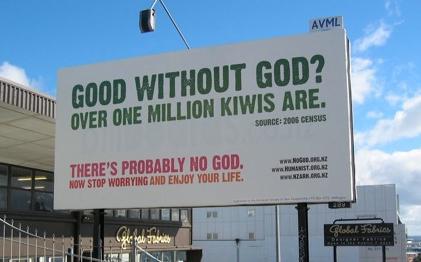
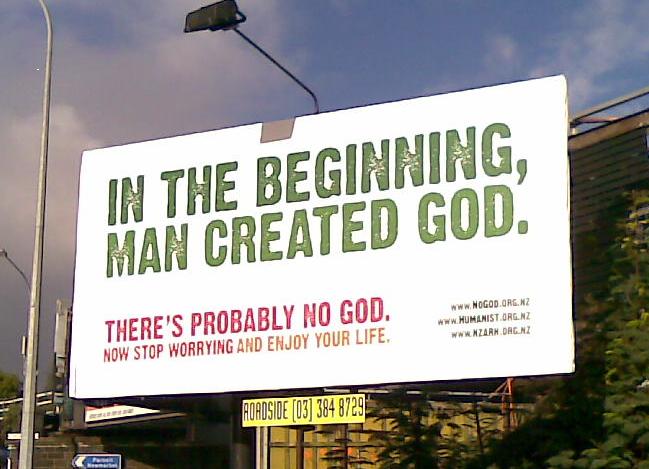
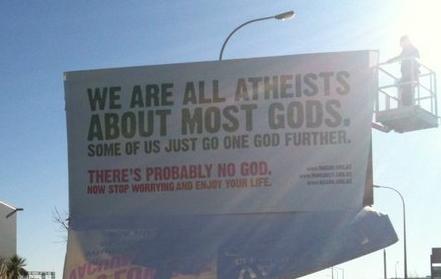
    On the way back from Bloggers drinks we drove past one of the controversial atheist advertising billboards, put up by NZ Atheist Campaign, The Humanist Society and NZARH, which have appeared around Auckland. This appears to have come on the back of the Richard Dawkins inspired bus advertising that made headlines earlier this year. It is worth fisking them a bit.

    Here is a pic of the first one.

    Good Without God? Over One Million Kiwis Are.

    Here we are told one million kiwis are good without God because the census says so. This, however, is fallacious. What the census shows is not that one million kiwis are good without God, it shows that one million kiwis are good (although this is granting a lot for the sake of argument) without believing in the existence God. But to say one can be good without believing in God is not the same as saying one can be good without God. Many people throughout history have been able to live and breath without believing in the existence of hydrogen and oxygen atoms, it does not follow that they could live without water.

    Moreover, it is hard to tell what the point of this sociological fact is anyway. Why does the fact that people do not need to believe in something to do good deeds mean that the belief is false? For centuries people have done good deeds and lived good lives without believing in evolutionary theory or quantum mechanics, should we conclude that these theories are therefore ‘probably false’? Surely these atheists are not suggesting that our beliefs should be based on what is useful or helpful as opposed to what is true or false?

    Perhaps the atheists here mean to convey something else. Some Christian thinkers such as William Lane Craig, Robert Adams, Stephen Layman, Alvin Plantinga, John Hare, Philip Quinn have argued that moral properties such as right and wrong depend on God for their existence. Atheist writers such as Paul Kurtz and Christopher Hitchens retort that this claim is falsified by the existence of morally upright atheists. I suspect something like this is behind the slogan on the billboard, it repeats Hitchens and Kurtz’s retorts as though they said something insightful or clever.

    The problem is, as any one familiar with this discussion should know, this retort misses the point (as I pointed out in On a Common Equivocation). Craig, Adams, et al are not claiming that one needs to believe in God to be good (a point made several times in the literature and particularly made so many times to Kurtz that it beggars belief that he keeps repeating it) rather their claim is that moral properties, such as right and wrong, depend on God for their existence.

    This is a fairly basic and elementary distinction in the literature. How exactly expressing a common philosophical confusion counts as reason for thinking “there probably is no God” is hard to see.

    Let’s look at the next one.

    In the Beginning, Man Created God.

    What is asserted here? That man created God. This, however, is clearly absurd. God is typically defined as an all-powerful, all-knowing, immaterial, necessarily-existent being who created the world. Now if one is going to claim that humans actually created an all-powerful, all-knowing, immaterial, necessarily-existent who created the world, then they are contradicting themselves.

    Humans are part of the world and therefore cannot have created the being that created the world – otherwise humans would have to exist prior to their own existence.

    Similarly, one cannot create a necessary being, this would entail it is possible for a necessary being to not exist, in which case it would not be a necessary being. Taken in a straight-forward, literal manner (the way freethinkers are so fond of taking every passage in the Bible) this billboard simply asserts contradictions.

    Of course, the authors of this billboard probably do not mean to say humans actually created God, they do not think he exists after all. Their claim is that humans created the idea or concept of God and developed it. This is undoubtedly true. Of course, humans also invented the idea or concept of atoms as well, ancient Greek philosophers came up the basics of this concept millennium ago. This trivial fact tells us nothing about whether or not the idea or concept humans developed actually corresponds to anything in reality. To assume that it tells us something about whether the idea or concept is true or false is a fairly obvious case of the genetic fallacy.

    So the second billboard either asserts a contradiction or it is a clear case of a logical fallacy.

    The last one is my favourite.

    We are all atheists about most gods. Some of us just go one god further.

    I am inclined to think the argument on this sign is invalid. To see why let’s take out the term “God” in the sign and replace it with some other term such as “non-Christian perspective.” When we do this we get: “We all reject most non-Christian perspectives, some of us just reject one more.” This argument has true premises, do we now have, a knock-down argument for Christianity?

    Similarly, an analogous argument form with true premises gives us an argument for nihilism, the total denial of the existence of morality. “We are all nihilists about some conceptions of morality, some of us are just nihilistic about one more.”

    The same argument for also furnishes a refutation of secularism, “we all reject some secular perspectives on reality, some of us just reject one more.” I could go on.

    Taking a stand on any issue of philosophical substance, whether by affirming, denying or simply being sceptical of it, is to put oneself in opposition to any number of other people and groups who take a contrary stance. That is life. Such pluralism hardly provides a reason for thinking “there probably is no God” any more than it gives us a reason to doubt any other perspective on the world.

    So what do the atheist billboards do? Well the first one tells us that some atheist groups conflate basic philosophical distinctions and don’t really understand the debate they are contributing to. The second shows us that these groups think contradictions and obvious fallacies are some how savvy and smart. The last shows us that they think that invalid argument forms, forms from which you could infer the denial of anything and everything by substituting one true premise with another, are avant-garde.

    All in all, pretty accurate advertising for these groups.

    Hat tip: MCAS

  • Sunday Study: Abraham and Isaac – Did God Command the Killing of an Innocent?

    Perhaps the most infamous passage in the Hebrew scriptures occurs in Genesis 22:2,

    Then God said, “Take your son, your only son, Isaac, whom you love, and go to the region of Moriah. Sacrifice him there as a burnt offering on one of the mountains I will tell you about.”

    Of course, as anyone who has read the story knows, God intervened before Abraham carried out the command and prevented him from killing Isaac. It is also true that in the Mosaic laws that follow this passage, the Prophets, the Psalms and the historical books, human sacrifice is condemned. Nevertheless, God still, in this instance, commanded Abraham to kill Isaac. For this reason this story looms large in the criticisms of theological morality. The problem can be expounded succinctly; it seems plausible that Christians are committed to an inconsistent triad;

    [1] If God commands an action A then A is morally required;
    [2] It is wrong to kill innocent human beings;
    [3] God commanded Abraham to attempt to kill an innocent human being.

    It is worth noting here that the problem in [3] arises only if one takes the patriarchal narrative in Genesis as literally true, if one assumes that these narratives accurately and reliably convey the actual historical events. Some commentators evade the dilemma by denying this; according to one line of interpretation, the story of Gen 22 is a sort of parable instructing Israel, in an age where infant sacrifice was common, that God did not require such sacrifices and instead required that such piety be expressed through the sacrifice of goats.

    If this interpretation is correct the problem evaporates. However, I will not pursue this line here because, while I think there are some interesting questions around whether the proto-history of Gen 1-11 should be understood as literal history, I am not convinced that this applies to the patriarchal narratives. Kenneth Kitchen makes a reasonable case that these narratives are historically reliable. Moreover, even if he is mistaken, it seems clear that anyone who raises this objection must assume this (at least for the sake of argument). If not then there would be no basis for asserting [3] and the dilemma would again evaporate. So, in this post I will assume it as a given that the patriarchal narratives are literally true, that what they describe actually occurred.

    As I understand the objection, the objector is offering a reductio ad absurdum. He or she starts by assuming, that the patriarchal narratives are literally true and then derives a contradiction from this assumption. The question then is whether, granting this assumption, such a contradiction actually does arise.

    Proceeding on this basis, the obvious problem is that [1], [2] and [3] cannot all be true. Kant and Robert Adams have contended Christians should abandon [3] in favour of [2]. While others such as Quinn and Evans have offered defences of the claim that it in certain situations a person (or at least a person in Abraham’s epistemic situation) could rationally deny [2]. While the philosophical questions here are interesting, in this post I will endeavour to solve the dilemma exegetically. I will argue that while [1] is true, a careful examination of the text shows that the events occur in a certain context. I will then argue that when the context is taken into account, [2] is not correct. In essence, while it is true under normal circumstances that killing the innocent is wrong, in certain unusual circumstances it is not wrong. A contextual interpretation of The Torah suggests it affirms that in the case of Abraham unusual circumstances were in play.

    The Command in its Context
    In Gen 12:1-2 God reveals;

    The LORD had said to Abram, “Leave your country, your people and your father’s household and go to the land I will show you. “I will make you into a great nation and I will bless you; I will make your name great, and you will be a blessing.

    Here Abram is told by a God that he will be the father of an entire nation, one that will have its own country. An obvious implication of this is that Abram will have descendants; he will have a son who will live at least as long enough to have children of his own. The text then implicitly teaches that Abram knew on the basis of a reliable source that his son would live to adulthood.

    This point is reiterated in several other encounters between God and Abram. In Gen 15 “the word of the LORD” comes to Abram “in a vision.” Abram’s response is, “You have given me no children; so a servant in my household will be my heir.” God’s answer was emphatic, “This man will not be your heir, but a son coming from your own body will be your heir.” Abram is told, and hence knows, that his heir will be a son from his own body, a biological descendant.” The text continues; “He took him outside and said, ‘Look up at the heavens and count the stars—if indeed you can count them.’ Then he said to him, ‘So shall your offspring be.’”

    In the New Testament Paul utilises this incident as a paradigm example of salvation by faith. Paul notes that Abram, at this stage a Gentile, is considered righteous because of his response in faith to God’s revelation. What’s important in this context is that again Abram knows that he will, both, have a biological son and that this son will live at least long enough to have children. Obviously, if his son dies early in life, before he is able to have children, then Abram will not have biological descendants yet it is clear that Abram knew that he would. Moreover, the passage continues with God promising, as part of a covenant, that these things will be so; again Abram knows that his son will live into adulthood.

    After this incident, Abram makes the mistake of sleeping with Hagar, which results in her giving birth to Ishmael. This leads to various domestic problems including rivalry between Hagar, Ishmael and Abram’s wife Sarah. However, Abram has another encounter with God; in Gen 17:2-14 we read,

    I will confirm my covenant between me and you and will greatly increase your numbers.”

    Abram fell facedown, and God said to him, “As for me, this is my covenant with you: You will be the father of many nations. No longer will you be called Abram; your name will be Abraham, for I have made you a father of many nations. I will make you very fruitful; I will make nations of you, and kings will come from you. I will establish my covenant as an everlasting covenant between me and you and your descendants after you for the generations to come, to be your God and the God of your descendants after you. The whole land of Canaan, where you are now an alien, I will give as an everlasting possession to you and your descendants after you; and I will be their God.”

    Then God said to Abraham, “As for you, you must keep my covenant, you and your descendants after you for the generations to come. This is my covenant with you and your descendants after you, the covenant you are to keep: Every male among you shall be circumcised. You are to undergo circumcision, and it will be the sign of the covenant between me and you. For the generations to come every male among you who is eight days old must be circumcised, including those born in your household or bought with money from a foreigner—those who are not your offspring. Whether born in your household or bought with your money, they must be circumcised. My covenant in your flesh is to be an everlasting covenant. Any uncircumcised male, who has not been circumcised in the flesh, will be cut off from his people; he has broken my covenant.”

    God promises that Abram’s descendants will be numerous, again implying, very clearly, that Abram’s son will live to adulthood. This promise was signified by a covenant marked by circumcision; it was reiterated by God changing his name from Abram (exalted father) to Abraham (father of many).

    The text goes on however to provide us more specifics in verses 15-19,

    God also said to Abraham, “As for Sarai your wife, you are no longer to call her Sarai; her name will be Sarah. I will bless her and will surely give you a son by her. I will bless her so that she will be the mother of nations; kings of peoples will come from her.”

    Abraham fell facedown; he laughed and said to himself, “Will a son be born to a man a hundred years old? Will Sarah bear a child at the age of ninety?” And Abraham said to God, “If only Ishmael might live under your blessing!”

    Then God said, “Yes, but your wife Sarah will bear you a son, and you will call him Isaac. I will establish my covenant with him as an everlasting covenant for his descendants after him.”

    Here it is made crystal clear; the promise will come through the line of a child called Isaac who will be born through his wife. This seems impossible to Abram due to the fact that his wife is barren. God, however, is emphatic, changing his wife’s name from Sarai (my princess) to Sarah (mother of nations). Abram is again reassured that Isaac will be born and will live at least long enough to have children of his own and will enter into a covenant with God himself. This promise is promised to be confirmed by a seemingly impossible event, a barren woman will bear a child.

    In chapter 18 the promise is again reiterated. Abraham is visited by three men who appear to represent God himself. The text records in verse 10, “Then the LORD said, ‘I will surely return to you about this time next year, and Sarah your wife will have a son.’” Again the point is made in a crystal clear fashion; Sarah will have a child. Again the strong impression from the surrounding text is that this child will live on to adulthood to have children of his own. Abraham is again reassured that Isaac will survive to adulthood.

    If the point has not yet been belaboured enough by the narrative, in Gen 21, when Isaac is born, God again makes it clear to Abraham on the day Isaac is weaned. Abraham is told in verse 12, “Listen to whatever Sarah tells you, because it is through Isaac that your offspring will be reckoned.” Again Abraham is reassured that Isaac will live for at least long enough to have children of his own.

    This then, is the backdrop to the events described in Gen 22. It is worth remembering that this is all one narrative, the division into chapters and verses that occurs in our modern English version were added centuries later. In the original narrative and in the canonically authoritative forms, the division does not occur. Hence by the time we get to Gen 22 both Abraham and the astute reader know that Isaac is not going to die; both the reader and Abraham know that Isaac will live beyond this day to rear children of his own. This is actually pointed out in the text; just before Abraham goes up the mountain to sacrifice Isaac, Abraham states to his servants in verse 5, “Stay here with the donkey while I and the boy go over there. We will worship and then we will come back to you.” Abraham expected Isaac to return alive.

    Just to clinch this point, let me note a final line of evidence; the New Testament teaches that this is the correct way to understand the passage. In Hebrews 11:17-19 it states,

    By faith Abraham, when God tested him, offered Isaac as a sacrifice. He who had received the promises was about to sacrifice his one and only son, even though God had said to him, “It is through Isaac that your offspring will be reckoned.” Abraham reasoned that God could raise the dead, and figuratively speaking, he did receive Isaac back from death.

    Earlier in the same chapter, verses 11-12, the reader is reminded of the promise that Isaac would live to have many descendants. This is significant because Christians do not accept any and all interpretations of the Old Testament, Christians accept as authoritative, the Old Testament as interpreted by the New Testament. One can think whatever they like about Christianity, but this is how Christians are supposed to accept and interpret the story. If one attacks a different interpretation of the passage, one is attacking an interpretation Christians (should) reject, and hence, are not attacking anything Christians (should) believe or are committed to believing. In light of this, I think we can establish the following point, that premise [3] is true provided that a certain context or qualification is understood to apply; namely, God commanded Abraham to attempt to kill his son in a context where Abraham knew that his son would not die but live on after the incident.

    At this stage, no doubt, some will scoff; they will contend that they do not believe these stories could be literally true. They do not think God appeared to Abraham and told him any of this or that he did know these things. However, this complaint is beside the point, whether a person believes the story or not, this is what the story says. If a person is to argue that the text, taken literally, is immoral or portrays God a certain way then he or she needs to accurately portray what the text says. Not believing what a text says is one thing, however, misrepresenting what it says and using that distortion as the basis of an argument to a conclusion is another.

    In the context of this discussion we are asking, if one takes the text to be literally true then what does it teach? Does it teach that God commanded Abraham to kill his son? The answer here, is that God commanded Abraham to kill his son, in a context where Abraham knew his son would not die but live on after the incident. Commanding killing, in this context needs to be shown as immoral for the objection to gain traction.

    Is This Immoral?
    I have argued that [3] is true only if a certain context is assumed. I will now ask if [2] is correct, the claim that “It is wrong to kill innocent human beings.” Here again, I think the answer is yes provided a certain context is assumed. Many people will find this answer a little shocking; I think some reflection, however, will show that it is not.

    Many of the ethical prohibitions that hold in the actual world do so because of certain facts about the world. Hitting someone in the head, for example, is wrong because, in the world we actually live in, doing so causes pain and harms people. However, if the physical structure of the world was different, if hitting someone in the head actually advanced their health and improved their quality of life, then it would be permissible and possibly even commendable, to hit someone in the head. Of course, none of this shows us that in the actual world hitting people in this way is not wrong, this is because in the actual world hitting people in the head usually cause harm. However, it does show that the prohibition relies on certain background assumptions about the effects of hitting. If these assumptions were not true then the prohibition would not hold.

    In a critique of deductivist natural law theory, John Hare develops this point showing that slight alterations in the way God set the world up could lead to quite different moral rules applying than in fact do. One example Hare notes, is particularly interesting, “Perhaps (to get more bizarre) God could have willed that we kill each other at the age of 18, at which point God would bring us immediately back to life.” Hare asks us to imagine a world, in which, when people of a certain age are killed they immediately come back to life. He opines, quite plausibly, that if this were to be the case then killing people at this age would not be wrong or at least, not seriously wrong. One of the reasons that killing people is wrong in the world we live in is because people stay dead. If they were only unconscious for a split second and came back to life in full health then arguably killing a person would not be the serious wrong we believe it is.

    Once this is realised, I think it is evident that [1], [2] and [3] are consistent. If one assumes, for the sake of argument, that the Patriarchal Narratives are literally true then it follows that [3] is true only if a certain context is assumed. God commanded Abraham to kill his son in the highly unusual context where Abraham knew that his son would not stay dead but would come down the mountain afterwards and live on to adulthood to father children of his own. Proposition [2] is defensible only in a context where people do not know these sorts of things; the rule to not kill the innocent applies to a world where people do not come back to life after they have been killed. Hence, the story of Abraham and Isaac, if taken literally, does not entail that God commanded something immoral or contradictory.

    1. See for example, Louise Anthony “Atheism as Perfect Piety” in Is Goodness without God Good Enough: A Debate on Faith, Secularism and Ethics Eds Robert K Garcia and Nathan L King (Lanham: Rowan & Littlefield Publishers, 2008), 77-79.
    2. Kenneth Kitchen On the Reliability of the Old Testament (Grand Rapids MI: Eerdmans Publishing Company, 2003) 313-372.
    3. Immanuel Kant The Conflict of the Faculties (Ak. VI1, 63) 115; similar statements can be found in Kant’s
    Religion within the Boundaries of Mere Reason (Ak, VI,87, 186f).
    4. Robert Adams Finite and Infinite Goods (New York: Oxford University Press, 1999) Chapter 12.
    5. Philip Quinn Divine Commands and Moral Requirements (Oxford: Oxford University Press, 1978); also “Obligation, Divine Commands and Abraham’s Dilemma” Philosophy and Phenomenological Research 64(2) 459-466.
    6. C Stephen Evans Kierkegaard’s Ethic of Love: Divine Commands and Moral Obligations (New York: Oxford University Press, 2004).
    7. Ibid.
    8. John E Hare God’s Call: Moral Realism, God’s Commands and Human Autonomy (Grand Rapids MI: Eerdmans Publishing Co, 2001) 68-69.