Year: 2009

  • Sunday Study: Gender in Genesis a take on Adam’s Rib

    In the comments on The Problem of Evil: Why does God Allow Suffering? Marc suggested that the scriptures denigrate women. In the comments on The Inconsistent, Condescending, Paternalism of Left-Wing Feminism, Anna has also raised some thoughtful questions about the scriptures and how they portray women, many of which are worth addressing. The issue, however, is a large one; numerous different texts could be discussed and there is too much to deal with in a single blog post. Here I thought I would elaborate on some reflections I made a few years ago in response to a comment by Hugh Young, a thoughtful, Wellington based, historian. (A reflection, I later used as the basis for a homily I preached at Lost Soul’s wedding last year.)

    The discussion began when Young stated that the creation story in Genesis 2 “denigrates women.” When questioned, he clarified his position somewhat; he stated that the text in Genesis “defines the woman in terms of the man, rather than as a human being in her own right. It says women were MADE to be “helps meet” for men (and nothing else).” And went on to state

    I guess the inferior position of women came first, and the story was concocted to justify it. They’d hardly write a creation myth in which man was created out of woman’s rib and then say “Hey, we ought to be treating women better! “When I said “the INTENTION is to denigrate women” I meant the intention is to keep them in their place.

    Young is of course not unique in reading Genesis in this way. I have heard feminist critics of Christianity express essentially the same interpretation of the passage on several occasions so I hope my response is helpful to the current discussions on the matter.
    First, the Hebrew word is not necessarily a reference to a rib; the meaning is broader and is probably more accurately translated as something like ‘side’. Also, the text needs to be read in the context in which it appears. The immediate context is Gen 2:19-24,

    Then the LORD God said, “It is not good for the man to be alone; I will make him a helper suitable for him.”19 And out of the ground the LORD God formed every beast of the field and every bird of the sky, and brought them to the man to see what he would call them; and whatever the man called a living creature, that was its name.20 And the man gave names to all the cattle, and to the birds of the sky, and to every beast of the field, but for Adam there was not found a helper suitable for him.21 So the LORD God caused a deep sleep to fall upon the man, and he slept; then He took one of his ribs, and closed up the flesh at that place.22 And the LORD God fashioned into a woman the rib which He had taken from the man, and brought her to the man.23 And the man said, “This is now bone of my bones, And flesh of my flesh; She shall be called Woman, Because she was taken out of Man.”24 For this cause a man shall leave his father and his mother, and shall cleave to his wife; and they shall become one flesh.

    Note three things here. The emphasis is on the fact that it is not good for man to be alone and he needs a helper suitable to him. This phrase in Hebrew is ezer neged this is the idea of someone who helps or aids and who is similar; a counterpart to or an equal to oneself. David Freedman argues it has the sense of a help equal to him,[1] a view defended by Walter Kaiser.[2] The phrase appears to teach that the helper is like the male, on par with, a counter-part to him, an equal.

    Second, this fact is emphasised further by the context. Note that none of the animals is a help equal to man; while no Hebrew in an agrarian society would deny that animals can be aids or helps to mankind they are not helpers that are equal to or of the same nature as humans and that is the whole point.

    Finally, note Adam’s response, when he learns that Eve has been created from his side, This is now bone of my bones, And flesh of my flesh; She shall be called Woman, Because she was taken out of Man.

    Two things are noteworthy here. First the reference to bone of my bones, etc is a Hebrew idiom for kinship. Second, the last sentence emphasises a Semitic literary technique known as paronomasia or word-play. This technique is common in this section of Genesis; for example, Noah sounds similar to the Hebrew word for comfort and Noah designates the man in the narrative who brings comfort (Gen 5:29). Abraham means ‘father of many’ and the whole story of Abraham is a story about how he is promised that he will have many children. Jacob means ‘pulls his leg’ and the story is of a trickster. In each case the name is deliberately used to emphasis a characteristic or feature of the person named. In Gen 4 it is noted that Adam and Eve acquired a child by the LORD, the child is named Cain which sounds like the Hebrew word acquired.

    Similarly, use of word-plays occurs here in Genesis. Adam is similar to the Hebrew word for dust ‘Adamah.’ The emphasis of Genesis 2-3 is that man has kinship with the dust; he is made from it 2.7; will return to it 3.19; will toil it 3:17; his sin curses it once again. The clearest use is in 3:19 where it says “dust you are,” the name Adam is used to point to a feature or character of man.

    Similar things can be said about Eve. The word eve sounds like the Hebrew word for mother; the text notes that she was called Eve because she was the mother of the living. Again, the name is deliberately chosen to reinforce a point or teaching.

    In this passage the play is on the Hebrew word for women ishshah and man iysh. The idea is that she is called ishshah because she comes from man iysh, the point is that the two are fundamentally of the same nature. Understood in its genre, then, the passage asserts that women and men are very close kinsman, they are fundamentally of the same nature, they are one.

    The passage then states that it was not good for man to be without a helper equal to or like him. The animals, though helpful, are not like him, they are different and hence, won’t do. That is the point of the passage. Far from teaching the inferiority of men to women or teaching women are subhuman, the passage teaches the precise opposite.

    [1] R. David Freedman “Woman, A Power Equal to Man” Biblical Archaeology Review January-February 1983 56-58.
    [2] Walter Kaiser Towards an Old Testament Ethics.

  • April with MandM

    April April was another busy month for us. We had just over 4,500 unique visitors, another record high for us, and we had our highest ever stat day (since keeping stats) that saw us have 600 page views in one 24 hour period. Further, HalfDone’s half-April stats reported we were in the position of 6th most read New Zealand blog; we are looking forward to the official result for April coming out in the next day or so.

    Our Alexa stat continued to grow. At the time of writing this our Alexa score is 295,028, up considerably when you consider this time last month it was 365,051 a climb 170,000 spots in the past month and 6.8 million in the last year. (The Alexa number tells you how far away a website is from the position of number 1 most read website in the world – this is not limited to blogs)

    We have maintained our US traffic ranking, which varies from 10-15%. The US IP addresses suggest that most of this comes from US Universities with strong Philosophy departments, so we are absolutely delighted about that! We have also made the blogrolls of a few major US philosophy websites in the past month and would have no objection to being added to more 😉

    We have also been personally approached by three separate media websites comprising, international and local, who have asked for our feedback, participation and endorsement and our number of followers on Twitter has almost doubled.

    One of Matt’s recent publications, “Abortion and Capital Punishment,” came online; Thinking Matters Auckland, which we run, has announced its winter lineup and things are going well for all of us undertaking tertiary study. Still on the wish-list, however, is the elusive permanent, full-time lectureship for Matt; we will relocate anywhere in the world so if you have an ethics, philosophy of religion or theology vacancy please contact Matt to see his CV.

    In case you missed them, here are seven quick takes as to what was most read on MandM during April:

    Good Friday: Why Celebrate Easter?
    Matt wrote some reflections on the importance of ritual from a Protestant perspective. He shared some of his faith means to him personally alongside his cerebral insights.

    The Problem of Evil: Why does God Allow Suffering?
    Madeleine gave an overview of the problem of evil and the resources that Christian Philosophy offers to overcome it.

    How to become a Famous Blogger
    Madeleine sarcastically poked at those who insist that paying attention to blog rankings is evidence of bad motives.

    Guest Post: The Virtue of Christian Dogma
    Dominic Bnonn Tennant defended being dogmatic and rebutted the cliched and superficial epistemology that is often used to repudiate dogmatism.

    With God Anything can be Permitted: Another Bad Argument against Theistic Morality
    Matt responded to Ken Perrott of Open Parachute’s contention that because people appeal to divine commands on different sides of the same debate that it follows that theistic morality is relativistic.

    Walter Sinnott-Armstrong, William Lane Craig and the Argument from Harm
    In a two-part series Matt responded to Armstrong’s arguments for the conclusion that God is not an adequate foundation for morality because causing harm is a more plausible foundation.

    The Foundations of the Alexandrian Argument against Feticide
    In a six-part series Matt set out his Alexandrian Argument and then offered a critique of Beverly Wildung-Harrison’s claim that this argument is based on a mistranslation of the Septuagint.

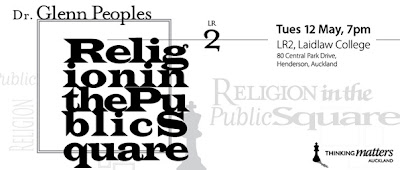
  • Dr Glenn Peoples on Religion in the Public Square

    You are invited to the next Thinking Matters Auckland event in the God, Morality and Society winter series:

    What: Dr Glenn Peoples speaking on Religion in the Public Square
    When: Tuesday 12 May – 7:00pm
    Where: Lecture Room 2, Laidlaw College, 80 Central Park Drive, Henderson, West Auckland
    Format: Talk followed by questions, answers and discussion
    Cost: Free but donations are appreciated

    According to a number of influential thinkers, it is wrong for citizens to support policies because of their religious convictions because this would make those policies unjustified in a liberal democracy. Is this true?

    Dr Peoples argues that the rules used to exclude such policies are simply not workable or reasonable. He explains that more sensible and fair models of public justification do in fact permit us to promote policies that we hold on the basis of our religious convictions. However, when the architects of these improved models realise that they have now opened the door to religious participation in public life, they change the rules, shifting the goalpost and inventing special exceptions in order to maintain that those with religious convictions should keep them out of the public square.

    Dr Peoples graduated with his PhD in philosophy from the University of Otago in 2008 after completing undergrad and graduate degrees in theology. He runs New Zealand’s top Christian podcast, Say Hello to my Little Friend and is a very clear and articulate speaker.

    Religion in the Public Square

  • Compulsory Membership of Student Associations Has to End

    VUWSA (the Victoria University of Wellington Students Association) are at it again. Just last week David Farrar slammed them for their intended ANZAC day flag burning protest and this week they put Dave Crampton on notice for defamation and then retracted it at the 11th hour confessing that it was them at fault.

    I wouldn’t have a problem with these acts if they were just voicing their own left-wing pacifist opinions or wasting their own money on hiring lawyers to draft letters in the pursuit of frivolous and vexatious lawsuits but they are not. When they do these things they are doing so on behalf of every single student at the University of Victoria; they are paying for these things out of the pockets of every single student at the University of Victoria.

    There is no way every single student (and I’m confident that I remain on safe ground even if I invoke the majority) support flag burning protests being carried out at ANZAC day memorial parades or frivolous and vexatious law suits enacted purely to shut down criticism of those with different political views than their own. I am certain that had VUWSA asked students to voluntarily donate money for such activities they would not have raised any where near enough to fund them.

    The current National government, despite the fact that they did attempt to fix this last time they were in office (but their then coalition partner, New Zealand First, messed it up), do not have a voluntary student membership and funding bill even planned. Worse, they do not even see it as a priority or properly understand the extent and nature of the problem.

    The relevant bits in the New Zealand Bill of Rights are:

    13 Freedom of thought, conscience, and religion

    Everyone has the right to freedom of thought, conscience, religion, and belief, including the right to adopt and to hold opinions without interference.

    Being forced to join and fund a political organisation that routinely expresses contrary viewpoints to your own, on your behalf and in your name, violates section 13.

    17 Freedom of association

    Everyone has the right to freedom of association.

    Being forced to join and fund a political organisation in order to obtain an education violates section 17.

    [Compulsory membership and funding also violates discrimination laws but as these are not human rights, despite the fact they are found in the Bill of Rights, I will not list them. The above real human rights are more than adequate.]

    For a brief overview as to some of what proponents of compulsory student associations have done to Matt and I see:

    Studying at Otago University no Riot
    Go on and Rubberneck

    For further reading see:

    VUWSA’s ANZAC Charade Is More Student Association Misrepresentation
    Student Choice

    If you wish to do more than read you could always email Anne Tolley (Minister of Tertiary Education) and Wayne Mapp (Minister of Defence and Associate Minister of Tertiary Education).

  • Thinking Matters Winter Series: God, Morality and Society

    Want something to do on those wintery Tuesday nights? Thinking Matters Auckland has lined up a winter series addressing apologetic issues around God, Morality and Society.

    Dates, speakers and topics as follows:

    Semester Break

    As each event in the series approaches more information on each speaker and their topic will be provided.

    Thinking Matters

  • MandM on Opposing Views in Religion and Society

    We were contacted a while back by Opposing Views and asked if we would consider allowing them to link to us. We had a look at their site, liked what we saw and said yes. We are now featured on their Religion and Society page as a recommended site.

    “Dr Matthew Flannagan” is also officially in their pool of experts to call on for when they present their for and against articles on matters of religion and society. To suggest a topic they could use Matt on you can click on the contact link on their site and recommend him 😉

  • Don’t Forget!

    Tonight!
    Thinking Matters JP Moreland on Faith and Reason at Laidlaw College at 7pm.

    Next Thursday 7 May
    Blogger Drinks from 6.30pm at Galbraiths, 2 Mt Eden Road, Mt Eden, Auckland.

    See you there 🙂