Author: Madeleine

  • Guest Post: The Virtue of Christian Dogma

    The following is authored by Dominic Bnonn Tennant, of the blog Dominic Bnonn Tennant – Developing the Mind of Christ. Please support Bnonn by clicking through to his site. Bnonn writes:

    Damian over at ‘And Slaters Go Plop’ has recently written on Dogma, arguing against its intellectual legitimacy, and asking how we can avoid it. He says,

    By ‘dogmatic’ I am describing an absolutist kind of belief that, if I could summarise in my own words, boils down to the fact that you would really rather hold to what you believe than accept an alternative even if the alternative is true. Dogma is the belief you refuse to interrogate.

    Dogma in Christianity
    “I consider my dogmatism an intellectual virtue”I’d like to note, for the record, that this is not how dogmatism is typically perceived in Christianity. Dogma is a mainstay of biblical Christianity, and where it is rejected the religion crumbles. Dogma is there whenever a doctrine is taken as authoritative, or presupposed as true—such as when we treat the Bible as the word of God. So, for the sake of avoiding confusion, let it be noted that Christians do not define dogma in such a negative way. That is not the primary meaning of the word, as most dictionaries reflect. William Shedd’s Dogmatic Theology, for instance, is a seminal and highly positive dissertation on the theoretical truths of faith concerning God and his works.

    Why is dogmatism bad anyway?
    As regards this colloquial, negative view of dogmatism, however, some questions need to be asked. Damian seems to be taking absolutism in one’s beliefs as inherently undesirable, assuming we do want truth. But this doesn’t seem a very sustainable attitude if he wishes to be consistent and avoid special pleading.

    A dogma, he says, is the belief you refuse to interrogate. But what of beliefs which are not readily interrogatable? Presumably, for instance, we all believe that our sense perception correlates accurately to a real, external world. Is that belief undesirable or unlikely merely because it cannot be readily interrogated? In fact, since we resist attempts to interrogate that belief, and don’t take them seriously, are we acting in a poor or intellectually shoddy manner? It certainly doesn’t seem so. Thus, there look to be at least some beliefs we may hold quite rightly and properly as being basically unquestionable, without shirking our philosophical responsibilities. Why is it, then, that Christians should not take the divine inspiration of Scripture as such a belief? Damian needs to make a better case as regards the negative nature of dogmatism, spell out just when it does and does not apply, and why.

    “should he jump up in dismay and hire a private detective to find me and stake out my home to verify that, indeed, I am a real person who makes real blog posts?”Similarly, what of beliefs which are held on good grounds? Damian presumably thinks he has good grounds for believing that I am a real person and not, say, an advanced computer program writing posts in a convincingly human way. Should he be condemned for resisting the compulsion to interrogate his belief in my existence as a real person on every possible occasion? Were someone to say to him: Your belief in that chap Bnonn Tennant is dogmatic because you refuse to interrogate it! should he jump up in dismay and hire a private detective to find me and stake out my home to verify that, indeed, I am a real person who makes real blog posts? In fact, is he not being entirely rational to refuse to interrogate this belief, in the absence of any good evidence that it is false? If so, why should a Christian be criticized for refusing to interrogate his belief in God, when he has no good reasons to think that it’s false?

    Good reasons
    And what, indeed, would constitute a good reason for thinking that God doesn’t exist? No doubt Damian believes there are many. But on the other hand, a delusional out-patient from the halfway house down the road might think that there are good reasons for believing I don’t exist and am in fact a complicated artificial intelligence. He could probably find all sorts of evidences which, if looked at the right way and with the right mindset, seem quite compelling; and he might produce all sorts of arguments showing that Damian really has the burden of proof. Should Damian be persuaded—should he even look at these evidences or accept this burden of proof—if he already knows that the fellow is a schizophrenic who reverts to believing that Christian bloggers are really internet-capable AIs whenever he’s off his meds? If not, why should a Christian act differently when he knows from Scripture that atheists are self-deceiving fools who deny the existence of God because of their sin?

    The skeptic’s false humility
    The last point I’d like to make is as regards Damian’s assertion that if we refuse to honestly put our beliefs to the test then we ought to show a little more humility when telling others what we ‘know’ to be true. As I’ve already suggested above, this is a perfectly silly attitude to knowledge—its implication being that a belief which is not tested cannot constitute knowledge in any proper sense.

    Even ignoring his obvious imposition of a scientific method of knowledge-acquisition onto religious or philosophical matters, where it doesn’t belong, is this reasonable? Does Damian need to verify my existence, for example, before he can say that he knows I’m not an artificial intelligence? Is this the way he really operates in terms of making knowledge claims? Or take another example: say he sees an acquaintance, Roger, at the supermarket. He doesn’t speak to Roger for whatever reason, and no one else at the supermarket knows him, so Damian is the only one to recognize him. Say Roger is arrested the next day on some charge. Damian thinks Roger can’t be guilty, because he saw him at the supermarket at the time the crime was committed. Is Damian really going to say that he does not know Roger was there, since he did not (and no longer can) test that belief? Is it reasonable for me to get up before the jury when he is testifying in Roger’s defense, and say that he ought to show a little more humility when telling them that he ‘knows’ Roger is innocent? Or imagine the situation is reversed, and Damian ‘knows’ Roger is guilty on a similar basis. Is this sort of stringent view of things really sensible? How would it cash out in the real world?

    Maybe Damian means to confine this constraint on knowledge to religious claims. This seems arbitrary, but it doesn’t get him anything in any case, since Christian beliefs enjoy far better attestation than the trivial amount of support in the example above. In fact, Christians have excellent grounds for saying that they know certain things—so why should they shuffle and slink and pretend false humility, as if they really aren’t certain when they are? A Christian grounds his beliefs in God’s word—does he then need to interrogate these beliefs, or find ways to test them, in order for them to constitute knowledge? Of course not.

    The plain fact that they are God’s own testimony is all the justification required. Thus, rather than being commendable, this “humility” of which Damian speaks is despicable. Imagine a Christian who knows the gospel witnessing to someone as follows:

    I don’t presume to say I know this, but, well, I believe you’re under God’s wrath and liable to judgment if you don’t repent and trust in the work of Jesus. And…well, I don’t know that Jesus really existed…but I’m sure you should believe anyway!

    This is certainly an ignoble way of witnessing. If we, in fact, have good reasons for believing the gospel—if we indeed know the gospel to be true—and then do not urgently entreat others to heed it, attempting to persuade them of its truth as well, we aren’t being “humble”. We are being cads. It doesn’t matter if we have tested our knowledge, or if we can defend it against attack. Speaking for myself, I can—but some Christians can’t for whatever reason. That doesn’t invalidate what they know. Christians don’t accept Damian’s views on epistemology, and neither should they.

    So let’s not throw around the “dogmatism” charge too hastily. I am proud to be a dogmatic Christian, and I consider my dogmatism an intellectual virtue. Saying that I am dogmatic is essentially the same as saying that I am a presuppositionalist in my Christian philosophy—a position which I’ve defended on many occasions. If Damian or other atheists would like to dogmatically oppose that, let them start by showing that it even makes sense to do so.

    If you are interested in guest posting on MandM see our guest posting policy.
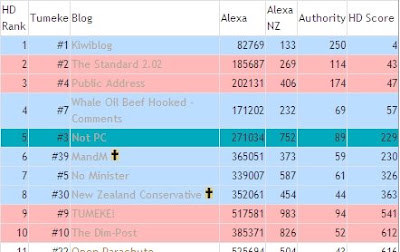
  • Half April HalfDone Stats: MandM 6th Most Read Blog in New Zealand

    These rankings are not the official results for April, just an indication of the lay of the land and how the month is progressing for everyone.

    The top 10 New Zealand blogs on public discourse are shown below, the other 250 or so that made the rankings are over here.

    We have climbed 1 spot from last month and are now only 1 point away from number 5, watch out Not PC. We are still holding the number 1 Christian blog position.

    Tomorrow marks 6 months since we switched to our own domain so we finally have the full 6 months worth of Technorati authority, meaning that from now on, when our Technorati score is compared to another blog’s, it is a fair comparison.

    Blog Rankings
    As always, thank you for your blogroll links, backlinks, comments and visits!

  • Alvin Plantinga v Daniel Dennett: Evolution, Naturalism and Christian Theism

    Given how heavy and long some of our posts have been of late, I thought something more entertaining was in order (and because Matt has been asking me for weeks to put this up). Here is the February exchange at the APA between Alvin Plantinga and Daniel Dennett.

    By way of intro, I will quote from The Prosblogion who published an admittedly biased, nevertheless entertaining, play by play of the exchange that described Plantinga as “Abraham Lincoln” and Dennett as “Santa Claus” (if you know what they look like this is very funny);

    [O]n February 21st, the Central Division of the American Philosophical Association – the main professional body of American philosophers – hosted a kind of debate. I say “kind of debate” because one philosopher gave a paper, the other commented and the first philosopher replied and the floor opened for questions. But in fact the session was a debate.

    The debate was between Alvin Plantinga and Daniel Dennett. Plantinga is one of the founders of the Society of Christian Philosophers and one of the fathers of the current desecularization of philosophy. He is widely regarded – even by his critics – as one of the finest epistemologists of the last fifty years and one of the finest philosophers of religion since the Medieval period. Daniel Dennett is one of the New Atheists and is a well-known proponent of atheistic Darwinism and critic of religion. He is widely regarded – even by his critics – as one of the most important early philosophers of mind that opened the field to cognitive science and evolutionary biology. He has contributed enormously to the serious study of the mind and its relationship to the brain.

    This is a very good exchange that is hysterically funny in places as both Plantinga and Dennett possess great wit. It is very accessible, no PhD necessary to understand it. Those present were a veritable who’s who of US philosophy, atheist and theists alike, so watch (listen really) and enjoy.

  • The Problem of Evil: Why does God Allow Suffering?

    One of the most common objections to the Christian faith is the problem of evil. Of all objections mounted against the Christian faith, prima facie, it does seem the most compelling, one of the hardest things for us to get our heads around.

    How does a Christian reconcile the fact of evil and suffering in the world in the face of a God that is omnipotent, omniscient and benevolent? If he is omnipotent then he knows about all evil before it occurs so why does he allow it? Surely if god is omnipotent then he can halt evil. If he is benevolent then why will not act against it?

    Marc raised the same question in the comments section of, Good Friday: Why Celebrate Easter? In the discussion that followed I charged him with special pleading, of holding Christians to a higher standard than the standard he tacitly holds skepticism to. As discussions in comments sections are often missed instead of continuing the debate with Marc I thought I would express myself more clearly here. In doing so I will borrow extensively from a talk Matt gave for the launch of Thinking Matters (which you will see when we finally get the video footage of the talk online). [Given the difficulties of footnoting notes and impressions from talks and knowledge obtained through years of discussions with one’s spouse (though some came from primary sources that I read myself) pretty much from this post from this point onwards, though not in entirety, should be seen as being authored by MandM as opposed to just me though it is posted by me because overall it I put it together.]

    Before addressing an objection of this nature one should first establish the correct approach to take towards addressing criticisms of the faith and be clear as to what constitutes a fair set of rules for the terms of engagement. Timothy Keller writes,

    All doubts, however sceptical and cynical they may seem, are really a set of alternate beliefs. You cannot doubt belief A except from a position of faith in belief B….

    The only way to doubt Christianity rightly and fairly is to discern the alternative belief under each of your doubts and then ask yourself what reasons you have for believing it. How do you know your belief is true? It would be inconsistent to require more justification for Christian belief than you do for your own, but that is frequently what happens.

    In fairness you must doubt your doubts. My thesis is that if you come to recognise the beliefs on which your doubts about Christianity are based, and if you seek as much proof for those beliefs as you seek from Christians for theirs – you will discover that your doubts are not as solid as they first appeared.[1]

    In making his assertions, Marc, criticised my beliefs from a position of belief, or faith, in the correctness of his own. He asked a standard of my beliefs that he did not require for his own.

    When one encounters a charge like the one Marc raised, I understand that even if Marc didn’t set the problem out in the manner the world’s top atheist philosophers might have done, his question nevertheless hides a disguised argument that warrants addressing. Daniel Howard-Snyder states,

    [T]he theoretical “problem” of evil is often expressed in the form of a pointed question. God is able to prevent evil and suffering and He would know about them before they happened, right? Moreover, since He is unsurpassably good, surely He would not permit them just for the fun of it. So why doesn’t He prevent them?[2]

    In the literature this argument is typically more formalised so that it reads something like:

    [1] That as God is omniscient and omnipotent (all-knowing and all-powerful) he would be both able to know about all the suffering that exists and act to prevent it;
    [2] Given that God is good, he would not allow such evil to exist unless he had a good reason for it.

    [2] is what Snyder calls a justifying reason “a reason that was compatible with his never doing wrong and his being perfect in love.”[3]

    These premises entail that if God exists then he must have a good reason for allowing suffering. I agree with Marc and those who have gone before him on this part of their objection, I am sure that God does had a good reason. However, the question that follows from here, which is typically “then, what is God’s reason for allowing suffering?” which I concede has powerful rhetorical force, contains a critical flaw.

    If one is to look at the question purely rationally it is should become apparent. This flaw is widely noted and discussed in the literature by the likes of Steve Wykstra, Alvin Plantinga, Peter Van Ingwagen, William Rowe, Micheal Tooley, William Alston, and Howard-Snyder to name a few.

    So what is this flaw? I have not contested the claim that if God exists then he must have a good reason for allowing evil. However this has not satisfied Marc who wants to know what that reason is. Asking this latter question tacitly attempts to add a further premise to the above argument,

    [3] If a Christian cannot provide a detailed account of God’s reasons in [2] then it follows that God has none.

    This assumed premise is the point at which the argument succeeds or fails. If the failure to provide God’s reasons in detail does not provide any grounds for thinking that God in fact has no reasons then failure to answer the question, while deeply perplexing and emotionally unsatisfying, does not establish a reason for rejecting God.

    Alvin Plantinga provides an illustration of the flaws inherent in [3]. Paraphrasing him; suppose I ask you too look in a tent and tell me if there’s a St Bernard inside. In this instance, I would have every reason to trust what you say you see as a St Bernard the sort of thing I would expect you to be able to observe if it were inside a tent. But suppose I ask you to look inside and tell me if there are any ‘no-see-ums’ inside the tent (a no-see-um is gnat with a big bite that is small enough to pass through the netting of a tent, as such it is too small to see). Now, I have no reason to trust your answer in this instance, as you can’t see no-see-ums. Here’s the problem; the sceptic is assuming that if there is a reason for our suffering then it is more like a St Bernard than it is like a no-see-um. However, this is simply assumed, not argued for. It is certainly, if not at least possible, that we suffer for a reason but that that reason may not be something that we can easily detect.[4]

    As Keller notes, “we see lurking within this hard nosed skepticism an enormous faith in one’s cognitive faculties. If our minds cannot plump the depths of the universe for answers to suffering, well there can’t be any!. This is blind faith of a tall order.”[5]

    For the problem of evil to succeed the sceptic must provide some argument as to why God’s detailed reasons for allowing evil are like St Bernards and such an argument must be grounded on premises that Christians are rationally required to accept or else we could simply escape the charge by justifiably rejecting the premise.

    Now if a finite human being, such as myself, with limited factual knowledge, limited perspective in time and space and an imperfect moral character cannot produce a good reason as to why evil occurs then I fail to see why the Christian must accept the conclusion: ‘therefore, God cannot possibly have any such reasons.’

    William Alston has noted that the sceptic argument in this context is a bit like a person who, with no background in quantum physics, decided that when he failed to understand why the world’s best physicist held a particular view that if followed that the physicist obviously had no reason to hold it.[6]

    Suppose I am wrong. Suppose that the failure to provide an answer does mean that it is improbable that one exists and from this, that it follows the existence of God is improbable given the existence of evil. What follows from this? Nowhere near as much as you might think because the fact that the existence of God is improbable on one fact does not mean that it is improbable per se.

    Plantinga notes that there are many beliefs that we hold to which are improbable on some body of evidence we believe. If I was playing poker was dealt four aces, then this is highly improbable given the number of cards in the pack and number of possible combinations that I could have been dealt. Yet I am rational in believing that I was dealt four aces as I can see that I have four aces in my hand (to give but one defence).

    Moreover, it is well known that a belief can be improbable on one sub-set of beliefs a person possesses and yet highly probable by every thing that the person believes. For example, if I know my friend is French and I know that most French people cannot swim then my belief that my friend is a swimmer is improbable based on this set of evidence. On the other hand, suppose I know that my friend is a life guard by profession and that all life guards, even French ones, can swim. Then despite the fact that a belief is improbable on the basis of one set of evidence, it is not necessarily improbable on the whole.

    Finally the question needs to be raised about how well Christianity performs regarding the existence of evil relative to alternative views. Some Philosophers have suggested that the existence of evil might also make the non-existence of God impossible. I can only sketch the reasons briefly but they are worth noting.

    First, in order for suffering to exist sentient life forms must exist. However, there have been various discoveries from contemporary physics which establish that a universe evolving life is extremely improbable. For life to evolve there are around 15 constants necessary, each must have precise values and if they were off by a million or even one in a million, life could not evolve. Even if some of these constants had differed by 1 in 10 to the power of 60 then life could not evolve.[7]

    Second, some of the worst forms of evil involve human cruelty and evil but in order to identify these things as such this requires the existence of moral principles or rules that prohibit this kind of conduct and deem them as cruel or evil. Now one question that can be raised by many in the literature, William Lane Craig and J.L. Mackie spring to mind, is whether the existence of objective moral principles is likely on an atheistic view of the world.

    Is it likely that in a universe composed entirely of matter and energy that objective principles or rules could come into existence independently of any mind? Many people find this a puzzling question. My point is not to endorse (or reject) these lines of inquiry; it is simply to show that it is not obvious that the typical sceptical view is any more defensible given the existence of evil than belief in God is and more work would need to be done by the sceptic to show that it is.

    So my response to the problem of evil then is three fold. The objection relies on an assumption that is false or at any rate, an assumption that no reason is forthcoming as to why a Christian should accept it. Further, even if evil does make the existence of God improbable one would need further argument to show that this meant Christianity was irrational. Finally, even if the sceptic could do this it the problem of the mirror remains, one would need to show that the alternatives to Christianity, such as skepticism, were better able to account for the existence of evil. As none of these criteria have been met, I remain a Christian.

    [1] Timothy Keller Reason For God: Belief in an Age of Skepticism (New York: Dutton, 2008) xvii-xviii.
    [2] Daniel Howard-Snyder “God, Evil, and Suffering” in Reason for the Hope Within (Eerdmans 1999), ed. Michael J. Murray, 3, http://www.ac.wwu.edu/~howardd/god,evil,andsuffering.pdf.
    [3] Ibid, 4.
    [4] Alvin Plantinga Warranted Christian Belief (Oxford University Press: 2000) 466.
    [5] Keller Reason for God xvii-xviii.
    [6] William Alston “Some Temporary Final Thoughts on Evidential Arguments from Evil” in The Evidential Argument from Evil ed Daniel Howard-Snyder (Bloomington Indianapolis, Indiana University Press: 1996) 317.

    [7] Francis S. Collins The Language of God: A scientist Presents Evidence for the Existence of God (Free Press, 2006) 75.

  • JP Moreland on Faith and Reason

    You are invited to the next Thinking Matters Auckland DVD screening:DVD Screening

    What: Dr JP Moreland on Faith and Reason
    When: Tuesday 28 April – 7:00pm
    Where: Lecture Room 2, Laidlaw College, 80 Central Park Drive, Henderson, West Auckland
    Format: DVD followed by discussion (Matt will be available to fire questions at)
    Cost: Free!

    Dr Moreland is distinguished professor of Philosophy at Talbot School of Theology in California. In this DVD, he will talk about the importance of truth in religion, the evidence for monotheism and his own personal experience in coming to the Christian faith.

    With degrees in philosophy, theology and chemistry, Dr Moreland has taught at several universities throughout the USA. He has authored and co-authored books including Philosophical Foundations for a Christian Worldview; Christianity and the Nature of Science; Scaling the Secular City; Does God Exist?; Immortality: The Other Side of Death; The Life and Death Debate: Moral Issues of Our Times. He is co-editor of Christian Perspectives on Being Human and Jesus under Fire: Modern Scholarship Reinvents the Historical Jesus. His work appears in journals such as Christianity Today, Journal of the Evangelical Theological Society, Philosophy and Phenomenological Research, and The American Philosophical Quarterly.

    Thinking MattersHe is a very good, clear and easy to follow speaker so bring your popcorn and don’t miss this screening!

  • How to become a Famous Blogger

    As MandM have recently been flagellated with the following non-sequitur [no link as the accusers righteously distance themselves from seeking readership from any source not purist enough to already follow their blogs for blogging solely for joy in their niche category and as we would hate to offend by increasing either’s Technorati ranking (is mentioning that both have Technorati accounts an accusation of hypocrisy?) we respectfully do not link to them here]. The non-sequitur alleged against us is,

    [1] If you appear to pay attention to how your blog ranks, its readership and other stats; then
    [2] You are blogging with the wrong motives.

    The conclusion does not follow from the premises. The missing premise is that if you pay attention to something then this is your primary motive. It is like saying that because you pay attention to how much you are being paid, your only motivation to work is to get paid and then in a bizarre attempt to avoid materialism allow your family to starve with no income.

    We realised, as we wallowed in our “shame” and “self-indulgence” for expressing stokedness at being the number 1 New Zealand Christian Blog in HalfDone’s rankings for March 09, that our only option was to embrace the dilemma and confess our sins; yes we have a tracking counter *sob* and a Technorati account and not only do we publish the top 10 NZ Christian blog rankings in which we consistently feature somewhat prominently but when we feature at the top of a New Zealand blog ranking report it does give us a brief, momentary surge of accomplishment [I know, I know, penitence, penitence for such wanton emotions – our accusers pay no attention whatsoever to their readership and we should follow their pietistic example].

    As such, we feel obligated to share our strategy, it is the least we can do to make up for our indiscretions. In Well I’ll Be Blogrolled! Dr Doug Geivett provides sage instruction as to how to obtain your 15 minutes in the chart published below. We adhere to this religiously (and we spend many hours each week researching and writing our blogs when we could be getting on with our lives but I am sure that has nothing whatsoever to do with our ranking “success” and speaks only to our motives). /sarcasm>

    Famous Blogger Guide

    I will leave it to our readers to work out which route we have taken.

  • Christian Blog Ranking Report for March 09 – HalfDone UPDATED

    UPDATE: There has been an error in the ranking calculations and I have had to adjust the top 10 and list of those making the top 100 below. Scrubone explains why here and in the below comments. Apologies and congrats (as applicable) to those affected.

    Here are the top 10 NZ Christian blogs based on HalfDone’s NZ blog stats for March; these stats make up part of the calculations for the MandM top 10 NZ Christian Blog rankings for March 09:

    Top 10. name of blog HalfDone Rank

    Of Note:

    Note: This list only includes Christian blogs that are openly identified as Christian blogs on HalfDone’s ranking list.

    When Tumeke’s March stats are out we will compare them with HalfDone’s and publish the overall MandM top 10 NZ Christian Blog rankings for March 09 later in the month.