Author: Matt

  • Madeleine Registered

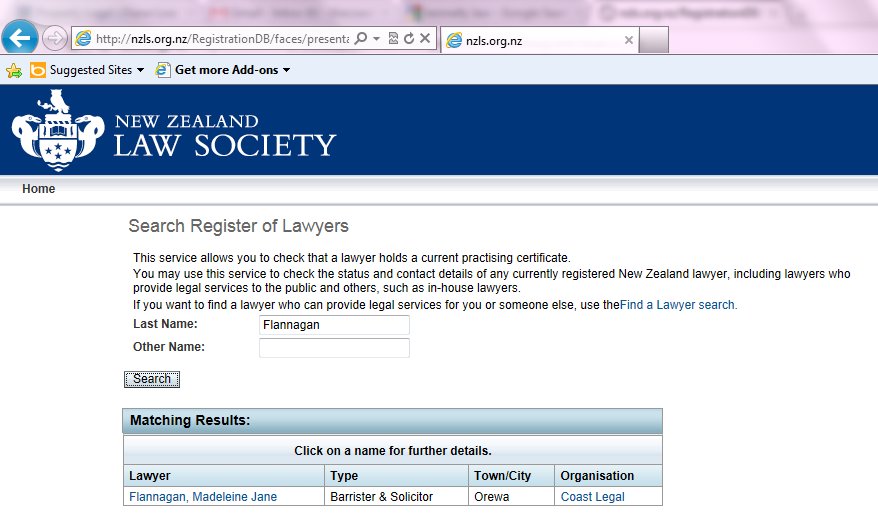
    News that many may have missed while we were in our moving house and not blogging mode is that Madeleine has been admitted to the Register of Lawyers, this means that she may now practice law and work in the areas restricted by law for lawyers. You can even go to the New Zealand Law Society Register of Lawyers and look her up.

    The New Zealand Law Society Register of Lawyers

    I am also rather chuffed to share that after working for her firm, Coast Legal, for a relatively short time she has been offered and has accepted the position of Associate. As I understand it this was based on her performance thus far. She is currently working primarily in family law doing a number of child protection cases where her background in legal philosophy seems to really be an asset as well as the other general areas of family law. She also does a bit of criminal, traffic, estate, home schooling law and civil work and has recently been asked to first chair a High Court matter by another firm who are aware of her arguing skill; she’ll be doing that at the end of the month.

  • Thinking Matters Youth Conference

    This Saturday is the first, of hopefully many, Thinking Matters Youth Conference, the schedule is  below.  I am leading a breakout session on Moral Relativism

    WHEN: Saturday, February 18
    WHERE: Greenlane Christian Centre, 17 Marewa Rd, Greenlane, Auckland
    COST: $10


    Schedule:
    10am Registration
    10.30am Jeff Tallon – Is Science a Threat to Faith?
    11.30am Sean McDowell – Is Faith Blind? (via Skype)
    12.15pm Lunch
    1pm Breakout Sessions 1

    • Stream 1: Is morality relative and does it matter? – Matt Flannagan
    • Stream 2: How can one religion be “right” and the others “wrong”? – Trevor Mander
    • Stream 3: Why doesn’t God do something about the evil in the world? – Ben Carswell
    • Stream 4: Does God get mad when we doubt? – Jason Kumar and Dominic Bnonn Tennant
    1.45pm Breakout Sessions 2 (repeated)
    2.30pm Tim McGrew – Is the Bible Reliable? (via Skype)
    3.30pm Q&A Panel – Jeff Tallon, Ben Carswell, Matt Flannagan, and Trevor Mander
    4.15pm Conference closes
  • Is Ethical Naturalism more Plausible than Supernaturalism? A Reply to Walter Sinnott-Armstrong Part I

    This is  first half of the paper I presented to the Naturalisms in Ethics Conference at Auckland University last year.

    In many of his addresses and debates William Lane Craig has defended a Divine Command Theory of moral obligation (“DCT”). In a recent article Walter Sinnott-Armstrong has criticized this contention.[1] Armstrong contends that even if theism is true then a particular form of ethical naturalism is a more plausible account of the nature of moral obligations than a DCT is. This paper critiques Armstrong’s argument.

    Craig’s contention
    Craig’s contention is that if theism is true then we can plausibly explain the nature of moral obligation by identifying obligations with God’s commands analogous to the way “we explain the nature of water by identifying it with H2O, or explain the nature of heat by identifying it with molecular motion.”[2] By “God” Craig means a necessarily existent, all-powerful, all-knowing, loving and just, immaterial person who created the universe.

    This emphasis, both on God as a loving and just being and identifying moral obligations with God’s commands suggests that Craig defends a version of the modified DCT defended by Robert Adams,[3] William Alston[4] and C Stephen Evans[5]. Both Adams and Evans have argued, like Craig, that if God exists then his commands “best fill the role assigned to wrongness by the concept”.[6] Much of Craig’s arguments can be seen as an appropriation and popularisation of Adams.[7]

    Armstrong’s Argument from Harm
    Walter Sinnott-ArmstrongArmstrong contends that such a position is “incredible”[8], he states:

    There is a much more plausible foundation for morality. It seems obvious to me, and to everyone who does not start with peculiarly religious assumptions, that what makes rape morally wrong is the extreme harm that rape causes to rape victims.[9]

    We do not need a “new supernatural level” for morality because a natural property, the property of harming others without an adequate reason, fulfils the role assigned to wrongness by the concept better than divine commands do. Armstrong provides two arguments for this conclusion.

    (a) The harm account makes moral obligations more objective than a DCT does;

    (b) The harm account is more economical than a DCT.

    Armstrong contends that his argument refutes, not just Craig, but any theistic account of ethics, “Other theists might try to give better arguments for a religious view of morality. I don’t see how they could avoid all the problems in Craig’s account without leaving traditional Christianity far behind.”[10]

    I will address arguments (a) and (b) below. However, it is worth noting that, as stated, Armstrong’s conclusion here misses the point. He contends that everyone who does not start with peculiarly religious assumptions will see that the harm-based account is more plausible than a DCT. But Craig’s contention is that if God exists then a DCT is a plausible account of the nature of moral obligations. Neither Craig nor Adams contend that a DCT is the most plausible theory in the absence of religious assumptions. They contend that a DCT is the more “attractive theory, given those [theistic] beliefs, than any other meta-ethical theory is, given non-theistic (more…)

  • Back from San Francisco: A Belated Report

    MandM has been quite of late, this is because Madeleine and I have been very busy.  With moving house in the midst of Christmas and New Years and Madeleine working part-time in a law firm and so on, we’ve had little time to blog. We are now set up, to some extent, and so this post will be a belated comment on my recent trip to San Francisco.

    In November I flew to San Francisco where I attended I attended the  Meeting of the Evangelical Theological Society (ETS), The Annual Meeting of the Evangelical Philosophical Society (EPS), The Evangelical Philosophical Society Apologetics Conference and The Annual Meeting of the Society for Biblical Literature (SBL) and American academy of religion.(AAR). While I would love to give detailed commentary on each session, to do so would require several blog posts of inordinate length, instead I will simply summarise what went down.

    I arrived in San Francisco at around 4pm  on the 15th. I presented my first paper at 8:30am the next morning. My paper was a critique of Walter Sinnott Armstrong’s arguments against divine command theory meta-ethics. Armstrong contends that the nature of moral obligation is best explained by identifying moral obligations with the natural property of harming others without justification, and, focusing largely on Craig’s work, argues this is superior to divine command ethics. I argued: (a) his argument fails to note the conditional nature of Craig’s (his main target’s) contention that if theism is true moral obligations are best explained as divinecommands (b) Armstrong’s does not provide a better account of moral objectivity (c) Armstrong’s account is not more economical than a divine command theory. (d) Even if it were an economical account, it does not explain various features of obligation such as (i) the social nature of moral obligations (ii) the fact that moral obligations constitute a decisive reason for acting and (iii) the specific moral content of obligations; as well as a divine command theory. All in around 30 minutes!!! The paper was very well received, with several people asking me to forward them a copy. I plan to get it published later this year.

    The rest of the morning was filled with me hearing various papers on moral theory and philosophy of religion all of which were interesting and stimulating. These panellists all shared similar perspectives yet were astutely critical of each other’s arguments. Particularly interesting was the dialogue between Baggett and Craig. Some of the issues here were technical and deserve further discussion so I plan to blog on this dialogue in more detail in the future. But in sum: Craig has defended a counterfactual: if God did not exist then moral obligations would not exist. Baggett  argued for various reasons that this is too strong; if God, the creator and sustainer of the universe, did not exist, the universe would not exist. To make sense, Craig’s claim needs to envisage a compossible world, which is like the actual world in all respects except that God does not exist, if it’s like the world in all other respects however, then it has all the features of the world God has created – and hence the resources for something like moral obligations to exist. Instead, Baggett contended, one should argue that a world with God provides a better explanation of the nature and existence of moral obligations than a world without God does. This means the theist does not have to argue, with Craig, that there is no adequate secular account of the existence of moral obligations, only that a divine command theory is more plausible than such accounts. Both Craig and Baggett made telling points which I will have to elaborate on some other time. highlight of Wednesday was the afternoon session. A panel discussion of David Baggett and Jerry Wall’s new book “Good God: The Theistic Foundations of Morality”. This book is the latest defence of divine command theory ethics, recently published by Oxford University Press. Baggett and Walls sketched briefly the content of the book and Paul Copan and William Lane Craig offered critical commentary, to which Baggett and Walls responded.

    Thursday started with an excellent critique of evolutionary (more…)

  • Madeleine Grounded

    As regular readers will know we have spent a good chunk of this year focussed on planning and fundraising to get to the USA to speak at conferences in South Bend, Indiana and in San Francisco. Yesterday we should have been on a flight heading to the USA but we had to make the tough call to cancel Madeleine’s planned when Madeleine’s non-immigrant visa failed to come through in time.

    Twenty years ago, when Madeleine was 18 and not a Christian, she committedwhat she calls “an act of teenage stupidity” and was convicted of theft and had to do some community service. In New Zealand this conviction is covered by clean slate law but this law does not apply to other countries and the US ask all their visitors seeking visa waivers “have you ever been convicted of a crime of moral turpitude?” Anyone answering “yes” has to apply for a non-immigrant visa. Now Madeleine applied for one of these last time she went to the US some 13 years ago and was granted it in 2 days. This time she phoned up and was told provided she applied about 4 weeks out from her planned date of travel she should be fine – especially as her conviction is now 20 years old and she has never been in trouble since and she has been granted a visa before. She applied with nearly 6 weeks in hand but at the point we had to make the call, her application was still “pending” (and it still is as I write this). In addition, the American Consulate are still holding her passport so they can put her visa in it… With no passport and no visa she could not get on the plane.

    Given that we were going to Indiana because Madeleine was speaking at Notre Dame and now she is not we decided to change my trip so that I will now just go to San Francisco and deliver all my planned talks (I will now give our joint talk to the SBL by myself). I now will not leave New Zealand until Tuesday 15 Nov.

    We have been able to get a lot of refunds thankfully with not too much in the way of penalty fees and we were able to get a new flight for me at the same ticket price so once we know what it will cost for me to go, any left-over donated monies will be held over to next years cluster of EPS and SBL conferences, as at the very least I expect to be travelling to the US to speak at them – Madeleine will come with me if the US Department of State have actually processed her visa application by Nov 2012… (You can check the status of her application by going here and clicking on the link in the right hand column under “CASE STATUS CHECK” and using “control F” and entering: 20112782761 – that is her)

    As you can imagine we are deeply disappointed by this turn of events and we have had a fairly flat few days as a result. I am pleased to be able to share that there is some good news to among the bad, Madeleine was last week offered a job in a law firm working part-time for an employer who understands and is willing to accommodate her pain disability caused by her car accident in 2008. Her trip being cancelled has meant she has been able to start proper this week so that has given her something to focus on.

  • Contra Mundum: When Scientists Make Bad Ethicists

    One thing I find particularly frustrating is reading commentary on theology and philosophy written by scientists. To be fair, some scientists I have read are informed and do offer astute and insightful comments; commonly, however, one finds a person who is undoubtedly brilliant in their own field, writing with confident gusto, articles that fail to understand the most basic theological and philosophical distinctions.

    Jerry CoyneA good example can be seen in a recent USA Today article by influential biologist Jerry Coyne entitled, As atheists know, you can be good without God. Coyne, an outspoken atheist, is disturbed that many Americans, including some prominent scientists, believe that our instinctive sense of right and wrong is “strong evidence for [God’s] existence.” He ventures into moral philosophy to explain why this is clearly mistaken.

    From the get-go Coyne demonstrates he does not understand the issues.

    It is necessary to accurately understand the position Coyne is criticising before we look at the paucity of his critique. The argument that our instinctive sense of right and wrong “is strong evidence for [God’s] existence” found its most important formulation in a 1979 article by Yale Philosopher Robert Adams. In it, Adams noted that we instinctively grasp that certain actions, like torturing children for fun, are wrong; hence, he reasoned, we are intuitively aware of the existence of moral obligations. According to Adams, the best account of the nature of such obligations is that they are commands issued by a loving and just God. Identifying obligations with God’s commands can explain all the features of moral obligation better than any secular alternative. Consequently, the existence of moral obligations provides evidence for God’s existence.

    It is important to note what Adams did not claim. Central to Adams’ argument, and to pretty much every author who follows him, is a vital distinction; this is the distinction between the claim that moral obligations are, in fact, divine commands and the claim that one cannot recognise what our moral obligations are unless one believes in divine commands or some form of divine revelation. Adams illustrates this distinction with the example of H20 and water.

    Contemporary chemistry tells us that the best account of the nature of water is that water is, in fact, H20 molecules. This, of course, means that water cannot exist unless H20 does. However, it does not mean that people who do not know about or believe in the existence of H20 cannot recognise water when they see it. For centuries people recognised, swam in, sailed on and drank water before they knew anything about modern chemistry.

    This distinction has important implications. The claim that moral obligations are, in fact, commands issued by God does not entail that people must believe that God exists and has issued commands in order to be able to recognise right and wrong. These are separate and logically distinct claims.

    Coyne conflates this distinction from the outset. After noting that some people believe that moral obligations provide strong evidence for God’s existence, he claims that this is an oft-heard argument, “‘Evolution,’ many argue, ‘could never have given us feelings of kindness, altruism and morality…’;” to this he rejoins that, “scientists studying our primate relatives, such as chimpanzees, see evolutionary rudiments of morality: behaviours that look for all the world like altruism, sympathy, moral disapproval, sharing — even notions of fairness.”

    This is confused. Apart from the fact that no one who cites morality as evidence for God actually makes the argument about evolution that Coyne sets out, the claim that moral obligations cannot exist independently of God is not the claim that without God people would not have moral feelings. Feeling that one has an obligation to do something and actually having an obligation to do it are clearly different things. People can feel that they have a certain obligation without it actually being the case that they do.

    Coyne makes a similar mistake when he argues that secular European countries like Sweden and Denmark “are full of well-behaved and well-meaning citizens, not criminals and sociopaths running amok.” This  (more…)
  • The Podcast: 20 Tough Questions on Life FM’s “The Forum”

    The Podcast of last night’s show on Life FM’s The Forum, which featured this blog’s Madeleine Flannagan, along with Frank Ritchie and Dale Campbell, answering 20 Tough Questions about God, the Bible, Christianity, Church and life, thrown at them by host George Penk, is now available online in its entirety.

    Click the image to listen online or use these links for the MP3s:

    Click to Listen to Madeleine Flannagan on Life FM's The Forum answering 20 Tough Questions

    The Forum 18 September 2011: 20 Questions Part 1

    The Forum 18 September 2011: 20 Questions Part 2

    Normally Life FM only release a 20 minute highlight podcast of The Forum but they announced on Facebook today that due to the sheer volume of requests for the whole show they decided to make an exception. I think that says a lot about how hungry people are for Apologetics and what a good job Madeleine, Frank, Dale and George did.