Category: Ethics

  • Nonsense on Stilts: Non-Discrimination Rights

    When the Human Rights Act was passed in 1993 I supported the writing of non-discrimination rights into law. At that time I, like many New Zealanders, believed that people had a right to not be discriminated against that the government should protect. Since then, reflecting on the issue has lead me to change my mind. I am now inclined to think that non-discrimination rights do not exist, they are “nonsense on stilts”. Laws which purport to recognise and protect them are recognising and protecting something that does not exist.

    My position now is that discrimination is not wrong, it is morally neutral. It is justified and reasonable to discriminate on certain grounds in certain contexts, and it is unjustified to do so in other contexts. When it is unjustified, what makes it so are factors that have nothing to do with discrimination; these factors would be problematic if applied equally.

    Jake the muss: not a skinny asian womanBefore elaborating my reasons for being sceptical about such rights, let us be clear as to what denying non-discrimination rights does not mean. It does not mean I believe that it is permissible for people to refuse to serve ethnic minorities because one holds to false sterotypes and has unwarranted hatred towards those minorities. Nor does it mean I support depriving women or African Americans of the vote. Likewise I do not support racist lynchings or gay bashings.

    A sceptic about anti-discrimination rights can oppose all these things and still not be committed to supporting the existence of anti-discrimination rights. All that is entailed by my scepticism is that these thing are not wrong because they violate a right to not discriminate, and its clear to me that this is true; they are wrong for other reasons.

    Discriminating against minorities in the manner suggested above is wrong because we have duties to not stereotype and treat people with contempt. If we treated everyone equally in this way it would still be wrong. Similarly, racist lynchings are wrong because they involve kidnapping, assault and homicide. If people were equal-opportunity lynchers who indiscriminately lynched people of all races, sexes, lifestyles and degrees of ability, it would still be wrong for them to do so. Depriving people of the vote is wrong because people have a right to vote, the right is not attached to sex or race, and so on. The point is that the wrongness of these sorts of practices can be adequately explained, and I think is more plausibly explained, without recourse to an alleged right to not be discriminated against. An appeal to “discrimination” misdiagnoses the moral problems with the action complained of.

    Why Discrimination is Not Wrong
    It is not wrong to discriminate. To discriminate against one person in favour of another is to treat the former less favourably than the latter. The problem is that, so defined, discrimination is clearly not wrong. In fact, discrimination is essential to any moral thinking at all.

    To make a moral judgement condemning a particular action involves adopting a less favourable stance towards those who perform that action. We condemn particular actions, and if a person doing those actions lacks an adequate excuse we blame and censure that person for what he or she did. We expect the person to feel guilty and to make appropriate apology and reparations. On the other hand to judge an action is right (more…)

  • Dialogue with Randal Rauser

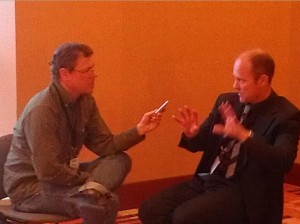
    When I was in Baltimore last November I caught up with fellow theologian and blogger Randal Rauser. Randal is professor of Theology at Taylor Seminary in Edmonton Canada.

    Randal and I have had some spirited but cordial exchanges in the past, including a panel discussion at the Society of Biblical Literature in 2010.While we do not always agree I find him to be a very astute critic of my work.

    Randal Rauser and Matthew Flannagan

    Randal asked to interview me in Baltimore on the topic “Matthew Flannagan on God, ethics, and divine commands” so the readers of his blog could get a take on the positions I have staked out. The interview is now available at the link above.

  • Religious Freedom and Non-Discrimination

    Currently I am working on a post on the issue of non-discrimination rights and the morality of discrimination. In the mean-time  I thought I would highlight the thoughtful commentary from James-Michael Smith in this video.

  • Talks from Baltimore Available

    For those who are interested, the Evangelical Theological Society has put recordings of all the papers presented in Baltimore online for a price of $4 each. My 2 presentations are available here. The talks include the Q&A so during the second presentation Professor Swinburne from Oxford University can be heard offering critical comments on my paper.

    I found that the website says that most people who bought recordings of my talks also bought recordings of a paper by Gordon Otese, Associate Professor of Old Testament and Hebrew at Heritage Theological Seminary, Cambridge, Ontario, who presented a paper in the old testament narrative session at the ETS, entitled “The Use of 1 Samuel 15 as a Critique of Holy War Hyperbole“. I purchased a recording of Otese’s paper and found that it discusses, critiques and expands upon some of my work on the existence of hyperbole in 1 Samuel 15.

    UPDATE: My third talk “Morality and Gods Commands: Answering Common Objections” presented at  the  Annual Apologetics Conference of the Evangelical Philosophical Society  is  now available.

  • Matt to speak at the EPS Apologetics Conference in Baltimore on Morality and God’s Commands

    This blog’s Matthew Flannagan has been invited to speak at the 12th Annual Apologetics Conference of the Evangelical Philosophical Society in Baltimore, USA. The theme of this year’s conference is Reasonable Faith in an Uncertain World. Matt’s talk is titled “Morality and God’s Commands: Answering Common Objections.” The blurb for Matt’s talk is as follows:

    EPS Apologetics Conference

    “It is widely believed in contemporary philosophy that morality does not depend on God. Theories that attempt to identify our moral obligations with God’s commands are believed to be subject to several important objections. In this talk I will offer reasons for rejecting this position. I will clarify what it means to claim our moral duties depend on God’s commands and I will distinguish this claim from various misconceptions. I will then examine the most common objections to this position and that show they fail.”

    Matt is the only New Zealand speaker and he will be speaking alongside some of the top Christian thinkers and speakers in the world such as Dr. Gary Habermas, Sean McDowell, Dr. Paul Copan, Mary Jo Sharp, Dr. Craig Hazen, Dr. John Bloom, Greg Koukl, Dr. Mark Foreman, Patty Houser, Dr. Angus Menuge, and many more. You can see a full list of speakers here. Check out the sessions and tracks for the the EPS Apologetics Conference, which runs from 21-23 November 2013, and register here.

    Matt is also speaking at the annual meetings of the Evangelical Theological Society, on Feticide, and the Evangelical Philosophical Society, on Divine Commands re Abraham and Issac,  in Baltimore earlier in the week. (See Matt to speak at the 2013 Evangelical Theological Society in Baltimore on Feticide and Matt to speak at the 2013 Evangelical Philosophical Society in Baltimore on Divine Commands re Abraham and Isaac).

    If you are minded to support his and my fundraising efforts to get him to Baltimore for his 3 speaking engagements next week, please consider donating using one of the methods in the side bar.

  • Madeleine to Speak at the ACTIV8 Pro-Life Training Day in Wellington

    This blog’s Madeleine will be speaking at the ACTIV8 Pro-Life Training Day in Paraparaumu, just North of Wellington, on 23 November 2013.  ACTIV8 is a pro-life formation event that is hosted by Stayin’ Alive every year.  (I was originally scheduled to speak but as I will be in the USA Madeleine is taking my place.)

    ACTIV8 Pro-Life Training Day 2013

    From the organisers:

    “[The event] features knowledgeable and informative speakers who present formation sessions on issues such as practical pro-life apologetics, understanding the media and political issues, as well as having a special focus on introducing you to some great pro-life resources and projects that you can adopt.

    This year’s Pro-Life Summer Training Day features presentations from:

    Madeleine Flannagan:
    ‘How to refute pro-choice arguments’

    Bob McCoskrie:
    ‘How to talk to the NZ media about abortion’

    Kate Cormack & Jordan Verrent:
    ‘Skills for effective pro-life outreach’

    Brendan Malone:
    ‘Get activated for the culture of life!’

    Rachel Wong:
    ‘Understanding NZ abortion laws’

    Dr. Michael McCabe:
    ‘Informed consent and abortion’

    Plus…

    -Abortion Apologetics Q&A panel with Madeleine Flannagan and Brendan Malone
    -Sessions on: ‘What is informed consent?’, and: ‘Using social media to build a culture of life’
    -Small group discussions and activities
    -Heaps of opportunities for networking with other passionate pro-life people!
    -Resources and t-shirts for sale”

    To find out more and to register head to Stayin’ Alive.

  • Is a Divine Command Theory Psychotic? Sam Harris on Divine Commands Part III

    William Lane Craig v Sam HarrisIn Sam Harris on Divine Commands Part I I criticised Harris’ characterisation of divine command meta-ethics. I refuted Harris’ contention a divine command theory is pscyopathic in Is a Divine Command Theory Pscyopathic? Sam Harris on Divine Commands: Part II. In this last post in this series, I will address Harris’s contention that a divine command theory reflects a “psychotic moral attitude”. Harris says a divine command theory is “psychotic because this is completely delusional. There’s no reason to believe that we live in a universe ruled by an invisible monster called Yahweh.”

    Harris’s argument in this regard seems to involve four premises. [1] A person can accept a divine command theory only if her or she believes in the existence of an invisible monster called Yahweh (which Harris earlier identifed as an “iron age God of war”); [2] there is no evidence for an invisible monster called Yahweh; [3] to believe something without evidence is delusional; [4] to be delusional is to be psyhcotic.

    Turning to [1], a divine command theorist holds that the most plausible account of the nature of moral obligations is that moral obligations are constituted by, or are identical with, God’s commands. God is understood by the theorist to be a being worthy of worship, a necessarily existent, essentially loving and just, omniscient, omnipotent, personal being who created, sustains and providentially guides the universe. Holding this position does not commit one to believing in an invisible monster or a stone-age God of war for two reasons.

    First, a divine command theory is compatible with being an athiest. Plantinga has noted that a person could argue that moral obligations are best accounted for in terms of God’s commands and then conclude from this that if God does not exist then moral obligations do not exist either. In this sense a divine command theory could be a premise in an atheistic argument for nihilism. Interestingly, when I was a grad student in the 90’s I attended a conference where one of the presenters offered an argument for nihilism very much along these lines.

    Second, most divine command theorists accept the existence of moral obligations. Most would accept, for example, that moral claims such as that it is wrong to torture children purely for entertainment are true, and that, the action of torturing children in this way actually has the property of being wrong, further, that it does so independently of whether we or our society believe that it does.

    A divine command theorist does not have to identify this God with Yahweh. Obviously, divine command theorists who are Jews or Christians will do this, but that’s in virtue of their Judaism or Christianity, it is not in virtue of their belief in divine command meta-ethics. Strictly speaking a divine command theorist could reject the identification and still maintain that moral obligations are best identified with the commands of God.

    Third, even if one does identify God with Yawheh, it is evident that such an identification would rule out construing God as “an invisible monster” who is, according to Harris, ” a stone-age God of war”. If Yahweh is identified as a loving and just, invisible person, then he is neither an invisible monster or a stone-age God of war. Of course, a person who held this view might grant that at one piont in history, perhaps in the late Bronze Age or early Iron Age, various people groups believed that Yahweh was a God of war, but by identifying God as Yahweh, such a person is explictly rejecting this conception. The fact that people once concieved of something a certain way tells us nothing about whether that thing is, in fact, that way. Harris may as well castigate contemporary atomic theory by pointing out that ancient greek atomists held scientifically indefensible understandings of an atom.

    So Harris’ [1], the contention that a person can accept a divine command theory only if they believe in the existence of an invisible monster is false.

    Turning then to [2], the contention that there is no evidence for the existence of an invisible monster called Yahweh. Harris’s argument is circular. Suppose, for the sake of argument, (more…)