Readers of this blog will note that, of late, I have been focusing a lot in my thinking, writing and research on questions of the relationship between religion and morality. One particular frustration I encounter in this topic is the, unfortunately common, tendency for writers and researchers to conflate separate questions and subsequently give answers to the wrong questions thinking they have answered the right ones.
A good example is article which was sent to me via e-mail recently entitled “The destructive myth about religion that Americans disproportionately believe.” The article comments on a recent survey which found that the majority of people in certain parts of the world, including the United States of America, believe that belief in God is essential for morality. The author considers this a “destructive myth”. His rebuttal involves two premises: (a) he interprets the survey’s results to mean that the majority of people believe you cannot live a morally good life unless you believe in God; (b) he aims to refute this by appealing to some unsourced crime statistics that suggest atheists do not commit disproportionately more crimes than theists.
 I think his reasoning on both points is mistaken, before getting into why, I note that this article proposes to be about whether belief in God is essential to morality; it is not about the related, though separate, question of whether the existence of morality depends on the existence of God.
Turning to the first premise (a), the article opens with:
“Pew Research Center published the results of a survey conducted among 40,080 people in 40 countries between 2011 and 2013. The survey asked a simple question: Is belief in God essential to morality? While clear majorities say it is necessary, the U.S. continues to be an outlier. In 22 of the 40 countries surveyed, the majority says it is necessary to believe in God in order to be a moral person. “This position is highly prevalent, if not universal, in Africa and the Middle East,” says the report.”
This is confused. The author states the question asked was: “Is belief in God essential to morality?” The author then interprets those answering in the affirmative as saying “it is necessary to believe in God in order to be a moral person.” This does not follow from the affirmative answer. The question asked was whether belief in God is essential to the institution of morality itself; such a question is asking whether the institution needs this belief. The question did not ask what attributes were necessary to be a moral person.
Not only are these separate issues, they are logically distinct. (more…)
 Jason Thibodeau over at The Secular Outpost has written
 After making an acknowledged assumption as to whom authored the publisher’s description, Lowder then moves to confidently asserting that his assumption was correct, and leaps from there to critiquing the then-not-yet-published-or-available to-Lowder-to-actually-read content of the book. Yes folks, it is a live example of judging a book, quite literally, by its cover.
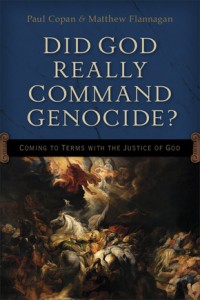 Advice to Lowder: try, I don’t know, reading it. It got released today so you finally can. Did God Really Command Genocide? is now available from the following book providers:
 In this post I want to respond to two objections to this line of argument. The first contends my position is contradictory or incoherent; one cannot coherently deny that God is subject to the commands he issues to human beings. The second contends my argument makes God a cosmic hypocrite. Human morality consists of God saying to us, “do as I say not as I do”.
 Recently I discovered Coyne’s latest riposte on the issue of divine commands: “
