Category: Ethics

  • Matt to speak at the 2014 Evangelical Philosophical Society in San Deigo

    Evangelical Philosophical SocietyThis blog’s Matthew Flannagan has had his paper “Mackie’s Answer to the Error Theory: A Reply to Joyce″ accepted for the National Annual Meeting of the Evangelical Philosophical Society (“EPS”) in San Diego, USA, from 19-21 November 2014. The abstract for Matt’s paper is as follows:

    Abstract
    Richard Joyce has argued that the “real problem” with divine command theories of ethics is not the euthyphro dilemma, but rather that such theories cannot account for the platitude that moral obligations have inescapable moral authority. In this paper I reply to Joyce’s contention.

    First, I look at Joyce’s objection in the context of Joyce’s own defence of John Mackie’s error theory. Joyce interprets Mackie as arguing that moral obligations are queer precisely because, if they existed, they would have inescapable authority and no sense can be made of such authority.

    Then I note that Mackie himself argued that a divine command theory was an exception to his thesis. Mackie contended that naturalistic theories face this challenge but a divine command theory does not. I argue that Joyce’s own reconstruction of Mackie’s argument confirms this conclusion.

    Finally, I examine some objections that Joyce raises to this kind of response. I argue they fail. Mackie and Joyce’s error theory, if sound, is an objection to naturalistic or secular accounts of moral obligations and not to divine command theories.”

    This year’s conference theme will be “Ecclesiology”. The Plenary Speaker is Paul Helm of Regent College, Vancouver Canada. The draft copy of the ETS-EPS program is available here.

    (Matt has also had a paper accepted for the Evangelical Theological Society’s Annual Meeting, which is also in San Diego around the same time.)

    As with previous years, we will need to fundraise to raise the $2,500 NZD shortfall in our budget needed to get him there. Family life on one modest, full-time income with a special needs child, who is unable to go to school, makes it very hard. Almost all of Matt’s philosophical and theological work on this blog is the result of his unpaid commitment to the field. Donations, no matter how modest, are greatly appreciated.

  • Matt to speak at the 2014 Evangelical Theological Society in San Deigo

    ETS ProgramThis blog’s Matthew Flannagan has had his paper “Abortion as Self Defence” accepted for the 66th Annual Meeting of the Evangelical Theological Society (“ETS”) in San Diego, USA, from 19-21 November 2014. The abstract for Matt’s paper is as follows:

    Abstract
    Eileen McDonagh has proposed an ingenious argument for abortion rights; she concedes, for the sake of argument, that a fetus is a human being but argues that a fetus’ presence inside the womb of a woman who does not consent to pregnancy constitutes unjust aggression. Consequently, the woman has a right to expel and kill the fetus in self-defence.

    In this paper I will sketch a critique of this line of argument suggested decades ago by Alan Donagan. Donagan argues that, in cases where a woman has not been raped, the woman is has acquired parental obligations to the fetus. Parental obligations are acquired through the act of begetting. If  a person brings a child into existence through voluntary sexual intercourse then he or she has a duty to provide the necessities of life for that child. The fetus is, therefore, not an unjust aggressor.

    I will defend this argument against two influential objections. First, the objection that a woman who does not consent to getting pregnant cannot have parental obligations to her offspring. Second, the objection that, even if  a woman does have parental obligations to her offspring, these obligations do not include a duty to provide bodily life support. I will argue that both objections fail.

    This year’s Annual Meeting theme is “Ecclesiology”. Plenary speakers for this year’s meeting are  Gregg R. Allison (Professor of Christian Theology, Southern Baptist Theological Seminary), Joseph H. Hellerman (Professor of New Testament Language and Literature, Talbot School of Theology, Biola University) and Miroslav Volf (Henry B. Wright Professor of Systematic Theology, Founding Director of Yale Center for Faith and Culture, Yale Divinity School).

    (Matt has also had a paper accepted for the Evangelical Philosophical Society’s Annual Meeting, which is also in San Diego around the same time.)

    As with previous years, we will need to fundraise to raise the $2,500 NZD shortfall in our budget needed to get him there. Family life on one modest, full-time income with a special needs child, who is unable to go to school, makes it very hard. Almost all of Matt’s philosophical and theological work on this blog is the result of his unpaid commitment to the field. Donations, no matter how modest, are greatly appreciated.
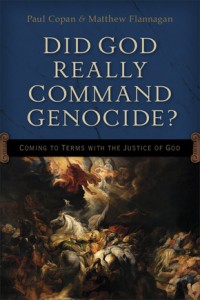
  • Did God Really Command Genocide? A new book by Copan and Flannagan

    Did God Really Command Genocide?Coming to a bookstore near you in November 2014: Did God Really Command Genocide? Coming to Terms with the Justice of God by: Paul Copan and Matthew Flannagan

    From Baker Publishing Group’s page:

    “Reconciling a violent Old Testament God with a loving Jesus
    Would a good, kind, and loving deity ever command the wholesale slaughter of nations? We often avoid reading difficult Old Testament passages that make us squeamish and quickly jump to the enemy-loving, forgiving Jesus of the New Testament. And yet, the question remains.

    In the tradition of his popular Is God a Moral Monster?, Paul Copan teams up with Matthew Flannagan to tackle some of the most confusing and uncomfortable passages of Scripture. Together they help the Christian and nonbeliever alike understand the biblical, theological, philosophical, and ethical implications of Old Testament warfare passages.”

    Some of the endorsements are below, you can read more here:

    “The Old Testament describes God as a warrior who directs his people to fight the Canaanites. Divine violence in the Bible is a theme that has aroused the ire of atheists and the discomfort and confusion of many Christians. Copan and Flannagan address the arguments of the atheists who use these texts to undermine belief and confidence in God. Not only are they adept at biblical interpretation and philosophy as they effectively counter this challenge, but they also write in a deeply compelling way that will appeal to both students and laypeople.”

    Tremper Longman III, Robert H. Gundry Professor of Biblical Studies, Westmont College, Santa Barbara, California

    “In their wide-ranging book, Copan and Flannagan go beyond standard treatments of Old Testament warfare; they incorporate biblical, theological, philosophical, ethical, legal, and historical perspectives on a much-debated but often misunderstood topic. This volume makes important strides forward in laying out a case for the coherence of divine command theory in connection with these Yahweh-war texts.”

    William Lane Craig, research professor of philosophy, Talbot School of Theology, La Mirada, California

    “As a full-scale follow-up to the excellent popular treatment of the topic in Is God a Moral Monster?,this book provides the most thorough and comprehensive treatment of the problem of violence in the Old Testament that I have encountered. The authors tackle the aggressive charges of the new atheists, as well as other equally sceptical but less strident critics of ‘the God of the Old Testament.’ And they do so with a blend of careful biblical exegesis and incisive moral argumentation. The book reaches deep, but remains readable, and the summaries at the end of every chapter are a great help in following the case as it is steadily built up. All of us who, in teaching or preaching the Old Testament, are constantly bombarded with ‘But what about the Canaanites?’ will be very grateful for these rich resources for a well-informed, gracious, and biblically faithful reply.”

    Christopher J. H. Wright, International Ministries Director, Langham Partnership, author of Old Testament Ethics for the People of God and  The God I Don’t Understand

    Chapter 1 is available here.

    Pre-order your copy now on Amazon, Book Depository or Mighty Ape (or wherever you normally get your books).

  • Richard Carrier and the Arbitrariness Objection

    In, “Is ethical naturalism more plausible than Supernaturalism“, I criticised Walter Sinnott-Armstrong’s objection that a divine command theory (DCT) makes morality arbitrary. Armstrong argued:

    “Let’s assume that God commanded us not to rape. Did God have any reason to command this? If not, his command was arbitrary, and then it can’t make anything morally wrong. On the other hand, if God did have a reason to command us not to rape, then that reason is what makes rape morally wrong. The command itself is superfluous. Either way, morality cannot Carrierdepend on God’s commands.”[1]

    This argument can be summarized as follows:

    [1] Either: (i) there is a reason, r, why God prohibits rape; or, (ii) there is no reason, r, why God prohibits rape.

    [2] If there is no reason, r, why God prohibits rape, then God’s commands are arbitrary.

    [3] If there is a reason, r, why God prohibits rape then, r, is what makes rape morally wrong.

    [4] If r is what makes rape morally wrong then God’s commands are superfluous.

    In response, I argued this argument commits the fallacy of equivocation because the word “makes” in premise [3] and [4] is ambiguous. I noted the word “makes” can be used in at least two different senses.

    One sense refers to constitutive explanations, such as when one affirms that what makes a cup of clear liquid a cup of water is that fact the liquid is H20. The second refers to a motivational explanation, as in, when I state that my love for my children makes me persevere in parenting. If the word makes is used in the constitutive sense, [4] is true but [3] is false. If it’s used in a motivational sense [3] is true but [4] is false. Either way the argument fails.

    Armstrong’s Dilemma
    In a footnote, Carrier dismisses this response as “hand waving” and “completely off point”:”When Armstrong says “reason [r] is what makes rape morally wrong” he simply means “r is the reason rape is morally wrong.” Thus “r is what makes rape morally wrong” simply means “rape is morally wrong when r.”[2]

    There are two problems with this response.

    First, Carrier’s assertion that Armstrong “simply means ‘r is the reason rape is morally wrong’” is not supported by the text. Two pages earlier, Armstrong explicitly states he intends (more…)

  • Video: “Discussing Divine Command Theory” Special Guest: Matthew Flannagan

    Last week I was invited to be part of a discussion on divine command ethics in Google hangouts. The full discussion is now on-line as episode 22 of Ode to Dialogue: “Discussing Divine Command Theory.” Enjoy.

  • Ethical Supernaturalism is still more Plausible than Naturalism: Carrier’s Preliminary Objections

    Last year I had an article Is Ethical Naturalism more plausible than Supernaturalism: A reply to Walter Sinnott Armstrong published in the journal Philo. In the comments section a reader asked me to comment on a response to that article published by classical historian Richard Carrier. This post will be the first of several where I do so.Carrier

    In, Is Ethical Naturalism more Plausible than Supernaturalism, I did two things. Firstly, I briefly explicated a conditional that has recently been proposed explicitly by William Lane Craig but which is also defended by several others, and secondly I rebutted several arguments raised against this conditional by Walter Sinnott-Armstrong. Carrier argues my rebuttals fail, but before he does so he offers three preliminary arguments against the positive thesis I was defending against Armstrong. It is these that I will address in this post.

    The Contention

    The conditional I explicated as follows:

    Craig’s contention is that if theism is true then we can plausibly explain the nature of moral obligation by identifying obligations with God’s commands, analogous to the way “we explain the nature of water by identifying it with H2O, or explain the nature of heat by identifying it with molecular motion.” By “God” Craig means a necessarily existent, all-powerful, all-knowing, loving and just, immaterial person who created and providentially orders the universe.[1]

    Note three things.

    First, this is a conditional, if affirms that if theism is true then then we can plausibly explain the nature of moral obligation by identifying obligations with God’s commands.

    Second, I define the concept of God used in this conditional as a necessarily existent, all-powerful, all-knowing, loving and just, immaterial person who created and providentially orders the universe.

    Third, this conditional specifies the kind of grounding relationship I am addressing, one where the relationship between God’s commands and moral obligations is one of identity. It’s the same kind of (more…)

  • Open Letter to Maurice Williamson

    Dear Maurice Williamson,

    Maurice Williamson and his "big gay rainbow"I hear you are having some troubles in the media at the moment. Apparently there are moral questions swirling around you about honest disclosure, potential abuse of power, unduly influencing the police in favour of a person who donated money to you, and so on.

    Don’t let judgmental people like Prime Minister John Key discriminate against you any longer. Such people clearly believe they can make moral judgments about what is appropriate and impose them onto you. Stand up to the bigots.

    Here is my advice to you.

    Call a press conference and do the following:

    1. Point out that the moral rules about lying and bribing being an abomination come from that archaic book, The Bible. While you are at it, make a sarcastic jab about how some people think you will go to hell for doing such things, then mock this belief with silly jokes about the physics of hell.
    2. Observe that there was recently a rainbow in New Zealand somewhere and opine that this proves that God approves of your actions.

    Do this and I am certain you will be hailed as a man of great moral insight. All will agree that you have given a decisive answer to the serious moral questions raised about your conduct. Perhaps David Farrar will blog about it on Kiwiblog, you’ll get offers to stand for Governor in several states in America, and someone in Hollywood might even offer you a spot on their show to obtain your insight.

    We all know, after all, that serious moral questions can be adequately set aside by engaging in these kind of tactics, and given your well known moral insight and wisdom, that’s all you need to do. You have led the nation utilising such wisdom and discernment in the past, I am sure you can do it again.

    All the best,

    Matthew Flannagan