In a previous post, I discussed Carrier’s defence of “The infantile Objection” to divine a command theory (DCT) of meta-ethics. Some comments he makes in the same paper, suggest a slightly different version of the argument. Seeing I have found this version of the objection relatively common in oral discussions. It is worth having a […]
Entries Tagged as 'Divine Command Theory'
Carrier on infantile moral reasoning: one more time
March 16th, 2017 1 Comment
Tags: Divine Command Theory · Historical Atrocities · Richard Carrier
Erik Wielenberg and the Autonomy Thesis: part one Wielenberg’s criticism of Divine command meta-ethics
March 11th, 2017 2 Comments
The autonomy thesis contends that there can be moral requirements to φ regardless of whether God commands, desires, or wills that people φ. In his monograph, Robust Ethics: The Metaphysics and Epistemology of Godless Normative Realism,[1] Erik Wielenberg offers arguably one of the most sophisticated defences of the autonomy thesis to date. Wielenberg argues that: […]
Tags: Divine Command Theory · Erik Wielenberg · God and Morality · Wes Morriston
Video: The Smith-Flannagan Debate “Morality Does Not Need God”
July 6th, 2016 Comments Off on Video: The Smith-Flannagan Debate “Morality Does Not Need God”
On Wednesday 21st May at the University of Waikato retired Philosophy and Political science lecturer Dr Ron Smith and Dr Matthew Flannagan (of this blog) debated the resolution “Morality Does not need God”. Here is the video of that debate.
Tags: Debates · Divine Command Theory · God and Morality · Ron Smith · Waikato University
Richard Carrier and the “Infantile” objection to God’s command’s
October 27th, 2015 1 Comment
In his article, “Why Traditional Theism Cannot Provide an Adequate Foundation for Morality”, Walter Sinnott-Armstrong argued that a “Divine command theory makes morality childish.”[1] In my response to Armstrong, “Is Ethical Naturalism more Plausible than Supernaturalism?”[2] I made two points. First, I addressed a tangential point: that Armstrong’s argument caricatures divine command theory (“DCT”) by tacitly assuming that […]
Tags: Autonomy · Divine Command Theory · God and Morality · Hell · Richard Carrier · Walter Sinnott-Armstrong
Did God Really Command Genocide? Summarised at Moral Apologetics
October 24th, 2015 Comments Off on Did God Really Command Genocide? Summarised at Moral Apologetics
Over at Moral Apologetics, David Baggett and Mark Foreman, are undertaking the task of writing chapter summaries of Paul Copan’s and my book, “Did God Really Command Genocide?” The chapter summaries are available here.
Tags: Canaanites · David Baggett · Did God Really Command Genocide? · Paul Copan
The Arbitrariness Objection (once more): A brief reply to Jason Thibodeau
November 7th, 2014 6 Comments
Jason Thibodeau over at The Secular Outpost has written a thoughtful discussion and response to the critique I made of Walter Sinnott Armstrong’s arbitrariness objection in my article, “Is Ethical Naturalism more Plausible than Supernaturalism: A Reply to Walter Sinnott-Armstrong.” Jason suggests that when you disambiguate the premises of Armstrong’s argument, it is formulated as follows: […]
Tags: Arbitrariness Objection · Divine Command Theory · God and Morality · Jason Thibodeau · Walter Sinno
Out Now: Did God Really Command Genocide? Coming to Terms with the Justice of God by Paul Copan and Matthew Flannagan
November 4th, 2014 Comments Off on Out Now: Did God Really Command Genocide? Coming to Terms with the Justice of God by Paul Copan and Matthew Flannagan
Well done Matt and Paul. 🙂 Out now! Get your copy today of Did God Really Command Genocide? Coming to Terms with the Justice of God, by Paul Copan and Matthew Flannagan, published by Baker Books. More here. Buy from Baker Books Buy on Amazon in paperback Buy for your Kindle Buy from Book Depository (The New Zealand store launch is […]
Tags: Canaanites · Did God Really Command Genocide? · Divine Command Theory · God and Morality · Is God a Moral Monster? · Old Testament Ethics · Paul Copan

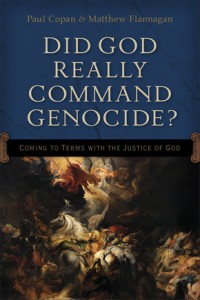 A common objection to belief in the God of the Bible is that a good, kind, and loving deity would never command the wholesale slaughter of nations. In the tradition of his popular Is God a Moral Monster?, Paul Copan teams up with Matthew Flannagan to tackle some of the most confusing and uncomfortable passages of Scripture. Together they help the Christian and nonbeliever alike understand the biblical, theological, philosophical, and ethical implications of Old Testament warfare passages.