In, my article “Tooley Plantinga and the Deontological Argument from Evil”, I argued that Tooley’s specifically deontological version of the argument from evil fails. To summarise very briefly, Tooley’s version of the argument assumes that God has moral obligations. However, according to a fairly mainstream theistic position on the relationship between God and morality, the […]
Entries Tagged as 'Philosophy of Religion'
“Do as I say, not as I do.” Is God a cosmic hypocrite?
October 23rd, 2014 8 Comments
Tags: God and Morality · Hypocrisy · Problem of Evil
Jerry Coyne on Deception and the Omission of Facts
October 21st, 2014 4 Comments
In 2011 I wrote a criticism of Jerry Coyne’s USA Today article, “As atheists know, you can be good without God.” My critique, “When Scientists make bad Ethicists,” attracted some attention motivating Coyne to write a response. I wrote a following up piece the next year, “Jerry Coyne on God and Morality Revisited,” my conclusions were not […]
Tags: Atheists · Divine Command Theory · God and Morality · Jerry Coyne · William Lane Craig
Richard Carrier and the Abhorrent Commands Objection
October 5th, 2014 4 Comments
In my last post, Richard Carrier and the Arbitrariness Objection, I argued that Richard Carrier’s attempt to defend Walter Sinnott-Armstrong’s arbitrariness objection failed. I also argued his defence of this argument is incoherent and engages in special pleading because the arguments he defends apply with equal cogency to his own version of ethical naturalism. When […]
Tags: Divine Command Theory · God and Morality · Richard Carrier
Matt to speak at the 2014 Evangelical Philosophical Society in San Deigo
October 2nd, 2014 Comments Off on Matt to speak at the 2014 Evangelical Philosophical Society in San Deigo
This blog’s Matthew Flannagan has had his paper “Mackie’s Answer to the Error Theory: A Reply to Joyce″ accepted for the National Annual Meeting of the Evangelical Philosophical Society (“EPS”) in San Diego, USA, from 19-21 November 2014. The abstract for Matt’s paper is as follows: Abstract Richard Joyce has argued that the “real problem” with divine command theories of ethics […]
Tags: Divine Command Theory · EPS · Evangelical Philosophical Society · San Diego
Matt to speak at the 2014 Evangelical Theological Society in San Deigo
October 1st, 2014 3 Comments
This blog’s Matthew Flannagan has had his paper “Abortion as Self Defence” accepted for the 66th Annual Meeting of the Evangelical Theological Society (“ETS”) in San Diego, USA, from 19-21 November 2014. The abstract for Matt’s paper is as follows: Abstract Eileen McDonagh has proposed an ingenious argument for abortion rights; she concedes, for the sake of argument, that […]
Tags: Abortion · ETS · Evangelical Theological Society · Feticide · San Diego
Did God Really Command Genocide? A new book by Copan and Flannagan
September 27th, 2014 13 Comments
Coming to a bookstore near you in November 2014: Did God Really Command Genocide? Coming to Terms with the Justice of God by: Paul Copan and Matthew Flannagan From Baker Publishing Group’s page: “Reconciling a violent Old Testament God with a loving Jesus Would a good, kind, and loving deity ever command the wholesale slaughter of nations? […]
Tags: Canaanites · Did God Really Command Genocide? · Divine Command Theory · God and Morality · Is God a Moral Monster? · Old Testament Ethics · Paul Copan
Richard Carrier and the Arbitrariness Objection
September 5th, 2014 5 Comments
In, “Is ethical naturalism more plausible than Supernaturalism“, I criticised Walter Sinnott-Armstrong’s objection that a divine command theory (DCT) makes morality arbitrary. Armstrong argued: “Let’s assume that God commanded us not to rape. Did God have any reason to command this? If not, his command was arbitrary, and then it can’t make anything morally wrong. On […]
Tags: Divine Command Theory · God and Morality · Publication · Richard Carrier

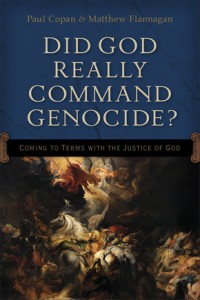 A common objection to belief in the God of the Bible is that a good, kind, and loving deity would never command the wholesale slaughter of nations. In the tradition of his popular Is God a Moral Monster?, Paul Copan teams up with Matthew Flannagan to tackle some of the most confusing and uncomfortable passages of Scripture. Together they help the Christian and nonbeliever alike understand the biblical, theological, philosophical, and ethical implications of Old Testament warfare passages.