Category: Philosophers

  • Guest Post: Paul Copan Replies to Hector Avalos – Deuteronomy 25:11-12, an Eye for an Eye, and Raymond Westbrook

    My book review of John Loftus’s The Christian Delusion: Why Faith Fails prompted several responses from Hector Avalos, one of the book’s contributors. Avalos has offered critiques of not just my arguments but also those of my good friend Paul Copan. This Guest Post, written by Paul Copan, responds to some of Avalos’s charges. Paul Copan writes:

    Paul CopanRecently Hector Avalos has responded to a particular argument in my book Is God a Moral Monster? (Baker).  In it, I follow biblical scholar Jerome Walsh’s interpretation of Deuteronomy 25:11-12:[1] If two men, a man and his countryman, are struggling together, and the wife of one comes near to deliver her husband from the hand of the one who is striking him, and puts out her hand[yad] and seizes his genitals, then you shall cut off her hand [kaph]; you shall not show pity.

    I first came across Walsh’s perspective by way of Richard Davidson’s book on sexuality in the Old Testament, Flame of Yahweh (Hendrickson)—a book I highly recommend.  I follow both Walsh and Davidson on the view that this text is not referring to amputating the hand, but rather depilation.  This was a punishment of humiliation involving shaving a woman’s pubic hair in thekaph—the curved region below the waist.  I won’t elaborate on what my book says, but I’ll simply address Deuteronomy 25:11-12 in the bulk of this blog posting.  In the post, I’ll address the question of lex talionis (“an eye for an eye”) and the work of Raymond Westbrook.

    1. Preliminary remarks: I have been in communication with Jerome Walsh, who prefers to stay out of the discussion.  Walsh has read Avalos’s post, though, and noted too that he did not see anything new in Avalos’s arguments that he hasn’t encountered before.  He simply saw nothing linguistically to persuade him to alter his views.

    Avalos’s repeated identification of kaph = “hand” as the “literal” meaning is misleading.  While it may be the commonest meaning, the term has less-common usages too (the bowl of a spoon, the frond of a palm tree).  It’s unproductive to start from the assumption that commonest meaning is the only one allowable unless one can prove otherwise.  The point in the article is that yad tends to refer to the hand without connotation or nuance, or when the hand is envisaged, as an instrument of pointing, hitting, doing.  Kaph, so far as he can see, connotes the hand as an instrument of grasping and holding, thus the curvature and the focus on the palm.

    In Walsh’s estimation, Avalos seems to be operating from the position of a methodological absolutism:  “X” is the common opinion, and unless one can definitively prove not-X, then one must espouse X.  He doesn’t appear to leave much room for “more likely” or “less likely” as the possible evaluation of a hypothesis.

    Avalos cites Marc Cortez for support: “The Law on Violent Intervention: Deuteronomy 25.11-12 Revisited,” Journal for the Study of the Old Testament 30:3 (2006), 431-47.  As I note in my book, though, it is unfortunate that Cortez fails to interact with Walsh’s essay, which had been published two years earlier.

    In correspondence with Walsh (May 2010), he commented on an online version of Cortez’s article.  He pointed out that while Cortez dismisses Eslinger’s attempt to identify kaph with gynecological exactitude (and he can agree with Cortez on that point), Cortez does not deal with the fact that kaph is used not just for the palm of the hand, but for several other curved, arched objects, both corporeal (sole of foot) and not (bowl of a spoon, frond of a palm tree).  Walsh’s argument simply treats kaph as the curve of the groin, a very likely meaning in Song of Solomon, and (pace Cortez) in Genesis as well.

    Cortez wants to retain without discussion the understanding of kaph as “hand.”  But Walsh notes that Cortez’s explanation of why a “talionic” law would equate “hand” as an instrument of offense with “palm of the hand” as the object of “cutting-off” is, basically, “why not?”  That begs the question.  Further, he ignores completely that there is no reason whatsoever for treating the qal of qatsats as if it were the piel.  In the piel, it clearly means “to cut off.”  In the few other instances of its appearance in the qal, it means “to cut (hair).”  Why, in this unique case, should the qal be translated as if it were a piel?

    Now, Walsh readily acknowledges that his article is not the standard reading of the passage, and that Cortez’s evaluation of others’ interpretations of Deut 25:11-12 is judicious, careful, and sober.  He would agree with Cortez completely that the peculiarities of this unique law in the Israelite corpus have led scholars to some truly egregious attempts to make sense of its oddity.  And Cortez is very good indeed at identifying the unpersuasive lengths to which some scholars have gone.  But he, like all of those scholars, has not looked at the words.  This is the contribution that Walsh’s article proposes to make.  Instead of accepting unquestioningly that “you shall cut off her hand” is what the Hebrew words mean, he has argued that that is a misreading of the Hebrew terms.  To put the disagreement in a nutshell, let me quote a line from Cortez’s article.  Cortez says:  “The first and most important question that must be addressed with respect to the woman’s punishment is (more…)

  • Hector Avalos and Careful, Non-Selective Citation of Sources

    On Debunking Christianity, Hector Avalos has posted a response to my critique of his post A Reply to Hector Avalos’ “Why Flannagan Fails History”. His latest post is entitled Flannagan Versus Westbrook: Understanding the Problem; it pretty much repeats points I have addressed in my critique, basically Avalos pretends I did not answer them.

    In the comments section, Avalos pretty much admits that Westbrook holds the view I maintained he does. When a questioner asks Avalos about the lex talionis he stated:

    “This is a highly contested issue. Some think that the literal interpretation could still be held even in post-Christian Jewish texts (I cited some in my initial post). Westbrook believes that both the literal and monetary co-existed, each applied depending on circumstances, in the biblical period.”

    Compare this with my comment to Max explaining my position:

    “Westbrook argues that serious wrongs “gave rise to a dual right in the victim or his family, namely to take revenge on the culprit, or to make composition with the culprit and accept payment in lieu of revenge”. He goes on to note, “[t]his right was a legal right, determined and regulated by the court”. The courts could “fix the level of composition payment” making “revenge a contingent right, which was only revived if the culprit failed to pay”.

    When talionic legal formulae occur in A.N.E. legal texts they merely express that the punishment be proportional to the crime. This could involve punishment in kind (which would be proportional to the crime) but in most cases it would probably involve monetary compensation.”

    Avalos is aware of my dialogue with Max as he quotes from it in his post. Readers will note the position he now attributes to Westbrook. This is almost exactly the view I said Westbrook held in my response yet, oddly, this comment by Avalos occurs under a post he entitled “Flannagan versus Westbrook” where he continues to argue to Debunking Christianity’s readers that I misrepresented Westbrook’s position.

    I am flat tack with mid-semester marking at the moment, in the coming month I have two conferences looming I am giving papers to, I am moderating a panel discussion and speaking in another so unfortunately I cannot respond to all of Avalos’ claims. However, I do want to address one objection he raised in Why Dr. Flannagan Fails History, Dr. Hector Avalos Responds, which was part of  Avalos’ case that I engaged in “a very selective and uncritical reading of the sources” I cited to support my position:

    “As it is, Flannagan might need to update his Copan readings. On page 121 of Is God A Moral Monster: Making Sense of the Old Testament (Grand Rapids, MI: Baker Books, 2011), Copan reluctantly admits that Deuteronomy 25:11-12 might be “the only biblical instance of punishment by mutilation.” So now Copan has gone from arguing that the Bible represented an advance over other cultures that practiced legal mutilation to making a case for the Bible’s superiority because it might have ONLY ONE case of mutilation for a poor woman helping to save her husband. What a magnificent improvement.”

    MirrorThe conclusion people are supposed to draw from this is that I am unaware of Copan’s latest writings. However, as my readers know, I have read Copan’s book (Paul sent me an electronic copy before it was published because he wanted my feedback on the manuscript; he also sent me post publication electronic and hard copies as well). It is worth comparing Avalos’ citation, and summary with a copy and paste from the original, as it is revealing to do so. Here is what Copan actually says on page 121 (more…)

  • A Reply to Hector Avalos’ “Why Flannagan Fails History”

    It seems my recent Philosophia Christi review of  John W. Loftus’ The Christian Delusion: Why Faith Fails has hit something of a nerve. Professor Hector Avalos, who wrote “Yahweh is a Moral Monster” in The Christian Delusion, has written a response entitled “Why Dr. Flannagan Fails History, Dr. Hector Avalos Responds”.

    Avalos raises several points which I cannot address in a single post. Here I will simply address his claim that I that I relied “on a very selective and uncritical reading of the sources”, misrepresented the views of Raymond Westbrook and utilised “careless scholarship”.

    1. My Sources
    In my review I stated,

    “On p215, Avalos dismisses Copan’s contention that the lex talionis does not call “for bodily mutilation, but rather just (monetary) compensation” as “mere assertion”. However, only a page later, Avalos criticizes Copan’s comments about the manumission of slaves citing the authority of “Raymond Westbrook, one of the foremost biblical legal specialists”. In fact, Westbrook has defended Copan’s position on the lex talionis [“The Character of Ancient Near Eastern Law” in A History of Ancient Near Eastern Law (Boston: Brill Academic Publishers, 2003) 74].”[1]

    Here I state the position that Avalos attributes to Paul Copan, the position that that the lex talionis does not call “for bodily mutilation, but rather just (monetary) compensation”, has been defended by Raymond Westbrook in a particular book that I referenced. Avalos contended I have “misrepresented Westbrook”; he provides four arguments for this conclusion. None of them is sound.

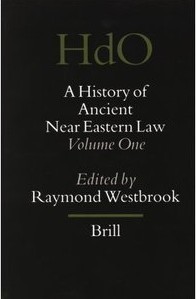
    A History of Ancient Near Eastern Law by Raymond WestbrookFirst Avalos stated that I offered “no actual quote to support this allegation so that we can verify whether he is even reading Westbrook correctly.” This is false, I did provide a way of verifying my claim. While, due to word count restrictions, I did not give a direct quote, I did provide a reference; I referred the reader to page 74 of Westbrook’s “The Character of Ancient Near Eastern Law” in A History of Ancient Near Eastern Law (Boston: Brill Academic Publishers, 2003). This is clear from the quotation above, which, oddly, Avalos cited in his criticism.

    Moreover, even if I did not provide a citation (which I patently did) Avalos’ conclusion that I misrepresented Westbrook would not follow from this. What would follow would be that he would have no way of checking that I had not misrepresented Westbrook; however, the fact one cannot check that something  is not the does not mean it is, in fact, the case. From my living room in New Zealand tonight I cannot check the whether Loftus has  not robbed a bank, so can I conclude he is a bank robber? Of course not.

    It is logical howlers like this in Avalos’s work that has lead me to be so critical of it. If Avalos cannot check whether my citation was accurate then he cannot know I misrepresented it, which raises the question: why then has he claimed that I did?

    2. Wrong Book
    Avalos’ second argument was to ignore my citation and refer to a different book by Westbrook. He states:

    “Westbrook has made himself quite clear in Everyday Law in Biblical Israel: An Introduction[Louisville: Westminster/John Knox Press, 2009], pp. 78-79). Therein he discusses how later Rabbinic literature, and specifically Mekhiltah Neziqin 8 to Exodus 21:24, claimed that “An eye for an eye’ [means] money.”

    Westbrook comments: ‘This interpretation seems strained to a modern reader. The introduction to the formula in Leviticus 24:19 is unequivocal: “If anyone maims a fellow, as he had done so shall it be done to him.’” [Emphasis Avalos’]

    There are several problems here.

    First, this does not refute my claim. I said Westbrook defended a certain position in his article “The Character of Ancient Near Eastern Law” in A History of Ancient Near Eastern Law. Pointing out that Raymond Westbrook argued for a different view in a different book, does not show that my claim was false or a misrepresentation.

    Second, the quote Avalos provided from the different book by Westbrook does not contradict my claim. By prefacing the quotation with “Westbrook has made himself quite clear”, “Therein he discusses how … and specifically…” and “Westbrook comments”, Avalos creates the impression that Westbrook claimed that the rabbinic position is “strained” and is “unequivocally” contradicted by the biblical text.  However, the careful reader will note that the citation does not actually say this. In the citation, (more…)

  • The Christian Delusion: Why Faith Fails – A Philosophia Christi Review of John Loftus’ Book

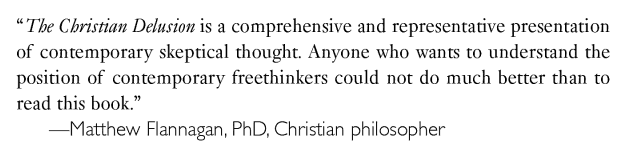
    On the list of blurbs just inside the cover of The Christian Delusion: Why Faith Fails, edited by John W. Loftus (Amherst, NY: Prometheus Books) 2010, the following appears:

    The Christian Delusion Blurb by Matthew Flannagan

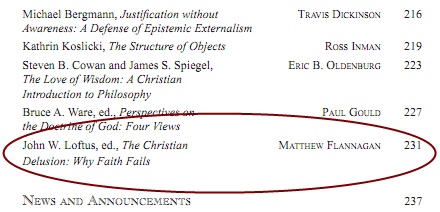
    As a result of being published on the blurb of the book, the current edition of Philosphia Christi, Vol. 13, no. 1 – Summer 2011, shows the following in the table of contents under “Book Reviews”:

    Philosophia Christi Table of ContentsThe Editor of Philosophia Christi has kindly granted Matt permission to reproduce his review of The Christian Delusion: Why Faith Fails here on MandM.

    A Review of The Christian Delusion: Why Faith Fails

    by Matthew Flannagan

    In The Christian Delusion John Loftus brings together a series of articles by contemporary free thinkers all focused around a common epistemological critique. It is the sequel to Loftus’s Why I Became an Atheist: A Former Preacher Rejects Christianity.

    The book is divided into five parts, each addressing a different aspect of Christianity. Part 1 is entitled “Why Faith Fails” and comprises four chapters. In chapter 1, David Eller argues that religions both deeply influence and are deeply influenced by culture; he argues that different cultural contexts lead to different forms of Christianity. In chapter 2, Vallerie Tarico draws on cognitive science to offer naturalistic explanations for why people believe in God. In chapter 3, Jason Long explains how people believe in Christianity despite its obvious absurdity by documenting how humans frequently engage in certain fallacies, have certain biases, believe things that are comfortable and resist changing their minds.

    By themselves it is hard to discern how these chapters provide arguments against Christianity. They appear to assume Christianity is false and provide naturalistic explanations as to why people believe such falsehoods. The relevance is explained in chapter 4, where John Loftus uses them to defend what he calls the Outsider Test for Faith (“OTF”). Loftus argues that a rational person should adopt the same skeptical stance towards her own religious beliefs that she does towards religions she rejects. The OTF (more…)

  • Stark Wars

    Darth VaderThom Stark has written a lengthy response (304 pages!) to Paul Copan’s book Is God a Moral Monster? which he has published on his blog, Religion at the Margins; it is entitled Is God a Moral. Compromiser? A Critical Review of Paul Copan’s. “Is God a Moral Monster?” In it, alongside his criticisms of Copan, Stark makes several criticisms of the work of Richard Hess and Matt.

    Matt has not yet had time to read Stark’s book-length review, much less respond to it, but Copan and Hess have. Copan has published the following blog posts on his blog, Parchment and Pen:

    Is God a Moral Monster Revisited: Preliminary Replies to Thom Stark

    Richard Hess’s Response to Thom Stark

    Matthew Flannagan’s Interactions with Thom Stark

    Stark has responded to these posts with:

    Copan and Company, Part 1: A Brief Introduction

    Copan and Company, Part 2: Response to Matt Flannagan

    Copan and Company, Part 3: Response to Paul Copan

    Copan and Company, Part 4: Response to Richard Hess

    Other blogs have chimed in:

    Thom Stark’s Sweeping Claims by Christopher Copan Scott

    Reflections on the Thom Stark-Paul Copan debate by Randal Rauser

    Matt has on his ‘to do’ list an intention to wade through Stark’s review and write a response, at the very least, to the parts that critique his work. He also intends to answer Stark’s questions put to him on this blog post. However, Matt has several publication, conference and marking commitments to meet first and Matt simply cannot churn material out at the prolific rate Stark can.

    RELATED POSTS:
    Thom Stark on Wolterstorff and Hagiographic Hyperbole
    Is God a Moral Monster? A Review of Paul Copan’s Book
    God and the Genocide of the Canaanites Part I: Wolterstorff’s Argument for the Hagiographic Hyperbolic Interpretation
    God and the Genocide of the Canaanites Part II: Ancient Near Eastern Conquest Accounts
    God and the Genocide of the Canaanites Part III: Two Implications of the Hagiographic Hyperbolic Account

  • Lawful Authority and Just Wars

    A reader pointed me to this interesting post on Pacifism and Just War Theory from Baylor University Philosophy Professor, Alexander Pruss.

    Just WarInterestingly Pruss offers an argument similar to the one I presented at a panel discussion on the ethics of war recently. In this discussion I suggested that traditional Christian Just War Theory follows from the contention that a government has the right and duty to use force to uphold justice within the geographical area over which it has jurisdiction. A just war is simply an extension of the government’s police powers. If a criminal attempted to rape or kill people within the geographical realm over which a government has authority then the government could justifiably use force to prevent this. It could also use force to try and punish anyone who did do these things; this is why we have a police force, court system and prisons. Just war theorists cannot see why this should cease to be the case when the person committing the offence is a soldier from another country as opposed to a domestic criminal.

    Pruss gives a similar argument; he starts by defining problematic violence as “lethal violence, i.e. violence that, if successful, has a high probability of resulting in the opponent’s death, counts as problematic, even when the death is not intended.” He then argues,

    “If it is permissible to use problematic violence to stop a citizen wife from murdering her citizen husband, it should also be permissible to use problematic violence to stop a non-citizen woman who sneaked into one’s country to murder her citizen husband. Moreover, this should be permissible even if the woman was commissioned by another state to kill her husband. But if we allow that it is permissible to use problematic violence against criminals acting on behalf of foreign states, then there seems to be no way to deny that it is permissible to use problematic violence to stop invaders.”

    He makes this illustration,

    “When the invading army marches in, burning crops and murdering citizens, they are breaking the victim country’s laws. If problematic violence is permitted to enforce the laws of one’s territory, it should be permissible to use problematic violence to stop them. But this seems to be a case of war.”

    This argument is common in the Reformed or Presbyterian traditions. John Murray, in his book Principles of Conduct, notes the Pauline teaching that the  “governing authorities” are “established by God.” One is morally bound to submit to rulers because “rulers do not bear the sword for no reason. They are God’s servants, agents of wrath to bring punishment on the wrongdoer.” He then asks, “by what kind of logic can it be maintained that the magistrate, who is invested with the power of the sword, may and must execute vengeance upon evil doers within his own domain must sheath the sword of resistance when evil doers from without invade his domain.”

    The Westminster confession makes a similar argument. It argues that because a Government has the authority to use force to maintain justice and peace within the realm over which it governs it can fight wars to maintain justice and peace within this realm.

    I think this is one of the most important lines of argument in defence of Just War Theory. In my talk, I argued that the standard six criteria of a just war: just cause, lawful authority, last resort, the use of proportionate and discriminate force and so on simply unpack the general circumstances in which governments are permitted to us force and apply it to warfare. Here I simply want to explore one implication of this line of argument that Pruss raises. (more…)

  • In Defense of Reasonable Disagreement

    At the close of his 1967 book “God and Other Minds”, Alvin Plantinga argues that if theistic belief is to be dismissed as “irrational”, or in some sense “epistemically sub-par” on the basis that it lacks a rationally compelling argument, then likewise we should also reject belief in other minds, since the best argument for the belief in such minds (the analogical argument) is not rationally compelling[i]. What this implies is that if belief in other minds is justified even in spite of the fact that it lacks a rationally compelling argument, then equally so, belief in God may be justified in spite of such an argument[ii]. To hold then, that belief in God is unjustified in the absence of a compelling theistic proof, would be to hold a double standard[iii].

    What elephant?For obvious reasons, few people would dare to dispute the contention that belief in other minds is rational. However, Plantinga’s critics have two options: (1) they might contend that belief in other minds is rational, but only in virtue of a rationally compelling argument. Hence their burden would be to produce a rationally compulsive version of the analogical argument. (2) They could admit that there is no rationally compulsive version of the analogical argument, but argue that there is a relevant difference between theistic belief and belief in other minds, such that the two beliefs are not epistemically equivalent or, as it were, “equiprobable”.

    In this paper, I am not concerned to argue against (1), but suffice to say I think it thoroughly wrong-headed. I am concerned however, to argue against one particular version of (2). Some of Plantinga’s critics have charged that belief in God and belief in other human minds are epistemically unalike in the sense that reasonable people do not disagree about whether or not other minds exist, whereas reasonable clearly disagree about whether or not God exists.

    While he doesn’t explicitly respond to Plantinga or any of the so called “Reformed Epistemologists”, Richard Feldman argues something akin to in his article entitled “Reasonable Religious Disagreements”. Hence it makes sense to analyze his argument in the context of an objection against Reformed Epistemology.

    I do not find his argument convincing. In-fact, as I will go on to argue, un-sharable private evidence in the form of religious experience proves an intractable problem for Feldman’s argument with respect to religious disagreements. That is not to say that there is no epistemic parity between theistic belief and belief in other minds, rather it is simply to say that at least one attempt to establish any such parity is not successful.

    Feldman’s thesis is that reasonable disagreement between epistemic peers who have fully disclosed their evidence is not possible[iv]. That is to say, reasonable disagreement cannot subsist between two parties that are equivalently intelligent, have approximately equal powers of reasoning, are equal with respect to background information and have shared all relevant evidence[v]. When he says that reasonable disagreement cannot subsist between such people, Feldman does not mean to say that both parties should agree. Rather, what he means to say is that both parties should suspend judgement[vi]. In other words, those who are party to the discussion cannot simply “agree to disagree” (at least they can’t do so rationally) . Rather, they must opt for a position that can only be described as “agnostic”. The final preliminary point to clarify is the issue of “reasonability”. By this Feldman means to say is that a belief is “reasonable” just if it has sufficient evidential support. This point is important, because as Feldman points out, if by “reasonability” one simply means that there is no “obvious blunder”, then it’s possible to be “reasonable” and yet base ones beliefs on confusion and misunderstanding etc[vii]. Feldman introduces his thesis by way of the following questions: (more…)