Category: Series

  • Fallacy Friday: Denying the Antecedent

    This week I will look at the fallacy of denying the antecedent. Before I can elaborate exactly what is involved in this fallacy, it is important to introduce and analyse some valid arguments that are superficially similar.

    Modus Ponens
    One of the very first valid inferences one learns in logic is modus ponens. To use the well worn example that was repeated ad nauseam when I was learning logic (and one I probably bored my students with too) a paradigmatic example of modus ponens is,

    1. If it is raining then the  grass will be wet.

    2. It is raining;

    Therefore:

    3. The grass will be wet.

    Put more abstractly, a modus ponens has the form:

    1’ If P then Q.

    2’ P;

    Therefore:

    3’ Q.

    UnicornModus ponens proceeds with the first premise contending that a conditional statement is true. A conditional statement is a statement about a hypothetical situation; in this case the claim is “if it is raining then the grass will be wet”. Notice that for this conditional to be true, it does not have to actually be raining. On a sunny day it is still true that if it starts raining the grass will be wet. A conditional statement tells us what will be the case if some other thing or event is the case – not what actually is the case.

    Conditional statements of the form “if P then Q” have what logicians call an “antecedent” and a “consequent”. P is the antecedent; in the above example the antecedent is the claim, “it is raining”. In a conditional statement one talks about what occurs if the antecedent is true. Q is the consequent; in the example above the consequent is the proposition “the grass will be wet”. The consequent is what is said to be true if the antecedent is correct.

    Modus ponens proceeds by first affirming that a conditional statement is true and then affirming the antecedent is true. If both a conditional statement is true and its antecedent is true then it is impossible for the consequent to not also be true. This is obvious upon immediate reflection. If the conditional ‘if P then Q’ is true, and P is true, then Q must also be true. Note, that in a valid modus ponens inference, one affirms the antecedent. (more…)
  • Fallacy Friday Podcast on Apologetics 315: Petitio Principii (Begging the Question)

    Apologetics 315 are producing an audio version of Matt’s Fallacy Friday series.

    Fallacy Friday Podcasts

    The Fallacy Friday Podcasts are released every Friday on Apologetics 315. You can subscribe using:

    • RSS Feed
    • iTunes
    • One-Click

    The Mp3 of Petitio Principii (Begging the Question) is here.

    To navigate the series in print, use the Fallacy Friday tag, to navigate MP3 series use the Fallacy Friday Podcast tag.

  • Fallacy Friday Podcast on Apologetics 315: False Cause & Post Hoc, Ergo Propter Hoc

    Apologetics 315 are producing an audio version of Matt’s Fallacy Friday series.

    Fallacy Friday Podcasts

    The Fallacy Friday Podcasts are released every Friday on Apologetics 315. You can subscribe using:

    • RSS Feed
    • iTunes
    • One-Click

    The Mp3 of False Cause & Post Hoc, Ergo Propter Hoc is here.

    To navigate the series in print, use the Fallacy Friday tag, to navigate MP3 series use the Fallacy Friday Podcast tag.

  • Friday Fallacy: Equivocation

    In my post on Assessing Arguments I noted that a valid argument is one where it is impossible for the premises to be true and the conclusion false. I gave the following example:

    Premise: All men are under 10 feet tall;
    Premise: John is a man;
    Conclusion: John is under 10 feet tall.

    This argument is valid because it is impossible for both premises to be true and the conclusion false. If it is true that all men are under 10 feet tall and if it is true that John is a man then John cannot be over 10 feet tall. If it were possible for John to be over 10 feet tall then the first premise would mean he could not be a man, which, of course, would contradict the second premise.

    In this post I want to note an important feature of this type of argument. There is an obvious link between the first and the second premises. The first premise makes a claim about all men; it identifies a class of beings, those we call men, and it attributes a property to members of this class. The second premise identified John as a man – a member of the class mentioned in premise one. The fact that both premises refer to the same class of beings is important to the validity of the argument because John is a member of the same class that is stated to be under 10 feet tall; the conclusion, that John is under 10 feet tall, cannot be logically avoided. This argument is valid because the word ‘man’ refers to the same thing in both premises. If the word ‘men’ in the first premise did not refer to the same class John is said to be a member of in the second premise then the argument would not follow.

    This brings me to this weeks fallacy: the fallacy of equivocation. Sometimes the same word has more than one meaning. The fallacy of equivocation occurs when a person uses the same word in different premises but not the same meaning. Because the same word is used the argument appears valid but when one looks at what the word actually refers to in each premise, the argument is not valid.  A obvious example is as follows:

    1. Money put in a bank will earn interest;
    2. A bank is the body of land at the side of a river;

    Therefore:

    3. If you want to earn interest on your money you should put it in the body of land at the side of a river.

    This silly example shows quite nicely how the fallacy works. Both premise 1. and premise 2. make reference to a bank; at a superficial glance the argument might appear valid if what the first premise says of a bank is true and if what the second premise says of a bank is true. The problem is (and in this example it is fairly obvious) the word ‘bank’ in each premise has a different meaning. In the first premise it refers to a financial institution, in the second it refers to a body of land at the side of a river. When one looks at what the terms actually refer to, as opposed to their verbal form, the argument is invalid.

    In this example the fallacy is obvious; the conclusion is so outrageously silly and the premises so uncontroversial that the mistake is obvious. However, in other cases the fallacy can be more subtle.

    The Fallacy of Equivocation

    Here is an example I recently spotted on Common Sense Atheism’s (more…)

  • Fallacy Friday Podcast on Apologetics 315: Division and Composition

    Apologetics 315 are producing an audio version of Matt’s Fallacy Friday series.

    Fallacy Friday Podcasts

    The Fallacy Friday Podcasts are released every Friday on Apologetics 315. You can subscribe using:

    • RSS Feed
    • iTunes
    • One-Click

    The Mp3 of Division and Composition is here.

    To navigate the series in print, use the Fallacy Friday tag, to navigate MP3 series use the Fallacy Friday Podcast tag.

  • Fallacy Friday: Ad Ignorantiam (Arguments from Ignorance)

    In the discussion following last week’s Fallacy Friday topic, Ad Populum, LJ asked about the ad ignorantiam fallacy. In particular she wanted to know about its relationship to creationism. I suspect LJ was being sarcastic but despite this it is worth exploring this issue a bit.

    First, we should recall that a fallacy is not simply a false position on some subject. The fact that someone expounds a mistaken view in theology, philosophy, science, law, ethics or any other subject does not necessarily mean that that person has committed a fallacy. A fallacy is a common mistake in reasoning. A fallacy occurs when one attempts to infer a conclusion from a premise in an invalid manner. I noted in Assessing Arguments that an argument can be valid even if it has false premises and false conclusions. So the fact that someone believes in or propounds contemporary evolutionary theory or creationism or something else does not, in and of itself, mean that that person has committed the ad ignorantiam fallacy.

    What is an Ad Ignorantiam?
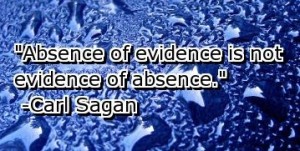
    "Absence of evidence is not evidence of absence" Carl SaganSo what exactly is the mistake being made when one commits an ad ignorantiam fallacy and how does one commit it? The ad ignorantiam fallacy is as an argument from ignorance. It occurs when a person argues that a conclusion is false because no one has shown it to be true or when a person argues a position is true because no one has shown it to be false.  Applied to evolution, the argument has the form:

    1. No one has shown that evolutionary theory is true;

    Therefore:

    2. Evolutionary theory is false.

    Similarly, with creationism:

    1. No one has ever shown creationism is true

    Therefore:

    2. Creationism is false.

    What the person who makes this inference fails to appreciate is that the failure to provide a reason for affirming a conclusion is not the same as providing a reason for thinking the conclusion is false. It is possible, and probably actual, that there are many things that are true which we do not yet know about. In such situations, no one will have shown these things to be true and no one will be able show them to be false yet they are true; we simply will not know that they are.

    An example from history might illustrate this; consider the heliocentric hypothesis, (more…)

  • Fallacy Friday Podcast on Apologetics 315: Tu Quoque (But you did it too!)

    Apologetics 315 are producing an audio version of Matt’s Fallacy Friday series.

    Fallacy Friday Podcasts

    The Fallacy Friday Podcasts are released every Friday on Apologetics 315. You can subscribe using:

    • RSS Feed
    • iTunes
    • One-Click

    The Mp3 of Tu Quoque is here.

    To navigate the series in print, use the Fallacy Friday tag, to navigate MP3 series use the Fallacy Friday Podcast tag.