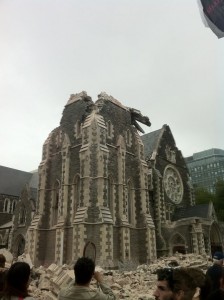
 22 February 2011 “may well be New Zealand’s darkest day”; these were the words of Prime Minister John Key in the aftermath of the earthquake which devastated the South Island’s largest city Christchurch. The death toll is expected to be over 200, many more have been injured, have lost property and now live in fear of the next big one. Inevitably a question is posed to those, like me, who have faith in God. Where was God that day? Of course the person who asks this is not literally asking where God physically was, he is asking, why did God not prevent this from happening? Why does God allow people to suffer? God clearly, as an all powerful being, can prevent suffering so why doesn’t he?
The question is ambiguous. Taken one way it is simply a question which assumes that God exists and asks for God’s reasons for allowing a particular event. Taken the other way it is a rhetorical question which hides an unspoken argument that the existence of disasters, like the Christchurch earthquake, is evidence that God, most likely, does not exist. In “God, Evil and Suffering” Daniel Howard-Snyder notes,
[T]he theoretical “problem” of evil is often expressed in the form of a pointed question. God is able to prevent evil and suffering and He would know about them before they happened, right? Moreover, since He is unsurpassably good, surely He would not permit them just for the fun of it. So why doesn’t He prevent them?
The sceptic notes two things; first that God knows about and is able to prevent suffering. Second that God, being perfectly good, would prevent this suffering unless he had a good reason for allowing it, which Howard-Snyder defines as “a reason that was compatible with his never doing wrong and his being perfect in love”. This is the implicit background to the question.
The rhetorical force of this argument is powerful and its emotional appeal has a strong pull, particularly on the back of an horrific disaster. Nevertheless, many philosophers have found that when examined rationally it has an important flaw. The argument establishes that if God exists then He must have a good reason for allowing suffering. The sceptic is asking for an account of these reasons. The assumption is that if a believer cannot give a precise account of God’s reasons then there probably are none. It is this assumption upon which the argument hangs or falls.
The problem is that this assumption is questionable. Philosopher Alvin Plantinga illustrates,
I look inside my tent: I don’t see a St. Bernard; it is then probable that there is no St. Bernard in my tent. That is because if there were one there, I would very likely have seen it; it’s not easy for a St. Bernard to avoid detection in a small tent. Again, I look inside my tent: I don’t see any noseeums (very small midges with a bite out of all proportion to their size); this time it is not particularly probable that there are no noseeums in my tent—at least it isn’t any more probable than before I looked. The reason, of course, is that even if there were noseeums there, I wouldn’t see ’em; they’re too small to see. And now the question is whether God’s reasons, if any, for permitting such evils as [the Christchurch earthquake] are more like St. Bernards or more like noseeums.
In his book The Reason for God: Belief in an Age of Skepticism, Timothy Keller notes “we see lurking within supposedly hard-nosed skepticism an enormous faith in one’s own cognitive faculties. If our mind (more…)