Category: Series

  • Fallacy Friday: The Fallacy of False Cause & Post Hoc, Ergo Propter Hoc

    This week I will look at the fallacy of false cause and in particular the post hoc, ergo propter hoc fallacy. These fallacies occur when one conflates the fact that two things occur at the same time or in close succession with the conclusion that one caused the other.

    Post Hoc, Ergo Propter Hoc
    This neat little clip from the West Wing gives a good example:

    Post hoc, ergo proptor hoc

    Transcript
    For those of you with bandwidth issues, here is the transcript from the clip:

    LEO
    What else?

    C.J.
    The Ryder Cup team is declining our invitation to come to the White House.

    LEO
    You’re kidding.

    C.J.
    Because of the joke.

    BARTLET
    You’re kidding.

    C.J.
    I’m not.

    [Mrs. Landingham comes in and gives Bartlet his schedule.]

    BARTLET
    The Ryder Cup team? (more…)

  • Fallacy Friday Podcast on Apologetics 315: Assessing Arguments

    Fallacy Friday PodcastsApologetics 315 are producing an audio version of Matt’s Fallacy Friday series.

    The Fallacy Friday Podcasts are released every Friday on Apologetics 315. You can subscribe using:

    • RSS Feed
    • Via iTunes
    • one-click to your feed-reader

    The Mp3 of Assessing Arguments is here.

    To navigate the series in print, use the Fallacy Friday tag, to navigate MP3 series use the Fallacy Friday Podcast tag.

  • Fallacy Friday: Division and Composition

    Today I want to look at two fallacies, the fallacy of composition and the fallacy of division. These two fallacies are related in that they both mistakenly confuse what is true of the parts with what is true of the whole.

    The Fallacy of Composition

    M&MsThe fallacy of composition involves mistakenly reasoning that what is true of all the parts of something is therefore true of the whole of that thing. Some obvious examples would be reasoning that because every track on a CD is 10 minutes long the whole CD is ten minutes long; or arguing that because atoms are colourless, and m&ms are made up of atoms, it follows m&ms are colourless. These are examples are fairly obviously cases of invalid inferences.

    However, some examples are less obvious. In some versions of the Cosmological Argument for God’s existence, or at least in some apocryphal versions of the argument, it is mistakenly argued that because every item in the universe has a prior cause, the universe as a whole has a prior cause. This is mistaken. If the universe is infinite in time, i.e. it has no beginning, then it is possible for the whole universe to be uncaused while every part is caused by a prior part. Hence, what is true of each individual part of the universe will not be true of the whole. Of course, not all forms of the cosmological argument make this mistake but those that do commit the fallacy of composition.

    The Fallacy of Division
    Just as the fallacy of composition mistakenly infers what is true of the parts is true of the whole, the fallacy of division mistakenly reasons that what is true of the whole is true of the parts. This would occur, for example, if someone reasoned that because the All Blacks score multiple tries in a game, it follows that every member of the All Blacks scores multiple tries in a game; or that because a particular wall is fragile and breakable, every single brick that makes up the wall is fragile and breakable.

    Our Schist Flagstone FireplaceThe problem with both these fallacies is that they mistakenly assume that the whole and the parts that make up the whole have the same properties. Madeleine and I have a beautiful flagstone fire-place in our lounge. It is made up of a series of different sized, shaped and coloured pieces of schist rock, plastered together in flagstone formation to make a single rectangle panel. Merely looking at the fire-place gives a visual illustration that the parts can have different properties to the whole. The individual flagstones are a variety of shapes and not very rectangular yet the whole fire-place is rectangular. Some of these rocks are grey, others are brown,  some have amethyst and teal tones to them but the whole panel is not grey, nor is the whole panel brown, amethyst or teal. This visual picture shows, quite nicely, that what is true of the parts is not always true of the whole and vice-versa.

    Conflating Collective & Distributive uses of General Terms
    Apart from the straight-forward mistake of confusing what is true of a part with what is true of the whole, there are more subtle versions of this kind of fallacy. The most common is where a person conflates what is true of a group distributively and what is true of it collectively. This is less technical than it sounds; consider the following two propositions which can be sensibly said to be true:

    1) Cats have roamed the earth longer than humans.

    2) Cats have a natural life span of around 15-20 years.

    1) is a statement about cats collectively; it is a statement about cats as a group. This type of animal has been roaming the earth since before humans came on the scene. On the other hand 2) is true of cats distributively; it is a  about a property possessed by every individual cat.

    Felis takes a break from all the earth roamingIf a person does not pay attention to the differences between distributive and collective uses of general terms one can make fallacious inferences that may sound correct but which are not. An example will illustrate, our children have a cat called Felis who  is around 5 years old. Suppose, however, that I were to reason:

    1) Cats have roamed the earth longer than humans;

    2) Felis is a cat;

    Therefore: (more…)

  • Fallacy Friday Podcast on Apologetics 315: Introduction & What is an Argument?

    Fallacy Friday PodcastsApologetics 315 are producing an audio version of Matt’s Fallacy Friday series.

    The Fallacy Friday Podcasts will be released every Friday on Apologetics 315. You can subscribe using:

    • RSS Feed
    • Via iTunes
    • one-click to your feed-reader

    The Mp3 of the introduction to the series is here; the first episode: What is an Argument? is here.

    To navigate the series in print, use the Fallacy Friday tag, to navigate MP3 series use the Fallacy Friday Podcast tag.

  • Fallacy Friday: Tu Quoque (But you did it too!)

    Last week I looked at the Straw Man Fallacy, today I want to explore the tu quoque fallacy. In latin tu quoque (too kwo-kwee) means “you too”;  in fact, the phrase “you did it too” is a good, succinct account of this fallacy. A tu quoque occurs when one rebuts a particular criticism of one’s own position by showing one’s opponent’s position is subject to the same criticism; this is done instead of showing that one’s own position is not susceptible to the criticism.

    A good example is the following segment of a CNN Interview with Osama Bin Laden,

    Q: Now, the United States government says that you are still funding military training camps here in Afghanistan for militant, Islamic fighters and that you’re a sponsor of international terrorism. … Are these accusations true? …

    Osama Bin LadenOsama Bin Laden: … At the time that they condemn any Muslim who calls for his right, they receive the highest top official of the Irish Republican Army at the White House as a political leader, while woe, all woe is the Muslims if they cry out for their rights. Wherever we look, we find the US as the leader of terrorism and crime in the world. The US does not consider it a terrorist act to throw atomic bombs at nations thousands of miles away, when it would not be possible for those bombs to hit military troops only. These bombs were rather thrown at entire nations, including women, children and elderly people and up to this day the traces of those bombs remain in Japan. The US does not consider it terrorism when hundreds of thousands of our sons and brothers in Iraq died for lack of food or medicine. So, there is no base for what the US says and this saying does not affect us.[1]

    Here Bin Laden was asked to respond to the claim that he has been sponsoring terrorism and training Islamic militants. Bin Laden argued that there is no basis for this claim because the United States supports terrorism and has itself engaged in activities which can justifiably be labelled ‘terrorist’. Bin Laden’s comments about the United States may or may not be true but either way it would not answer the questions as to whether Bin Laden has been sponsoring terrorism. It is possible, after all, that both Bin Laden and the United States sponsor and engage in terrorism.

    The Difference Between a Tu Quoque and Internal Criticism
    It is important to distinguish this argument from another similar argument, which I will call internal criticism. Internal criticism occurs when one argues against an opponent’s position by noting that one proposition the opponent holds conflicts with another proposition he holds.

    An example is Alvin Plantinga’s famous argument in God and other Minds. In this book Plantinga looks at the question of whether belief in the existence of God is irrational because it cannot be proven to be true with a non-circular argument (more…)

  • Fallacy Friday: The Straw Man

    In my last Fallacy Friday I covered the The Genetic Fallacy, the error of arguing that an idea is false on the basis of where it originated from. Today I want to look at what’s known as the “straw man” fallacy.

    Origins of the Name
    This fallacy takes its name from a practice common in the middle ages. A knight would practice jousting by putting a straw man on a horse and attempting to knock it off. This practice provides a vivid image of how the fallacy works, anyone who knocks a straw man off a horse has not defeated a jousting opponent; he has only knocked down a dummy or effigy of his opponent. A real opponent was not so easy to knock down.

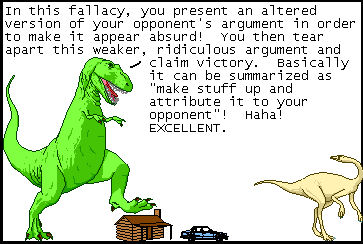
    Straw Man

    www.qwantz.com

    Similarly, the straw man fallacy occurs when a person attempts to refute an argument or conclusion, not by showing that that argument is unsound or that the conclusion is false, but instead by falsely attributing a different argument or conclusion to their opponent and refute that. Usually the position attributed to the opponent is similar to their actual position so that it looks to other people like it has actually been refuted. Like the straw man the jouster trains with, the falsely attributed position is typically easier to rebut. Unfortunately rebutting an argument or conclusion which is like your opponent’s, is not the same as refuting the argument or conclusion your opponent actually holds.

    Structure
    Straw man reasoning typically proceeds in the following fashion, let’s say John and Sally are having a discussion:

    1. John affirms P.
    2. Sally then attributes Q to John (Q is a distorted version of P although superficially similar to it).
    3. Sally then offers a refutation of Q
    4. Sally concludes she has refuted P.

    In this exchange Sally does not respond to P. Instead she misrepresents John’s position as being Q.

    There are several ways this kind of misrepresentation is (more…)

  • Fallacy Friday: The Genetic Fallacy

    The Genetic FallacyA fallacy related to the one we looked at last week (the Ad Hominem fallacy) is the genetic fallacy. One commits the genetic fallacy if one argues that a proposition is false on the basis of where the idea originated from.  Like the ad hominem, this fallacy invokes a kind of psychological transference where one transfers one’s disapproval of the source of an idea to the content of the idea itself. This kind of transference is fallacious because the content of an idea, its truth or falsity, depends on whether what it affirms about the world is the case and not on where the idea originated.

    Examples
    Consider, the ancient Greek thinker Pythagoras. Pythagoras was a religious mystic who worshipped numbers and geometrical systems as part of a broader religious scheme which included a strict diet and belief in reincarnation. Few people are aware of this; today he is best known for being traditionally credited with discovering the famous mathematical formula known as Pythagorean Theorem which affirms that, “for any right triangle, the square of the hypotenuse is equal to the sum of the squares of the other two sides”.

    Now suppose someone were to reject Pythagorean theorem on the grounds that it was discovered by a odd religious mystic. This rejection would obviously be invalid. Even if tradition were correct in identifying Pythagoras with the discovery of this theorem, this does not mean that the theorem is false; its truth is determined by what the realities of math and geometery actually are, not by who discovered them.

    A second example illustrates the same point. Some early defences of heliocentricism, the view that the planets in the solar system orbit the sun, originated in certain systems of sun mysticism. People worshipped the sun as a symbol of God and hence thought it fitting that the sun be at the centre. This fact about the origins of some beliefs about heliocentricism does nothing to show that heliocentricism is false. Its truth or falsity depends on location of different planets, not on how the idea was first formulated.

    These examples may seem fairly obvious but they often beguile people. In Theology, for example, some theologians dismiss certain ideas as false because they originated in Greek Platonism. Yet (more…)