Category: Public Policy

  • The 2009 Forum on the Family: A Review

    On Friday Madeleine and I attended the Forum on the Family and the following is our long awaited (and long) review of it.

    The Forum kicked off with an impassioned talk from Bev Adair. Bev gave a harrowing account of her own story of childhood physical and sexual abuse and subsequent encounter with God that transformed her life and character and enabled her to break the cycle in her own life, heal and bring her own experience into her work with the Family and Child Trust. She stressed that the solution to child abuse was that people stopped blaming others or their social context for what happens to them; that they must cease demanding solutions from the state and being reliant on welfare; she called for individuals and communities to take responsibility for their own actions and for an end to the silence; abuse is not invisible, people who see it must act. Bev stated that voluntary organisations that were not funded by the state were doing some of the most effective work in the community and the consensus from them was that poverty does not make people hurt their children, she pointed out that countries with real poverty don’t brutalise their children or have stats like New Zealand’s.

    What was interesting was that later in the program the children’s commissioner, Dr John Angus, gave a much drier facts and figures type talk that reinforced what Bev stated. Relying on data compiled by CYFS, Angus noted that abuse tended to be more correlated to drug and alcohol abuse than poverty and that while reports of child abuse are on the increase, the actual cases are not. Like Bev he also suggested that the solutions were at the family, individual and community levels as opposed to government. Angus noted that one of the biggest problems was that when people were worried about a friend or family member’s conduct they rang CYFS rather than actually confronting or addressing it at a family level. Angus argued that real progress is made when families and communities own the problem and openly confront the issues family members face and offer constructive help instead of just looking to the state. It was at this family/community level, that real change can be made.

    In contrast to this, Labour Leader Phil Goff gave a speech about how poverty and economic hardship were the key issues in child abuse. Goff spoke of the need for a society where no children missed out on health care, education or basic necessities due to economic deprivation. He noted the historic Christian motivation behind the original welfare policies of Labour and suggested a need for all parties to work towards helping families in need. While I am not generally a fan of Labour, it is hard to dispute Goff’s claim that we should work towards having a society where no child misses out on basic necessities due to poverty and God clearly would want Christians should to be committed to achieving such a society, that said, none of this speaks to the question as to how this should be done and what the just and appropriate means of bringing it about are (I have discussed the issue of sustenance rights in a previous post). In the Q&A when I questioned Goff further on this he made it clear that he specifically saw this support as primarily coming from the state and not from the voluntary sector on the grounds that “the state has the money.” (Ironically Goff also justified high taxes on the grounds that it was needed for the state to play this role making his position somewhat circular.) These criticisms aside, Goff is to be commended for being the first Labour leader to front up and address the Forum on the Family and for attempting to build bridges with conservative Christians instead of trying to “marginalise them out of existence.”

    One unfortunate feature of Goff’s talk was the focus in the Q&A on the smacking issue. Goff suggested this was a side issue, not as important as child abuse and that people should focus their energy and passions on more important issues. That is, of course, correct and the fixation by members of the audience on this issue did seem disproportionate. However, at the same time, as members of the audience noted, a large number of the audience were from voluntary organisations that were dealing with domestic violence and child abuse at the coal face; hence, the suggestion they were not addressing this or were not as committed to these issues is inaccurate. Moreover, opponents of the current s59 of the Crimes Act had repeatedly told Labour that laws about smacking had nothing to do with child abuse in the past. Proponents had justified the decriminalisation of reasonable force for the purposes of parental correction on the grounds that it would help to stop child abuse and some had, in fact, equated smacking with child abuse. The previous Labour government’s support of this line of argument was the reason that there was now a Bill before the house, John Boscawen’s Crimes (Reasonable Parental Control and Correction) Amendment Private Member’s Bill. So for Phil Goff to now claim now that concern around s59 was a side issue and the question of child abuse was a different, more important issue that Labour was deeply committed to was more than a tad disingenuous, which is what evoked the scathing (and justified) attack from Christine Rankin that David Farrar referred to on his Facebook page.

    Moreover, with a Bill before the house, Labour really do need to take a stance; it is fine to say s59 is not their main focus but when the bill is actually put before them they will need a position. Their opinion on the now, apparently separate and unrelated to light smacking, issue of child abuse, while commendable, is not what they will be asked to vote on. When Madeleine pressed Goff on this he stated that Labour will be voting against Boscawen’s Bill.

    Not all the speakers spoke on child abuse and s59, Greg Fleming, CEO of the Maxim Institute, gave a good talk entitled “Right Wing, Left Wing. What Does it Mean? Does it Matter?” Fleming made essentially three points; first, he noted that the terms ‘right wing’ or ‘left wing’ often function as labels that are used to pigeon hole or brand a person so as to summarily dismiss their position without actually addressing it or considering its merits. Fleming’s contention that such dismissals often reflect a kind of unjustifiable intellectual laziness is undoubtedly correct and occurs far too often.
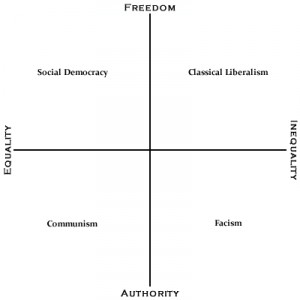
    Political SpectrumFleming’s second point was to suggest that the labels ‘left’ and ‘right,’ when understood correctly, do have a useful descriptive function in highlighting where a person sits on a particular spectrum. For Fleming, this spectrum constituted a horizontal axis whereby equality was at one end, the left and inequality at the other, the right. In addition to the horizontal left-right spectrum is a vertical spectrum with freedom at the top and authority on the bottom. These axes lead to communism being on the bottom left, totalitarian authority to maximise equality; fascism on the bottom right, totalitarian authority to maintain inequality; social democracy on the top left, limited government focused on achieving equality; finally, classical liberalism on the right, limited government for the sake of maximising individual freedom.

    One criticism I have of this is that (more…)

  • Christchurch Event: John Boscawen, David Garrett, Larry Baldock on s59

    Recently I attended a public meeting in support of John Boscawen’s Bill to restore the right of parents to use reasonable force for the purposes of correction in the course of parenting removed by the current s59 of the Crimes Act. This Bill will be voted on shortly and for those of us who voted no in the recent referendum it is our best shot, currently available, to achieve a law change. Whilst National have said they will vote against it there are other parties in Parliament who might, apparently Labour are turning over a new not-so-nanny-state leaf and there are those in National who share our views who do have the power to challenge John Key’s decision to whip his MP’s (the notion that elected MP’s should vote in accord with what they believed right seems lost on John Key) so while the Bill remains alive so does some hope.

    The next meeting is in Christchurch:

    What: John Boscawen, David Garrett, Larry Baldock speaking in support of the Bill (other speakers to be advised).
    When: Monday 21 September, 7.30 p.m
    Where: St. Bede’s College, Performing Arts Centre, 210 Main North Road, Papanui, Christchurch City

    John Boscawen has challenged Clayton Cosgrove to attend; Kate Wilkinson, the National List MP for the area has also been invited.

    For info on future meetings email: kbridgman@xtra.co.nz or phone: 09 531 5531.

  • Goff on Labour’s Mistakes: What about Fixing a Few Phil?

    I have got to give it to Phil Goff, the more I hear from him the more I like.

    I grew up in a Social Credit family. I lived in Uncle Gary’s East Coast Bays electorate, my mum was even his electorate secretary at one point. I remember watching my father and uncle on the news protesting visiting nuclear ships, I went on nuclear-free marches when I was a kid, we rode on election floats waving green and yellow ribbons around the bays, my whole family would go out door to door canvassing and election days were spent working in polling offices crossing names of those who had voted off the electoral roll. I remember passionately cheering when Lange got elected and my aunt has been known to do a classic Jenny Shipley and Ruth Richardson ‘we hate the poor’ impersonation at the Christmas table. We were a left wing family and until last election, I was the only black sheep. (I voted left once, I gave the Alliance two ticks the first time I voted because I thought their tax policy was really clever [*yes I KNOW*] but then I was cured and have voted right ever since.)

    So when my father who has voted Social Credit/Alliance/Greens/Labour his whole life told me he voted ACT and my stepmother voted National in the last election, I just about dropped the phone. He’d had enough. He had grown disillusioned with the left and the reason is pretty much summed up in Goff’s comments in today’s Herald article, “Goff admits: We made mistakes.”

    So Goff is doing well. He has got my attention. Of course it will be a cold day in hell [well not really because I am a conditionalist – metaphorically speaking then] before he gets my vote, but talk is cheap; if Goff really, truly means what he is saying he might put his money where his mouth is and act (literally) he could start with backing Boscawen’s and Douglas’ Bills to select committee (though I suspect my old Waikato political adversary, colleague and fellow law student now Labour’s General Secretary Chris Flatt might have something to say about the latter).

    Hat tip: Christian News New Zealand

  • A Review of Last Night’s Boscawen, McCoskrie, Evans, Baldock Meeting UPDATED

    Last night’s meeting with John Boscawen, Bob McCoskrie, Jim Evans and Larry Baldock on amending s59 of the Crimes Act to decriminalise the use of reasonable force for the purposes of parental correction was encouraging. The main themes I came away with from each speaker were:

    John Boscawen – ACT Party MP
    John Boscawen has not given up on his Bill and will use the time between now and 15 October 09, the date he expects his Bill to go to first reading, to rally support for it. He needs us to keep the issue live. So commenters, keep commenting; bloggers keep blogging. Everyone keep the pressure on the MP’s, especially the Nats  and everyone keep an eye out for public meetings as John travels around and turn up to them with friends – we want the media to be able to report that there are bums on seats everywhere he goes in support of this Bill.

    Despite John Key’s refusal to act, keep in mind that MP’s feel political pressure, they are human beings, they are not immune to it.

    Jim Evans – Emeritus Professor of Law at the University of Auckland
    Professor Evans confirmed that the dominant purpose of any act of force in the course of parenting cannot be correction. He spoke of his concern for the danger to the rule of law caused by reliance on police discretion for acts that are clearly criminal. He said it might be one thing for the police to exercise discretion over issuing a traffic fine but when it comes to criminal acts it is not an adequate solution. If you have a situation where conduct that should not be criminal in fact is then the solution is not to just not prosecute but to change the law.

    Highlighting Fitzgerald v Muldoon [1976] 2 NZLR 615 (NZSC) he spoke of the legal principle that required this contained in the Bill of Rights Act 1689, Article 1, which provides:

    “That the pretended power of suspending of laws or the execution of laws by regal authority without consent of Parliament is illegal.”

    Essentially this means that only parliament can change the law and it must make a statute to do so. Professor Evans pointed out that being governed by discretion, as opposed to law, makes it impossible for one to stand on the law.

    Bob McCoskrie – Family First
    Bob spoke on research on the real causes of child abuse and called for more action on that.  Not one, even those done by the likes of UNICEF, CYFS and the Children’s Commissioner, cited smacking as a cause.  I support this research and action being done but not by government.

    He also put up some excellent quotes:

    John’s Key speaking on Radio Live on 4 Sept 09 at 11:40 am to Michael Laws:

    “It’s a complete and utter dog’s breakfast – let’s acknowledge that”, that it’s badly drafted, “extremely vague”, and “we believe the Borrows amendment was the right place to settle.”

    Hat tip: S59Blog, Voxy

    [I won a chocolate bar at the meeting for knowing who said that – it was very nice]

    Sue Bradford’s contradictory and confusing statements on the law;

    Will ban smacking: “Greens draw up their own anti-smacking bill”

    Won’t ban smacking:
    Sue Bradford: “It won’t be legal but that won’t mean…
    Barry Soper (interviewer): “So it’s banning smacking.”
    Bradford: “No it’s not”

    Smacking is banned: “Ms Bradford says parents need to accept that it is no longer legal to hit children.”

    Smacking isn’t banned: “Smacking has never been a criminal offence, and still isn’t”

    Smacking already banned: “it is already illegal to smack children but her bill removes a defence of reasonable force for the purpose of correction.” (March 2007)

    There is no such law:
    “There is no specific law relating to smacking on New Zealand’s statute books. People like Mr McCoskrie have fostered a myth that what has happened is that a new law has been created that specifically outlaws smacking. This is simply not true.”

    Smacking bill won’t help: “The epidemic of child abuse and child violence in this country continues – sadly. My bill was never intended to solve that problem.” (National Radio – 21 Dec 07)

    Sue Bradford attempts to explain the effect of the anti-smacking law to National Radio’s Sean Plunket (18 June 2009) – click here to listen [or read Dave Crampton’s summary of the interview.]

    Sue Bradford says it’s not a decision that should be left to the people – watch her on YouTube.

    Hat tip: Vote No

    A great one by former Labour Prime Minister Michael Moore (not the faux-documentary maker) in the Herald,

    The expensive, puerile, futile controversy over the ill-considered anti-smacking legislation is a monument to political cowardice and opportunism.

    Hat tip: Big News, Contra Celsum

    [Many thanks to the readers who sent these quotes to me; I have had a very bad run with pain lately and sitting through the meeting on hard plastic chairs was really difficult and I was paying for it yesterday which is why I did not hunt them down myself.]

    Larry Baldock – Kiwi Party
    Larry spoke of his plans to promote another referendum; a non-binding referendum to ask the question “should Citizens Initiated Referenda seeking to amend or repeal a law be binding?’ He asked for people to sign up to help promote it, once it is approved by the Clerk of the House.

    I did not sign up and will not help to promote it.

    Direct democracy is a flawed concept. Legislating is a skill, it is not something that every person is capable of. This is why we must take care to elect skilled and capable and ethical people to parliament when we vote. We elect them to consider the issues, all of them and wisely legislate on our behalf. They should listen to the people but democracy is not mob rule, it is not and should not constitute bowing to the will of the majority. The majority can and have and continued to jump on the wrong bandwagons; the majority once supported slavery, circuses in Rome, they elected Hitler to power and in New Zealand if we held binding referenda today abortion on demand and the removal of the defence of provocation would fly through – positions that are wrong (see here and here respectively) that are held on the basis of knee-jerk emotionalism instead of reason.

    Much philosophical literature has been written over the centuries against direct democracy.  If I have not convinced you, read some before you sign your name to Larry’s petition or agree to help promote it.

    I agree with Larry’s frustrations, I agree there is a massive problem with our political system in New Zealand but the solution is that we need an upper house. An upper house vets legislation sent up by the lower house. It is typically elected by a different system so you get quite a different makeup. Essentially it means that all legislation gets a second look by skilled, knowledgeable eyes, gets re-debated, amended and tweaked before it becomes law. This is a far better safeguard that the option to call a binding referendum where only a vague conception can be communicated to parliament in the form of the referenda question to which one can only offer a yes or a no. A bill still has to be drafted in response to a binding referendum and who gets to write that or determine how much it is in line with the referenda question?

    If Larry’s petition was a clearly worded call for an upper house I would be behind him completely.

    UPDATE:
    You Tube videos of the speakers are here.

  • Monday Night: John Boscawen, Bob McCoskrie and Jim Evans on Amending s59

    Fresh from Facebook’s “5000 Demanding Anti Smacking Law Change” group is this invitation:

    ACT MP John Boscawen is holding a series of public debates on the smacking referendum result and how his bill to amend S59 will bring the legislation into line with public opinion.

    John Boscawen will be holding the first debate in Phil Goff’s electorate MT Roskill this Monday. He has challenged Phil Goff to front up and defend his position on ignoring the referendum result.

    The debate will be held on Monday, September 7 2009, 7.30pm, Hay Park School, 670 Richardson Road, Mt Roskill, Auckland.

    Speakers include John Boscawen, Bob McCoskrie and Professor Jim Evans from the Auckland Law School.

    If you live in the Auckland area, please do come along and learn more about John Boscawen’s bill while demanding that the politicians listen to the people and change the anti-smacking law.

    I’ll be there; Matt, sadly, will be in Tauranga.

  • Boscawen’s Smacking Bill drawn from the Ballot

    In impeccable timing, this afternoon I heard the announcement that ACT MP John Boscawen’s Bill to amend Section 59 of the Crimes Act, in line with the Borrows amendment that defined reasonable force, had been drawn from the ballot.

    However, John Key swiftly announced that National would not back it to Select Committee trotting out the flawed “the law is working” argument; basically, smacking is illegal but we promise to not enforce it as long as we are in government, which is somehow supposed to reassure parents. NOT.

    So the bill appears dead in the water. Hopefully Boscawen will elect to delay its first reading until just before the next election.

  • Dear Mr McCully,

    The law criminalises smacking, the best and most faithful reading of the law deems any use of force for the purposes of parental correction criminal; experts in legal interpretation agree on this. The people have objected loudly and all you have done is issue a promise to not enforce the law; a promise that can only be kept for as long as you govern, a promise that offends the duty of a government to ensure that the law is enforced.

    Your so called “safeguards” offer no long term protection. What happens to those safeguards in the future if the Greens hold the balance of power? Or is that what is really going on – you won’t change the law because you want it to be easy to eradicate smacking long term in New Zealand?

    I am not fooled. Courts are primarily directed by the black letter of the law not promises to not enforce it made by past governments. This government has a chance to offer parents protection that a future government will find harder to undo and it will fail if these “safeguards” are all it does.

    Promises to not enforce a law that criminalises smacking are not good enough. If the government does not wish for parents who lightly smack their children for the purposes of correction to be prosecuted then it must change the law now, before the possibility of a new government arises.

    Regards,

    Madeleine Flannagan

    The Hon Murray McCully emailed me (I suspect generically) this morning in response to my first email, Dear Cabinet,. The above is a response, sent to all members of Cabinet, to Mr McCully’s email to me which is pasted below,

    The Prime Minister has announced that the Government is introducing safeguards to give parents comfort they will not be criminalised for lightly smacking their children.

    The safeguards follow the Citizens Initiated Referendum on smacking. The referendum result reinforces the message that New Zealanders do not want to see good parents criminalised for a light smack.

    To give parents comfort that this will not happen, Cabinet has agreed on a number of measures. These are:

    The Police and Ministry of Social Development chief executive will lead a review of Police and Child, Youth & Family policies and procedures, including the referral process between the two agencies, to identify any changes that are necessary or desirable to ensure good parents are treated as Parliament intended. The Commissioner of Police and Ministry of Social Development chief executive will seek an independent person to assist in the conduct of the review and will report back by 1 December 2009.

    We will be bringing forward the delivery of the report from the Ministry of Social Development chief executive on data and trends and the effect of the law change from the end of the year to late September/early October. The Minister of Social Development will table the report in Parliament.

    The Government will invite Police to continue to report on a six-monthly or annual basis for the next three years on the operation of the law, and invite Police to include data on cases where parents or caregivers say the force used on the child was reasonable in the circumstances.

    If future Police data indicates a worrying trend, the law will be changed to ensure that good New Zealand parents are not criminalised for lightly smacking.

    The Government believes the law is working as intended, but we want to give parents an assurance that a National-led Government will continue to monitor the way the law is being implemented.

    RELATED POSTS:
    Dear Cabinet,
    Fisking Margaret Mayman: The Flawed Moral Theology on the Smacking Referendum
    Fisking Ian Hassall: The Arbitrary Ethical Reasoning on the Smacking Referendum
    No Defences Permitted for the Accused
    MandM Smacking Label