Category: Politics

  • Some subversive thoughts on immigration

    I’ve been thinking recently about the moral issues surrounding immigration. This is partly because it’s an issue I’ve never really studied in depth, and partly because it’s become a massive political football.

    Here’s a thought that came to me. As I understand it, the right of a refugee to seek asylum in international law has Christian roots, which in turn draw on certain passages in the Torah, such as this one:

    You shall not hand over to his master a slave who has escaped from his master to you. He shall live with you in your midst, in the place that he chooses in one of your towns where it pleases him; you shall not mistreat him.(Deut 23:15-16)

    This law contrasts with common legal practice in the ancient Near East, where people were legally required to return any runaway slaves. Consider, for example, the Laws of Hammurabi (c. 1750 BCE):

    LH §16: If a man should harbor a fugitive slave or slave woman of either the palace or of a commoner in his house and not bring him out at the herald’s public proclamation, that householder shall be killed.

    Or a fifteenth-century BCE treaty between two Syrian kings:

    If a fugitive slave, male or female, of my land flees to your land, you must seize and return him to me; (or), if someone else seizes him and takes him to you, [you must keep him] in your prison, and whenever his owner comes forward, you must hand him over to [him].[1]

    Jefferey Tigay explains:

    The only thing remotely close to this biblical law in the ancient world is the practice at certain temples of granting asylum to slaves fleeing harsh treatment by their masters. Generally, such asylum was not permanent; it protected the slave until he could come to terms with his master or, as a last resort, was sold to another master. By contrast, the biblical law is absolute and treats the whole land of Israel as a sanctuary offering permanent asylum.[2]

    Notice what the Torah passage states: it forbids Israel from deporting someone who has escaped into their nation to escape slavery, and it prohibits restricting their freedom of movement within Israel or limiting their choice of where to live. (Here the “you” is a collective reference to Israel, not simply “your” towns.)

    I was familiar with this passage, but I was struck by its possible application to modern immigration.

    Let’s begin with some historical examples.

    Example 1 (1850). The Fugitive Slave Act required citizens of states where slavery had been criminalized to assist in the capture and return of escaped slaves who had made their way into those states. Abolitionists at the time quoted Deuteronomy 23:15–16 to justify refusing to comply with this law.

    So: you live in a free state in 1850. You discover the whereabouts of a runaway slave who is fleeing an abusive master. Do you (a) comply with the Fugitive Slave Act and hand him over to the authorities, or (b) conceal his whereabouts to prevent his capture? I think most of us would agree that (b) is the right thing to do.

    Example 2 (1930s). The Nazis persecute Jewish people across Europe. Thousands of Jews flee and seek to emigrate, but protectionist U.S. immigration policies mean many are refused entry. You discover a German Jewish overstayer. Do you (a) inform the authorities so he is deported back to Germany, or (b) help conceal his whereabouts? Intuitively, (b) again seems the morally right course; (a) would be immoral.

    Example 3 (contemporary). It is 2025. The Taliban rule Afghanistan. You discover an Afghan overstayer who fled the Taliban; if reported, he will be deported. Do you (a) report him, or (b) conceal him? Or you discover an undocumented Mexican restaurant owner in California who fled cartels, or a Nigerian Christian overstayer who fled persecution? Do you disclose their legal status or do you conceal it? From what I read, many American evangelicals appeal to Romans 13—“obey the government”—to argue that Christians must support the deportation of illegal aliens because the law has been broken in these cases.

    So here is my question: how do these 2025 cases differ in principle from examples 1 and 2? In all cases, the person is illegally in the country while fleeing life-threatening danger—slavery, genocide, Taliban rule, cartels. Is there a principled difference between returning a slave to his master and sending someone back to the Taliban or cartels? If those who defied the Fugitive Slave Act were doing the right thing, why must we follow the law here?


    [1] Jeffrey H. Tigay, Deuteronomy, JPS Torah Commentary (Philadelphia: The Jewish Publication Society, 1996), 387.

    [2] Tigay, Deuteronomy, 215
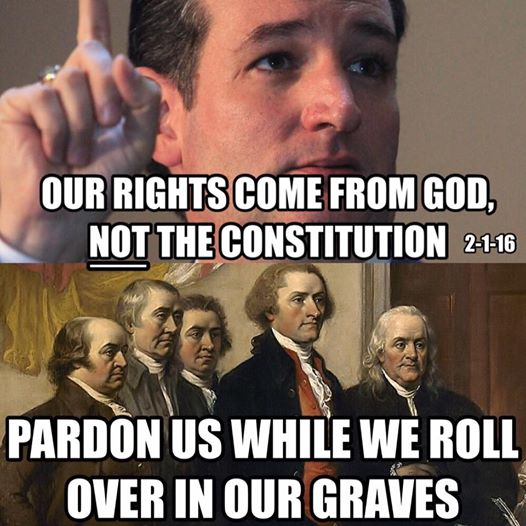
  • An Interesting Comparison

    This from Occupy Democrats:

    12647129_1058653647561022_4746717199189857381_n

    This from the Unites States Founding Fathers:

    When in the Course of human events, it becomes necessary for one people to dissolve the political bands which have connected them with another, and to assume among the powers of the earth, the separate and equal station to which the Laws of Nature and of Nature’s God entitle them, a decent respect to the opinions of mankind requires that they should declare the causes which impel them to the separation.

    We hold these truths to be self-evident, that all men are created equal, that they are endowed by their Creator with certain unalienable Rights, that among these are Life, Liberty and the pursuit of Happiness.–That to secure these rights, Governments are instituted among Men, deriving their just powers from the consent of the governed, –That whenever any Form of Government becomes destructive of these ends, it is the Right of the People to alter or to abolish it, and to institute new Government, laying its foundation on such principles and organizing its powers in such form, as to them shall seem most likely to effect their Safety and Happiness. Prudence, indeed, will dictate that Governments long established should not be changed for light and transient causes; and accordingly all experience hath shewn, that mankind are more disposed to suffer, while evils are sufferable, than to right themselves by abolishing the forms to which they are accustomed. But when a long train of abuses and usurpations, pursuing invariably the same Object evinces a design to reduce them under absolute Despotism, it is their right, it is their duty, to throw off such Government, and to provide new Guards for their future security…

    We, therefore, the Representatives of the united States of America, in General Congress, Assembled, appealing to the Supreme Judge of the world for the rectitude of our intentions, do, in the Name, and by Authority of the good People of these Colonies, solemnly publish and declare, That these United Colonies are, and of Right ought to be Free and Independent States; that they are Absolved from all Allegiance to the British Crown, and that all political connection between them and the State of Great Britain, is and ought to be totally dissolved; and that as Free and Independent States, they have full Power to levy War, conclude Peace, contract Alliances, establish Commerce, and to do all other Acts and Things which Independent States may of right do. And for the support of this Declaration, with a firm reliance on the protection of divine Providence, we mutually pledge to each other our Lives, our Fortunes and our sacred Honor. (emphasis mine)

    Oceania is at war with Eastasia. Oceania has always been at war with Eastasia.

  • Ad Homonym: MandM are not suing the National Party

    For the record MandM are not suing the New Zealand National Party over their election advertisement. Rumours to the contrary we hereby reject as an ad homonym.

    National Party Ad

  • Open Letter to Maurice Williamson

    Dear Maurice Williamson,

    Maurice Williamson and his "big gay rainbow"I hear you are having some troubles in the media at the moment. Apparently there are moral questions swirling around you about honest disclosure, potential abuse of power, unduly influencing the police in favour of a person who donated money to you, and so on.

    Don’t let judgmental people like Prime Minister John Key discriminate against you any longer. Such people clearly believe they can make moral judgments about what is appropriate and impose them onto you. Stand up to the bigots.

    Here is my advice to you.

    Call a press conference and do the following:

    1. Point out that the moral rules about lying and bribing being an abomination come from that archaic book, The Bible. While you are at it, make a sarcastic jab about how some people think you will go to hell for doing such things, then mock this belief with silly jokes about the physics of hell.
    2. Observe that there was recently a rainbow in New Zealand somewhere and opine that this proves that God approves of your actions.

    Do this and I am certain you will be hailed as a man of great moral insight. All will agree that you have given a decisive answer to the serious moral questions raised about your conduct. Perhaps David Farrar will blog about it on Kiwiblog, you’ll get offers to stand for Governor in several states in America, and someone in Hollywood might even offer you a spot on their show to obtain your insight.

    We all know, after all, that serious moral questions can be adequately set aside by engaging in these kind of tactics, and given your well known moral insight and wisdom, that’s all you need to do. You have led the nation utilising such wisdom and discernment in the past, I am sure you can do it again.

    All the best,

    Matthew Flannagan

  • Yet Another Lawyer Agrees: Marriage Amendment Act Bill is an Affront to Freedom of Religion and Belief

    Barrister Ian Bassett has given another opinion describing the risks to freedom of religion and belief of Louisa Wall’s Marriage Amendment Act Bill if it is enacted in its presently proposed form, which would include this amendment:

    “Without limiting the generality of subsection (1), no celebrant who is a minister of religion recognised by a religious body enumerated in Schedule 1, and no celebrant who is a person nominated to solemnize marriages by an approved organisation, is obliged to solemnize a marriage if solemnizing that marriage would contravene the religious beliefs of the religious body or the religious beliefs or philosophical or humanitarian convictions of the approved organisation.”

    It is clear that any marriage celebrant exercising their public function who is not covered by the amendment risks being in breach of the New Zealand Bill of Rights Act 1990 and the Human Rights Act 1993 if they refuse to perform their public function as marriage celebrants because it is a same sex couple seeking to be married.

    Injustice

    Church ministers, marriage celebrants, court registrars, church elders, leaders, photographers and caterers and any other person or entity supplying services to the public risks being in breach of the Human Rights Act 1993 if they refuse to supply services to a couple seeking to be married because the couple are same sex. For some this could also mean risking their employment.

    Service providers to the public risk being in breach of the Human Rights Act 1993 if they refuse to supply services to a married couple because the couple are same sex.

    The New Zealand Law Society’s Law Reform Committee headed by Professor Paul Rishworth LLB (Hons) M Jur highlighted the risk to freedom of religion and belief in the Bill in its submission to Parliament:

    “The proposer of the Bill said that the Bill was not intended to compel marriage celebrants to perform marriages contrary to their religious beliefs. However, in the Law Society’s view, Professor Rishworth says it is arguable that marriage celebrants who refuse to perform same-sex marriages will be acting unlawfully under the Human Rights Act 1993, the New Zealand Bill of Rights Act 1990, or both.

    “We want to highlight arguable conclusions which seem to be at odds with the settled intentions of the Bill’s drafters. Whatever the position, the Law Society believes it makes sense to put the matter beyond doubt,” Professor Rishworth says.

    The only thing that the amended Bill puts beyond doubt is that the critics of those raising fears about the Bill’s threat to freedom of religion and belief were wrong. By recommending an amendment the Select Committee are agreeing that a risk existed, as the likes of Ian Bassett, Grant Illingworth have argued, contra to The Human Rights Commission’s claim that all “…religious officials and leaders are free to refuse to perform marriages that are not in accordance with their religious beliefs.”

    Bassett, Illingworth and Rishworth are not alone with their concerns among the legal fraternity.

    Graeme Edgeler, a Wellington Barrister has been quoted in the Herald saying:

    … if an independent celebrant declined to marry a same-sex couple, the couple could then complain to the Human Rights Commission.

    “It’s not about [celebrants] being forced, it’s about people getting in trouble afterwards if they didn’t,” he told APNZ.

    “They’re not breaking any rule in the Marriage Act, but rules in other acts. The main one would be the Human Rights Act, which says you can’t discriminate on the basis on sexual orientation or gender.”

    Auckland Barrister Rachel Wong has raised issues against the Bill.

    This blog’s Madeleine Flannagan LLB, Associate Barrister and Solicitor at Coast Legal, adds her voice:

    “The Bill, in its present form, fails to protect individual freedom of religion and belief (belief being a comprehensive viewpoint not based on religion). The proposed amendment only protects group religious rights, which is little protection at all for most religious celebrants as few denominations hold formal views on marriage, many practitioners of religion do not belong to a group and for those that do they might hold a different personal view on this topic to the group view. The amendment then fails to protect the religious freedom of most religious celebrants just as it utterly fails to protect the freedom of belief of non-religious celebrants who have no group to appeal to to protect their freedom.”

    Ian Bassett’s latest opinion thoroughly analyses the legal effects of the amended Bill, a summary as to whose freedom of religion and belief it protects and whose it does not follows: (more…)

  • Auckland Uni Debate “This House supports the legalisation of same-sex marriage in New Zealand” Feat. Louisa Wall, Colin Craig, Matthew Flannagan, et al.

    Gay Marriage DebateMatt has accepted an invitation from the Auckland University Students Association (AUSA) to participate in a public debate on the Same Sex Marriage Bill to be held at 7pm at the University of Auckland on Tuesday 2 October 2012 in Library Basement 28.

    The moot is: “This House supports the legalisation of same-sex marriage in New Zealand” 

    The Marriage (Definition of Marriage) Amendment Bill just passed the first reading in the New Zealand Parliament but the debate continues. Its full passage would allow unrelated same sex couples to marry.

    This debate is open to the public so mark it in your calendars now!

    Confirmed speakers are:

    The Facebook page for this event is here. This event is part of AUSA’s Politics Week at Auckland University.
  • “Jesus – Left or Right or Neither?” Hear Matthew Flannagan Interviewed on Radio

    Radio RhemaPat Brittenden interviewed this blog’s Matthew Flannagan on whether Jesus was a political figure or not on Wednesday 1 August 2012 on his morning show on Radio Rhema.

    Click here to hear Matt on “Jesus – left or right or neither?”