Category: Politicians

  • Auckland Uni Debate “This House supports the legalisation of same-sex marriage in New Zealand” Feat. Louisa Wall, Colin Craig, Matthew Flannagan, et al.

    Gay Marriage DebateMatt has accepted an invitation from the Auckland University Students Association (AUSA) to participate in a public debate on the Same Sex Marriage Bill to be held at 7pm at the University of Auckland on Tuesday 2 October 2012 in Library Basement 28.

    The moot is: “This House supports the legalisation of same-sex marriage in New Zealand” 

    The Marriage (Definition of Marriage) Amendment Bill just passed the first reading in the New Zealand Parliament but the debate continues. Its full passage would allow unrelated same sex couples to marry.

    This debate is open to the public so mark it in your calendars now!

    Confirmed speakers are:

    The Facebook page for this event is here. This event is part of AUSA’s Politics Week at Auckland University.
  • Contra Mundum: Stoning Adulterers

    Back in 2005 there was a minor furore when Labour MP Ashraf Choudhary stated he agreed with the Koran’s teaching that people who engaged in homosexual conduct or who committed adultery should be stoned to death. In the media spiral that followed, some commentators pointed out that it was not just Islam that held this view; Christians are committed to the same conclusion. Consider Deuteronomy 22:22 “If a man is found sleeping with another man’s wife, both the man who slept with her and the woman must die. You must purge the evil from Israel” or Leviticus 20:10 “If a man commits adultery with another man’s wife—with the wife of his neighbour—both the adulterer and the adulteress are to be put to death. Often passages like this motivate a rhetorical question “why don’t Christians today stone to death women who commit adultery? After all, this is what the Bible commands isn’t it?”

    Ten Commandments

    I’ll make two points in response to this. First, those who press this line of argument assume that these commands are addressed to contemporary Christians. This is a dubious assumption; the laws occur as part of a covenant or vassal treaty between the tribes of Israel and God. While some of the laws expounded in this treaty reflect rules of justice and equity applicable to all people, Gentiles were not parties to this treaty nor were gentile Christians required to be – something the New Testament spends a lot of time elaborating on.

    Second, and this will be my main focus, this line of argument assumes that these apparent laws function like modern statute law; the assumption is that they are literal and binding commands to kill people who had committed certain crimes. It is also assumed that the author of these laws expected them to be carried out. Interestingly, it is precisely this assumption which many scholars of these laws have questioned. Here I will spell out some reasons why they do so.

    Comparisons between Leviticus and Deuteronomy and other ancient Near Eastern (“ANE”) law codes suggest they are the same genre. One feature of such codes is seemingly harsh penalties. In old Babylonian law, the hand that assaults was severed; a man who kissed another’s wife was to have his lips cut off; a person who stole bees was to be stung by bees; a man who raped another’s wife would be sentenced to having his own wife or daughter raped; a negligent builder whose house collapsed and killed another’s son would be sentenced to having his own son killed, and so on.

    ANE expert Raymond Westbrook notes that these prescribed punishments are both inconsistent with the actual legal practice known to have occurred in these cultures and are often inconsistent with themselves. He notes, “some law codes impose physical punishments and others payments for the same offenses, while some codes have a mixture of the two.” The contradiction is only apparent because, “in highlighting one or the other alternative, the codes are making a statement as to their view of the gravity of the offence.” He argues that the laws “reflect the scribal compilers’ concern for perfect symmetry and delicious irony rather than the pragmatic experience of the law courts.” Westbrook concludes that the method used in ANE legal texts was “to set out principles by the use of often extreme examples.”

    A similar point is made by Old Testament scholar John Goldingay who suggests that many of these laws “were not intended to be enforced” but rather were “promulgated to indicate the moral and social priorities of the law giver.” They functioned to express certain ideals of behaviour, to denounce actions like adultery as really bad and intolerable rather than to define precise penalties for these actions.

    Westbrook points to the practice of (more…)

  • Chai Feldblum: “We Should not Tolerate Private Beliefs”

    In “Diatribe: To All Da Haters” (originally entitled “Queers and Destiny: Who Hates Who”) an article published a few years ago in Critic (the student magazine of Otago University) I wrote the following:

    … If teaching that homosexual conduct is wrong is akin to racism or propagation of apartheid, then the aforementioned religious organisations are the moral equivalent of the Ku Klux Klan. Those who propagate such arguments need to reflect on the implications of what they affirm. Imagine a society where the local synagogue or Mosque is treated as though it were the local Klan headquarters. Or where Muslim students are perceived and treated the way we currently relate to white supremacists. It is not difficult to see that the widespread dissemination and acceptance of this argument would lead to an atmosphere of pervasive religious intolerance – such intolerance is the very antithesis to what many of those protesters ostensibly claim to stand for.

    The solution to intolerance is tolerance. Tolerance of those ideas you may fervently disagree with and recognition of another’s right to freely hold and express them. Tolerance requires one to respond to disagreement with rational persuasion, not vilification. This cuts both ways.

    I was widely vilified and ridiculed for my comments and denounced as hate filled and bigoted. It is interesting to compare what I said with the comments of Chai Feldblum, the Georgetown University law professor nominated by Obama to serve on the Equal Employment Opportunity Commission.

    Just as wYes we can!e do not tolerate private racial beliefs that adversely affect African-Americans in the commercial arena, even if such beliefs are based on religious views, we should similarly not tolerate private beliefs about sexual orientation and gender identity that adversely affect LGBT [lesbian, gay, bisexual, and transgender] people,” the Georgetown law professor argued…

    For those who believe that a homosexual or bisexual orientation is not morally neutral, and that an individual who acts on his or her homosexual orientation is acting in a sinful or harmful manner (to himself or herself and to others), it is problematic when the government passes a law that gives such individuals equal access to all societal institutions.

    Of course those religions that believe homosexual conduct is sinful include Roman Catholicism, Eastern Orthodoxy, evangelical Protestantism, many neo-orthodox Protestants, Islam, Orthodox Jews, Mormons, Jehovah’s Witness’s, Seventh Day Adventists and so on. So presumably, if we are to take Feldblum at her word, none of these groups should be tolerated in Obama’s society and all should be denied equal access to societal institutions.

  • View Episode 2 Pacific Viewpoint TV Panel on Abortion & Parental Consent Here (Feat. Madeleine)

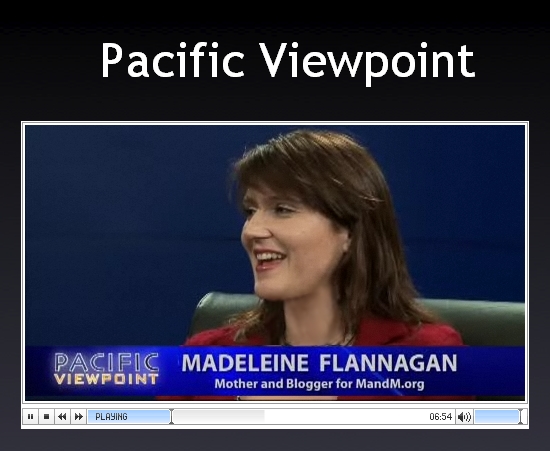
    Episode two of the television panel discussion I participated in on parental consent/notification for abortion is now available for viewing online here at Pacific Viewpoint TV. (Episode one can be viewed here).

    Madeleine on Pacific Viewpoint

    The show runs for 30 minutes; in this episode I appear as a panel member (last time I was an audience member). Panelists are host, Setita Millar, Family First’s Bev Adair, National Party MP Paul Hutchison, Reverend Tavale Matai’a, Ula Sangyum, Cushla McNabb and moi!

    Pacific Viewpoint Panel

    A lot of the dialogue made the editing room floor, some of which was frustrating, and the conversation did stray more onto sex education – state v home – but it was still all good.

    NOTE:
    In this footage I make a comment stating I used the pill as a form of contraception. I wish to make it clear that on learning of the pill’s abortifacient properties (this applies to both the mini and combined pills) I ceased using it some years ago.

    As a protestant I have no issue preventing conception. However, the pill permits conception but prevents implantation (often sneakily worded on your pill packet or by your doctor as “preventing pregnancy” where pregnancy is re-defined as beginning at implantation and not conception).  I reject the common protestant argument that because plenty of conceptuses fail to implant anyway it is ok to actually cause that to happen by taking the pill – if you view life beginning at conception this is like saying it is ok to shoot children in 3rd world countries because plenty will die of hunger and disease anyway.

  • Madeleine on TV Tonight on Abortion & Parental Consent

    Part two of the television panel discussion Madeleine participated in on parental consent/notification for abortion airs on Pacific Viewpoint tonight, Wednesday 16 December, on Stratos TV (Freeview 21 & Sky Digital 89) at 8:00 pm. Part one can be viewed online here.

    We’ll put a link up on this blog to the online video of the show when it becomes available tomorrow.

    The panel features Dr Paul Hutchison, MP for Hunua and former member of the Abortion Supervisory Committee; Bev Adair, spokesperson for Family First, Reverend Tavale Matai’a, a couple of other women and Madeleine. In tonight’s episode Madeleine features as a panel member (last week she was an audience member who asked a question) so she gets a lot more speaking time (assuming she makes it past the editing room).

  • Auckland Public Meeting: Climategate, NIWA and the ETS

    In the wake of climategate, the NIWA contraversy and public concern over the effect of the Emissions Trading Scheme (ETS) legislation a public meeting will be held in Auckland on Monday featuring Richard Treadgold, convenor of the Climate Conversation Group, who collated the paper Are we Feeling Warmer Yet? that Matt drew from in NIWA, Climategate and Evasive Fallacious Answers. This data originated from a combined research project undertaken by members of the Climate Conversation Group and the New Zealand Climate Science Coalition.

    Richard will present the findings of the research project and explain why, since New Zealand’s warming comes entirely from the adjustments, they are concerned that the figures have been published without mentioning the adjustments and that they have been used repeatedly to influence national policy, the ETS being case in point. He will also reveal their latest discovery of a contradiction between this official NIWA graph of the past and official predictions for the future.

    The event is free to the public and will also feature member of parliament John Boscawen, ACT Party spokesperson on Climate Change who will speak on the ETS and what he thinks its effects might be on the cost of living for everyday New Zealanders.

    Where: Royal Akarana Yacht Club, 10 Tamaki Drive, Okahu Bay, Auckland
    When: Monday 7 December, 7.30 pm

    For more information
    email karen.bridgman@parliament.govt.nz
    or call 09 531 5531

    Having attended these sorts of meetings organised by John Boscawen’s office previously, I am confident that the organisers would be more than willing to give floor space to a scientist who wishes to speak in defence of NIWA’s graphs, the greater climategate controversy and the theories in support of anthropogenic climate change. I for one would be most interested to hear all sides and as such I will attend the meeting and take this opportunity to encourage any such scientist to contact Karen Bridgman as above.

  • During, Sherwin & Hutchison on Backstreet Abortion

    Recently Madeleine was on a TV panel discussion regarding the issue of abortion and parental notification/consent which will go to air in the next week. During the ensuing dialogue Dr Paul Hutchinson, National Party Member of Parliament for Hunua, specialist in Obstetrics and Gynaecology and former member of the Abortion Supervisory Committee, raised the famous backstreet abortion argument for abortion rights. In many respects this is hardly surprising. In almost any media discussion of the issue of abortion the back-street abortion argument comes out. In Abortion: A Feminist Perspective, Susan Sherwin states, “Feminists recognise that women have abortions for a wide variety of compelling reasons.”[1] One reason she immediately cites is,

    No one denies that if abortion is not made legal, safe, and accessible in our society, women will seek out illegal and life-threatening abortions to terminate pregnancies they cannot accept. Antiabortion activists appear willing to accept this cost, although liberals definitely are not; feminists, who explicitly value women, judge the inevitable loss of women’s lives that results from restrictive abortion laws to be of fundamental concern.[2]

    In similar vein Dr Zoe During, former President of the Abortion Law Reform Association of New Zealand (ALRANZ), in a debate with the me, gave a paper entitled “Is Abortion Justifiable: An Examination of the Evidence”, in which she argued,

    But the majority of women, poor women, have had to go to backstreet practitioners or swallow dubious potions or use knitting needles on themselves. Attempting illegal abortion by such means has always been dreadful and dangerous and greatly increased maternal mortality.

    The World Health Organisation estimates that worldwide there are 20 million abortions each year, half or more being illegal, these causing up to 78,000 maternal deaths and hundreds of thousands of disabilities. A New York statistic is illuminating. For the three years before abortion became legal in that state, the maternal death ratio averaged 51 per 100,000 live births. For each of the three years immediately following legalisation it dropped to a mere 38, and there was the additional bonus of a 5% reduction in the neo-natal mortality rate. Thus not having access to legal abortion unjustifiably kills mothers and babies, while legalising abortion saves lives.[3]

    During’s argument rests upon three contentions:

    (a) That prohibiting feticide results in the death of women.
    (b) That (a) entails that prohibiting feticide kills women.
    (c) That killing of thousands of women in these circumstances is unjustifiable.

    Firstly, this is an argument not to the conclusion that feticide is permissible but rather that it should not be a criminal action. The fact (if it is a fact) that there are reasons why an act should not be a criminal offence does not entail that the act is morally permissible. Strictly speaking, this argument is compatible with the position that feticide is morally wrong. However, even as an argument for decriminalisation it is unsound.

    Many debates swirl around (a). As the citation shows During bases her conclusion on statistics from the World Health Organisation (WHO) and an un-referenced study about mortality in New York. These statistical claims are vigorously debated in the literature,[4] however, for our purposes this debate can be set aside. More interesting, I think, are the normative premises encapsulated in (b) and (c). If these are mistaken, the argument as a whole is unjust regardless of any merits of (a).

    Regarding premise (b) During appears to think that if passing a law results in the death of large numbers of women then to pass such a law is to kill these women. This is false. It is an empirical fact that building motorways results in innocent people dying, yet it does not follow that a person who builds a road kills innocent people. It is also a fact that by allowing people to swim at beaches some people will drown yet in permitting people to swim at beaches the government cannot be said to have drowned these people. Even if it could be demonstrated that restricting feticide results in women dying it does not follow that such restrictions kill women.

    During fails to distinguish between an action that foreseeably results in a person’s death and an action that causes that person’s death. Suppose that Parliament were to criminalise feticide and this led to a chain of events one of which was the death of a woman due to septic abortion. Somewhere in this chain, between the act of the legislature and the death of the woman, are the free actions of various people who choose to ignore or breach these laws. Parliament does not perform these actions; in fact they are done in defiance of Parliament’s will and hence without Parliament’s consent. Such actions include the choice of a woman to violate the law and procure an abortion and the choice of an abortionist to perform an abortion and to violate hygiene and safety standards. The death and injury that occurs is caused by these actions. It is the abortionist’s decision, acting as an agent of the woman, to perform unsafe surgery that causes the injury to occur. These facts make it evident that Parliament does not cause such deaths. The actions of the woman and abortionist are un-coerced. They are free, voluntary actions and as such not caused by someone else. It follows immediately that they were not caused by the state. If they were not caused by the state, then the effects that follow from them were not caused by the state either. The suggestion that one causes the free (and hence uncaused) reactions of others to decisions one makes is far fetched.

    The failure to distinguish caused and foreseen effects is illustrated well by Augustine. In contending with the consequentialists of his day, Augustine proposed the following example. Suppose a man approaches a woman and tells her that he will kill himself if she refuses to have sex with him. Does that mean that she is a murderer if she refuses?[5]

    One response to this kind of rejoinder is to claim that a woman’s choice is not free; rather it is made out of desperation and anguish. She feels compelled to abort given the psychological and economic pressures she faces. Three responses can be given to this argument.

    Firstly, even if it is granted, the same cannot be said to be true of the abortionist and given that it is the abortionist’s actions that kill the woman, the fact that these are uncaused entails that Parliament cannot have caused them either.

    Secondly, even if the woman’s actions were not free but caused in some way it does not follow that Parliament caused them. In some circumstances other people, such as the man’s decision to have intercourse and then to not support her or the family’s refusal to help, caused this desperation. Given that these actions are free, then Parliament cannot be held to have caused these either.

    Thirdly, making the claim that a woman was not free to refuse an abortion makes this argument less plausible. Abortion is often trumpeted as a woman’s free choice. If this claim is correct then how can women be coerced into such an operation against their consent? Further, it seems odd to claim that we should legalise forced abortions.

    Turning to (c), this claim is plausible only if it is true that feticide is not homicide. If feticide is homicide then to permit feticide is to permit homicide. Not only will the failure to permit feticide result in human beings dying, permitting it will also result in human beings being killed. If, as During contends, endorsing a rule that results in deaths is wrong then it will also be wrong to permit feticide.

    It is worthwhile noting that the numbers of fetuses killed by legal abortion is significantly higher than the number of women killed by illegal ones. At its highest, the number of women who died from illegal abortion in New Zealand in any one year was 37.[6] The number of fetuses destroyed by legal abortion in New Zealand annually is approximately 18,000.[7] Moreover, according to the stats During cited from WHO, there are around 10 million legal abortions per year and 78,000 deaths resulting from illegal ones.[8] If we follow the argument During offers, then we are permitting the killing of 10,000,000 human beings per year to avoid killing 78,000 human beings.

    During’s argument in favour of feticide is sound only if feticide is not homicide. However, if feticide is homicide she is arguing that in order to prevent thousands of people from harming themselves we should kill millions of people; a claim that on the face of it is absurd.

    This absurdity is not unique to During; the same thing can be said about the arguments offered by Sherwin and Hutchinson.


    [1] Susan Sherwin “Abortion a Feminist Perspective” in Ethical Issues in Modern Medicine ed Bonnie Steinbock & John D. Arras (Mountain View CA: Mayfield Publishing Co, 1999) 361.
    [2]
    Ibid.
    [3]
    Zoe During “Is Abortion Justifiable?” New Zealand Rationalist Humanist Spring (1999) 10-11.
    [4]
    The debates on this issue are documented in Francis Beckwith Politically Correct Death: Answering the Arguments for Abortion Rights (Grand Rapids MI: Baker Books, 1993) 54-59.
    [5] Augustine On Lying 9.
    [6]
    Wayne Facer Criminal Abortion in New Zealand: Public Health Consequences; this study was distributed by the Abortion Law Reform Association of New Zealand in the 1970’s. Facer was an outspoken proponent of decriminalising abortion.
    [7]
    New Zealand Abortion Supervisory Committee Report 2008.
    [8]
    These figures are not current.

    RELATED POSTS:
    Is Abortion Liberal? Part 1
    Is Abortion Liberal? Part 2
    Sentience Part 1
    Sentience Part 2
    Viability
    Abortion and Child Abuse
    Abortion and Brain Death: A Response to Farrar
    Abortion and Capital Punishment: No Contradiction
    Imposing Your Beliefs onto Others: A Defence
    Boonin’s Defense of the Sentience Criterion: A Critique Part I
    Boonin’s Defense of the Sentience Criterion: A Critique Part II