On Wednesday I arrived back in New Zealand after a full-on week in Atlanta. During this time I attended bits of four conferences: The Annual Meeting of the Evangelical Theological Society (ETS), The Annual Meeting of the Evangelical Philosophical Society (EPS), The Evangelical Philosophical Society Apologetics Conference “Set Forth Your Case” and the The Annual Meeting of the Society for Biblical Literature (SBL).

These four conferences ran over a period of two weeks, in roughly the same place, and overlapped each other – thousands of people attended them.
There is no way I can do justice to everything that occurred so here are some highlights.
I did not attend many sessions of the ETS as it ran parallel to the EPS. However, the highlight for me of what I did see was a rigorous address by Tom Wright on justification and the new perspective on Paul. This was followed by a lively panel discussion on this issue with Tom Wright, Thomas Schreiner, Frank Thiemann.
 I thoroughly enjoyed my time at the EPS, this was an excellent three days. I attended numerous sessions. My hosts laughed at how I was constantly seen going back and forward to various Hilton conference rooms between sessions, I could always be found engaging in rigorous discussion during the Q&A sessions or simply involved in an intense conversation dissecting the issues just raised with other attendees. It was a fairly intense time intellectually but I really enjoyed it.
Space prevents me doing justice to all the excellent papers I heard. There was an interesting paper on the role of ridicule and irony in convincing people of basic beliefs, which combined ideas from Kerkigaard and Reid. Another I enjoyed was an interesting discussion on inclusivism, the view that people who have not heard or accepted the gospel can be saved through Christ’s atonement if they are invincibly ignorant and respond in faith to the minimal revelation about God they do have. I heard some fascinating discussions on whether it is possible for God to issue insincere commands and how the issue of Abraham relates to this; questions of whether the fact that one’s epistemic peers disagree with you provides grounds for reducing confidence in your beliefs.
Mike Austin delivered a thoughtful paper on the Canaanite issue, noting that on an influential moral theory, Rossian deontology, that duties to not kill are prima facie duties which can be overridden in certain circumstances and so God could, in principle, command killing the innocent. There was also a really interesting paper by Gary Habermas on the latest theories regarding the Turin Shroud. Frank Beckwith criticised evangelical appropriations of Aquinas. Mike Licona offered a synopsis of his new book. Paul Copan spoke on how naturalists declare the glory of God. All these sessions were associated with vigorous and thoughtful discussion.

The two most technical papers were William Lane Craig’s response to Peter Van Inwagen and Alvin Plantinga’s paper “A New Argument against Materialism.” Van Inwagen has argued for Platonism, the view that abstract objects have real existence independently of God. Craig, a fictionalist, argued Van Inwagen had not really responded to the nominalist and fictionalist alternatives. Plantinga, in a packed out plenary session – by packed out, I mean a good thousand in attendance – argued that the counter-factual test for causation shows that if materialism is true then beliefs cannot cause behaviour. This involved Plantinga making some really interesting moves such as rejecting the standard view of impossible counter-factuals. Plantinga was particularly good in the Q&A.

What was striking for me was not just the calibre of the papers and the philosophical seriousness of those in attendance but also the obvious evangelical Christian commitment of the attendees. There was a strong sense that even when offering critique we were working together to better each other’s papers in the service of God. It was quite weird for me to be in a context where both of these things were conjoined. It was also surreal to find myself in the same room as numerous people whose work I had read and respected for years and yet I was able to discuss and critique their work face to face. This mixture of intellectual rigor, fellowship and spirituality was perhaps most evident at the reception. There, while we mingled with Philosophy greats, like Alvin Plantinga, everyone paused for a talk on the importance of prayer and religious devotion in spiritual formation. My entire experience to that moment as a Christian had been that when people spoke of the latter they did so at the expense of the former. It was refreshing to see the kind of spiritual wholism those present aspired to.
Another thing that totally blew me away was how many people read MandM and recognised me on sight. On the first day I sat next to a woman who told me she knew my wife from the net. Later I heard someone walking past say “I read that guys work, he has a good website.” A few Philosophy professors approached me and said things like “it’s good to meet you Dr Flannagan” and they’d relay how they regularly read my work online.

On Thursday, we drove to Johnson Ferry Baptist Church for the EPS Apologetics conference. This church was huge. I have never seen a church of this size in my life. It was three stories high and had literally hundreds of rooms. It had numerous lecture theatres, a gymnasium, a two-storied church auditorium, a dining room, bookstore and so on. Over 1,500 people turned up to hear Alvin Plantinga give his plenary talk. Plantinga presented his paper “Science and Religion where the Conflict Really Lies.” He rebutted arguments that evolution shows that God does not exist and then offered a summary of his evolutionary argument against naturalism. What was a little disappointing was the aggressive response of some questioners who were horrified that evolution and atheism may not *be* the same thing. In the Q&A, however, Plantinga, quite typically, provided gracious but effective responses exposing with humour the fallacies in the objections raised.
After the talk I went to the book signing session only to discover a huge number of Americans who read MandM, knew who I was on sight and wanted my thoughts, ideas or even to be photographed with me (go figure!?). One biblioblogger made a point of snapping at least one papparazzi-style shot of me every day which he then published on his blog. Madeleine kept emailing me links to blogs and Facebook status updates of people present at the conferences excitedly rattling off a list of their favourite scholars that they’d met that day that had me in them. It was surreal.
The business end of the conferences occurred on Saturday where I had two presentations to give. The first was on Saturday morning where I presented my paper “God and the Genocide of the Canaanites,” an updated and modified version (thanks to the many people who interacted with it on this blog and others) of the infamous blog post I published back in January, which will soon be published in Come Let us Reason edited by William Lane Craig and Paul Copan to be published through B&H Academic.
 The basic thesis of this paper was that the accounts of Genocide in Josh 6-11, if taken literally, contradict the accounts of the conquest in Judges and Joshua 13-17. Given that the final editor of the Canon juxtaposed these accounts, and was not stupid, he must have not intended both to be taken literally. I suggested that Wolterstorff’s position, that the former were hagiographic history and highly hyperbolic, made best sense of the evidence.
To my considerable surprise it was well received. Given some of the tone of the questions directed at Plantinga, I was worried I might have upset the more literalist attendees but instead there was real interest in my idea that the Joshua narratives were not literal accounts of what happened. I later heard that William Lane Craig had said I’d had the biggest attendance of the break-out sessions that day, and I was inundated with people asking me questions afterwards so that I had to go into over time.
Particularly amusing was the response to an illustration in my talk I gave as an example of hyperbolic and hagiographic writing, the claim that the All Blacks annihilated their opponents whilst touring the northern hemisphere. This is obviously hyperbole and, as any kiwi knows, it is also a form of hagiography (the All Blacks are revered after all). After the talk, a US rugby player told me he really appreciated this illustration; he also told me that if his team ever played the All Blacks he expected that his team would be annihilated and that the annihilation would not be hyperbolic!
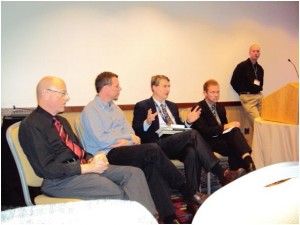 The second presentation was positively terrifying. I was on a panel at the SBL Conference. The SBL Conference was not only the biggest of the fourconferences but is the biggest annual gathering of biblical scholars in the world. Naturally it is a gathering of the world’s best biblical scholars in one place too. The panel topic was “Is Yahweh a Moral Monster?” and I was talking on how the holy war passages related to divine command morality. This was really scary. First I was on the panel with some pretty good scholars. Richard Hess, from Denver seminary, is a world class old testament scholar. Paul Copan of Palm Beach Atlantic University, the President of the Evangelical Philosophical Society has just published a monograph on Old Testament Ethics. Randall Rauser is a theologian from Canada who has also published in this area. The chair was the distinguished Notre Dame Philosopher, Michael Rea. Moreover, the audience contained numerous high-level scholars including Christopher Wright, William Lane Craig, Doug Geviett and many others. Each panellist was slated to speak for 20 minutes and then there would be a long Q&A afterwards. I was terrified.
 Despite being gripped with panic, the talk went well. Everyone in the audience I spoke to said they found it interesting and I eventually settled into the Q&A with increasing confidence. The panellist’s presentations were all very interesting. Richard Hess argued that the cities the Isrealites were commanded to attack in Deut 20:16 were forts not population centres. Paul Copan argued that the Bible does not support slavery, as that term is understood in English, but rather tolerated a form of indentured servitude. Particular suprising was the presentation from Randal Rauser. Prior to thetalk I had expected to be radically at odds with his views but I was surprised on how many basic issues and methods we agreed. Both of us, for example, advocated a more canonical approach, one that stressed the divine author of the final form as opposed to focusing on individual authors of pericopes in addressing the issue. We did disagree over some exegetical questions, how to interpret herem, for example, and we did sharply disagree over whether a particular analogy he used was valid.

What I was even more pleased with, however, was the positive feedback from the audience regarding the Q&A. William Lane Craig said he found our discussion “hugely interesting and helpful!” This was a sentiment repeated by numerous others including Doug Geviett and Mike Licona. Mary Jo Sharp said “this discussion was outstanding” and Claude Mariottini said that he considered it the best of the sessions he attended. It turned out to have had the biggest turn-out of any EPS presentation at the SBL to date.
So now I am back in NZ, having presented papers that began as blog posts on a international stage and have done so successfully. The opportunity was truly amazing and I thank all MandM supporters and readers who have supported me in doing this. I also need to thank Paul Copan and William Lane Craig for the opportunity to do so. I truly enjoyed the challenge and relish the opportunity to do it again next year in San Fancisco.
RELATED POSTS:
Georgia on my Mind
Joshua and the Genocide of the Canaanites Part I
Joshua and the the Genocide of the Canaanites Part II
Did God Command Genocide in the Old Testament?
A Selection of Matt’s posts on Divine Commands
 However, I generally regard this perspective on religious epistemology as flawed. There doesn’t seem much reason to limit the question of whether or not theistic belief is rational to solely evidential considerations. Furthermore, it would employ demonstrably double standards in our reasoning to require that the rationality of theistic belief be determined by reference solely to evidential considerations while other rational beliefs remain immune to such scrutiny. Why, for example, should we subject the rationality of our belief in God to any greater scrutiny than we do to our belief that our cognitive faculties give us true ideas about reality?