Category: Theology

  • MandM on Same-Sex Marriage and on being “sneaky”

    In his Letter from Birmingham Jail, Martin Luther King wrote there are two types of laws: just and unjust.” He went on to ask “How does one determine whether a law is just or unjust? A just law is a man-made code that squares with the moral law or the law of God. An unjust law is a code that is out of harmony with the moral law.”

    While King was protesting segregation, his argument drew on a theological tradition going back to Augustine, Aquinas, Locke and others, namely, that right and wrong is not defined by governments but by the law of God. Governments are under God’s authority and cannot command absolute allegiance. Of course the state can and often has good reasons for tolerating actions contrary to divine law but if the states endorses them,  is complicit in their commission or attempts to legitimate them as valid, then it usurps its authority. When it does this its citizens have the right to resist it.

    MarriageThis theological tradition is the reason many Christians oppose same-sex marriage. King was correct to claim that the law of God grants equal dignity to all people regardless of race; the law of God also instituted marriage as a union of one man and one woman. Sexual activity between people of the same-sex is morally wrong, just like people of the same family or sexual activity with multiple partners at the same time. The state may have good reasons in a fallen society for tolerating such actions but has no right to declare them valid.

    We believe that given certain defensible theological presuppositions this position is defensible and robust.

    The above summarises the basis for our opposition to same-sex marriage; this is why we believe the Marriage (Definition of Marriage) Amendment Bill should not be passed. Over at Whale Oil our guest post, “Critiquing the Case for Same-Sex Marriage“, offers rebuttals of the arguments that have been advanced by proponents of the Bill.

    Readers of both this post and the one at Whale Oil will note that in this post we appeal to theological premises – this is because we are describing why we oppose it and we, as Christians, accept these theological views – but on Whale Oil we are offering a rebuttal of other people’s arguments; hence, there we draw on premises that those who support the Bill are likely to be committed to.

    In the comments section at Whale Oil we have been accused of being sneaky in taking this approach. We disagree. We are quite happy to speak about our own position; however, that was not what we were doing on Whale Oil. What we were doing on Whale Oil was offering a critique of our opponents’ position – the dialectical context was not the same. Offering reasons why we accept something is not the same thing as offering our opponents reasons why they should reject certain arguments they have advanced. Far from doing anything sneaky, we are simply trying to engage our opponents on their own terms.

    When there is a fundamental difference in presuppositions between one’s opponent and oneself then a critique of one’s opponents’ argument only provides them with reasons for rejecting the argument if the critique appeals to premises they accept or are logically committed to by virtue of their presuppositions.

    Appealing to theological beliefs they do not themselves hold provides them with no reason for accepting anything. Incidentally, the converse is also true: attempts to rebut theologically based positions do not provide religious people who hold such positions any rational reason for abandoning them unless those rebuttals appeal to premises the religious person accepts and is logically committed to. This is not being sneaky, it is called effective rational dialogue. The alternative is simply talking past each other in a dialectical stand-off of assertion and counter-assertion where neither side is listening to each other, no true engagement occurs and no understanding is possible.

    So that said, check out our guest post: “Critiquing the Case for Same-Sex Marriage“.

    Aside
    For all those who state that the passage of the Marriage (Definition of Marriage) Amendment Bill will not have any impact on Christians like us consider section 56 of the Marriage Act 1955, then consider the statement we made at the outset of this post expressing our religious viewpoint in light of the Marriage Act being amended as proposed (and no, the proposed Bill does not propose amending this section):

    56 Offence to deny or impugn validity of lawful marriage

    (1) Every person commits an offence against this Act, and shall be liable on summary conviction to a fine not exceeding $200, who—

    (a) alleges, expressly or by implication, that any persons lawfully married are not truly and sufficiently married;

  • Matthew Flannagan on The Sermon on the Mount Part 2 (MP3)

    Matt preaches most Sundays at Takanini Community Church. Earlier in they year he did a series on the Sermon on the Mount. We published Matthew Flannagan on The Sermon on the Mount Part 1 (MP3) at the time but then we never got around to publishing Part 2. So now, download and listen to the MP3 of Matt preaching on The Sermon on the Mount Part 2.

    Now when Jesus saw the crowds, he went up on a mountainside and sat down. His disciples came to him, and he began to teach them. He said:
    “Blessed are the poor in spirit,
    for theirs is the kingdom of heaven.
    Blessed are those who mourn,
    for they will be comforted.
    Blessed are the meek,
    for they will inherit the earth.
    Blessed are those who hunger and thirst for righteousness,
    for they will be filled.

    Matthew 5:1-6 NIV

    The Sermon on the Mount

    Hat tip: TCC

  • “Jesus – Left or Right or Neither?” Hear Matthew Flannagan Interviewed on Radio

    Radio RhemaPat Brittenden interviewed this blog’s Matthew Flannagan on whether Jesus was a political figure or not on Wednesday 1 August 2012 on his morning show on Radio Rhema.
    Click here to hear Matt on “Jesus – left or right or neither?”

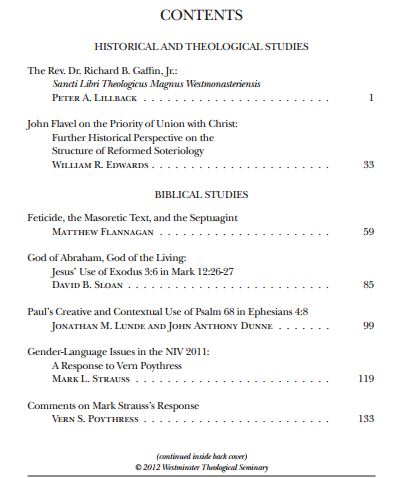
  • Published: “Feticide, the Masoretic Text, and the Septuagint” in The Westminster Theological Journal

    Matt’s article “Feticide, the Masoretic Text, and the Septuagint” is now available in Vol 74, No. 1 – Spring 2012 of The Westminster Theological Journal.

    The Westminster Theological Journal

    An abstract of “Feticide, the Masoretic Text, and the Septuagint” follows:

    A long Christian tradition of moral reflection on feticide interprets feticide, the killing of a formed conceptus, as a violation of  God’s law against homicide. In her book, Our Right to Choose, Beverly Harrison attempts to undercut this tradition of interpretation.

    Harrison alleges that the Alexandrian argument is based on a mistranslation of the Hebrew text. Harrison’s argument is based on apparent discrepancies between the Septuagint (LXX) and the Masoretic Text (MT) over the rendering of Exod 21:22-25. She makes three claims. Firstly, she suggests that Christian prohibition of feticide is based upon the LXX. Secondly, that the MT, which in her view accurately captures the original law, did not consider feticide a major crime. Thirdly, she argues that the LXX mistranslates this law and incorporates a prohibition of feticide into the text that is not there.

    In response I examine whether each of Harrison’s contentions is correct. From the outset I grant Harrison’s assumption that the MT accurately captures the original and that the LXX is the later translation. I also grant her point that the argument has origins in Alexandrian Judaism and the LXX. The discussion then asks whether each of Harrison’s other claims is correct. Does the MT consider feticide a minor crime? And does the LXX misinterpret the original?

    I defend a negative answer to both questions.

  • Contra Mundum: Dawkins and Secular Hypocrisy

    Richard DawkinsWhen I was a non-Christian I was forever hearing about how Christians are hypocrites. When I converted to Christianity at 17, one thing that struck me is how often these charges were often a case of the pot calling the kettle black. While there is undoubtedly some hypocrisy within the church, it is also pervasive outside it. Secular culture often contains absurd ironies and hypocrisy which are conveniently ignored.

    A great example was the media fiasco over William Lane Craig’s visit to the United Kingdom last year. Craig is distinguished philosopher known professionally for his work in philosophy of time and philosophy of religion. Alongside his scholarly work, he has also developed a reputation as a prolific public speaker and debater, debating many of the world’s leading sceptics. His combination of scholarly ability and effective debating skills has earned him a reputation as one of the world’s foremost Christian apologists.

    “Apparently, having two PhD’s, authoring over 100 papers, and writing 30 books on a topic makes you unqualified to speak on it, but being the star of the 80’s TV series “Growing Pains” does.”

    Craig’s visit to the UK attracted media attention when Richard Dawkins, author of the best selling “God Delusion”, publically and resolutely refused to debate him. Dawkins publically stated earlier of his critics that “he did not care” who they were, he would “dialogue” with them and “win the argument”. He also had publically debated numerous critics significantly less qualified than Craig, notably Ted Haggard. These facts, alongside Dawkins implausible and inconsistent reasons lead to accusations of cowardice and hypocrisy from other academics such as Daniel Came a philosophy professor at St Hugh’s College Oxford.

    In the UK newspaper the Guardian Dawkin’s gave two reasons for his refusal. According to Dawkins, Craig “parades himself as a philosopher, but none of the professors of philosophy whom I consulted had heard his name”. Dawkins omitted to mention that this was not the first time he had publicly denigrated Craig’s scholarly credentials. On a previous occasion  Daniel Came,  had e-mailed him stating:

    “Professor Craig has a PhD in philosophy and a PhD in theology. He is Research Professor in Philosophy at Talbot University. He has published more than thirty books and over a hundred papers in reputable peer-reviewed journal. Given your passionate and unconditional commitment to truth, I can only think that you were not aware of Professor Craig’s credentials when you made the above reference.”

    So Dawkins claim that no philosopher he had consulted had ever heard of Craig was less than honest. A less charitable person might describe this as simply slander.

    Dawkins concern about Craig’s alleged lack of scholarly credentials also seems odd seeing that he (Dawkins) had earlier accepted an invitation to debate actor Kirk Cameron.  Apparently, having two PhD’s, authoring over 100 papers, and writing 30 books on a topic makes you unqualified to speak on it but being the star of the 80’s TV series “Growing Pains” does qualify you. It’s also ironic that Dawkins would accuse Craig of lacking scholarly credentials on the matter given that he (Dawkins) is a biologist and not a philosopher of religion.

    Dawkins next excuse was that Craig is “morally unfit” to debate him.  To substantiate this he cites not from any of Craig’s scholarly writings. But two blog posts Craig had written on with the conquest of Canaan. At face value  the early chapters of the book of Joshua portrays God as commanding the killing of every man women and child in Canaan. I say “appears”, here because latter sections of the book of Joshua and its sequel in judges proceed on the assumption this never occurred, and studies into ancient conquest accounts of this genre have noted the widespread use of literary hyperbole whereby victories are described in sweeping rhetoric of killing absolutely everyone when in reality they were (more…)

  • “Ask Dr Matt” this Sunday Night at Massey Presbyterian Church

    If you are in Auckland this Sunday evening come along to Massey Presbyterian Church and ask Matt your burning theological questions. From the Facebook Page for the event:

    Ask your questionSometimes we have unanswered questions about God, the bible and religion. Dr. Matthew Flannagan will host a questions night. He is a philosopher, theologian and apologist for the Christian faith. So dust off those questions! No questions are too silly, heretical or unworthy of attention (well almost none;p). You can either write them on the thread in the MPC fb page, or put them in the specially marked box at Church on the reception desk, or message me if you want to be anonymous. You can even ask them on the night. Dr. Matt will tackle your questions on the night (it will be recorded too if you can’t make it).

    Massey Presbyterian Church
    510 Don Buck Road, Auckland, New Zealand
    Sunday 8 July 2010 @ 7pm
    (Church cafe open from 6.15pm)

  • Matt on the Evolution Debate on the “Theological Panel” on Pat Brittenden Mornings – with Craig Heilman

    Radio RhemaIf you tuned in to Radio Rhema at 11:00am (NZ time) on 3 May 2012 you would have heard this blog’s Matthew Flannagan and Tear Fund’s David Slack talk the stigmas surrounding the evolution take on creation and why many don’t want it talked about on “The Panel” on Pat Brittenden morning.

    You can listen online here.