Category: Theology

  • On the God Topic: Responding with Reason and Precision

    For anyone for whom Houston, Texas is not too much of a trek to get to, Biola University and Reasonable Faith Houston are running an apologetics conference in April. Speakers include: JP Moreland, Craig Hazen, Mary Jo Sharp, Louis Markos, Micah Parker, Scott Swiggard and more.

    On the God Topic:

    Responding with Reason and Precision

    Details:

    1 – 2 April 2011
    Friday 7:00 pm – 9:30 pm
    Saturday 8:30 am – 4:30 pm

    Gloria Dei Lutheran Church
    18220 Upper Bay Road
    Houston, TX 77058

    Conference Sessions:

    Defending Your Faith Kickoff
    With JP Moreland, Craig Hazen, and more

    The A, B, Cs…Ds & Es of Defending the Gospels
    with Mike Licona

    Did Jesus Really Rise from the Dead?
    with Craig Hazen (more…)

  • Matthew Flannagan on The Sermon on the Mount Part 1 (MP3)

    Matt preached at Takanini Community Church last Sunday and gave the first sermon in his series on the Sermon on the Mount. Download and listen to the MP3 of Matt preaching on The Sermon on the Mount Part 1.

    Now when Jesus saw the crowds, he went up on a mountainside and sat down. His disciples came to him, and he began to teach them. He said:
    “Blessed are the poor in spirit,
    for theirs is the kingdom of heaven.
    Blessed are those who mourn,
    for they will be comforted.
    Blessed are the meek,
    for they will inherit the earth.
    Blessed are those who hunger and thirst for righteousness,
    for they will be filled.

    Matthew 5:1-6 NIV

    The Sermon on the Mount

    Matt will be preaching Part 2  at 10:00 am on Sunday 20 March 2011 at Takanini Church of Christ, 160 Great South Road, Takanini, Auckland – all welcome.

    Hat tip: Christian LIFE Church Takanini

  • Religion, Science, 9/11 and the Moon: Dawkins’ Response to Copan

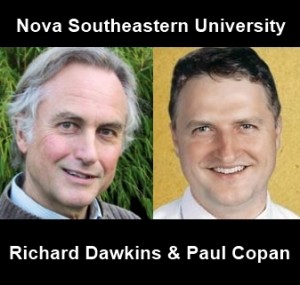
    Richard Dawkins and Paul CopanParchment and Pen, has an audio of a brief exchange between Paul Copan and Richard Dawkins who was speaking in Ft. Lauderdale at Nova Southeastern University on “The Fact of Evolution.” (The following week, Paul Copan spoke on “The Fact of God” at Nova Southeastern and gave a direct response to Dawkins.) This MP3 of Paul Copan and Richard Dawkins’ exchange is from the Q&A of Dawkins’ talk.

    In it Paul alludes to an argument advanced by C S Lewis, Alvin Plantinga, Michael Rea, Victor Reppert and also alluded to by Patrica Churchland, Thomas Nagel, William Whewell and Friedrich Nietzche. The argument is that if our cognitive faculties evolved by natural selection, unguided by God, then our cognitive faculties cannot be rationally relied on to give us truth. The literature on this argument is interesting but I won’t comment on that here.

    What interests me is the comment Dawkins made in the MP3 which got the applause of the audience. Dawkins appears to not grasp the point of the argument and takes it to be asking for a reason why he supports “scientific rationalism”. He said he believes in scientific rationalism because it “works”. He then provided an example of how it “works”, it is that “science flies us to the moon, while religion flies planes into buildings.”

    Much could be said here but I want to limit myself to a single point, the evidence Dawkins cites that science works and religion does not. Dawkins offers that science has done good things such as getting us to the moon; religion has done bad things like destroying the World Trade Centre on 9/11. In other words, the positive things science does commends it as a something we should trust whereas the negative things religious does commends it as some thing which we should not trust.

    So let’s look at the claim Dawkins made that “science” got us to the moon. Now how does a subject, get us to the moon? Presumably what he means is that it was through science that we developed the rocket propulsion technology which enabled us to get to the moon.

    But here is the problem. If the fact that science developed the propulsion technology that got us to the moon means that science is responsible for the flight to the moon, and can take credit for it, then science must be responsible for the flight into the World Trade Centre; science developed the propulsion technology of aeroplanes, hence, it should be science not religion that is blamed.

    Moreover, rockets are used for other things apart from space and air travel (more…)

  • Video of John Lennox “Why? Considering the Goodness and Sovereignty of God in the Midst of Suffering”

    On 27 February 2011, John Lennox spoke at Howick Baptist Church as part of his tour of New Zealand on the topic “Why? Considering the Goodness and Sovereignty of God in the Midst of Suffering”. Here is the video of that talk. In it Lennox discusses some of the challenges to Christianity that events like the Christchurch earthquake create and suggests some possible Christian responses.

    MP3 version here.

    Hat Tip: Howick Baptist Church

  • Contra Mundum: “Till Death do us Part” Christ’s Teachings on Abuse, Divorce and Remarriage

    Anne was clearly angry. She relayed how her former husband had been abusive, had beaten her and sexually violated her. Despite this, however, he had never – as far as she knew – had an affair. Did this mean she had sinned before God for leaving her marriage? Was she now required to remain celibate for the rest of her life? Anne recited Jesus’ words with palpable sarcasm, “whoever divorces his wife, except for adultery, and marries another woman commits adultery.”

    Christian MarriageAnne’s story was the real life face of an intellectual journey and struggle I had faced some years earlier during my theology studies. How should I understand the bibles teaching on divorce? When I was at Bible College I remember two approaches vividly.

    The first was from a marriage counsellor who, when I asked him if we should counsel battered spouses to leave their marriages, responded “no, until death do we part”. He refused to take with any seriousness my suggestion that in some cases the death of one spouse might be a realistic outcome if the battered spouse does not leave.

    The second was a lecturer who argued that the New Testament did not speak unequivocally on this topic. While Matthew’s gospel allowed an exception for adultery, Mark’s gospel seemed to condemn divorce outright with no exceptions. On the other hand Paul, in his epistle to the Corinthians, contended that a person abandoned by their spouse “is not bound”. The Greek in this epistle alluded to the wording of a Jewish divorce certificate, which stated that the person in question had a right to remarry. The lecturer, quite correctly, concluded that Paul allowed divorce and remarriage for abandonment. The lecturer then suggested that because Paul added to Jesus’ teaching so could we.

    Both approaches seemed to me to be evidently problematic. My questions remained equally unsolved by the Pastor who told me that he accepted Jesus’ teaching as correct but did not follow it because it was “impractical” in the real world and in his experience. I was underwhelmed by the author who suggested that because Mark, Paul and Matthew disagreed, we should just choose the one we find the most congenial.

    Then I discovered a study, which to my mind answered my questions and addressed Anne’s concerns. The book was Divorce and Re-Marriage in the Bible: The Social and Literary Context by David Instone-Brewer. Brewer is a scholar of first century rabbinical writings. In his book he places Christ’s teaching within the cultural context of first century Judaism; the results are interesting and enlightening.

    The passage Anne cited comes from Matthew 19. This passage begins with a question from the Pharisees – the Jewish religious scholars at that time – which asked, “Is it lawful for a man to divorce his wife for any reason?” In the dialogue the (more…)

  • The Presumption of Theism

    Modern analytic philosophy of religion, so it seems, is largely dominated by purely theoretical and evidential considerations. That is, the question of whether or not theistic belief is rational is decided purely on the balance of total available public evidence as opposed to existential and pragmatic considerations. The addition of the term “public” to the last sentence is significant in that it exactly specifies the brand of evidence focussed on in academic philosophy of religion. That is, evidence available to all people as opposed to that available only to some. Clearly this generalization of academic philosophy of religion is not universally true (sans Plantinga, Alston, Wolterstorff, Flannagan et al), nevertheless it remains largely true that the prevailing attitude within the philosophical academy is that the rationality of theistic belief is tied, almost exclusively, to the total public evidence a person has.

    Myth of SisyphusHowever, I generally regard this perspective on religious epistemology as flawed. There doesn’t seem much reason to limit the question of whether or not theistic belief is rational to solely evidential considerations. Furthermore, it would employ demonstrably double standards in our reasoning to require that the rationality of theistic belief be determined by reference solely to evidential considerations while other rational beliefs remain immune to such scrutiny. Why, for example, should we subject the rationality of our belief in God to any greater scrutiny than we do to our belief that our cognitive faculties give us true ideas about reality?

    With that in mind, we also need to ask why it is that we should exclude existential/pragmatic considerations from determining whether or not theistic belief is rational. It is this that my article principally concerns itself with, i.e. whether or not existential/pragmatic considerations can confer warrant or justification on our theistic belief. Can the question of “liveability”, by which I refer to our ability to live consistently and happily within that worldview, confer justification on that belief? Framed negatively, the question is “can the “unliveability” (by which I refer to a general inability to live consistently and happily within that worldview) of a worldview count against that system?”

    It seems at least intuitively plausible that, aside from evidentiary considerations, the “liveability” of a possible worldview is a fairly major existential concern we have when deciding upon which to adopt. When I refer to “liveability”, I refer to our ability to live in such a way as to harmonize our worldview with other concerns in life such as happiness. Furthermore, it should seem at least intuitively plausible that where we lack determinate public evidence one way or the other, it is positively irrational to choose that worldview which is ultimately unliveable. For instance, suppose that on one worldview, if we live our lives consistently (that is to its logical consequences) then we can’t be happy. Suppose further, that in order to be happy on that worldview, we must delude ourselves and others. Suppose once again, that on another worldview we wouldn’t need to engage in such grand delusion in order to be happy. Suppose finally, that the total available public evidence between the two is ultimately (more…)

  • The Sceptic and the Scientist: Ed Feser on Richard Dawkins and PZ Myers

    String TheoryHe is not one to pull punches and true to form, in To a Louse, Ed Feser holds a mirror up to the kind of reasoning that is all too common amongst Dawkins and Myers fans with this fictional dialogue between a scientist and a science sceptic;

    Skeptic: Science is BS. Physicists believe in these things called “quarks,” which are little flavored particles that spin around and work like magic charms. Their evidence is that they read about them in a James Joyce novel. Some of them think the universe is made up of tiny shoelaces tied together, though they admit that they have no evidence for this and have to take it on faith. Einstein said morality is all relative – which is why he stole his ideas from this guy who worked in a patent office, and why Richard Feynman stole atomic secrets during WWII. Meanwhile, the chemists contradict the physicists and believe instead in little colored balls held together by sticks. Biologists believe monkeys can give birth to human beings. What a bunch of crap! It’s child abuse to teach kids about this stuff in schools.

    Scientist: Are you joking? If not, I suggest that you actually read some science before criticizing it.

    Skeptic: I’ve already read a lot about it, in blog comboxes like this one. And why should I waste my time reading anything else? I already know it’s all BS! Didn’t you hear the examples I just gave?

    Scientist: No, you’re missing my point. You’ve completely distorted what scientists actually say. It’s not remotely as silly as you think it is. In fact it’s not silly at all. But you need to actually read the stuff to see that.

    Skeptic: So you deny that physicists believe in quarks? What flavor are your quarks, chocolate or vanilla? Do you deny that they think we came from monkeys? Which monkey was your mother?

    Scientist: No one says that monkeys gave birth to humans. That’s a ridiculous caricature. And of course I don’t deny that physicists believe in quarks, but you’re badly misunderstanding what they mean when they attribute “flavor” to them. They don’t mean that literally…

    Skeptic: Oh so it’s just empty verbiage, then. See, you’re just proving my point for me.

    Scientist: No, it’s not empty verbiage. It’s technical terminology.

    Skeptic: I see, like magic spells. That’s why (more…)