Category: Theology

  • Contra Mundum: Stoning Adulterers

    Back in 2005 there was a minor furore when Labour MP Ashraf Choudhary stated he agreed with the Koran’s teaching that people who engaged in homosexual conduct or who committed adultery should be stoned to death. In the media spiral that followed, some commentators pointed out that it was not just Islam that held this view; Christians are committed to the same conclusion. Consider Deuteronomy 22:22 “If a man is found sleeping with another man’s wife, both the man who slept with her and the woman must die. You must purge the evil from Israel” or Leviticus 20:10 “If a man commits adultery with another man’s wife—with the wife of his neighbour—both the adulterer and the adulteress are to be put to death. Often passages like this motivate a rhetorical question “why don’t Christians today stone to death women who commit adultery? After all, this is what the Bible commands isn’t it?”

    Ten Commandments

    I’ll make two points in response to this. First, those who press this line of argument assume that these commands are addressed to contemporary Christians. This is a dubious assumption; the laws occur as part of a covenant or vassal treaty between the tribes of Israel and God. While some of the laws expounded in this treaty reflect rules of justice and equity applicable to all people, Gentiles were not parties to this treaty nor were gentile Christians required to be – something the New Testament spends a lot of time elaborating on.

    Second, and this will be my main focus, this line of argument assumes that these apparent laws function like modern statute law; the assumption is that they are literal and binding commands to kill people who had committed certain crimes. It is also assumed that the author of these laws expected them to be carried out. Interestingly, it is precisely this assumption which many scholars of these laws have questioned. Here I will spell out some reasons why they do so.

    Comparisons between Leviticus and Deuteronomy and other ancient Near Eastern (“ANE”) law codes suggest they are the same genre. One feature of such codes is seemingly harsh penalties. In old Babylonian law, the hand that assaults was severed; a man who kissed another’s wife was to have his lips cut off; a person who stole bees was to be stung by bees; a man who raped another’s wife would be sentenced to having his own wife or daughter raped; a negligent builder whose house collapsed and killed another’s son would be sentenced to having his own son killed, and so on.

    ANE expert Raymond Westbrook notes that these prescribed punishments are both inconsistent with the actual legal practice known to have occurred in these cultures and are often inconsistent with themselves. He notes, “some law codes impose physical punishments and others payments for the same offenses, while some codes have a mixture of the two.” The contradiction is only apparent because, “in highlighting one or the other alternative, the codes are making a statement as to their view of the gravity of the offence.” He argues that the laws “reflect the scribal compilers’ concern for perfect symmetry and delicious irony rather than the pragmatic experience of the law courts.” Westbrook concludes that the method used in ANE legal texts was “to set out principles by the use of often extreme examples.”

    A similar point is made by Old Testament scholar John Goldingay who suggests that many of these laws “were not intended to be enforced” but rather were “promulgated to indicate the moral and social priorities of the law giver.” They functioned to express certain ideals of behaviour, to denounce actions like adultery as really bad and intolerable rather than to define precise penalties for these actions.

    Westbrook points to the practice of (more…)

  • Moving Beyond Sunday School

    On this blog we often rail against new-atheist readings of Biblical texts. Our pages are littered with expositions as to what a text is really saying when you consider the context, genre and textual evidence, all of which demonstrates that the new-atheist readings of the texts are at best wanting and at worst down-right stupid or dishonest. But, of course, it is not just atheists who sometimes fail to read Biblical texts properly.

    Joshua Fit the Battle of Jericho

    I was reminded of this recently in an exchange with someone who on considering Paul Copan’s work in Is God a Moral Monster? and Matt’s blog series God and the Genocide of the Canaanites Part I, Part II and Part III, asked me:

    “If these Biblical battles are so clearly exaggerated, why aren’t they taught to be so in churches? When I learnt in Sunday School about how “Joshua fit the battle of Jericho”, should the Sunday-School teacher have added “Of course, it didn’t really happen!”

    Aside from the fact that I thought it was an interesting observation on his part that he had never really sought to take his own understanding of those passages beyond Sunday School level, I think there is something in his question but before I go on I should make a brief qualification. Neither Copan or Matt have argued that the Battle of Jericho never happened; they have argued that the ‘genocide language’ in the earlier parts of the Book of Joshua should be read as hyperbolic hagiographic accounts of Israel’s early skirmishes in Canaan and that this language and the accounts of those battles should not be read in isolation from the rest of the Book of Joshua and the surrounding texts – especially Judges. This more Canonical approach shows that the Bible does not teach that the Canaanites were genocided by the Israelites.

    As to why Sunday School teachers don’t get into how to interpret the ‘genocide passages’ in Joshua, I expect it has something to do with the same reason the dove with the olive branch is generally not depicted flying over any floating, swollen corpses in the pictures of the happy pairs of animals floating on an ark with a rainbow in the background that dot the Sunday School walls. A Sunday School teacher should focus on the message or point of these stories and leave the realities of floods and wars and their effect on the people who don’t survive them for when a child is older.

    But this I guess is my correspondent’s point. The church seems to have produced Christians en masse whose understanding of these passages has not really moved beyond the Sunday School glossing of the story – their understanding now appears to be the Sunday School version plus, now they have lived a bit and get that floods and wars kill people, X number of dead people. If you scan the comments on the half or dozen posts Matt has published on the ‘genocide passages’ on this blog you will find Christians struggling to get their heads around the idea that perhaps instead of reading only Joshua 6-11 and forming a conclusion that is only fractionally more in touch with reality as the Sunday School stories they should instead read all 24 chapters plus a fair decent way through Judges.

    Now I am not trying to say that my fellow Christians are all stupid (or even that new atheists are) (more…)

  • Undesigned Coincidences in the Gospels – Tim McGrew

    Timothy McGrewIf we have a question on the historicity of the resurrection, Timothy McGrew is our first port of call; there is no one we would turn to before him on the subject. Tim is also highly regarded for his work on probability theory and on miracles – he is the author of “Miracles” for the Stanford Encyclopedia of Philosophy. We have previously linked to his Library of Historical Apologetics.

    I mention all this because Tim recently gave an excellent talk, which is available free as an MP3 and is entitled “Undesigned Coincidences in the Gospels.” Tim’s wife, Lydia McGrew, who first alerted us to this talk, writes:

    Undesigned coincidences in the Gospels … is an argument that was well-known in the nineteenth century but has, for no really clear reason, simply been forgotten as time has gone on. It is a cumulative case argument that the Gospels reflect, to an important extent, independent knowledge of actual events. Please note that this argument is quite independent of one’s preferred answer to the synoptic question. That is to say, even if, e.g., Mark was the first Gospel and others had access to Mark and show signs of literary dependence on Mark, the argument from undesigned coincidences provides evidence for independent knowledge of real events among the Gospel writers. There are many more of such coincidences beyond those given in the talk.

    Two of Tim’s other talks, which overlap the material in this talk but also extend it, “Beyond Minimal Facts, Part I: External Evidences” and “Beyond Minimal Facts, Part II: Internal Evidences” can be ordered for a small fee – details here. Matt and I have both of these and can highly recommend them.

  • Debate Review: Sam Harris and William Lane Craig on Divine Command Theory Part I

    William Lane Craig v Sam HarrisLast week Sam Harris and William Lane Craig debated the question: “Is the Foundation of Morality Natural or Supernatural?” at the University of Notre Dame. Given my interest in divine command meta-ethics I found the debate and the subsequent online discussion concerning it extremely interesting. I was particularly interested in how the ‘new atheist’ movement would address this issue given Dawkins’ neglect of moral arguments in The God Delusion. Unfortunately, the debate turned out to be very one-sided. [Both the debate video and the debate MP3 are now online.]

    In this review I will analyse the debate in two parts. In Part I, I will look at the discussion of Craig’s contention that,

    1. If God exists then we have a plausible account of (a) the nature of moral goodness and (b) the nature of moral obligation.

    In Part II, I will examine Harris’s contention that,

    2. If atheism is true then we have a plausible account of (a) the nature of moral goodness and (b) the nature of moral obligation.

    A couple of definitions are necessary here; what both Craig and Harris are defending are rival accounts of what both goodness and moral obligation are. When Craig or Harris offers an account of the nature of goodness, each is offering an account of what moral values and obligation are, that is, their ontological or metaphysical nature. Similarly, when Craig refers to God, he is referring to a personal immaterial being who is necessarily existent, omniscient, omnipotent and morally perfect.

    Craig’s Argument for a Divine Command Theory
    In support of 1(a) Craig argued that if theism is true, goodness could be identified with God himself. His view is that goodness is best understood in terms of an exemplar, that good is identified with the perfect paradigm of a good person and that the goodness of everything else is measured by its resemblance to this paradigm. An analogy to this idea is the official “metre stick” that exists in France today. The metre stick is exactly one metre long, and the length in metres of every other length is determined by comparison with it. In the same way, God is both perfectly good and is the standard of goodness for everything else. God’s goodness, for Craig, is cashed out in terms of certain character traits. To claim God is good is to claim that he is truthful, benevolent, loving, gracious, merciful and just, and that he is opposed to certain actions such as murder, rape, torturing people for fun and so on.

    In support of 1(b) Craig argued that if God exists, moral obligations can be identified with Gods commands. He therefore advocated the version of a divine command theory of obligation proposed by Robert Adams in Finite and Infinite Goods.

    While Craig sketched his account of goodness and obligation in his opening statement, he never offered any actual argument for why he thinks that if theism is true, this account is correct; yet later in the debate he said it was obvious. While I myself agree with a certain version of divine command theory, I think this suggestion is inadequate. There have been many objections raised against such theories in the literature, and hardly any of them presuppose the non-existence of God. I think these objections fail, and most of them fail miserably. But it would be a gross overstatement to claim that, given the truth of theism, a divine command theory is obvious.

    Later in the debate, (more…)

  • Unbelievable? Is God a Moral Monster? Paul Copan & Norman Bacrac

    Paul Copan recently debated Norman Bacrac on the topic “Is God a Moral Monster?” on a recent episode of Unbelievable? on the UK station Premier Christian Radio.

    Matt and I just listened to it and we both thought it was worth sharing as Copan really handled himself well and very clearly articulated his position on the hyperbolic reading of the Canaanites (a position he has co-authored with Matt on). The interaction between Copan, Bacrac and the show’s host Justin Brierly was very good too.

    Unbelievable?Listen here: Unbelievable? 9 Apr 2011 – Is God a Moral Monster? Paul Copan & Norman Bacrac
    [If the link will not load the Copan v Bacrac debate directly go to the Unbelievable? page then locate the 9 April 2011 episode ]

    The blurb from the show is:

    Richard Dawkins describes the Old Testament God as “a vindictive, bloodthirsty ethnic cleanser” (among other things).  Paul Copan is a Christian apologist and has written a book, “Is God a Moral Monster?” aiming to show why God’s actions in the Old Testament are not immoral when taken in context.

    Norman Bacrac is an atheist humanist and part ot the South place Ethical Society. He believes that Old Testament morality was barbaric and we don’t need a God to tell us how to behave.  He holds that God’s morality is called into question if we take the Old Testament literally.

    So how do we interpret passages where the Israelites were commanded to wipe out whole towns including women and children?

    “The blog of Matthew and Madeleine Flannagan in New Zealand” rates a mention from the host, Justin Brierly, about 38 mins in 😉

  • Thom Stark on Wolterstorff and Hagiographic Hyperbole

    Earlier this year I finished a forthcoming article in which I defended Nicholas Wolterstorff’s take on the Canaanite massacre recorded in the book of Joshua. Wolterstorff argues that the Book of Joshua is a highly figurative, hagiographic and hyperbolic account of Israel’s early skirmishes and it is not intended to be taken literally in its details.[1] The accounts of killing everything that breathes function something like the boast of a high school student who describes winning a football game in terms of totally slaughtering the opposition.[2]

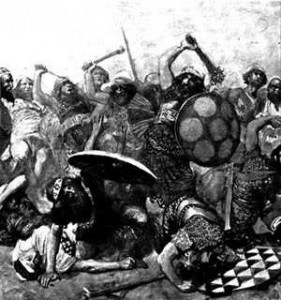
    Joshua Slaughters the CanaanitesMy article was a revised version of a paper I presented in Atlanta in November last year (my God and the Genocide of the Canaanites series gives a good overview of my position). Around the same time I presented this paper, Thom Stark, posted a critical review of Douglas S. Earl’s book The Joshua Delusion? Rethinking Genocide in the Bible. As a review, much of it was addressed to the specifics of Earl’s book. However, in the introduction Stark offered a critique of Wolterstorff’s position and made reference to my defence of it.

    He offered three lines of argument; two against the conclusion Wolterstorff and I offered and one against Wolterstorff’s argument itself. Since then several people have asked me my thoughts on his critique. In this post I will look at his critique of Wolterstorff’s argument, which I defended and adapted in my article.

    Before one can criticise an argument it is important to be clear as to what it is. As I note in my forthcoming article (and in the post I linked to above) Wolterstorff’s argument consists of three points and a basic assumption. The assumption is that “Joshua as we have it today was intended as a component in the larger sequence consisting of Deuteronomy, Joshua, Judges, I and II Samuel, and I and II Kings”.[3] On the basis of this assumption Wolterstorff contends “…  I propose that we interpret the Book of Joshua as a component within this larger sequence – in particular, that we interpret it as preceded by Deuteronomy and succeeded by Judges.”[4] In taking this approach, Wolterstorff engages in a more canonical approach to the text; he focuses on the meaning of the final form as part of a canonical sequence.

    The three premises are as follows. First, the so called genocide accounts in Joshua 1-11 are part of a broader context which includes both the rest of Joshua but also other canonical books, such as the book of Judges. When one reads the whole sequence one observes that while early passages in Joshua describe Israel exterminating the inhabitants, later passages in Joshua and Judges proceed on the assumption this never literally happened.[5] Taken literally these accounts of the conquest contradict each other (more…)

  • Is God a Moral Monster? A Review of Paul Copan’s Book

    On 11 September 2001 Islamic terrorists flew two planes into the World Trade Centre, killing thousands of innocent people. Ostensibly they did this because they believed God commanded them to do so. This event has reinvigorated a fear that has been latent in Western psyche since the 17th century when religious wars tore Europe apart. The fear of religious fanaticism, of people willing to murder hundreds in the name of God, has been whipped up by the new atheists–Richard Dawkins, Sam Harris, Christopher Hitchens, et al.

    The phenomenon is not just limited to the popular atheological literature. These fears went centre stage recently at a conference entitled “My Ways Are Not Your Ways” which was put on by the Centre for Philosophy of Religion at the University of Notre Dame. Sceptics presenting at the conference argued passionately that the God of the Bible issues commands which are at odds with modern understandings of morality; adultery is punished with death, God is portrayed as commanding the killing of non-combatants in “holy wars” against the Canaanites, God commanded Abraham to sacrifice his son, the Bible appears to approve of slavery and polygamy, and so forth.

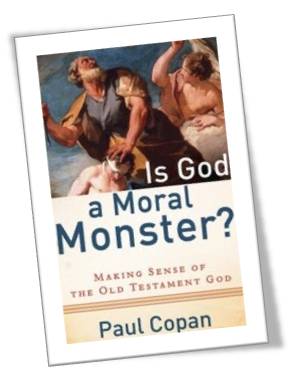
    Is God a Moral Monster?In Is God a Moral Monster? Paul Copan attempts to address some of these concerns. What’s novel about Copan’s approach is that, unlike many standard philosophical responses to the above problems, Copan draws on recent conservative Old Testament scholarship by people like Gordon Wenham, Tremper Longman, Christopher Wright, Walter Kaiser, Richard Hess and numerous others. This is novel as much of what has been going on in evangelical discussions of Old Testament ethics for decades has been done almost in isolation from contemporary philosophy of religion and vice versa. Copan, who has degrees both in Philosophy and in Biblical Studies, brings this material together in an accessible manner.

    There is no point in hiding the fact that I am a fan of Copan’s book. In a few places Copan cites my own writings as sources of ideas and in other places the overlap with my own thoughts on these issues is considerable. I have recommended it to my son who intends to read it as soon as he has finished William Lane Craig’s On Guard. However, this review will not simply be an exercise in cheer-leading; I will attempt to both summarise Copan’s work and add critical comments.

    The Review
    Is God a Moral Monster? opens with a discussion on the new atheism in general. In chapters 3 and 4 Copan addresses the charge that God in the Old-Testament is both jealous and egocentrically demands worship. Then in chapter 5 he turns to the binding of Isaac. I will touch briefly on this (more…)