Tag: William Lane Craig

  • Walter Sinnott-Armstrong and the Moral Scepticism Objection to Divine Commands

    In responding to William Lane Craig’s advocacy of a Divine Command Theory (DCT) Walter Sinnott-Armstrong makes the objection that,“The divine command theory makes morality unknowable.”

    He makes the following argument for this:

    To see why, consider whether or not it is immoral to eat pork. If the divine command theory is correct, we cannot answer this question simply by pointing out that eating pork causes harm to pigs or to us, unless we already know that God commanded us to avoid such harm. We also cannot know wether it is immoral to eat pork on the basis of other’s testimony or our own moral intuitions if we have no reason to think their testimony or our intuitions map onto divine commands, and we cannot have any such reason without knowing what God commanded. Thus, on Craig’s theory we cannot know what is morally wrong, if we cannot know what God commanded. Unfortunately, however we have no sound way to determine what God commanded.1

    Sinnott-Armstrong’s argument here is as follows:

    [1] If DCT is correct then we cannot know an action is wrong unless we know God prohibited it.

    [2] We have no sound way to determine what God has commanded or prohibited.

    From these it is concluded that

    [3] If DCT is correct we cannot know an action is wrong.

    In support of [1] he offers two premises,

    [1a] If DCT is correct then we cannot know an action a is wrong because it has property p, unless we know that God prohibits p

    [1b] If DCT is correct, then we cannot know an action a is wrong, on grounds g, unless we know that g “maps on to divine commands”.

    One serious problem with this argument is that [1] is false, as are the supporting premises [1a] and [1b]. According, to the DCT of Adams, Alston, and Evans, which Craig appropriates, the property of being wrong is constituted by the property of being contrary to Gods commands in the same way that the property of being water is constituted by the property of being H20. Sinnott-Armstrong thinks holding that moral duties are constituted by Gods commands, means, one cannot know if an action is wrong unless one knows it was forbidden by God. This seems to presuppose the following inference :

    I1: If A is constituted by B, then one cannot know if something is an A unless one knows it is a B.

    However, I1 is false. Consider the following counter example; water is constituted by H20. Yet people for thousands of years could perceive water, drink it, detect it, and use it etc without knowing anything about atomic theory. This example shows people can know something is an A (water), A can be constituted by something B (H20) and people not know A is a B.

    The same is true for [1a], the DCT claims that wrongness is constituted by God’s prohibition, Armstrong seems to think this means we cannot know if an action is wrong on the basis of some feature of that action unless we know that feature is prohibited by God. This seems to presuppose a similar inference

    I2: If A is constituted by B then we cannot know something is an A on the basis of it possessing p, unless we know that B has p.

    But again there are obvious counter examples to I2. Water is constituted by H20, if I2 is true it would follow one cannot tell that the cup of liquid I am drinking is water because of its taste unless I know that H20 tastes that way. But this is clearly false. Medieval men could recognize by taste a cup of water as well as any modern person despite not knowing anything about H20.

    [1b] faces similar difficulties, here Armstrong thinks, that if our duties are constituted by divine commands, this entails that we cannot know that an action is immoral on the basis of some ground, such as intuition or testimony, unless we have reasons for thinking that ground “maps onto divine commands”. But why think this? The argument seems to rely on the following inference

    I3. If A constitutes B, then one cannot know B exists on ground g, unless one has reason for thinking g reliably tracks A.

    But this is also false. Take the example I mentioned above. There are people do not know about atomic theory and yet know on the basis of perception that the glass in front of them contains water. These people do not need to have reasons for thinking that their eyesight tracts hydrogen and oxygen atoms before they can rationally trust their senses, they know about water quite independently of any knowledge about hydrogen or oxygen.

    So [1], [1a] and [1b] are all false. The error in each instance is the same, Armstrong assumes that the metaphysical claim that our duties are constituted by God’s commands entails that we cannot recognize or know whether an action is wrong unless we know what God commanded. This however is to conflate moral ontology with moral epistemology.

    Similar problems afflict Sinnott-Armstrong’s advocacy of [2] that “we have no sound way to determine what God commanded.” Immediately after making this claim Armstrong defends it by claiming the arguments from natural theology fail, he then states

    Theists often tell us what God commands, as if they knew, and the commands they ascribe to God are often (though not always) plausible. However, what makes us and them accept that God commands those actions rather than others is that we already and independently had a reason to think that certain acts are immoral. Assuming God is good, of course God would command us not to rape. But the only way we know God would issue that command is that we already know rape is wrong. There is no way to know what God does or would command without already knowing what is right or wrong.2

    Here Sinnott-Armstrong seems to contradict [2] when he contends that it’s plausible to claim God commands us not to rape and seems to countenance the conclusion that we can know what God would command on the basis of justified moral beliefs. But if this is true then [2] is false. Of course Sinnott-Armstrong contends such knowledge is dependent on moral beliefs and not revelation or natural theology. But, that is incompatible with [2], [2] does not state that we can’t know through revelation or natural theology it states we can’t gain such knowledge at all.

    Some of what Sinnott-Armstrong states here suggests he may have a different argument in mind. In “Morality: Religious and Secular”, Patrick Nowell-Smith refers to an argument that is “familiar to philosophers but of which the force is not always appreciated” which Smith contends refutes a divine command theory, the argument is:

    [We] must be persuaded independently of his goodness before we admit his right to command. We must judge for ourselves whether the Bible is the inspired word of a kind and benevolent God or a curious amalgam of profound wisdom and gross superstition. To judge this is to make a moral decision, so that in the end, so far from morality being based upon religion, religion is based upon morality.3

    James Cornman and Keith Lehrer have expressed essentially the same line of critique.4 I think this critique is based on a failure to make an important distinction. Take the claim that right and wrong is independent of God’s commands. This claim is ambiguous; it could mean (a), that ones knowledge of right and wrong is independent of ones knowledge of what God commands or (b), that right and wrong exist independently of God’s commands. The first claim states that beliefs about right and wrong are epistemologically independent of beliefs about divine commands. The second is that the existence of moral properties such as right and wrong are ontologically independent of God’s commands.

    Now the DCT denies (b). Divine command theorists claim that wrongness is constituted by the property of being contrary to God’s commands. Hence it postulates an ontological dependence between divine commands and moral properties such as wrongness. The arguments of Nowell-Smith above however do not refute this claim. If they show anything, they show not that (b) is the case but that (a) is the case. Nowell-Smith and Sinnott-Armstrong show that we can know what is right and wrong independently of knowing or believing in the existence of divine commands. Hence they show at most an epistemological independence.

    Showing that beliefs about right and wrong are epistemologically independent of beliefs about God’s commands does not show that right and wrong are ontologically independent of God’s commands unless epistemological independence entails ontological independence. The objector here assumes that if my knowledge of something does not depend upon my knowledge of something else then the two things can exist independently of each other.

    Again this assumption is false. The property of being water is constituted by the property of being H20; as such H20 and water are not ontologically independent. Yet, as noted, for thousands of years people could perceive water, drink it, detect it, and use it etc without knowing anything about atomic theory. Hence, our knowledge of water is independent of our knowledge of H20. Yet this fact does not mean that water is not constituted by H20. Sinnott-Armstrong’s objection therefore fails; it is hard to avoid Craig’s assessment that Sinnott-Armstrong’s critique is “pervaded by the conflation of moral ontology with moral epistemology.”5

    1. Walter Sinnott-Armstrong “Why Traditional Theism Cannot Provide an Adequate Foundation for Morality” in Is Goodness without God Good Enough: A Debate on Faith, Secularism and Ethics, Eds. Robert K Garcia and Nathan L King (Lanham: Rowan & Littlefield Publishers, 2008) 109.
    2. Ibid 110.
    3. Patrick H. Nowell-Smith, “Morality: Religious and Secular,” in Christian Ethics and Contemporary Philosophy, ed. Ian T. Ramsey (London: SCM Press, 1966) 97.
    4. James W Cornman & Keith Lehrer, Philosophical Problems and Arguments (New York: MacMillan, 1979) 429.
    5. William Lane Craig “This Most Gruesome Guests” in Is Goodness without God Good Enough: A Debate on Faith, Secularism and Ethics, Eds. Robert K Garcia and Nathan L King (Lanham: Rowan & Littlefield Publishers, 2008) 168.

    RELATED POSTS:
    Walter Sinnott-Armstrong on God, Morality and Arbitrariness
    Van Inwagen, Divine Duties and the Deontological Argument from Evil
    Walter Sinnott-Armstrong and Infantile Religious Morality
    Tooley, Plantinga and the Deontological Argument from Evil Part I
    Tooley, Plantinga and the Deontological Argument from Evil Part II

    Tooley, The Euthyphro Objection and Divine Commands: Part I
    Tooley, The Euthyphro Objection and Divine Commands: Part II
    Walter Sinnott-Armstrong, William Lane Craig and the Argument from Harm Part I
    Walter Sinnott-Armstrong, William Lane Craig and the Argument from Harm Part II
    On a Common Equivocation
  • Apologetics 315 Interviews Matthew Flannagan on his Contribution to Apologetics

    Apologetics 315, which brings together a variety of apologetics resources including audio, debates, podcasts, book reviews and articles profiling the works of the best apologists in the world, has interviewed Matt as part of their series.

    Apologetics 315 Interviews Matthew Flannagan

    Matt is the first kiwi apologist to be featured in this series and stands alongside

    such contemporary greats as William Lane Craig, Michael Licona, Gary Habermas, Paul Copan, Greg Koukl, Doug Groothius, Doug Geivett, Craig Hazen, Peter Williams, Kenneth Samples, Chris Shannon to name a few.

    The interview is in the form of a half-hour podcast entitled Apologist Interview: Matthew Flannagan. It covers how Matt got into philosophy of religion, the international attention some of his work has received, his upcoming research projects, his upcoming US speaking engagements, his recent debate with Raymond Bradley, his thoughts on the benefit of public debate, the need for reasoned faith and more.

    We’d like to thank our generous supporters who donated the necessary equipment for us to be able to do interviews via Skype.

  • Tim McGrew’s Library of Historical Apologetics: Rediscovering Forgotten Defenders of the Faith

    Last year Timothy McGrew, Professor of Philosophy at Western Michigan University (and reader of and occasional commenter on this blog) was kind enough to ship us a hard-drive from the US filled with thousands of old theological works on the historical argument for the truth of Christianity. It is truly a gold-mine of information, which Matt gets himself routinely lost in and for which visitors to our home have been known to arrive carrying their own portable hard drives so as take away a copy.

    Library of Historical Apologetics

    At the time Tim told us he was aiming to get this material online so that everyone could access it. Along with his advisory board of William Lane Craig, Gary Habermas, Craig Hazen, Robert Stewart, it seems he has made some progress as the Library of Historical Apologetics is now live and open for browsing and is really worth checking out.

    Paraphrasing and splicing bits together from the Collection page:

    The collection contains both one of the world’s largest catalogs of works in historical apologetics, the branch of apologetics dealing with the authenticity and credibility of the scriptures and particularly of the New Testament. The authors come from various denominational and educational backgrounds and would not agree with each other on all points of theology. Some are profound works of research and scholarship; others are brief works addressed to a non-specialist audience. But each makes a distinctive contribution to the literature of historical apologetics.

    In addition to the library, the site features:

    • Annotated Bibliography: Short descriptions of selected works.
    • Spotlight Articles: Published monthly, these two page articles describe an author, book or apologetic theme [Very cool!]
    • Quotation of the Week: Significant and pithy excerpts that make a poignant point and illustrate the subject matter of a particular author.

    All works available at the library are in English and are part of the public domain.

    HT Tim McGrew

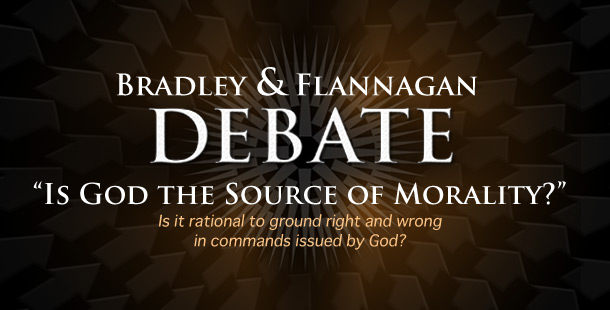
  • Bradley v Flannagan Debate @ Auckland Uni “Is God the Source of Morality?”

    Raymond Bradley and Matthew Flannagan will debate the topic “Is God the Source of Morality? Is it rational to ground right and wrong in commands issued by God?”

    The debate will be held at the University of Auckland on Monday 2 August from 7-9pm in “The Centennial” 260 – 098 OGGB (the bottom level of the Business School) on 12 Grafton Rd, Auckland City.

    Raymond Bradley v Matthew Flannagan "Is God the Source of Morality"

    If you enjoyed the 2008 debate at Auckland University between William Lane Craig and Bill Cooke, you should enjoy this debate.

    Raymond BradleyBradley is an Emeritus Professor of Philosophy with areas of specialty in Philosophical Logic, Metaphysics, Logical Atomism; he has previously debated William Lane Craig, Edward Blaiklock and many other Christian scholars and describes himself as an older generation “new atheist”.

    Matthew FlannaganFlannagan is an Auckland based Philosopher and Theologian with areas of specialty in Philosophy of Religion, Ethics and Theology; he has previously debated Bill Cooke, Zoe During and, of course, writes for this blog.

    The format of the debate will be as follows:

    Dr Bradley: Opening Comments [20 min]
    Dr Flannagan: Opening Comments [20 min]
    Dr Bradley: Reply to Dr Flannagan [10 min]
    Dr Flannagan: Reply to Dr Bradley[10 min]
    Dr Bradley: Closing Comments [7 min]
    Dr Flannagan: Closing Comments [7 min]
    Questions from the floor: [30 min]

    The moderator for the debate will be John Bishop.

    Bradley will be introduced by Robert Nola.

    Flannagan will be introduced by Chris Tucker.

    Both Bradley and Flannagan are experienced and engaging public speakers who are practiced at pitching their topics to suit their audiences. So, invite all your friends, and block out the evening of Monday 2 August from 7-9 pm now and make sure you get to the debate early to locate parking and grab a good seat.

    This debate is brought to you by the Evangelical Union and the Reason and Science Society as part of the University of Auckland’s Jesus week/Atheist week, with support from Thinking Matters.

    The event will be videoed and will be published on this blog. Entry is free and any and all are welcome.

    There is even a Facebook page you can rsvp on and use to invite your friends.

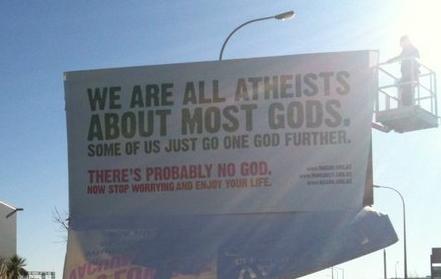
  • There’s Probably No God? Fisking Atheist Billboards

    On the way back from Bloggers drinks we drove past one of the controversial atheist advertising billboards, put up by NZ Atheist Campaign, The Humanist Society and NZARH, which have appeared around Auckland. This appears to have come on the back of the Richard Dawkins inspired bus advertising that made headlines earlier this year. It is worth fisking them a bit.

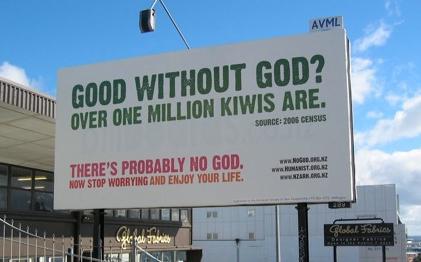
    Here is a pic of the first one.

    Good Without God? Over One Million Kiwis Are.

    Here we are told one million kiwis are good without God because the census says so. This, however, is fallacious. What the census shows is not that one million kiwis are good without God, it shows that one million kiwis are good (although this is granting a lot for the sake of argument) without believing in the existence God. But to say one can be good without believing in God is not the same as saying one can be good without God. Many people throughout history have been able to live and breath without believing in the existence of hydrogen and oxygen atoms, it does not follow that they could live without water.

    Moreover, it is hard to tell what the point of this sociological fact is anyway. Why does the fact that people do not need to believe in something to do good deeds mean that the belief is false? For centuries people have done good deeds and lived good lives without believing in evolutionary theory or quantum mechanics, should we conclude that these theories are therefore ‘probably false’? Surely these atheists are not suggesting that our beliefs should be based on what is useful or helpful as opposed to what is true or false?

    Perhaps the atheists here mean to convey something else. Some Christian thinkers such as William Lane Craig, Robert Adams, Stephen Layman, Alvin Plantinga, John Hare, Philip Quinn have argued that moral properties such as right and wrong depend on God for their existence. Atheist writers such as Paul Kurtz and Christopher Hitchens retort that this claim is falsified by the existence of morally upright atheists. I suspect something like this is behind the slogan on the billboard, it repeats Hitchens and Kurtz’s retorts as though they said something insightful or clever.

    The problem is, as any one familiar with this discussion should know, this retort misses the point (as I pointed out in On a Common Equivocation). Craig, Adams, et al are not claiming that one needs to believe in God to be good (a point made several times in the literature and particularly made so many times to Kurtz that it beggars belief that he keeps repeating it) rather their claim is that moral properties, such as right and wrong, depend on God for their existence.

    This is a fairly basic and elementary distinction in the literature. How exactly expressing a common philosophical confusion counts as reason for thinking “there probably is no God” is hard to see.

    Let’s look at the next one.

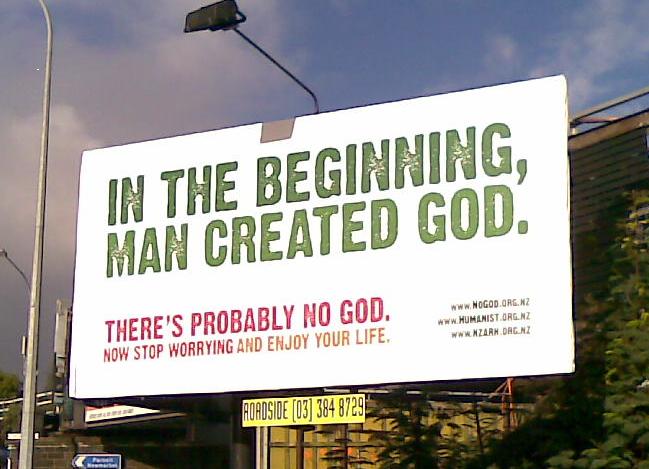
    In the Beginning, Man Created God.

    What is asserted here? That man created God. This, however, is clearly absurd. God is typically defined as an all-powerful, all-knowing, immaterial, necessarily-existent being who created the world. Now if one is going to claim that humans actually created an all-powerful, all-knowing, immaterial, necessarily-existent who created the world, then they are contradicting themselves.

    Humans are part of the world and therefore cannot have created the being that created the world – otherwise humans would have to exist prior to their own existence.

    Similarly, one cannot create a necessary being, this would entail it is possible for a necessary being to not exist, in which case it would not be a necessary being. Taken in a straight-forward, literal manner (the way freethinkers are so fond of taking every passage in the Bible) this billboard simply asserts contradictions.

    Of course, the authors of this billboard probably do not mean to say humans actually created God, they do not think he exists after all. Their claim is that humans created the idea or concept of God and developed it. This is undoubtedly true. Of course, humans also invented the idea or concept of atoms as well, ancient Greek philosophers came up the basics of this concept millennium ago. This trivial fact tells us nothing about whether or not the idea or concept humans developed actually corresponds to anything in reality. To assume that it tells us something about whether the idea or concept is true or false is a fairly obvious case of the genetic fallacy.

    So the second billboard either asserts a contradiction or it is a clear case of a logical fallacy.

    The last one is my favourite.

    We are all atheists about most gods. Some of us just go one god further.

    I am inclined to think the argument on this sign is invalid. To see why let’s take out the term “God” in the sign and replace it with some other term such as “non-Christian perspective.” When we do this we get: “We all reject most non-Christian perspectives, some of us just reject one more.” This argument has true premises, do we now have, a knock-down argument for Christianity?

    Similarly, an analogous argument form with true premises gives us an argument for nihilism, the total denial of the existence of morality. “We are all nihilists about some conceptions of morality, some of us are just nihilistic about one more.”

    The same argument for also furnishes a refutation of secularism, “we all reject some secular perspectives on reality, some of us just reject one more.” I could go on.

    Taking a stand on any issue of philosophical substance, whether by affirming, denying or simply being sceptical of it, is to put oneself in opposition to any number of other people and groups who take a contrary stance. That is life. Such pluralism hardly provides a reason for thinking “there probably is no God” any more than it gives us a reason to doubt any other perspective on the world.

    So what do the atheist billboards do? Well the first one tells us that some atheist groups conflate basic philosophical distinctions and don’t really understand the debate they are contributing to. The second shows us that these groups think contradictions and obvious fallacies are some how savvy and smart. The last shows us that they think that invalid argument forms, forms from which you could infer the denial of anything and everything by substituting one true premise with another, are avant-garde.

    All in all, pretty accurate advertising for these groups.

    Hat tip: MCAS

  • EPS Apologetics Conference: God and the Genocide of the Canaanites

    Matt has been invited to speak at the annual Evangelical Philosophical Society (EPS) Apologetics Conference in Atlanta, Georgia, USA which runs 18-20 November 2010. He will be speaking alongside some big names in contemporary Christian philosophy including Alvin Plantinga and William Lane Craig.

    Evangelical Philosophical Society Apologetics Conference

    Experience seasoned teaching by Alvin Plantinga, William Lane Craig, Gary Habermas, Greg Koukl, Randy Newman, Frank Beckwith, Craig Evans, Craig Blomberg, Mike Licona and over twenty other influencers in Christian apologetics as they equip you about the issues facing contemporary Christian witness.

    The full line up of speakers is here.

    You can register here.

    Matt’s talk is entitled “God and the Genocide of the Canaanites,”

    How could a just and loving God command Joshua to genocide the Canaanites as is apparently taught in the Old Testament? Is God really a moral monster as Christianity’s critics use these passages to claim? Matthew will re-examine these passages in light of the context they were written in showing that the skeptics’ case against God relies on a questionable reading of the Old Testament.

    This talk will be based on Matt’s blog series, Joshua and the Genocide of the Canaanites Part I and Part II, his Contra Mundum column, “Did God Command Genocide in the Old Testament?” (forthcoming August 2010) and his chapter, co-authored with Paul Copan, “Ethics of ‘Holy War’ for Christian Morality and Theology” in Old Testament ‘Holy War’ and Christian Morality: Perspectives and Prospects (forthcoming 2011).

    If you would like to donate to help Matt get to America to speak at the EPS Apologetics Conference please visit our support page.

  • Contra Mundum: Richard Dawkins and Open Mindedness

    The bold statement “Richard Dawkins opens minds” leaped out at me from the newsletter sitting on the University of Auckland’s Law Library counter. The article went on to sing the praises of Richard Dawkins and mentioned his book The God Delusion. On reading the piece one could be forgiven for concluding that Dawkins’ works are a paragon of the open minded assessment of ideas.

    Now Dawkins is a Zoologist and I, not being a Zoologist, would not presume to assess his work on Zoology. What is interesting, however, is that much of Dawkins’ most famous work is not on Zoology; it is on Theology and specifically Philosophy of Religion. That field of Philosophy which critically analyses religious questions, such as, the veracity of arguments for and against God’s existence. Having some background in these fields I find it a little surprising that an Auckland University publication would contend that his work is open minded because it is evidently not.

    In The God Delusion Dawkins’ main argument against the existence of God alludes to Fred Hoyle’s famous claim that the probability of something as complex as life evolving by blind chance was less likely than a fully-functional Boeing 747 being created by a hurricane blowing parts around in a junk yard. Dawkins writes, “However statistically improbable the entity you seek to explain by invoking a designer, the designer himself has got to be at least as improbable. God is the Ultimate Boeing 747.” Dawkins has made the same line of argument elsewhere “God, or any intelligent, decision-making calculating agent, is complex, which is another way of saying improbable.” In The Blind Watchmaker he argues,

    Once we are allowed simply to postulate organized complexity, if only the organized complexity of the DNA/protein replicating machine, it is relatively easy to invoke it as a generator of yet more organized complexity”. But of course any God capable of intelligently designing something as complex as the DNA/protein machine must have been at least as complex and organized as that machine itself.

    This argument contains three premises. First, that theism (belief in God) is justified by “postulating” God to explain the existence of organised complexity. Second that the God appealed to by theists is complex. Third, that the existence of complex beings are highly improbable. These lead to the conclusion that “God is the Ultimate Boeing 747” and hence “almost certainly does not exist”. The problem with this argument is that all three premises rest on caricatures and misunderstandings of contemporary theology and ignorance of contemporary philosophy of religion. I will explain.

    Dawkins contends that God is postulated to explain organised complexity. There are two problems with this contention. First, Dawkins assumes that God is rationally believed only if his existence is inferred by some kind of argument for the best explanation of a given phenomenon. However, not all beliefs are justified on the basis of some kind of argument of this sort. Our belief in the existence of the past, our belief that it is wrong to rape, our belief that other people exist or that basic axioms of logic are true are not based on inferences to the best explanation. It is not that they are rationally believed because they explain some phenomena better than all alternatives, it is rather that these beliefs are part of the background data that we use to assess proposed explanations against. These things are true because we immediately experience them as true. I have the experience of remembering the existence of a past event. I intuitively perceive that rape is wrong. I experience the basic axioms of logic as self-evident and so on. Such beliefs are called properly-basic beliefs.

    Since the late 1970’s an extremely important movement within Philosophy of Religion, known as the reformed epistemology movement, has offered detailed and rigorous defences of the contention that, for theists, belief in God can be properly-basic. This position has been defended by leading philosophers of religion such Alvin Plantinga, William Alston, Nicholas Wolterstorff, Peter Van Inwagen and others. Now, of course, it is possible that this movement is mistaken but Dawkins surely owes us an argument to this end as opposed to his simply assuming it and ignoring the counter evidence.

    Second, among those theists who do defend God’s existence on the basis of some argument for the best explanation, very few do so on the basis that God explains “organized complexity”. Richard Swinburne, the leading proponent of such arguments, argues that God explains the existence of laws of nature, religious experience, the origin of the universe and the continued existence of the universe. Swinburne does not postulate God to explain “organised complexity”. Similarly, William Lane Craig, a leading defender of theism, suggests that God explains the origin of the universe, the existence of morality and the fine tuning of the laws of nature. Again, Craig makes no appeal to “organized complexity”. In 2009 The Blackwell Companion to Natural Theology was published which contains the most up to date versions of the 11 most definitive arguments used to defend the existence of God in the literature today. Not one of them involves an appeal to “organised complexity”. While the cogency of arguments for the existence of God that do not involve “organized complexity” remains open to substantive debate, it is undisputed that these arguments exist. Dawkins’ picture of God as a postulate to explain organised complexity is a crude caricature of theistic scholarship.

    To be fair Dawkins attempts to address some of these other arguments elsewhere in the book. However, here again much of his writing consists of caricature. He attacks five arguments proposed 800 years ago by Thomas Aquinas as being representative of the current case for theism and completely ignores the vastly more sophisticated and vigorous versions being defended in the literature today. Ironically, Dawkins quite severely misunderstands Aquinas’ arguments and attributes to him a position no Aquinas scholar would accept as accurate. However, even if his account were accurate, critiquing theism by attacking the arguments of one 12th century theologian is a bit like me attacking evolution on the basis of the evidence for it gathered in the 12th century and ignoring any of the scientific developments of the last 800 years. Such ineptitude would not be tolerated in the scientific world and should not be seen as de rigueur just because the topic is religion.

    Dawkins’ second contention fares little better. Dawkins states that “A God capable of continuously monitoring and controlling the individual status of every particle in the universe cannot be simple” this seems to be because,

    The corners of God’s giant consciousness are simultaneously preoccupied with the doings and emotions and prayers of every single human being—and whatever intelligent aliens there might be on other planets in this and 100 billion other galaxies.

    There are several problems here. First, as Craig has noted, this confuses whether what God thinks about is complex with whether God himself is complex. Second, as Plantinga has noted, in The Blind Watchmaker Dawkins states that something is complex if it has parts that are “arranged in a way that is unlikely to have arisen by chance alone.” However, the concept of God employed by most theists is of an immaterial being that does not have material parts so by Dawkins’ own definition God is not complex (unless one assumes that God is a material being but theists almost unanimously maintain that God is an immaterial being).

    This misrepresentation is made all the more pertinent by the fact that for centuries theists have been offering rigorous and sophisticated arguments that God is not in fact complex but is simple. While these arguments may not be successful, Dawkins still needs to actually provide reasons for rejecting them. To simply assert that God is to be conceived in a way that no one conceives Him and to ignore the numerous arguments to the contrary seem more like a child who asserts his position and then puts his hands over his ears and repeats “I am not listening” than it does a serious critical evaluation of another’s position.

    Dawkins’ final contention, that the existence of complex beings is improbable, is similarly confused. Suppose one grants that God is “the Ultimate Boeing 747” and that God’s existence is as statically improbable as the complexity it is invoked to explain. Little in fact follows from this. This is because what is improbable in the Boeing 747 analogy is that the plane came into existence by chance. If God is “the Ultimate Boeing 747” then the conclusion to be drawn is only that it is improbable that God came into existence by chance. This, however, provides us with no reason for thinking that God does not exist. No theist holds that God came into existence by chance, theists hold that God is eternal. Here, again, Dawkins attacks a concept of God nobody holds to and hence is caught jousting with a straw-man.

    On examining Dawkins’ central argument what one discovers is not an open-minded, informed, careful examination of the contemporary debate over the existence of God. Nor does one find a carefully researched assessment of theism. Instead one finds Dawkins simply ignoring what theists mean by God. He ignores how they conceptualise God and ignores the arguments and discussions they have actually made. The theism Dawkins dismisses apparently assumes that God is a material being with parts, that He came into existence by chance and is postulated merely to explain organized complexity. The actual arguments proposed in defence of theism that have been put forward in the literature are not addressed at all.

    Some Auckland University academics might consider such tactics to count as open-minded but I do not. In my view an open-minded honest assessment of religion requires accurately representing what theologians say and teach. It means endeavouring to read and understand their position and offer informed and critical responses to these positions. Ignorance and caricature is not open-minded scholarship.

    I write a monthly column for Investigate Magazine entitled Contra Mundum. This blog post was published in the May 10 issue and is reproduced here with permission. Contra Mundum is Latin for ‘against the world;’ the phrase is usually attributed to Athanasius who was exiled for defending Christian orthodoxy.

    Letters to the editor should be sent to: editorial@investigatemagazine.DELETE.com

    RELATED POSTS:
    Contra Mundum: Slavery and the Old Testament

    Contra Mundum: Secular Smoke Screens and Plato’s Euthyphro

    Contra Mundum: What’s Wrong with Imposing your Beliefs onto Others?
    Contra Mundum: God, Proof and Faith
    Contra Mundum: “Bigoted Fundamentalist” as Orwellian Double-Speak
    Contra Mundum: The Flat-Earth Myth
    Contra Mundum: Confessions of an Anti-Choice Fanatic
    Contra Mundum: The Judgmental Jesus