Tag: William Lane Craig

  • Fallacy Friday: Ad Populum (Appeals to Popularity)

    This week I am going to look at the ad populum fallacy. Ad populum is Latin for “appeal to the people”. This fallacy occurs when a person argues that a particular claim is true because a large number of people accept it. Put crudely it contends that a position is true because it is popular – a majority of people, or a majority of one’s peers accept it.

    The Lemming PledgeAppeals to what others think have an important psychological influence on us because we are social beings and fitting in with one’s peers and the society around is important to us. Taking a view that is unpopular risks putting us at odds with others; in some circumstances it can lead to social alienation and ostracism – people risk being ridiculed, shunned or demeaned.  Our desire to avoid these sorts of responses by others can lead us to not question certain claims or to accept others.
    In fact often it is this kind of pressure that is deliberately used to try to influence people into accepting a claim is true. When I studied at University, it was far more common to hear people attempt to dismiss Christianity by claiming it was out of accord with what contemporary people think or that it was old fashioned and so on, than it was to hear any actual argument against Christianity.

    Unfortunately popularity is not the same thing as truth. If a claim is popular it tells us that a large number of people think it is true. However, a claim is true when what it affirms is, in fact, the case. It is possible that what a large number of people think is the case is not, in fact, the case. Majorities can be wrong and throughout history have been. False ideas, bigotries, prejudices, urban legends and superstitions can be widely held and popular in a society.

    As I noted in Analysing Arguments, an argument is valid when it is impossible for the conclusion to be true and the premises false. Given it is possible (in fact, it is often actual) for a popular claim to be false, inferring that a view is true because it is popular is a fallacy.

    Qualifications
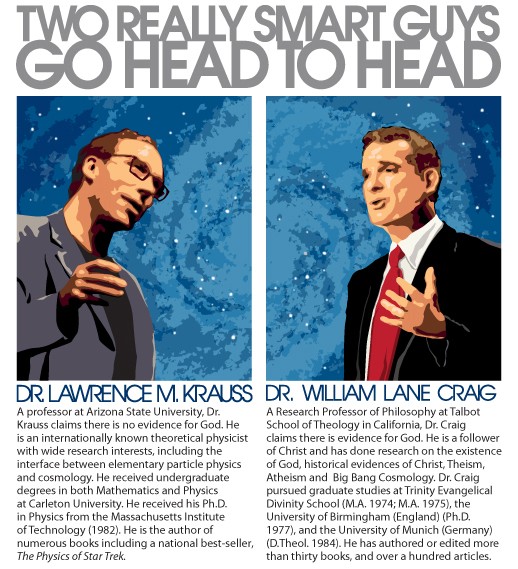
    This past week Philosopher and Theologian William Lane Craig and Physicist Lawrence Krauss, debated the moot “Is there Evidence for God?” at North Carolina State University (video and MP3 available at the link). At one point during the debate, Krauss stated that 90% of the American academy of sciences did not believe in God; this, he argued, provided good reason for thinking there was no evidence for God’s existence.

    This example highlights some subtleties in how this fallacy should be applied. Krauss suggested that there is no evidence for God’s existence because the vast majority of scientists do not believe in God. In support of this he stated that the vast majority of those who have studied the evidence contend that the evidence is not there. Krauss was arguing for a position on the basis of what the majority of the experts in a field think. On the face of it, there does seem some merit to this; surely, if (more…)

  • Is there Evidence for God? William Lane Craig v Lawrence Krauss Streamed Live @ Auckland Uni

    On 30 March 2011 (US time) Dr Lawrence Krauss and Dr William Lane Craig will debate the moot Is there Evidence for God? at North Carolina State University. The debate will be moderated by His Honour Paul M Newby, Justice of the Supreme Court of North Carolina.

    Thinking Matters, Evangelical Union and the Reason and Science Society have arranged permission to stream the debate at the University of Auckland on Thursday 31 March 1-3 pm (NZ time). They have invited Matthew Flannagan to field Q&A from the audience arising from viewing the debate.

    Krauss v Craig

    Professor Krauss is a theoretical physicist and director of the Origins Project at Arizona State University. Books he has written include “the Physics of Star Trek”.

    Professor Craig is a Research Professor of Philosophy at Talbot School of Theology, Biola University. His books include a written form of his debate with Anthony Flew. For more info on their scholarly work, check out Wikipedia.

    Both of these speakers have visited the University of Auckland in recent years and both drew large audiences; Dr Craig debated Dr Bill Cooke in 2008 and Dr Krauss gave a public talk there in 2010.

    So diarise this event now:

    What: Is there Evidence for God? Krauss v Craig Debate Streamed Live (Q&A with Matthew Flannagan)
    When: Thursday 31 March 1-3 pm (New Zealand time)
    Where: University of Auckland, Room to be advised (watch this space)

    Check out the Facebook page, RSVP and invite others.

  • William Lane Craig, Original Sin and Original Guilt

    A lot of people are up in arms at the moment about a paragraph in William Lane Craig’s answer to Question 193 “Overweening Ignorance.” Facebook, blogs, twitter and message boards are abuzz with Christians angrily attacking Craig with the charge that this paragraph shows he either does not hold to the doctrine of original sin or that he thinks it is not essential to Christianity. Here is what some are saying about the offending paragraph:

    “Craig denies that original sin is essential to the Christian faith.” Steve Hays

    In “Bible-optional Christianity” Hays sets out the offending sentences from the offending paragraph then puts them alongside Romans 5:12 and Corinthians 15:21-22, 45-49 (passages which speak of man’s sinful nature and the need for Christ’s salvation). The conclusion we are supposed to draw is that Craig is denying the truth of these passages and views these as “optional.”

    In “Hollywood Squares” Hays draws a ejusdem generis parallel between Craig’s paragraph and the writings of liberal scholars like Spong, Bultmann and The Archbishop of Canterbury.

    In the comments section of his third post on the paragraph “Rabbit Ears“, where he accuses Craig of making “a V-sign behind God’s head when God is speaking (the rabbit-ear gesture),” Hays writes:

    “Craig doesn’t seem to care what the Bible teaches about original sin. He simply absolves his correspondent of responsibility to believe what the Bible teaches on this subject, regardless.”

    On Facebook Dominic Bnonn Tennant wrote:

    “This is why, contrary to the objections of some, William Lane Craig not the world’s foremost apologist. The first duty of apologetics is to the truth. Not to unbelieving presuppositions. You can’t have good apologetics without good theology.”

    On Hays’ blog Bnonn Tennant wrote:

    “As I think someone has said already, the problem with Craig is that he starts with philosophy and only then worries about theology. That’s ass-backwards.”

    James R White of Alpha & Omega Ministries Apologetics Blog wrote:

    “this is not the first time WLC has made this statement. I have said repeatedly that WLC’s theology is way too hobbled to support biblical Christian theism, which is why he has to produce a much smaller theism to defend. And this is one of the manifestations of starting with philosophy and then crafting a theology to match your philosophical opinions.”

    Jonathan wrote:

    “Some apologists are eager to get people into the “Kingdom” anyway they can.”

    Saint and Sinner wrote:

    “I am so sick of minimalist Christianity”

    Peter Pike wrote:

    “Without Original Sin, there is no basis by which Christ’s blood can be applied to any sinner whatsoever. Craig should know this. He has a responsibility to teach this. I don’t care if ignorant, non-biblical “Christians” don’t hold to it–Craig is held to a higher standard, and his outright ignoring of this doctrine instead of teaching it in a way that someone can understand it simply neuters Christianity.

    You don’t defend Christianity by surrendering”

    William Lane Craig

    Apparently, Craig is not only affirming heresy but is a compromiser who is not committed to the truth, who denies that the existence of universal sinfulness and that the need for salvation is an essential Christian belief.

    This own goal demonstrates not just an alarming inability for many Christians to read in context but also some overweening ignorance about theology (not to mention an alarming lack of charity for the man who is internationally renowned and respected for publicly defending the faith by lay people and the academy alike.)

    Let us take a look at the offending paragraph (more…)

  • “Does the Universe Have a Purpose?” Dawkins, Ridley, Shermer v Craig, Geivett, Wolpe (in English)

    Richard Dawkins, Matt Ridley, Michael Shermer debated William Lane Craig, Douglas Geivett, David Wolpe on the topic “Does the Universe Have a Purpose?” on Mexican television on 13 November 2010. This is the english version:

  • In Atlanta

    I have a few snaps of Matt in Atlanta, this first one had our kids excited when they saw it [which should tell you everything you need to know about just how much Matt is a fan of Dr Alvin Plantinga – LOL!]

    Alvin Plantinga, Matt and Rodney Lake
    Alvin Plantinga, Matt and Rodney Lake

    Fellow kiwi Rodney Lake of Thinking Matters Tauranga, also in Atlanta attending the conferences, took the above photo and wrote on Facebook of it:

    Tonight I met and chatted with simply the greatest collection of Christian thinkers the world has to offer – hands down – without a doubt – the best! You couldn’t put together a better bunch in the same room than this. There were others, but the ones I got to talk to included: Alvin Plantinga, William Lane Craig, Mike Licona, JP Moreland, Paul Copan, Craig Hazen, Frank Beckwith, Mary-Jo Sharp and of course Matthew Flannagan. Also earlier in the day shook hands with Gary Habermas and Greg Koukl. A day to remember…

    Rodney has been doing a tour around the US over the last few weeks of the various Apologetics ministries and has been meeting up with various biblical scholars and Christian philosophers. You can read about what he has been up to and who he’s been trying to talk into coming out to New Zealand on his blog.

    Jim West snapped this one, Matt the kid in the candy shop – surrounded by the worlds best in his field and their books!

    Jim West snaps Matt at the EPS

    Jim has been quite the tourist, he’s been snapping everyone and everything by the looks of his homepage.

    I just talked to Matt on Skype – we are so grateful to the kind and generous people who donated us Skype equipment – he said it is quite surreal to be wandering around, sitting in seminars and recognising all these philosophers and theologians whose works he has read and admired all around him. He said the conversations following each session are very stimulating; everyone understands the topics, it is a lot like being at a Philosophy department seminar, only everyone is coming from a Christian perspective – which is something Matt is just not used to but is really appreciating. He said that MandM is clearly more widely read than either of us realised as plenty of people recognised him and complete strangers asked after me, commented on our blog and so on. The internet clearly makes the world a small place! Anyway he is having a blast and is doing great.

  • “Set Forth Your Case” The Promo Video

    Here is the promo video, featuring William Lane Craig, for the Evangelical Philosophical Society’s “Set Forth Your Case” conference (one of the two conferences Matt is speaking at in Atlanta Georgia in 3 weeks):

  • Commonsense Atheism and the Canaanite Massacre

    Luke Muehlauser at Commonsense Atheism has written a review of my argument on the genocide of the Canaanites (Joshua and the Genocide of the Canaanites Part I and Part II). Luke’s comments are largely positive (and I appreciate that a critic of Theism and Christianity sees merit in my position) he does, however, raise a few issues I would like to respond to.

    First, Luke summarises my conclusion as:

    Perhaps instead the most genocidal phrases in Joshua were meant as hyperbole. Imagine a basketball team speaking of how they “totally slaughtered” their opponents like their coach told them to. In the same way, maybe the Israelites wrote in hyperbolic language about how they defeated their enemies. Indeed, this kind of exaggeration and hagiography on a nation’s own behalf is common in ancient literature.

    This is not quite right; I did not state “perhaps” the passages are hyperbolic. I argued a hyperbolic reading best fits the context, as it explains why the author uses stylised phrases in some passages which, if taken literally, contradict what he affirms elsewhere in the text did literally happen. Furthermore, I did not suggest that such exaggeration and hagiography is common in ancient literature. I suggested it was common in literature of the same general time and place, which used the same literary conventions and rhetorical techniques as the Bible does in the Book of Joshua – namely Ancient Near-Eastern war and conquest accounts.   

    Second, Luke states that my position “agrees with the Biblical minimalism already espoused by most atheists, for it says that these events found in the Bible never happened.” This comment is intriguing because much of my research drew from the writings of biblical maximalists who were criticising minimalism. My repeated citation of Kenneth Kitchen is an obvious example. Minimalists point out that the archaeological record does not fit the picture of total conquest and genocide and hence conclude the Bible is inaccurate. Maximalists, such as Kenneth Kitchen and James Hoffmeier, respond by arguing that the text is not inaccurate because, having examined the literary conventions of Ancient Near-Eastern historiography, one finds it does not actually teach total conquest and genocide as it is written according to the hyperbolic and to some extent hagiographic rhetoric of Ancient Near-Eastern historiography. So I am inclined to think my position is a development of a rejoinder to minimalist challenges.  

    This is of course another area where my perspective has merit. It resolves not only some of the moral questions people have with the narrative; it also resolves the apparent contradictions within the text cited by critical scholars, answers the challenge of archaeology and fits what we know about the conventions of such literature. If we know that Joshua is written according to certain literary conventions and we know that these conventions frequently are hagiographic and hyperbolic, then to insist on a literal reading is implausible. This is particularly so when it makes the text contradictory, contrary to archaeological record and seemingly immoral.   Luke goes on to ask,

    If Matt did think these events happened literally as described in the Bible, would he then conclude that God was an evil monster to command them? Or would he, in the end, agree with Bill Craig that genocide is okay as long as God feels like it?

    I will make two points in answering Luke’s questions.

    One, it seems to me one could only conclude that Joshua actually carried out a divinely authorised Genocide if, in addition to taking Joshua literally one also accepts that the Bible is inerrant. But Joshua is not the only text in the canon, the Bible also in various other places teaches that God is good, just, and so on. So it’s hard to see how a person could coherently draw the conclusion Luke mentions. A person who concluded that God is evil, would have to conclude that much of what the Bible teaches about God is mistaken, but if this is the case then one has reason for doubting that it is accurate in its description of Genocide in the first place.

    Two, Luke asks if I “agree with Bill Craig that genocide is okay as long as God feels like it?” It is important to note is that this is not Craig’s position. Craig claims that killing non combatants in war is permissible if a loving and just God commands it. He also contends that God in fact did not command this in the biblical narratives hence his view is about a hypothetical conditional.1 Once this is realised the issues are not as simple as Luke appears to think.   Either it is possible for a just and loving omniscient person to command genocide or is not. If it is, then genocide would only be commanded in situations where a just and loving person aware of all the relevant facts could endorse it, and under these circumstances its hard to see how genocide could be evil.

    On the other hand if it is impossible for a perfectly good omniscient being to ever command genocide, then the situation Luke mentions is one with an impossible antecedent. On the standard accounts of counter factual logic, conditionals with impossible antecedents are true. Of course this is a disputed point of modal logic, the debate however is technical and complex and certainly not one with an obvious answer. As I have argued elsewhere every ethical theory is such that under impossible circumstances it entails that genocide is permissible.

    Finally, Luke argues that atheists are not “‘attacking a straw man’ or ‘taking things out of context’ as Matt sometimes says” but rather, “they are responding to the way that millions of Christian fundamentalists interpret these verses.” He states,  

    Atheists are not, as Matt claims, reading the Bible as fundamentalists. Atheists don’t believe the genocide ever took place! What we atheists are saying is this: If you think these events were literally commanded by God and carried out by the Israelites, then how can you call God “perfectly good”?

    But here Luke is quoting me out of context.  The argument I responded to was developed by Ray Bradley. Ray’s conclusion was not that fundamentalist Christianity is false but that theism is false, and that all forms of theistic ethics are false. This only follows if you assume either,

    (a) that fundamentalist readings are the only defensible ones or,
    (b) all theists as a matter of fact do make such readings.

    To affirm (a) is to adopt a fundamentalist hermeneutic as correct interpretation.

    To affirm (b) is to attack a straw man.

    Of course someone might adopt a more qualified argument along the manner he suggests. But if he does, then it is not an argument against theism, nor is it an argument against Christianity, it is not even an argument against a form of Christianity committed to a strong view of inerrancy. It is an argument against anyone who accepts these things and also accepts an interpretation of Scripture which reads these passages as a literal description of what actually happened, as opposed to hagiographic or hyperbolic description. Now showing this combination of positions to be indefensible might be  interesting and useful, but it is extremely limited in its conclusion. Anyone appraised of such an argument can respond simply by moving to a less literalistic hermeneutic and retaining every thing else. I suspect this is much less than atheists typically want and certainly less than they typically maintain this argument shows.

    1. In Divine Command Morality and Voluntarism William Lane Craig writes “I’ve come to appreciate that the object of God’s command to the Israelis was not the slaughter of the Canaanites, as is often imagined.” The command rather was primarily to drive them out of the land.” He goes on to state “But I’m assuming a “worst case” scenario for the sake of argument.”

    RELATED POSTS:
    Joshua and the Genocide of the Canaanites Part I
    Joshua and the Genocide of the Canaanites Part II
    Contra Mundum: Did God Command Genocide in the Old Testament?