Category: Justice

  • Some subversive thoughts about immigration part two: replies to objections

    Recently, I shared some reflections on the issue of immigration. Drawing on Deuteronomy 23:15–16 and the way this passage was interpreted and applied by 18th-century abolitionists, I argued that our present situation is analogous to that of illegal overstayers fleeing certain forms of degradation in their home countries. Below are some of the responses I received to this argument, followed by my replies.

    Is this a Noahide Command?

    One response points out that the passage I cited is in the Torah. But the Torah is a covenant between God and ancient Israel; there are lots of commands in the Torah — the command to circumcise male children, to refrain from eating pork, not to wear mixed cloth — which contemporary Gentile Christians are not required to follow.

    In reply: while not all commandments in the Torah apply to Gentiles, some do. As early as the Book of Jubilees, Jewish commentators argued that interpreters had come to recognise that, while the Torah as a whole was given only to Israel, certain commands in the Torah applied to both Jews and Gentiles alike. These were commandments that express moral requirements binding on all people — Jew and Gentile — antecedent to the Sinai covenant. Historically these were called the Noahide commandments[1]. Is the command in Exodus 23 (or Deuteronomy 23:15–16) a Noahide command?

    It is plausible to say it is. The reason is that on at least one occasion God is described as expecting Gentile nations, who were not parties to the Sinai covenant, to follow this law and to be held accountable for not doing so. When Jerusalem fell to Babylon in 587 BCE, refugees fled toward the border of Edom. The Edomites slaughtered some, rounded up others, and handed the fugitives over to the Babylonians. The prophet Obadiah condemns Edom for this action:

    Do not stand at the crossroads
    To eliminate their survivors;
    And do not hand over their refugees
    On the day of their distress. (Obadiah 14)

    Obadiah’s message is that God will hold Edom accountable for this action. Consequently, Deuteronomy 23:15–16 can be read as expressing a Noahide command — a moral requirement binding on Jew and Gentile alike.

    A second reply turns the reader back to case 1: do you believe the abolitionists did the right thing in breaking the Fugitive Slave Act? Would it have been right to hand runaway slaves over to the authorities? If you answer yes to the first question and no to the second, then you are implicitly endorsing the abolitionists’ interpretation of Deuteronomy 23:15–16 as a command applicable to Gentile Christians living in later ages.

    Limited Application
    A further response is that my argument has limited application: it applies only to asylum seekers and not to other forms of immigrants. In reply, Deuteronomy 23:15–16 applies to a person fleeing slavery; by analogy it applies to a person who has fled their country to escape any condition analogous to slavery. This is significant. The 1951 Convention Relating to the Status of Refugees defines a refugee as a person who, “owing to a well-founded fear of being persecuted for reasons of race, religion, nationality, membership of a particular social group, or political opinion, is outside the country of his nationality and is unable to or, owing to such fear, is unwilling to avail himself of the protection of that country.”

     That definition is narrower than what Deuteronomy 23:15–16 seems to command. A person can be in severe bondage or servitude to another without fitting that 1951 Convention definition — for example in forms of debt bondage or extreme economic servitude, or cases where the person is persecuted or mistreated for reasons other than the ones specified.

    What about illegal or undocumented aliens?

    A third response distinguishes between legal and illegal aliens. The claim is that we should not aid and abet the deportation of someone who has gone through the correct channels and applied for refugee status, but someone who has illegally entered the country is in a different situation: they have “jumped the queue” and failed to respect the law.

    In reply, I deny their situation is different in any morally relevant way. The slave in 1850 the would have clearly crossed a border into a free state illegally, and the Jewish overstayer in the 1930s example may well have been an overstayer despite attempts to apply for asylum. These are people who are illegally in the country, and yet deporting them can still be wrong. Let us reflect on why.

    Imagine I am being pursued by someone who wishes to do me harm — to enslave or kill me. I manage to escape to somewhere my pursuer cannot reach. You yell to my pursuer, “He is over there,” grab me, pull me out, and hand me over. Why would this be wrong? It is wrong because, in doing this, you are actively assisting my pursuers in enslaving or killing me. This is not merely a failure to help; it is active complicity in the attacker’s wrong.

    Notice that this is true whether or not I am a documented or undocumented alien. Suppose I have entered the country illegally — I “jumped the queue.” Suppose there was a legal path I could have followed and I did not. That fact does not change that I am being pursued; it does not change that exposing my whereabouts and handing me over will result in my death or enslavement; and it does not change that, by doing so, you are complicit in that killing or enslavement. The features of the action that make turning me over wrong hold regardless of whether I followed legal channels to enter.

    One way to see this is to ask the following question: was there a realistic possibility that, had the person followed the correct legal procedure, they would have been denied asylum? If the answer is yes, then this case doesn’t differ in any relevant respect from cases 1 and 2 above. The fugitive slave fleeing to a free state fled there illegally. He could have attempted to follow whatever legal procedures were available to leave his master and emigrate to a free state, but we know that under federal law in the US in 1850 this was prohibited. Making his existence known to the authorities would have resulted in his being returned to slavery.

    In the 1930s, thousands of Jewish asylum seekers who legally applied to emigrate to the US were turned down. In 1939, the St. Louis, a ship carrying 900 Jews fleeing Nazi Germany, sailed to the US. The US, along with various other nations, refused the Jews entry, and the ship was forced to return to Germany. In light of these facts, it is very plausible that a Jewish overstayer who revealed themselves to the authorities would have been deported.

    Suppose, then, that the person seeking asylum would have had it granted if they had followed the correct procedure. In this case, critics point out, the overstayer has “jumped the queue”; they have unfairly entered the US without following the procedures others have duly followed. Would we be justified in turning the undocumented alien in to the authorities, knowing they would be deported back to a country where they would likely be enslaved, killed, or persecuted?

    I think the answer is no. Let us grant that “jumping the queue” is wrong, that laws prohibiting it are in principle justified, and that some legal penalty is warranted. Even so, it seems implausible that you would be obliged to hand me over if the penalty inflicted by the authorities is disproportionate. Suppose I knew that stealing a loaf of bread carried a sentence of death. Or that using a false passport meant being handed over to a mafia gang to be tortured and killed. In such cases, I think it would be wrong to turn in someone I knew had stolen a loaf of bread or faked a passport. The fact that it is wrong to commit fraud and theft, and that laws against them are justified, does not mean I would be justified in handing you over under such circumstances.

    The case where the penalty for “jumping the queue” is deportation back to the country the asylum seeker fled from is also a case of disproportionate punishment. Remember, as we have stipulated, this is a case where asylum would have been granted had he not jumped the queue. The benefit he unfairly received, therefore, was not asylum itself—he would have gained that regardless—but merely one of convenience: less hassle, a shorter waiting period, and avoidance of some stressful processes. Do we really think that gaining this kind of advantage unfairly over another justifies execution, permanent enslavement, or permanent exile into destitution? Obviously not. Yet handing people over to authorities who will impose such disproportionate consequences makes you complicit in those outcomes.

    To make this vivid: suppose someone, fearing for their life, illegally fakes identification to stow away on a boat. The captain of the boat has the following policy: if someone tells him they are fleeing for safety, he will allow them on board. However, the captain has no tolerance for stowaways. Anyone discovered stowing away will—as punishment—be thrown into the Atlantic to drown. Or suppose a pilot discovers a passenger with a fake passport and, deciding the passenger is an illegal entrant, opens the plane door mid-flight and throws them out. Both acts would be monstrous. Arresting the person and issuing a proportionate punishment at their destination might be defensible; expelling them when such expulsion will result in death is not.

    Now suppose I know about the stowaway and also know that disclosure will lead to a disproportionate death sentence (being thrown from a plane or cast into the sea). Do I have a duty to disclose? I do not think so. I would be morally justified in concealing the person. I would not be obligated to hand them over.


    [1] Noahide command is the term used by Rabbi’s in the Talmudic literature, Christians have expressed a similar idea using the terms “moral law” or “natural law”. Consider for example Aquinas “The Old Law showed forth the precepts of the natural law, and added certain precepts of its own. Accordingly, as to those precepts of the natural law contained in the Old Law, all were bound to observe the Old Law; not because they belonged to the Old Law, but because they belonged to the natural law. But as to those precepts which were added by the Old Law, they were not binding on save the Jewish people alone” https://www.newadvent.org/summa/2098.htm#article5

  • A very belated report on my trip to San Diego

    With trips to the US, Christmas, New Years, the summer break, Madeleine’s work, my preaching and juggling the family and the launch of my book, it has been a while since I blogged. Since the last post was about me going to the US I figured I should start by giving a very belated update on the trip before I get down to more run of the mill blog posts.

    Last time Madeleine blogged it was Wednesday 19 November 2014, the day after I had flown out of Auckland. I arrived in Los Angeles at 10 am on Tuesday 18 November 2014 (love the international date line!) and I finally arrived in San Diego that afternoon where I had an enjoyable dinner with Moore College President Mark Thompson.

    The Evangelical Theological Society (ETS) and Evangelical Philosophical Society (EPS)  meetings began the next day. The first session I attended was a very good paper by Richard Davis and Paul Franks critiquing Wes Morriston’s criticisms of divine command meta-ethics (DCM). This paper was technical so I’ll try to summarise: Morriston objects that if moral requirements are identical with God’s commands, and even if it’s impossible for a perfectly good God to command the random sacrifice of 3 years olds, DCM still entails that if this impossibility were actualised and God were to command the random slaughter of 3 year olds, then such slaughter is wrong.

    This objection involves what is called a counter-possible, which is a hypothetical statement with an impossible antecedent. In this case the antecedent is that a perfectly good person could command the random sacrifice of children. According to the standard semantics for counter in modal logic all counter-possibles are  trivially true. Morriston argues this approach to standard semantics is mistaken; it is plausible that some counter possibles are false and that this counter-possible is one such example.

    Davis and Franks, give an interesting and thoughtful reply to Morriston in their forthcoming article “Counterpossibles and the ‘Terrible’ Divine Command Deity“. They argue: (a) Morristons’ own criteria  for distinguishing true from false counter-possibles entails that the counter-possible, If God commanded random sacrifice then random sacrifice is morally required, is, in fact, true and not false. Second, (b) they argue that DCM does not entail this counter-possible.

    To put their point in a nutshell: they argue that a world where God commands evil is a world where God ceases to be good; and since goodness is an essential property of God this entails that in such a world God would cease to exist. However, given God is the creator and sustainer of all that is distinct from him, a world where God does not exist is a world where nothing exists. Hence, it is false that if God commands evil, evil would be morally required. This was an excellent paper and I enjoyed some stimulating discussion with both of the authors during the Q&A and also at lunch.

    Next up was a paper by Frank Beckwith discussing Judith Jarvis Thomson’s famous article “A defence of abortion”. Thomson famously concedes for the sake of argument that a fetus is a human being and then argues, from analogy, that even if that is the case abortion is still permissible. Beckwith argued that, in fact, Thomson does not grant the personhood of the fetus in the way opponents of abortion understand it, but instead assumes a radically individualistic understanding of persons whereby people are not bound by any obligations to others which they do not willingly consent to, a picture which appears to rule out such things as parental duties to children or children’s duties to parents.

    This was followed by Micheal Rea’s interesting paper on whether God is gendered and the use of masculine and feminine language and imagery in describing God. His argument was that God is not gendered and the fact that most imagery used in scripture to describe God is masculine does not justify conceptualising God is exclusively masculine terms.

    In the break I had some very good fellowship and discussion over pizza with members of the Facebook group, Christian Apologetics Alliance.

    In the afternoon I took part in the ethics session of the ETS. The session kicked off with an interesting paper on how capital punishment is practiced in the US. The author, Ken Magnuson, made several disturbing observations about the fact that wealthy people almost always escape capital murder charges whereas the poor do not. This paper was unclear on what the nature of the core problem was: was it that innocent poor people were executed, or that the guilty escaped justice? While the fact that large numbers of innocent are executed might be a reason for opposing the death penalty, the fact that some guilty people get off does not seem to be. If the problem is that some escape capital punishment who deserve it, then ensuring everyone escapes capital punishment will increase the injustice. What was clear was that there needs to be some reforms to ensure less inequitable outcomes.

    Next was a paper by Evan Lenow where he argued that the philosophical doctrine of self-ownership, as articulated in its progenitor John Locke, does not support abortion rights. In this I thought he was right; Locke’s writing in the first treatise makes Lenow’s case even stronger.

    That afternoon I gave my paper, “Abortion as Self-Defence”. I offered a critique of Elieen Mcdonagh’s contention that even if a fetus is a human being, its presence inside a women who does not wish to be pregnant constitutes an act of unjustified aggression and so a women’s right to self-defence entitles her to kill it. My criticism was based on the fact that, in non rape cases, the fetus’ existence inside the woman is due to voluntary sexual intercourse for which her and her partner are responsible and this action confers parental obligations upon both of them. Given that parents have an obligation to provide the basic necessities of life to their children, the fetus’ appropriation of such necessities cannot be unjust aggression. This paper was well received and there was some excellent discussion about rape cases and therapeutic abortion in the Q&A. (Audio of my talk is available here.)

    Thursday was equally intense. I began the morning hearing a paper by David Wood on Paul Draper’s version of the problem of evil. This was followed by a panel discussion on Scott Smith’s recent book, In Search of Moral Knowledge. The panel consisted of Francis Beckwith, David Baggett and James Dew, all offering critique and commentary on the book and Smith offering a response.

    Matthew Flannagan and Paul CopanOver lunch I met with Paul Copan and a representative from Baker Academic to discuss the launch of Copan’s and my book, Did God Really Command Genocide?: Coming to Terms with the Justice of God, the promotional events we would each be participating in, and also the prospect of further publications in the future. I was then interviewed on camera for US television about the book. (more…)

  • On Judging Books by their Covers: A Fisk of the Secularist Outpost’s book review of Did God Really Command Genocide?

    You should not judge a book by its cover, unless you are a secularist… then it is okay.

    In a post entitled “Books Like This Should be a Warning Signal to Inerrantists“, published on 26 September 2014, The Secular Outpost’s Jeffery Jay Lowder refers to Paul Copan and this blog’s Matthew Flannagan’s, then forthcoming, book Did God Really Command Genocide? Coming to Terms with the Justice of God.

    crystal ballAfter making an acknowledged assumption as to whom authored the publisher’s description, Lowder then moves to confidently asserting that his assumption was correct, and leaps from there to critiquing the then-not-yet-published-or-available to-Lowder-to-actually-read content of the book. Yes folks, it is a live example of judging a book, quite literally, by its cover.
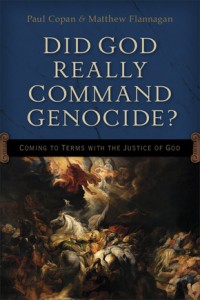
    Lowder wrote: [note: that bold, underlined, italics are my emphasis, any other emphasis is original. My comments are in italics]

    “So they admit that the relevant passages are among “the most confusing and uncomfortable passages of Scripture,” passages which make even hardened inerrantists like Copan and Flannagan “squeamish.”

    This is the bit wrongly attributed to Paul and Matt that I referred to above.

    “But, being the faithful believers that they are, Copan and Flannagan will argue that, yes, a “good, kind, and loving deity” would command (and, in fact, has commanded) “the wholesale slaughter of nations.””

    Apparently Lowder is a clairvoyant secularist. Either that or he is really good at cover interpretation.

    “How will they reconcile God’s goodness, kindness, and love with genocide? The book’s subtitle suggests that they will argue that “justice” is the answer.”

    See?

    “The fundamental problem with books like this is that they fly in the face of what seems obvious to everyone else who doesn’t already hold the a priori belief that everything the Bible says must be true,”

    Ah, so not being a Christian is what gives secularists the ability to boldly state the “obvious” about the content of books they have only had access to the covers of. I thought that maybe I just lacked the confidence to make such bold assertions about the content of books I have not read. (…Well, that, and the fact that, unlike Lowder, I do have access to the manuscript by virtue of my sleeping with one of the authors [whom I am married to] and I know for a fact that this is *not* actually what Paul and Matt argue. Small details, I know.)

    “just because the Bible says it.””

    That is actually not what inerrantists of Matt and Paul’s ilk believe;  this is actually a strawman (small detail, again, I know).

    To paraphrase something Nick Trakakis wrote in another context, “Defenses of genocidal behavior by the OT god turn a blind eye to what seem clear and obvious to everyone else — that such behavior makes a mockery out of what any person would consider morally justifiable behavior.””

    This would be a good ending if the book actually did defend “genocidal behavior by the OT god.” Again, small detail.

    Did God Really Command Genocide?Advice to Lowder: try, I don’t know, reading it. It got released today so you finally can. Did God Really Command Genocide? is now available from the following book providers:

    Baker Books
    Amazon
    Kindle
    Book Depository

  • Richard Carrier and the Abhorrent Commands Objection

    In my last post, Richard Carrier and the Arbitrariness Objection, I argued that Richard Carrier’s attempt to defend Walter Sinnott-Armstrong’s arbitrariness objection failed. I also argued his defence of this argument is incoherent and engages in special pleading because the arguments he defends apply with equal cogency to his own version of ethical naturalism.

    When one turns to Carrier’s defence of the abhorrent commands objection, similar points can be made. Armstrong hadCarrier argued:

    [1] If DCT is true then if God commanded us to rape we would be required to rape.

    [2] It is absurd that we could be required to rape.

    [3] God could command us to rape.

    Therefore:

    [4] A DCT is absurd.[1]

    I responded that [3] and [2] cannot both be true given that God, in the discussion, is defined as an an “all powerful, all knowing, loving and just, immaterial person who created the universe.” Premise [3] is true only if it is possible for an all knowing, all loving and just person to command rape, something which is unlikely to be true. Moreover, even if  it is possible for a loving and just person to command rape, this could only be in cases where the rape could be endorsed by a fully informed, loving and just person, and hence, would be a situation so different to the contexts rape normally occurs in as to make [2] no longer be obviously true.

    Carrier objects that this is an own goal he claims:

    “In challenging Armstrong’s claim that DCT can justify rape, Flannagan responds that this is true “only if it’s possible for an all knowing, loving and just person to command rape,” which Flannagan concludes “is unlikely” and even were it to occur, and if we were adequately informed, we would agree rape in that unusual case would be loving and just. I concur with Flannagan. But this rebuttal assumes rape is immoral for reasons other than that God commands it. Flannagan is therefore rebutting not Armstrong here, but his own DCT.”[2]

    Carrier’s response relies on his unargued for assertion that “this rebuttal assumes rape is immoral for reasons other than that God commands it.” This, however, is false. All my response does is assume that a person who has the character traits mentioned: being loving, just, powerful and omniscient, would not command rape. I do not need to assume these things are morally required prior to God’s commands, nor do I need to assume that a loving and just person would prohibit these things because they are morally required.

    To see this consider John Mackie’s famous argument for nihilism in The Subjectivity of Values. Mackie argued that (more…)

  • Religious Freedom and Non-Discrimination

    Currently I am working on a post on the issue of non-discrimination rights and the morality of discrimination. In the mean-time  I thought I would highlight the thoughtful commentary from James-Michael Smith in this video.

  • Yet Another Lawyer Agrees: Marriage Amendment Act Bill is an Affront to Freedom of Religion and Belief

    Barrister Ian Bassett has given another opinion describing the risks to freedom of religion and belief of Louisa Wall’s Marriage Amendment Act Bill if it is enacted in its presently proposed form, which would include this amendment:

    “Without limiting the generality of subsection (1), no celebrant who is a minister of religion recognised by a religious body enumerated in Schedule 1, and no celebrant who is a person nominated to solemnize marriages by an approved organisation, is obliged to solemnize a marriage if solemnizing that marriage would contravene the religious beliefs of the religious body or the religious beliefs or philosophical or humanitarian convictions of the approved organisation.”

    It is clear that any marriage celebrant exercising their public function who is not covered by the amendment risks being in breach of the New Zealand Bill of Rights Act 1990 and the Human Rights Act 1993 if they refuse to perform their public function as marriage celebrants because it is a same sex couple seeking to be married.

    Injustice

    Church ministers, marriage celebrants, court registrars, church elders, leaders, photographers and caterers and any other person or entity supplying services to the public risks being in breach of the Human Rights Act 1993 if they refuse to supply services to a couple seeking to be married because the couple are same sex. For some this could also mean risking their employment.

    Service providers to the public risk being in breach of the Human Rights Act 1993 if they refuse to supply services to a married couple because the couple are same sex.

    The New Zealand Law Society’s Law Reform Committee headed by Professor Paul Rishworth LLB (Hons) M Jur highlighted the risk to freedom of religion and belief in the Bill in its submission to Parliament:

    “The proposer of the Bill said that the Bill was not intended to compel marriage celebrants to perform marriages contrary to their religious beliefs. However, in the Law Society’s view, Professor Rishworth says it is arguable that marriage celebrants who refuse to perform same-sex marriages will be acting unlawfully under the Human Rights Act 1993, the New Zealand Bill of Rights Act 1990, or both.

    “We want to highlight arguable conclusions which seem to be at odds with the settled intentions of the Bill’s drafters. Whatever the position, the Law Society believes it makes sense to put the matter beyond doubt,” Professor Rishworth says.

    The only thing that the amended Bill puts beyond doubt is that the critics of those raising fears about the Bill’s threat to freedom of religion and belief were wrong. By recommending an amendment the Select Committee are agreeing that a risk existed, as the likes of Ian Bassett, Grant Illingworth have argued, contra to The Human Rights Commission’s claim that all “…religious officials and leaders are free to refuse to perform marriages that are not in accordance with their religious beliefs.”

    Bassett, Illingworth and Rishworth are not alone with their concerns among the legal fraternity.

    Graeme Edgeler, a Wellington Barrister has been quoted in the Herald saying:

    … if an independent celebrant declined to marry a same-sex couple, the couple could then complain to the Human Rights Commission.

    “It’s not about [celebrants] being forced, it’s about people getting in trouble afterwards if they didn’t,” he told APNZ.

    “They’re not breaking any rule in the Marriage Act, but rules in other acts. The main one would be the Human Rights Act, which says you can’t discriminate on the basis on sexual orientation or gender.”

    Auckland Barrister Rachel Wong has raised issues against the Bill.

    This blog’s Madeleine Flannagan LLB, Associate Barrister and Solicitor at Coast Legal, adds her voice:

    “The Bill, in its present form, fails to protect individual freedom of religion and belief (belief being a comprehensive viewpoint not based on religion). The proposed amendment only protects group religious rights, which is little protection at all for most religious celebrants as few denominations hold formal views on marriage, many practitioners of religion do not belong to a group and for those that do they might hold a different personal view on this topic to the group view. The amendment then fails to protect the religious freedom of most religious celebrants just as it utterly fails to protect the freedom of belief of non-religious celebrants who have no group to appeal to to protect their freedom.”

    Ian Bassett’s latest opinion thoroughly analyses the legal effects of the amended Bill, a summary as to whose freedom of religion and belief it protects and whose it does not follows: (more…)

  • Why Defamatory Speech is not Free Speech

    The following argument as to why a remedy requiring the removal of defamatory speech from a publication was not a violation of the right to free speech is representative of one I have previously put before the court:

    1. The right to Freedom of Expression is protected by s14 of the Bill of Rights Act 1990 (“BORA”).
    2. The operational provisions of the BORA provide in section 5 that a reasonable limit to Freedom of Expression can be justified in a free and democratic society where that limit is prescribed by law.
    3. Section 5 is subject to section 4, which states in mandatory terms that no court can decline to apply any provision of an enactment on the sole grounds that the provision is inconsistent with the BORA.
    4. Notwithstanding this, section 6 requires the court rule in a manner as consistent as possible with Bill of Rights.
    5. It is submitted that the Respondent’s actions constitute a breach of s4 of the Defamation Act 1992 therefore the remedy sought, removal of the defamatory material from the publication, does not violate the Respondent’s right to Freedom of Expression.

    Freedom of SpeechWhile this is the standard argument it feels wrong to me. There is something unsatisfactory about appealing to a mechanism in the law that, as argued, feels like it is shearing off a part of an important right and freedom, even if the law says that it is ok.

    I find this argument unsettling and lacking something; at the same time defamatory speech is insidious, causes harm, hurts; intuitively it just feels wrong to say that one is morally justified in spreading harmful falsehoods about a person and is not required to account for the wrongs done, because of their right to free speech.

    After discussions with Matt about this I have decided that I prefer the following argument:

    1. Freedom of Expression is defined in the BORA as “the freedom to … impart information and opinions …”.
    2. Defamation is expression imparted to another that lowers the standing of a person in the eyes of their peers and is not true and is not honest opinion which is genuinely held.(I am ignoring the third defence, privilege).
    3. A person who expresses defamation is not engaging in Freedom of Expression as where there is no truth or honest opinion then a person is neither attempting to inform another or attempting to express their opinion.
    4. The basis for this is that to attempt to inform someone is to attempt to increase that person’s repertoire of true beliefs’ and to impart an opinion is to express what one honestly believes to be the case.
    5. Therefore the speech the BORA protects is all speech that is true or honestly held to be true by the speaker.

    That is much better.

    Defamatory speech is not free speech therefore legal sanctions against it proportionate to the harm caused are entirely appropriate in both legal and moral senses.

    RELATED POSTS:
    Pluralism and Being Right
    Of course I think I’m right!