Category: Ethics

  • Klingon Cloaking Devices Unmasked by Boat People

    It was inevitable.  Sooner or later a boat filled with desperate people would set out from India, Sri Lanka, Indonesia, whatever, for New Zealand.  We have been “protected” to date only by an accident of geography–New Zealand’s relative distance.  Australia has faced the problem for decades.

    Sri Lankan Boat PeopleA group of Sri Lankan poor (allegedly Tamils previously caught up in the former civil war) have boarded a boat large enough to make it all the way here.  They have been declaring their intent to sail to New Zealand to seek asylum.  The Prime Minister, Mr Key has made dark hints that he has received intelligence briefings that leave him in no doubt that New Zealand was the intended destination.  Others have accused him of overreacting.  We believe Mr Key in this instance.

    The Commentariat is having conniptions.  The most consistent amongst us are represented by Green MP, Keith Locke and Amnesty International caudillo, Patrick Holmes.  They have urged the desperate plight of the economic refugees.  Doubtless they have suffered grievously, and New Zealand beckons as a wonderland.  Even the poorest in New Zealand would be comparatively rich to them.  They have urged pity as a motivation to accept and welcome these folk. We reiterate: these are the consistent Commentariat members.

    Others in the Commentariat are emphatic in their refusal to have anything to do with the boat people.  Their posturing is empty.  Offensively hypocritical.  The entire ethos of  New Zealand is built upon the principle that  all people,  by right of being human, have a legitimate and just claim to a certain amount of other people’s property.  Call it “a living wage”, a “fair go”, maintaining dignity–whatever.  It’s all the same in the end.  The supreme authority, our semi-divinised state, has both a duty and license to extract property by force from some and deliver it to others who have less.  Everybody believes this.  Except Christians who read their Bibles, but they don’t count.  Sure, the Commentariat maintains an inter-mural argument about how much extraction, and upon which subjects it will be bestowed, and on what terms and conditions, but these are mere details.  Everyone acknowledges the universal principle of the thing.

    Why, then, the emphatic rejection of the boat people?  Why are they “beyond the pale”?  Are they not human?  Do they not have economic rights?  Does not their being human entitle them to a just extraction by force from others better off  to make them more economically equal?  Apparently not.  Why? we wonder.  Out of one side of his mouth our Prime Minister argues vehemently for involuntary seizure of the property of some (via taxation) and for its distribution to others, appealing to justice, rectitude, and rights.  Everybody, everybody agrees–apart from those obnoxious Christians who read their Bibles. But out of the other side of his mouth he brusquely rejects these desperate folk.

    When it’s boat people, the universal principles of human rights are suddenly found to have geographic limitations.  Our gods turn out to be local deities after all. Our self-righteous, simpering notions of justice transform into harsh xenophobia, just like that.  Who would have thought.

    The Commentariat has some explaining to do. If the goose’s sauce is withheld from the gander we smell hypocrisy in the kitchen. Maybe the high faluting principles of Unbelief are worthless and empty, venal and self-serving?  Maybe justice and rights are not universal after all, but have geographical boundaries.  But (more…)
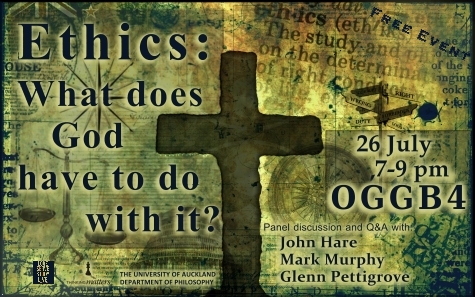
  • Ethics: What Does God have to do with it? @ Auckland University

    World class Ethicists John Hare (Yale Divinity) and Mark Murphy (Georgetown Philosophy) are in town for the Naturalisms in Ethics Conference and the Meeting of the Australasian Philosophy of Religion Association at the University of Auckland where they will be speaking along with New Zealand’s top Ethicists.

    We leaped on the opportunity to organise the following event, brought to you by the University of Auckland Department of Philosophy and Thinking Matters Auckland:

    Ethics: What does God have to do with it?

    Ethics: What Does God have to do with it? 
    A Conversation with Three Christian Philosophers

    7pm Tuesday 26 July
    Room OGGB4/260-073 (Owen Glenn Building)
    University of Auckland

    The question of the relationship between religion and morality has long been the subject of discussion and debate in western culture. Some philosophers and theologians contend the two cannot be separated; theological beliefs about God and the afterlife are needed to explain the existence and nature of moral obligations, and to ground motivation to live a moral life.

    Others contend the opposite. They claim that morality is entirely independent of religion and that religion encourages immorality. Questions have also been raised as to whether religion adds anything to morality in terms of its ideas about atonement, forgiveness and moral faith which are lacking in secular views.

    This panel brings together several of the world’s leading Christian thinkers on this question to discuss issues such as:

    – Why do we have to do what is right?
    – Can someone be a ‘good’ person without belief in God?
    – What role do grace and forgiveness play in morality?

    Bring your own questions and ask them at the Q & A session.

    This will be a free, lay friendly event open to the public – a university degree is not necessary in order for you to attend!

    Panel:
    Prof John Hare – Yale Divinity School
    Prof Mark Murphy – Department of Philosophy, Georgetown University
    Dr Glen Pettigrove  – Department of Philosophy, University of Auckland

    (Click on each of their names – they are each seriously cool!)

    Moderator:
    Dr Matthew Flannagan

    RSVP on Facebook or just turn up – bring your friends. This is soooo not to be missed!

  • The Australasian Philosophy of Religion Association Conference @ Auckland University

    The Australasian Philosophy of Religion Association (APRA) conference will be running at the University of Auckland from 16-17 July and will feature this blog’s own Matthew Flannagan and our good friend Glenn Peoples.

    The APRA conference is an annual event usually taking place over two days in mid July. Speakers include:

    More information at APRA’s website (which includes registration information) or at the Facebook Event page.

    Matt’s paper, “Armstrong on Divine Commands” will be chaired by John Hare of Yale Divinity School. Matt’s abstract is below:

    Abstract for: Armstrong on Divine Commands

    In several debates and addresses, William Lane Craig has defended the conditional,

    1. If God exists then a divine command theory provides a plausible account of the nature of moral obligation.

    In support of 1, Craig has appropriated the divine command theory of Robert Adams. He has identified the property of being morally obligated to do X with the property of being commanded by God to do X. Recently, Walter Sinnott-Armstrong has contended Craig’s conditional is “incredible” and that the divine command theory is “vulnerable to a cavalcade of devastating objections.” Armstrong has claimed that his criticisms do not just call into question Craig’s argument for a theistic based system of ethics; he contends that his arguments are conclusive against any theistic account of ethics compatible with Christian theism. I will argue that none of the objections Armstrong raises are persuasive, much less “devastating”; and that most of them have, in fact, been anticipated and addressed by defenders of divine command theories.

  • Naturalisms in Ethics Conference @ Auckland Uni

    The Naturalisms in Ethics conference will be running at the University of Auckland from 14-15 July and will feature this blog’s own Matthew Flannagan.

    Here is the blurb from organiser Chris Tucker’s page (which includes registration information – see also the Facebook Event page):

    ‘Naturalism’ is a multiply ambiguous term—hence the title Naturalisms in Ethics— but it is related to a range of questions concerning the relationship of morality to science, evolution, biology, religion, and natural properties (whatever those are). Many otherwise disparate moral theories have been labeled as ethical naturalisms, including virtue ethics (both neo-Aristotelian and neo-Humean), moral functionalism, Cornell realism, and natural law theories. Some potential paper topics include the following (but the list is hardly exhaustive):

    • What are the different types of ethical naturalism?
    • Why should we endorse/reject ethical naturalism or some specific version thereof?
    • What can science or evolution tell us about morality, moral psychology, or the rationality of moral judgments?
    • Are naturalistic accounts of morality better off than theistic ones?

    Speakers include:

    Matt’s paper, “Is Ethical Naturalism more Plausible than Supernaturalism? A Reply to Walter Sinnott-Armstrong” will be chaired by Erik Wielenberg of DePauw University. Matt’s abstract is below: (more…)

  • Contra Mundum: Pacifism and Just Wars

    Comedian Bill Maher recently berated Christians for being hypocrites for supporting military action against terrorists in his “New Rules” segment on the U.S. TV show Real Time (transcript here). Jesus, Maher contended, was a pacifist; “Jesus lays on that hippie stuff pretty thick. He has lines like, “do not repay evil with evil,” and “do not take revenge on someone who wrongs you.” Here Maher was citing from Romans 12, where Paul formulated Christ’s teaching about loving one’s enemies. In this passage Paul commanded people to “bless those who persecute them,” they are forbidden to “repay evil for evil” and are commanded to “not take revenge” but to “leave room for God’s wrath. For it is written, ‘Vengeance belongs to me. I will pay them back’.”

    Maher scathingly contended that this support contradicted Christ’s clear teaching; he said, “nonviolence was kind of Jesus’ trademark. Kind of his big thing. To not follow that part of it is like joining Greenpeace and hating whales.”

    After saying this Maher quipped, “the next line isn’t ‘and if that doesn’t work, send a titanium fanged dog to rip his nuts off.’” The irony is that it Maher clearly had not bothered to actually read the next line; Romans 13 states that the “governing authorities” are “established by God”; one is morally bound to submit to rulers because “rulers do not bear the sword for no reason. They are God’s servants, agents of wrath to execute vengeance upon evil doers”.

    The Greek words for evil, wrath, and vengeance are the same in both Romans 12 and 13. Paul is stating that the very things Christians are forbidden to do with regard to not repaying evil for evil, are precisely what the State has been given the legitimate authority and right to do.

    Paul here elaborates the basic premise that moral theologians appeal to to reject pacifism and to support the claim that war can be just under certain circumstances. The premise is that a government has the right and duty to use force to uphold within the geographical area over which it has jurisdiction. A just war is simply an extension of a government’s power to pass laws and create police powers.

    If a criminal attempts to rape or kill people within the geographical realm over which a government has authority then the government can justifiably use force to prevent this. And it can also use force to try and punish anyone who does these things; hence, the existence of a legislature, police force, courts and prisons. Just War theorists simply note that there seems no reason why this would not extend to when the person committing the offence is a soldier from another country as opposed to a domestic criminal.

    These theorists argue that for a war to be just it must (more…)

  • Lawful Authority and Just Wars

    A reader pointed me to this interesting post on Pacifism and Just War Theory from Baylor University Philosophy Professor, Alexander Pruss.

    Just WarInterestingly Pruss offers an argument similar to the one I presented at a panel discussion on the ethics of war recently. In this discussion I suggested that traditional Christian Just War Theory follows from the contention that a government has the right and duty to use force to uphold justice within the geographical area over which it has jurisdiction. A just war is simply an extension of the government’s police powers. If a criminal attempted to rape or kill people within the geographical realm over which a government has authority then the government could justifiably use force to prevent this. It could also use force to try and punish anyone who did do these things; this is why we have a police force, court system and prisons. Just war theorists cannot see why this should cease to be the case when the person committing the offence is a soldier from another country as opposed to a domestic criminal.

    Pruss gives a similar argument; he starts by defining problematic violence as “lethal violence, i.e. violence that, if successful, has a high probability of resulting in the opponent’s death, counts as problematic, even when the death is not intended.” He then argues,

    “If it is permissible to use problematic violence to stop a citizen wife from murdering her citizen husband, it should also be permissible to use problematic violence to stop a non-citizen woman who sneaked into one’s country to murder her citizen husband. Moreover, this should be permissible even if the woman was commissioned by another state to kill her husband. But if we allow that it is permissible to use problematic violence against criminals acting on behalf of foreign states, then there seems to be no way to deny that it is permissible to use problematic violence to stop invaders.”

    He makes this illustration,

    “When the invading army marches in, burning crops and murdering citizens, they are breaking the victim country’s laws. If problematic violence is permitted to enforce the laws of one’s territory, it should be permissible to use problematic violence to stop them. But this seems to be a case of war.”

    This argument is common in the Reformed or Presbyterian traditions. John Murray, in his book Principles of Conduct, notes the Pauline teaching that the  “governing authorities” are “established by God.” One is morally bound to submit to rulers because “rulers do not bear the sword for no reason. They are God’s servants, agents of wrath to bring punishment on the wrongdoer.” He then asks, “by what kind of logic can it be maintained that the magistrate, who is invested with the power of the sword, may and must execute vengeance upon evil doers within his own domain must sheath the sword of resistance when evil doers from without invade his domain.”

    The Westminster confession makes a similar argument. It argues that because a Government has the authority to use force to maintain justice and peace within the realm over which it governs it can fight wars to maintain justice and peace within this realm.

    I think this is one of the most important lines of argument in defence of Just War Theory. In my talk, I argued that the standard six criteria of a just war: just cause, lawful authority, last resort, the use of proportionate and discriminate force and so on simply unpack the general circumstances in which governments are permitted to us force and apply it to warfare. Here I simply want to explore one implication of this line of argument that Pruss raises. (more…)

  • Pacifism, the Bible and the Sin of Selfishness

    ‘If someone wants something from us and we do not want to give it to them that is the sin of selfishness and the Bible condemns selfishness.’ This was one of the three points a Christian pacifist speaker made in defending his stance at the panel discussion on War Ethics that Matt mentioned in Pacifism and The Golden Rule.

    Whilst there were a lot of issues raised that night that I wanted to respond to (being a member of the audience, I was only able to ask a question on one) it was this point that I woke up with in my head the next morning; I awoke with the question/statement I wished I’d have asked/said on the night fresh in my mind. Here it is:

    Mr Pacifist, you said that if someone wants something from us and we do not want to give it to them that is the sin of selfishness; if someone wants to take from us we should let them without resistance because that is what Jesus did when he let himself be crucified. Is that about right?

    Gun=Better Protection than any Pacifist Male

    So if I go out to the parking lot and a man pins me to the ground and starts raping me and my hand find a rock in the darkness next to me, is what you are saying that I should let him take what he wants, that I should not use the rock to smash him in the head but rather I should lie back and think of Jesus?

    I think the point you are missing is that Jesus let his life be taken to save humankind. If I let myself be taken I am saving no one; if I smashed the rapist in the head with a rock I could at least save the next victim. I could mount the argument that by responding with my choice to be pacifist I was selfishly not thinking of the next victim?

    And what if it was my daughter? What if I heard a noise in the night and found some man pinning my 10 year old down raping her? Should I tell her to lie back and think of Jesus too? Not call the police who might force him away in handcuffs to face a justice system that will deprive him on his liberty? Not smash him over the head with a frying pan or attack him with a kitchen knife? Because I’ll tell you what, anyone who I found doing that to my daughter would leave my house in a body bag or I would give my life trying.

    Pacifism might sound trendy but it misses the point that while Jesus might have lived a fairly pacifist looking life when he was on earth, Jesus is part of a Trinity and there are other parts of the Trinity that judge, that wage war, that strike down and destroy. Yet another part of the Trinity inspired the writing of  the whole Bible. All three elements of the Trinity’s example must be read together to understand the contexts they fall in and I believe  (more…)