Category: Ethics

  • Divine Commands Post 9/11

    The night of September 11, 2001, was a night we did not get much sleep in. By 4am September 12 (New Zealand time) our two-week old son and 14 month old daughter had woken us twice already. Frustratingly, I awoke again sometime after 4am to a different noise coming from the lounge; it turned out that our eldest son, then aged 6, was up watching television. I stumbled into the room and told him to go back to bed. As I got back into bed I told Madeleine “It’s OK hon, it was just Christian watching some movie about New York” (I’d seen the Twin Towers on the screen as I switched the TV off). Less than an hour later our sleep was interrupted again, this time by the telephone. Madeleine, awoken for the 4th time that night, angrily moaned “who the hell is ringing at this time? Don’t they know we have a newborn?” It was my Dad.

    “Matt” he told me tersely “I am just ringing to say I am alright. I got grounded at Heathrow airport and did not fly into the US as I had intended to this morning and so was not caught up in the drama that’s unfolded.”

    “What drama?” I said bewilderedly “why wouldn’t you be ok?”

    “Haven’t you heard?” he responded “planes have been high-jacked; there has been a terrorist attack in America – the World Trade Centre has been hit, as has the Pentagon”.

    I suddenly was wide awake.
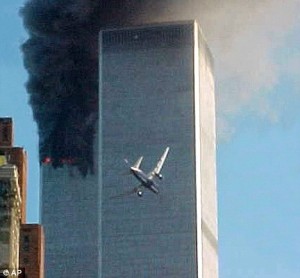
    9/11 World Trade Centre Terrorist AttackOne particularly poignant fact about the events of 9/11 is that the terrorists who carried out the attacks justified their actions by claiming God commanded them to do so. That fact has lead many contemporary commentators to argue that a divine command theory of ethics is indefensible. September 11 is just the most recent example in a series of incidents throughout history such as the Crusades, Inquisition and wars of religion. Divine command ethics is discredited by the fact that people appeal to such commands to justify terrorism.

    At first glance this objection is hard to take seriously; the premise is that some people have appealed to divine commands to commit atrocities. The conclusion is that any appeal to divine commands in ethics should be rejected.  This conclusion does not follow. To be valid the objector must assume a tacit premise: if people appeal to certain reasons to justify atrocities, then appeals to those reasons are always problematic. This premise is false.

    An analogous line of reasoning applies to appeals to right and wrong per se. Take any historical atrocity that people have attempted to justify; in almost every case the justifier will have argued that the action in question was the right action to do, the justifier invariably appeals to the purported rightness of their action. If the tacit premise is true then appeals to right and wrong are always problematic.

    Other examples illustrate the same point. The “reign of terror” during the French Revolution was justified by appeals to liberty, equality, fraternity and the rights of humankind; one victim of the guillotine famously remarked, “Oh, liberty, what crimes are committed in your name?” Millions have been slaughtered by appeals to the greater good of society or the liberation of the oppressed classes and it is well known that people have defended wars on the basis of justice and social peace. Should we therefore avoid liberty, equality, opposing oppression, seeking justice, social peace and so on? Obviously not.

    The fact that people have attempted to offer justifications for atrocities by appealing to some reason does not entail that any or all appeals to such reasons are problematic. This is a fairly innocuous claim. Take any premise you like – secular or theological – it is true that a person could appeal to this premise in an attempt to justify something but this fact does not mean the premise is problematic. For the appeals to atrocities argument to have bite one needs to show more than just that someone has tried to justify an abhorrent action by appealing to God’s commands; one would have to show that they did so successfully, that God actually commands such practises.

    The claim that God commands atrocities appears to be indefensible. We need to remember that we are not talking about the commands of just anyone; we are talking about God, who is typically defined as a being who is omnipotent, omniscient, and morally perfect. So, as the terms are defined, the claim that it is possible for God to command people to torture others for fun is true only if it is possible for a morally perfect person to command an atrocious thing. But this is not possible. The very reason that critics cite atrocities in their arguments against God is because they regard these actions as paradigms of conduct that no morally good person could ever (more…)


  • Response to William Lane Craig’s Question 225: “The ‘Slaughter’ of the Canaanites Re-visited” Part II

    Samuel rebukes SaulIn my last post “Response to William Lane Craig’s Question 225: “The ‘Slaughter’ of the Canaanites Re-visited” Part I” I discussed William Lane Craig’s position on the Canaanite Conquest account (in light of the fact that Craig referred to my argument in his question of the week: “Question 225: The “Slaughter” of the Canaanites Re-visited”). I clarified the delineations as to where he agrees and disagrees with the position I presented at the Evangelical Philosophical Society’s session at the Society for Biblical Literature Meeting in Atlanta last year and I established that the point of divergence in our agreement rests on 1 Samuel 15.

    In my Atlanta paper I argued that Nicholas Wolterstorff’s reading of the Canaanite conquest accounts in Joshua can also be applied to the account of Saul exterminating the Amalekites in 1 Sam 15.

    First, the so-called ‘genocide accounts’ in 1 Sam 15 are part of a broader context that includes the rest of Samuel and also other canonical books, such as 2 Samuel and the book of Chronicles. When one reads the whole sequence, one observes that while 1 Samuel 15 describes Saul, at God’s command, exterminating the Amalekites, later passages in Samuel and Chronicles proceed on the assumption this never literally happened.

    The key passage is God’s command to Samuel, “strike [nakah] Amalek [the Amalekites] and utterly destroy [haram] all that he has, and do not spare [hamal] him; but put to death both man and woman, child and infant, ox and sheep, camel and donkey.”[1] The text goes on to explicitly state that the Amalekites were all wiped out:

    “So Saul defeated [nakah] the Amalekites, from Havilah as you go to Shur, which is east of Egypt. He captured Agag the king of the Amalekites alive, and utterly destroyed [haram] all the people with the edge of the sword. But Saul and the people spared [hamal] Agag and the best of the sheep, the oxen, the fatlings, the lambs, and all that was good, and were not willing to destroy them utterly; but everything despised and worthless, that they utterly destroyed.” [2]

    A few verses later (15:33) the text records that Agag, the sole survivor, was executed. So, read literally, this passage states that all the Amalekites were killed and all their livestock were either destroyed or taken as plunder to be sacrificed to God at Gilgal.[3]

    Now the language of “defeated” (or struck), “utterly destroyed”, the reference to “sparing” and to livestock parallels the language of the command in 15:3. Given this, it seems implausible that we should interpret the command in verse 3 as literal but the fulfilment, just 4 verses later, as hyperbolic; the text requires that the command and fulfilment be read in the same sense.

    That said, when one reads this passage as part of as a single narrative a literal reading appears untenable; the proceeding text states quite emphatically that the Amalekites were not, in fact, literally wiped out. In 1 Samuel 27:8-9 David invaded a territory full of Amalekites:

    “Now David and his men went up and raided the Geshurites, the Girzites and the Amalekites. (From ancient times these peoples had lived in the land extending to Shur and Egypt.) Whenever David attacked an area, he did not leave a man or woman alive, but took sheep and cattle, donkeys and camels, and clothes. Then he returned to Achish.”

    Not only does this text affirm that the Amalekites still existed but the reference to Egypt and Shur states that they existed in the very same area that Saul ‘utterly destroyed every single one of them’ in in the previous passages. Moreover, David took sheep and cattle as plunder; again, livestock was another of the things Saul was said to have already eradicated.

    After the text has told us that Saul “utterly destroyed all the people”, including King Agag, and despite the text telling us that when David attacked an area (the very same areas as Saul) he did “not leave a man or woman alive”, three chapters later we read that a sizeable Amalekite army attacked Ziklag![4] David apparently pursued this army and fought a long battle with them and 400 Amalekites fled on horseback!![5] Where are all these Amalekites coming from?

    These are not the only examples. In 2 Samuel 1:8 an Amalekite took credit for killing Saul –but didn’t Saul “utterly destroy all the people”? In 1 Chronicles 4:43 Amalekites were still around in battle-ready numbers during the reign of Hezekiah who reigned after Saul and David.

    Read literally, the narrative affirms both that the Amalekites were and were not totally wiped out. This apparent contradiction in the Samuel narrative is (more…)

  • Response to William Lane Craig’s Question 225: “The ‘Slaughter’ of the Canaanites Re-visited” Part I

    Every week William Lane Craig answers a question on his website; this week’s question of the week is entitled “The “Slaughter” of the Canaanites Re-visited”. The questioner asked what Craig thinks of the Canaanite Conquest account. I got a mention in Craig’s reply:

    The EPS Session at the SBL: Richard Hess, Randal Rauser, Paul Copan, me, Michael Rea

    “The topic of God’s command to destroy the Canaanites was the subject of a very interesting exchange at the Evangelical Philosophical Society session last November at the Society of Biblical Literature Convention in Atlanta. Matt Flannagan defended the view put forward by Paul Copan in his Is God a Moral Monster? that such commands represent hyperbole typical of Ancient Near Eastern accounts of military conquests. Obviously, if Paul is right about this, then the whole problem just evaporates. But this answer doesn’t seem to me to do justice to the biblical text, which seems to say that if the Israeli soldiers were to encounter Canaanite women and children, they should kill them (cf. Samuel’s rebuke of Saul in I Sam. 15.10-16).”

    Craig raises an important issue. In God and the Genocide of the Canaanites I, II and III I defended Nicholas Wolterstorff’s take on the Canaanite massacre in “Reading Joshua”.[1] Wolterstorff argued that the book of Joshua is a highly figurative, hagiographic and hyperbolic account of Israel’s early skirmishes and it is not intended to be taken literally in its details. My adaptation of Wolterstorff’s argument consists of three points.

    First, taken as a single narrative, and taken literally, Joshua 1-11 gives a contradictory account of events to that narrated by Judges and also to that narrated by the later chapters of Joshua itself.

    Second, those who put these books into a single narrative would have been well aware of the obvious contradictions mentioned above. These editors were not mindless or stupid, particularly if we hold that God spoke through them.

    Third, while Judges reads more like “down-to-earth”[2] history, a careful reading of Joshua shows it to be full of ritualistic, stylised accounts and formulaic language. I supported this third point with research into Ancient Near Eastern conquest accounts. Studies show such accounts are hyperbolic, hagiographic, figurative and follow a common transmission code. Comparisons between these accounts and the early chapters of Joshua suggest Joshua was written according to the same literary conventions and transmission code. I suggest these three points, taken together, provide compelling reasons for thinking that one should interpret the text as a hyperbolic, hagiographic and figurative account of what occurred; it was not meant to be taken as literally true in all its details.

    Craig’s objection to my position (and that of Paul Copan’s whose position is very close to mine) is a reference to 1 Samuel 15. Craig referred specifically to verses 10-16, where Samuel rebuked Saul “because [Saul] has turned away from [God] and has not carried out [God’s] instructions.”[3] The instructions in question were given in verse 3; God commanded Saul, “Now go and strike [nakah] Amalek [the Amelekites] and utterly destroy [haram] all that he has, and do not spare [hamal] him; but put to death both man and woman, child and infant, ox and sheep, camel and donkey.”[4] Craig suggests this “seems to say that if the Israeli soldiers were to encounter Canaanite women and children, they should kill them”. I think Craig pushes an important objection (more…)

  • Contra Mundum: Consenting Adults and Harm

    In debates over abortion, homosexual conduct, euthanasia, prostitution, drugs, those who call themselves liberals often mount the same basic argument; a socially or morally permissive stance is necessitated towards such practices because people have a right to choose do what ever they like with their own bodies. As John Stuart Mill put it in his book On Liberty:

    “The only part of the conduct of anyone, for which he is amenable to society, is that which concerns others. In the part which merely concerns himself, his independence is, of right, absolute. Over himself, over his own body and mind, the individual is sovereign.” [Emphasis added]

    John Stuart Mill

    Here Mill articulates the harm principle. He makes a distinction between other-regarding actions, actions that harm other people, and self-regarding actions, those that harm oneself. He argues that society, either by law or by social pressure, cannot justly regulate any action a person performs unless it is other-regarding; that is, it harms people other than the agent him/herself.

    As Mill’s position is typically interpreted, harm is understood to be governed by the principle volenti non fit injuria (where there is consent there is no injury); it refers to things done to other people without their consent. Mill states that a self-regarding action is one “which affects only himself, or affects others with their free and voluntary, and undeceived consent”.

    Mill intended his principle to be criteria as to what should and should not be made a criminal offence; he did not consider it criteria for determining what is right and wrong. Yet many contemporary liberals appear to use it in this latter way. They contend that as long as the action involves only consenting adults it is morally permissible. It is often asserted in our society, as though it were self-evident, that people have a moral right to do whatever they like with their own bodies.

    I think this claim is far from self-evident. Irving Kristol famously proposed this counter-example in a 1971 article in New York Times Magazine:

    “[T]he plain fact is that none of us is a complete civil libertarian. We all believe that there is some point at which the public authorities ought to step in to limit the “self-expression” of an individual or group even where this might be seriously intended as a form of artistic expression, and even where the artistic transaction is between consenting adults. A playwright or theatrical director might, in this crazy world of ours, find someone willing to commit suicide on stage, as called for by the script. We would not allow that-any more than we would permit scenes of real physical torture on the stage, even if the victim were a willing masochist. And I know of no one, no matter how free in spirit, who argues that we ought to permit gladiatorial contests in Yankee stadium, similar to those once performed in the Coliseum of Rome-even if only consenting adults were involved.”

    The examples Kristol gives are all cases where any person of common sense would condemn the act but where all the victims consent to be harmed.

    In his book Harmless Wrong Doing: Moral Limits of the Criminal Law, Liberal Political Philosopher Joel Feinberg considers Kristol’s objection as the most important and potentially-devastating counter-example to the harm principle and he spends considerable energy attempting to circumvent it. He offers four responses. Here I will argue that these responses fail.

    First, Feinberg questions whether such cases are really cases of consensual homicide. He suggests (more…)

  • “Are there Good Reasons for Abortion?” Wendy Savage and Madeleine Flannagan Debate on Unbelievable?

    Wendy Savage and Madeleine FlannaganThis week, the UK’s Christian Premier Radio show, Unbelievable?, aired an episode on the topic “are there good reasons for abortion?” The episode saw host, Justin Brierley, moderate a debate between this blog’s Madeleine Flannagan and Professor Wendy Savage, a representative of Doctors for a Women’s Choice.

    A range of topics related to the issue of abortion were raised which saw some interesting back and forth between Madeleine and Professor Savage.

    Amidst the discussion as to what counts as a good reason for having an abortion, they got into post-viability abortions, whether a fetus is human, whether brain activity or lack of dependency on the mother should be the criteria for humanity, the use of terms like fetus, abortion for fetal abnormalities, abortion to save a woman’s life, the  argument from backstreet abortion and so on. The episode provides a pretty good presentation of the alternative views in the debate.

    I am clearly biased but I think Madeleine offered the more persuasive position; her arguments were on the mark and very cogent yet she came off measured, humane and reasonable. You can listen to the Unbelievable? episode here: “Are there good reasons for abortion?“

    RELATED POSTS:
    Abortion and the Morality of Feticide: Part I
    Abortion and the Morality of Feticide: Part II
    My Body, My Choice? The Inconsistent Paternalism of Feminism
    Abortion and Viability
    Abortion and Sentience Part I
    Abortion  and Sentience Part II
    Abortion and Brain Death
    Illegal “Backstreet” Abortion
    Abortion and Child Abuse
    Is Abortion Liberal?
    Abortion and Capital Punishment: No Contradiction 
    See our Feticide and Abortion tags for more.

  • Ethics in Journalism – Hear Matt’s Interview on Radio Rhema

    On Thursday Matt was interviewed on Radio Rhema by their breakfast host, Tim Sisarich, on the topic of ethics in journalism. This was in the wake of the media frenzy over the Israelis killed in the Christchurch earthquake and New Zealand Prime Minister John Key’s rebuttal to claims that they were spies. The Murdoch saga was running at the same time.

    Radio Rhema ran the interview 3 times on Thursday but in case you missed it, here was the intro and an MP3 (used here with permission):

    “An Israeli news agency is slamming reports of Israeli spies working in Christchurch around the February earthquake.
    The original story, by Southland Times Editor Fred Tulett has attracted criticism from Israeli groups in New Zealand – and now the editor of the Jerusalem Post.
    An editorial in the paper describes the allegations as ‘far-fetched fiction disseminated by New Zealand news outlets’.
    It accuses this country of being biased and says no tourists from any other country would have been the objects of what it calls, ‘unsubstantiated suspicion’.
    This morning Rhema Breakfast host, Tim Sisarich, asked blogger and theologian, Matthew Flannagan, if we, as Christians and consumers of news, do enough to search out the truth behind the news we read…. “

    Click to Listen to Matthew Flannagan on Journalism Ethics

  • Does Moral Commitment Presuppose Belief in Providence?

    John HareLast week I had the privilege of hearing Professor John Hare, of Yale Divinity school, speak on God and morality at the Naturalisms in Ethics and APRA conferences. One idea Hare proposes, which fascinates me, is that commitment to morality presupposes belief in what he calls “strong providence” the position that “the world is so ordered that a person’s own virtue is consistent with her own happiness, whether other people are virtuous or not.”[1]

    Here is one line of argument he gives for this conclusion:

    “Consider the fact that we try to teach our children to be moral. We also want them to be happy. If we thought that being virtuous would make them miserable, we would be more ambivalent about teaching them virtue than we actually are. But many people persevere in the attempt to bring up their children to be morally good people even though they do not think their children will be living in a society in which most of their fellows are morally good people. … What lies behind such perseverance is surely a belief that the world is so ordered that when their children grow up, they can be both morally good and happy, and that this is secured not by general human virtue but by something else. The nature of this something else is often, I think, left indeterminate.”[2]

    This example is interesting because it focuses not on one’s own happiness but on the happiness of others. Appeals to self-interest and one’s own happiness are often dismissed as corruptions to moral motivation. In Hare’s example, one is concerned about the happiness of others, in particular one’s children, so the concerns he highlights are altruistic as opposed to egoistic.

    I am inclined to think there is something to Hare’s argument.  I do think that if we thought being virtuous would make our children miserable then a lot of parents might be less disposed towards bringing up their children to be pursue good. Most I talk to agree;  it is hard to comprehend how a loving and caring parent could teach children to be virtuous if doing so would result in their unhappiness. However, our practice of trying to teach our children to be moral suggests we do not believe being virtuous and being happy are incompatible.

    This has me wondering, does commitment to morality as an institution, where we attempt to follow its precepts and encourage them in others, commit us to assumptions about some kind of moral providential order to the world? What would happen to morality if we rejected this? Would there be something sadistic about inculcating moral virtue in our children or encouraging it in others?


    [1] John Hare Moral Faith and Providence, a paper presented at the 1996 Annual Wheaton Philosophy Conference, accessed 27 December 2010.
    [2] Ibid.

    Don’t miss hearing John Hare speak in Auckland next week, he is not in New Zealand for long. All the following events will be held at the University of Auckland and are open to the public, click on the links to get the details: