Category: Ethics

  • Contra Mundum: Did God Command Genocide in the Old Testament?

    Perhaps the most perplexing issue facing Christan believers is a series of jarring texts in the Old Testament. After liberating Israel from slavery in Egypt, the Israelites arrived on the edge of the promised land. The book of Deuteronomy records that God then commanded Israel to “destroy totally” the people occupying these regions (the Canaanites); the Israelites were to “leave alive nothing that breathes.” The book of Joshua records the carrying out of this command. In the sixth chapter it states “they devoted the city to the LORD and destroyed with the sword every living thing in it—men and women, young and old, cattle, sheep and donkeys.” In the tenth and eleventh chapters the text states that Joshua “left no survivors. He totally destroyed all who breathed, just as the LORD, the God of Israel, had commanded.” The text mentions city after city where Joshua, at God’s command, puts every inhabitant “to the sword” and “left no survivors.” If these passages are taken in a strict, literal fashion then it is correct to conclude that they do record the divinely authorised commission of genocide. In light of this critics of Christianity often ask how a good and loving God could command the extermination of the Canaanites?

    In response, I want to suggest that this strict, literal reading is mistaken. Reading these texts in isolation from the narrative in which they occur risks a distortion of the authors intended meaning. Consider the book of Joshua, critics are quick to point out that in chapters ten and eleven the text states that Joshua “totally destroyed all who breathed”, left “no survivors” in “the entire land”, went through the land “exterminating them without mercy”.

    The problem is that chapters fifteen to seventeen record that the Canaanites were, in fact, not literally wiped out. Over and over the text affirms that the land was still occupied by the Canaanites, who remain heavily armed and deeply entrenched in the cities. Astute readers will note that these are the same regions and the same cities that Joshua was said to have “destroyed all who breathed”, left “no survivors” in just a few chapters earlier.

    This continues through into the next book in the Old Testament. The first two chapters of the book of Judges record that the Canaanites lived in the very same regions and cities that Joshua was said to have put every inhabitant “to the sword” in and “left no survivors” in. Moreover, again we see that they occupied these cities and regions in such numbers and strength that they had to again be driven out by force, which chapter one of Judges declared was very difficult.

    Read in context then, it is difficult to see how the language of total genocide in chapters ten and eleven of the book of Joshua could have been intended to be taken literally by the authors.

    This phenomena is not limited to the books of Joshua and Judges. The book of Deuteronomy in chapters seven and twenty contain commands to the Israelites to “destroy them [the Canaanites] totally” and “not leave alive anything that breathes.” The books of Deuteronomy and Exodus, in numerous places, state that the Canaanites are to be slowly driven out and expelled from the land, which is not the same thing as killing them. In fact, legislation is cited in the texts which clearly assumes that the Canaanites will survive Joshua’s the invasion. Immediately after stating that the Israelites should “destroy them totally” the text reads, “make no treaty with them, and show them no mercy. Do not intermarry with them. Do not give your daughters to their sons or take their daughters for your sons.” If they were all supposed to be dead then why bother issuing instructions regarding treaties and intermarriage?

    When read in context, it is unlikely that the author of these texts intended the language “destroy totally”, “do not leave alive anything that breathes”, destroy “men and women, young and old”, and so on, to be taken literally. How then should these passages be understood? At a recent conference at the University of Notre Dame, Philosopher Alvin Plantinga suggested a possible solution is to take this language hyperbolically. He suggested phrases such as, “destroy with the sword … men and women … cattle, sheep and donkeys” are phrases to be understood more like we understand a person who, in the context of watching David Tua in a boxing match, yells, “Knock his block off! Hand him his head! Take him out!” or hopes that the All Blacks will “annihilate the Springboks” or “totally slaughter the Wallabies.” Now, the sports fan does not actually want David Tua to decapitate his opponent or for the All Blacks to become mass murderers. Plantinga suggests that the same could be true here; understood in a non-literal sense the phrases probably mean “something like, attack them, defeat them, drive them out; not literally kill every man, woman, child donkey and the like.” If this is correct then the differences between the different texts is easily explained and more significantly, the texts do not teach that God commanded genocide or that Joshua carried it out.

    Interestingly, research into Ancient Near-Eastern history writings bear Plantinga’s idea out. In a comprehensive comparative study of Ancient Near-Eastern conquest accounts, Old Testament scholar, K. Lawson Younger documents stylistic and literary similarities between Joshua and reports of wars written by the some of these surrounding cultures. He concludes that the Old Testament uses the same literary conventions. He notes, “the composition and rhetoric of the Joshua narratives in chapters 9-12 are compared to the the conventions of writing about conquests in Egyptian, Hittite, Akkadian, Moabite, and Aramaic texts, they are revealed to be very similar.” He substantiates with numerous examples in his book.

    In addition, when one examines the literary conventions of such accounts it is evident that the rhetoric of total conquest, complete annihilation and destruction of the enemy, killing everyone, leaving no survivors, etc, is a common hyperbolic way of describing a victory in the manner Plantinga suggests. Renowned Egyptologist Kenneth Kitchen notes,

    [T]he type of rhetoric in question was a regular feature of military reports in the second and first millennia, as others have made very clear. … In the later fifteenth century Tuthmosis III could boast “the numerous army of Mitanni, was overthrown within the hour, annihilated totally, like those (now) non-existent” –- whereas, in fact, the forces of Mitanni lived to fight many another day, in the fifteenth and fourteenth centuries. Some centuries later, about 840/830, Mesha king of Moab could boast that “Israel has utterly perished for always” – a rather premature judgment at that date, by over a century! And so on, ad libitum. It is in this frame of reference that the Joshua rhetoric must also be understood.

    Some examples will illustrate this. The Merneptah Stele states “Yanoam was made nonexistent; Israel is laid waste, its seed is not.” here the Egyptian Pharoh Merneptah describes a skirmish with Israel in which his armies prevailed, hyperbolically, in terms of the total annihilation of Israel. The Assyrian king Sennacherib uses similar hyperbole, “The soldiers of Hirimme, dangerous enemies, I cut down with the sword; and not one escaped.” Mursili II records making “Mt. Asharpaya empty (of humanity)” and the “mountains of Tarikarimu empty (of humanity).” Similarly, The Bulletin of Ramses II, an historical narrative of Egyptian military campaigns into Syria, narrates Egypt’s considerably less than decisive victory at the battle of Kadesh with the rhetoric, “His majesty slew the entire force of the wretched foe from Hatti, together with his great chiefs and all his brothers, as well as all the chiefs of all the countries that had come with him” [Emphasis added]. The examples could be multiplied but the point is that such language was hyperbolic and not intended to be taken literally.

    Consequently, if one does not read the texts in isolation and is sensitive to the genre of Ancient Near-Eastern writings then a literal reading is far from obvious. As Egyptologist James K. Hoffmeier notes, such a reading commits “the fallacy of misplaced literalism … the misconstruction of a statement-in-evidence so that it carries a literal meaning when a symbolic or hyperbolic or figurative meaning was intended.” This underscores an obvious but often neglected point, the bible is not written in accord with the conventions of 21st century English. It was written in ancient foreign languages and in the conventions that governed historical, legal, epic, etc writings of that time. To understand what it teaches accurately one needs to ask what it teaches given these factors. When one does this, it seems probable that the Old Testament does not teach that God commanded or that Israel carried out the genocide or extermination of the Canaanites.

    I write a monthly column for Investigate Magazine entitled Contra Mundum. This blog post was published in the Aug 10 issue and is reproduced here with permission. Contra Mundum is Latin for ‘against the world;’ the phrase is usually attributed to Athanasius who was exiled for defending Christian orthodoxy.

    Letters to the editor should be sent to:
    editorial@investigatemagazine.DELETE.com

    RELATED POSTS:
    Contra Mundum: Fairies, Leprechauns, Golden Tea Cups & Spaghetti Monsters
    Contra Mundum: Secularism and Public Life
    Contra Mundum: Richard Dawkins and Open Mindedness
    Contra Mundum: Slavery and the Old Testament

    Contra Mundum: Secular Smoke Screens and Plato’s Euthyphro

    Contra Mundum: What’s Wrong with Imposing your Beliefs onto Others?
    Contra Mundum: God, Proof and Faith
    Contra Mundum: “Bigoted Fundamentalist” as Orwellian Double-Speak
    Contra Mundum: The Flat-Earth Myth
    Contra Mundum: Confessions of an Anti-Choice Fanatic
    Contra Mundum: The Judgmental Jesus
  • Middleton Grange, Free Exercise and the Gay Rights Movement UPDATED

    Over at GayNZ.com’s Proclamations of the Red Queen blog, Craig Young is in a celebratory  mood. Middleton Grange, a Reformed Evangelical Christian school has been forced by law to pay reparations and have their management undergo “human rights education” because they dismissed a netball coach on the grounds that he openly engaged in homosexual conduct.

    Middleton Grange is a school based in Christchurch. The school’s aim’s, as stated on its website, show that its first aim as a educational facility is to “Help pupils know and understand God and His ways and respond to Him in obedience, love and service.” The website further states,

    The school rests on a Reformed and Evangelical interpretation of Scripture which informs all aspects of governance and management. The Christian Schools’ Trust is responsible for safeguarding the Special Character of the school.

    Now it should be no surprise to any educated person that a reformed evangelical interpretation of scripture usually includes, among other things, the contention that sex between people of the same sex violates God’s commands. Nor should it be a surprise that, given the school’s stated purpose is to inculcate these beliefs, it will not hire or retain people whose example or teaching contradicts this purpose.

    The only question that really needs to be asked then is whether it should be legal for religious groups like this to set up such schools and teach these things and engage in these sorts of hiring practices. Should reformed evangelical Christianity be a tolerated religion? The alternative is, of course, to ban such schools, force parents to send their children to schools that will teach that their parents religious beliefs are false  – essentially not allow adults to propagate these values to their children. This is known as religious persecution.

    In fact by ruling that the school must hire/retain staff whose actions are inconsistent with the schools purpose and then requiring the staff to undergo “human rights education.” the Human Rights Commission (HRC) goes one step further. It states that not only must such schools not exist but it maintains that the adults running them must undergo compulsory re-education into the secular liberal way of thinking. Am I the only one who finds this sort of thing a tad draconian?

    Mr Young, however, seems to think otherwise, he states,

    Frankly, I’m surprised that this sort of collision between lesbian and gay teachers and backward fundamentalist enclaves has taken so long to materialise. I suspect that it’s because we shun such neurotic and hermetically sealed enclaves unless there is good reason to do otherwise

    Apparently the biggest problem in all this is that this sort of religious persecution and re-education has not happened sooner. As to why such schools should be persecuted, Young gives three reasons.

    First because it is a “malignant Christchurch fundamentalist” school. In other words, Young considers this school to expound fundamentalism and he considers such a religion to be “malignant.” This really is not the issue, the issue is whether the state should persecute such religious groups and subject the people within them to compulsory re-education. There are many religious perspectives I disagree with, some I find highly offensive yet this does not mean that the state should intervene in this way.

    Young’s second reason is,

    Founded in 1964, it was host to Graham Capill, Christian Heritage Party leader. His dad Don was Vice Principal until the eighties. I was a one-time inmate there. It served as a nexus for the abortive campaign against homosexual law reform in the mid-eighties.

    There are three reasons here (a) Young attended the school and did not like it, (b) a political leader Young is known to immensely dislike and who was convicted for sexual molestation once attended the school and this man’s father was once Principal; and, (c) the school promoted political views at odds with the secular liberal mainstream on issues like abortion and homosexuality.

    It is hard to see how any of these reasons justify the HRC’s actions. Is Young saying any school he does not like should be legally punished? Is Craig suggesting that if an old boy of a school is convicted of a crime years after leaving that the whole school should be held responsible? Does Young support a return to collective and vicarious punishments perhaps?

    The last reason Young gave is perhaps the most telling; schools should be subject to legal sanction if their politics are disagreeable. Again, am I the only one who finds it odd that this sort of crap is proposed by one of the voices for “tolerance” and “respect for diversity”?

    Craig then gives the usual red herrings; he states “Should it end there? Well, no. If Middleton Grange refuses to employ lesbian and gay teachers, then what about issues like LGBT suicide prevention? Or homophobic bullying?” While I agree that bullying of any human being is wrong (it being assault) and suicide of any person is tragic, the reasoning here lacks cogency. Suppose a fundamentalist Christian was severely bullied at school, the kids picked on him because they considered him to be an intolerant bigot or suppose that his refusal to have pre-marital sex or drink alcohol made him a social outcast? I take it that Young would support fundamentalist teachers coming into this school and teaching a fundamentalist interpretation of the bible to their students so as to re-educate those bullying him? Perhaps the HRC should force the management of any secular school that does not do this to attend church…

    The only remotely sensible comment Craig makes is a rhetorical question, “Should fundamentalist private schools be penalised by withheld operational funding if they refuse to obey mainstream New Zealand anti-discrimination laws?” Indeed that is the core question. Should private religious schools be allowed to teach and freely exercise their religion? Some segments of the gay rights movement and their supporters need to be honest and just outright admit that they support religious persecution instead of talking about “tolerance” and “the celebration of diversity” – values they clearly do not believe in.

    UPDATED BY MADELEINE

    In the comments below Joel, a blogger from the US, writes:

    There is no liberty in New Zealand, I take it, nor equality.

    And what about the human rights violated against the Christian school?

    I have chosen to respond this here as originally Matt and I had toyed with looking at this in this post anyway and so I don’t want it getting lost in the comments, which I anticipate will be prolific in number (just a hunch).

    New Zealand does not have an entrenched constitution, its Bill of Rights is a simple statute which is ultimately subordinate to any other statute it clashes with, see section 4:

    4.  Other enactments not affected
    No court shall, in relation to any enactment (whether passed or made before or after the commencement of this Bill of Rights),—

    (a) Hold any provision of the enactment to be impliedly repealed or revoked, or to be in any way invalid or ineffective; or

    (b) Decline to apply any provision of the enactment—

    by reason only that the provision is inconsistent with any provision of this Bill of Rights.

    Although, to be fair, for any clash the clashing rule, law or policy must be read in the way most conducive to it being consistent with the Bill of Rights, see section 6:

    6. Interpretation consistent with Bill of Rights to be preferred
    Wherever an enactment can be given a meaning that is consistent with the rights and freedoms contained in this Bill of Rights, that meaning shall be preferred to any other meaning.

    If a consistent reading cannot be achieved then the courts will either deem a policy inconsistent with the Bill of Rights or deem it a justified limitation,

    5. Justified limitations
    Subject to section 4 of this Bill of Rights, the rights and freedoms contained in this Bill of Rights may be subject only to such reasonable limits prescribed by law as can be demonstrably justified in a free and democratic society.

    The reality is that due to the fact the courts cannot strike statutes down or refuse to apply them and that there are no penalties for Bill of Rights breaches either beyond the stigma of being in breach of it, which only works if society values the right in question, if it is an unpopular group or cause being violated who cares right?

    So that is the context freedom of religion sits in in New Zealand, which is covered in the section on democratic and civil rights:

    13. Freedom of thought, conscience, and religion
    Everyone has the right to freedom of thought, conscience, religion, and belief, including the right to adopt and to hold opinions without interference.

    14. Freedom of expression
    Everyone has the right to freedom of expression, including the freedom to seek, receive, and impart information and opinions of any kind in any form.

    15. Manifestation of religion and belief
    Every person has the right to manifest that person’s religion or belief in worship, observance, practice, or teaching, either individually or in community with others, and either in public or in private.

    Now at a glance at these sections our US friends must be wondering how the tale Matt told above and the story in the newspaper article he linked to could happen; it appears that New Zealand requires the state to allow its citizens and private organisations the right to form any belief they like, impart it and act on it.

    The reason you are momentarily lulled into this false sense of reality is because you have not factored in the Human Rights Act. Remember earlier when I said the Bill of Rights is subject to other laws? Let’s take a look at section 22, I have highlighted the key bits to take note of in italics:

    22. Employment
    (1) Where an applicant for employment or an employee is qualified for work of any description, it shall be unlawful for an employer, or any person acting or purporting to act on behalf of an employer,—

    (a) To refuse or omit to employ the applicant on work of that description which is available; or

    (b) To offer or afford the applicant or the employee less favourable terms of employment, conditions of work, superannuation or other fringe benefits, and opportunities for training, promotion, and transfer than are made available to applicants or employees of the same or substantially similar capabilities employed in the same or substantially similar circumstances on work of that description; or

    (c) To terminate the employment of the employee, or subject the employee to any detriment, in circumstances in which the employment of other employees employed on work of that description would not be terminated, or in which other employees employed on work of that description would not be subjected to such detriment; or

    (d) To retire the employee, or to require or cause the employee to retire or resign,—

    by reason of any of the prohibited grounds of discrimination.

    Let’s take a look at the “prohibited grounds of discrimination” shall we? The definitions section states “prohibited ground of discrimination has the meaning given to it by section 21″. Section 21 is long so I have only included the relevant bits for our purposes,

    21 Prohibited grounds of discrimination

    (1) For the purposes of this Act, the prohibited grounds of discrimination are—

    (m) Sexual orientation, which means a heterosexual, homosexual, lesbian, or bisexual orientation.

    So there you have it, freedom of thought, conscience, religion, expression and the manifestation of those beliefs are trumped by the Human Rights Act (and the Education Act which permits private schools to educate and manage themselves along the lines of the special character of the school).

    Joel is right, New Zealand’s commitment to liberty and equality is lacking as is respect for freedom of religion.

  • Bradley v Flannagan Debate @ Auckland Uni “Is God the Source of Morality?”

    Raymond Bradley and Matthew Flannagan will debate the topic “Is God the Source of Morality? Is it rational to ground right and wrong in commands issued by God?”

    The debate will be held at the University of Auckland on Monday 2 August from 7-9pm in “The Centennial” 260 – 098 OGGB (the bottom level of the Business School) on 12 Grafton Rd, Auckland City.

    Raymond Bradley v Matthew Flannagan "Is God the Source of Morality"

    If you enjoyed the 2008 debate at Auckland University between William Lane Craig and Bill Cooke, you should enjoy this debate.

    Raymond BradleyBradley is an Emeritus Professor of Philosophy with areas of specialty in Philosophical Logic, Metaphysics, Logical Atomism; he has previously debated William Lane Craig, Edward Blaiklock and many other Christian scholars and describes himself as an older generation “new atheist”.

    Matthew FlannaganFlannagan is an Auckland based Philosopher and Theologian with areas of specialty in Philosophy of Religion, Ethics and Theology; he has previously debated Bill Cooke, Zoe During and, of course, writes for this blog.

    The format of the debate will be as follows:

    Dr Bradley: Opening Comments [20 min]
    Dr Flannagan: Opening Comments [20 min]
    Dr Bradley: Reply to Dr Flannagan [10 min]
    Dr Flannagan: Reply to Dr Bradley[10 min]
    Dr Bradley: Closing Comments [7 min]
    Dr Flannagan: Closing Comments [7 min]
    Questions from the floor: [30 min]

    The moderator for the debate will be John Bishop.

    Bradley will be introduced by Robert Nola.

    Flannagan will be introduced by Chris Tucker.

    Both Bradley and Flannagan are experienced and engaging public speakers who are practiced at pitching their topics to suit their audiences. So, invite all your friends, and block out the evening of Monday 2 August from 7-9 pm now and make sure you get to the debate early to locate parking and grab a good seat.

    This debate is brought to you by the Evangelical Union and the Reason and Science Society as part of the University of Auckland’s Jesus week/Atheist week, with support from Thinking Matters.

    The event will be videoed and will be published on this blog. Entry is free and any and all are welcome.

    There is even a Facebook page you can rsvp on and use to invite your friends.

  • There’s Probably No God? Fisking Atheist Billboards

    On the way back from Bloggers drinks we drove past one of the controversial atheist advertising billboards, put up by NZ Atheist Campaign, The Humanist Society and NZARH, which have appeared around Auckland. This appears to have come on the back of the Richard Dawkins inspired bus advertising that made headlines earlier this year. It is worth fisking them a bit.

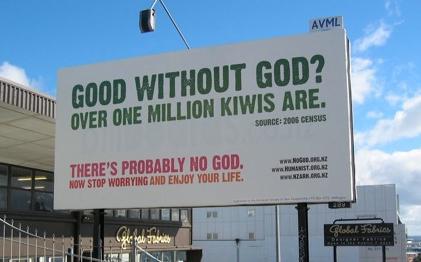
    Here is a pic of the first one.

    Good Without God? Over One Million Kiwis Are.

    Here we are told one million kiwis are good without God because the census says so. This, however, is fallacious. What the census shows is not that one million kiwis are good without God, it shows that one million kiwis are good (although this is granting a lot for the sake of argument) without believing in the existence God. But to say one can be good without believing in God is not the same as saying one can be good without God. Many people throughout history have been able to live and breath without believing in the existence of hydrogen and oxygen atoms, it does not follow that they could live without water.

    Moreover, it is hard to tell what the point of this sociological fact is anyway. Why does the fact that people do not need to believe in something to do good deeds mean that the belief is false? For centuries people have done good deeds and lived good lives without believing in evolutionary theory or quantum mechanics, should we conclude that these theories are therefore ‘probably false’? Surely these atheists are not suggesting that our beliefs should be based on what is useful or helpful as opposed to what is true or false?

    Perhaps the atheists here mean to convey something else. Some Christian thinkers such as William Lane Craig, Robert Adams, Stephen Layman, Alvin Plantinga, John Hare, Philip Quinn have argued that moral properties such as right and wrong depend on God for their existence. Atheist writers such as Paul Kurtz and Christopher Hitchens retort that this claim is falsified by the existence of morally upright atheists. I suspect something like this is behind the slogan on the billboard, it repeats Hitchens and Kurtz’s retorts as though they said something insightful or clever.

    The problem is, as any one familiar with this discussion should know, this retort misses the point (as I pointed out in On a Common Equivocation). Craig, Adams, et al are not claiming that one needs to believe in God to be good (a point made several times in the literature and particularly made so many times to Kurtz that it beggars belief that he keeps repeating it) rather their claim is that moral properties, such as right and wrong, depend on God for their existence.

    This is a fairly basic and elementary distinction in the literature. How exactly expressing a common philosophical confusion counts as reason for thinking “there probably is no God” is hard to see.

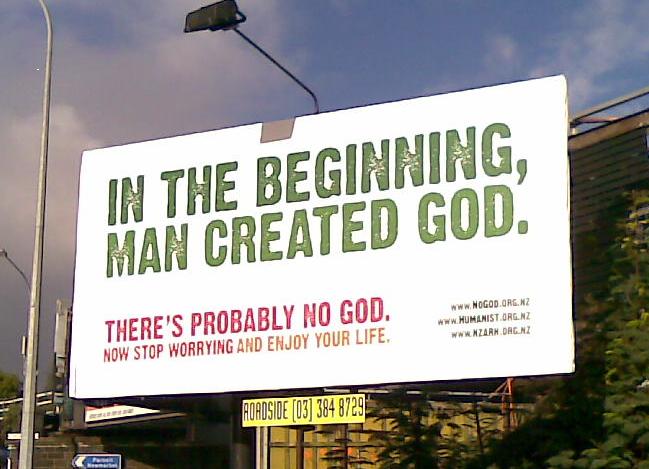
    Let’s look at the next one.

    In the Beginning, Man Created God.

    What is asserted here? That man created God. This, however, is clearly absurd. God is typically defined as an all-powerful, all-knowing, immaterial, necessarily-existent being who created the world. Now if one is going to claim that humans actually created an all-powerful, all-knowing, immaterial, necessarily-existent who created the world, then they are contradicting themselves.

    Humans are part of the world and therefore cannot have created the being that created the world – otherwise humans would have to exist prior to their own existence.

    Similarly, one cannot create a necessary being, this would entail it is possible for a necessary being to not exist, in which case it would not be a necessary being. Taken in a straight-forward, literal manner (the way freethinkers are so fond of taking every passage in the Bible) this billboard simply asserts contradictions.

    Of course, the authors of this billboard probably do not mean to say humans actually created God, they do not think he exists after all. Their claim is that humans created the idea or concept of God and developed it. This is undoubtedly true. Of course, humans also invented the idea or concept of atoms as well, ancient Greek philosophers came up the basics of this concept millennium ago. This trivial fact tells us nothing about whether or not the idea or concept humans developed actually corresponds to anything in reality. To assume that it tells us something about whether the idea or concept is true or false is a fairly obvious case of the genetic fallacy.

    So the second billboard either asserts a contradiction or it is a clear case of a logical fallacy.

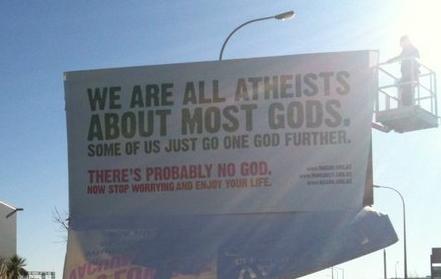
    The last one is my favourite.

    We are all atheists about most gods. Some of us just go one god further.

    I am inclined to think the argument on this sign is invalid. To see why let’s take out the term “God” in the sign and replace it with some other term such as “non-Christian perspective.” When we do this we get: “We all reject most non-Christian perspectives, some of us just reject one more.” This argument has true premises, do we now have, a knock-down argument for Christianity?

    Similarly, an analogous argument form with true premises gives us an argument for nihilism, the total denial of the existence of morality. “We are all nihilists about some conceptions of morality, some of us are just nihilistic about one more.”

    The same argument for also furnishes a refutation of secularism, “we all reject some secular perspectives on reality, some of us just reject one more.” I could go on.

    Taking a stand on any issue of philosophical substance, whether by affirming, denying or simply being sceptical of it, is to put oneself in opposition to any number of other people and groups who take a contrary stance. That is life. Such pluralism hardly provides a reason for thinking “there probably is no God” any more than it gives us a reason to doubt any other perspective on the world.

    So what do the atheist billboards do? Well the first one tells us that some atheist groups conflate basic philosophical distinctions and don’t really understand the debate they are contributing to. The second shows us that these groups think contradictions and obvious fallacies are some how savvy and smart. The last shows us that they think that invalid argument forms, forms from which you could infer the denial of anything and everything by substituting one true premise with another, are avant-garde.

    All in all, pretty accurate advertising for these groups.

    Hat tip: MCAS

  • Inter-Continental Developments: Matt to Speak in the US

    When Matt wrote his blog series Joshua and the Genocide of the Canaanites Part I and Part II he had no idea just how far clicking the ‘publish’ button would end up taking him. It turns out that it will be taking him quite far;  half-way around the world from Auckland, New Zealand to Atlanta, Georgia in the United States to be precise.

    What’s in Georgia? Well it is this years location for the annual conferences and meetings of the  Evangelical Theological Society (ETS), the Evangelical Philosophical Society (EPS) and the Society of Biblical Literature (SBL). Each organisation’s events dove-tail the others so that they all run between 17-23 November 2010 in pretty much the same location.

    Anyway, in addition to the  Canaanite blog series being the catalyst to Matt’s receiving invitations to co-author chapters in edited books with Philosophers of Religion and Old Testament Ethicists  working at the top of the international field on the subject of Old Testament Ethics (see the upcoming publication list on Matt’s profile page) Matt will also be speaking on this topic in Atlanta.

    At the EPS Apologetics Conference, Matt will speak on “God and the Genocide of the Canaanites” (full details here). The following day he will join Palm Beach Atlantic University Professor of Philosophy  and Ethics and EPS President Paul Copan, Denver Seminary Professor of Old Testament and Semitic Languages Richard Hess and Taylor University Associate Professor of Historical Theology Randal Rauser at the SBL Annual Meeting for a panel discussion entitled “Navigating Old Testament Ethics” (full details here). He’ll also be attending bits of the ETS conference too.

    This is an incredible opportunity for Matt. Not only does he get to go somewhere where most of the Philosophers and Theologians at the top of his field will all be gathered in one place and meet them all but he gets to present his work to them and speak alongside them. The potential for Matt to obtain more research and speaking opportunities coupled with the fact that attending the EPS is seen in the evangelical academic world as one of the best ways to obtain employment makes this an opportunity that we are determined for Matt to take up.

    The problem is cost. Almost every other speaker in attendance has institutional backing. Financially this translates to their respective academic departments funding most of their attendance. Matt does not have institutional backing. EPS President Paul Copan, who personally invited Matt to take up these speaking opportunities, is aware of this and has generously offered to help Matt out with accommodation and to and fro conference travel. This brings the total cost down considerably but we are still chasing a total of $2,481.55 NZD ($1746.52USD) to get Matt there.

    From simply talking to friends about this opportunity we are aware that people who are able to would like to help Matt get to these conferences so we have decided to take a step of faith by accepting the speaking offers and purchasing the tickets. Given our employment woes and battle with ACC over my injury compensation being wrongfully discontinued, this has made things rather tight but we have faith we will get through.

    If you would like to help, our support page has various donation options. We would also greatly appreciate the word being spread, so if you are a blogger or you have website, please consider linking to this page.

  • SBL Annual Meeting: Navigating Old Testament Ethics

    Matt has been invited to participate in a panel discussion at the annual Society of Biblical Literature (SBL) Annual Meeting in Atlanta, Georgia, which runs 20-23 November 2010. He will join leading Christian academics Paul Copan, Richard Hess and Randal Rauser in a segment entitled “Navigating Old Testament Ethics.” Matt’s contribution to the panel discussion will be on Divine Commands and Old Testament Ethics.

    Society of Biblical Literature Annual Meeting

    The SBL Annual Meeting is the largest gathering of biblical scholars in the world. Each meeting:

    • showcases the latest in biblical research,
    • fosters collegial contacts,
    • advances research, and
    • focuses on issues of the profession.

    At this meeting, scholars benefit from sessions on religion, philosophy, ethics, and diverse religious traditions.

    You can register here.

    If you would like to donate to help Matt get to America to speak at the SBL Annual Meeting please visit our support page.

  • EPS Apologetics Conference: God and the Genocide of the Canaanites

    Matt has been invited to speak at the annual Evangelical Philosophical Society (EPS) Apologetics Conference in Atlanta, Georgia, USA which runs 18-20 November 2010. He will be speaking alongside some big names in contemporary Christian philosophy including Alvin Plantinga and William Lane Craig.

    Evangelical Philosophical Society Apologetics Conference

    Experience seasoned teaching by Alvin Plantinga, William Lane Craig, Gary Habermas, Greg Koukl, Randy Newman, Frank Beckwith, Craig Evans, Craig Blomberg, Mike Licona and over twenty other influencers in Christian apologetics as they equip you about the issues facing contemporary Christian witness.

    The full line up of speakers is here.

    You can register here.

    Matt’s talk is entitled “God and the Genocide of the Canaanites,”

    How could a just and loving God command Joshua to genocide the Canaanites as is apparently taught in the Old Testament? Is God really a moral monster as Christianity’s critics use these passages to claim? Matthew will re-examine these passages in light of the context they were written in showing that the skeptics’ case against God relies on a questionable reading of the Old Testament.

    This talk will be based on Matt’s blog series, Joshua and the Genocide of the Canaanites Part I and Part II, his Contra Mundum column, “Did God Command Genocide in the Old Testament?” (forthcoming August 2010) and his chapter, co-authored with Paul Copan, “Ethics of ‘Holy War’ for Christian Morality and Theology” in Old Testament ‘Holy War’ and Christian Morality: Perspectives and Prospects (forthcoming 2011).

    If you would like to donate to help Matt get to America to speak at the EPS Apologetics Conference please visit our support page.