Category: Professional

  • Philosophia Christi: Abstract Objects and Divine Command Ethics Down-Under

    In December we were told that Matt’s article “Tooley, Plantinga and the Deontological Problem of Evil”  had passed peer review and would be published in Philosophia Christi.  Issue, 13: 2  is  now out and if you look at the contents page you’ll see Matt’s article has now been published.

    The abstract to Matt’s article is as follows:
    Philosophia ChristiThis article criticises the deontological argument from evil proposed by Michael Tooley  in The Knowledge of God. I sketch Tooley’s distinction between deontological and axiological arguments from evil. Tooley rejects the axiological version because it rests  on “controversial ethical claims”, claims that are “likely to be rejected by many theists” and formulates a deontological version in its place. I argue that Alvin Plantinga’s criticism of the moral premises of this argument can be reformulated by appealing to a divine command theory of ethics. So reformulated, I argue that Tooley’s argument relies on controversial moral assumptions that many theists reject. I defend this response against potential criticisms found in the writings of Linda Zagzebski,  Tooley’s debate with William Lane Craig, and Peter Van Inwagen.

    Much of the focus of this issue is the topic of God and Abstract Objects. However, fortuitously, our good friend and fellow Kiwi, Glenn Peoples from Say Hello to My Little Friend,  has also been published in the same issue of Philosophia Christi immediately after Matt. His abstract is below:

    Of the objections to divine command ethics that still circulate in the literature, the epistemological objection is one of the two most common (the other being the objection from abhorrent commands). If morality is based on divine commands, the objection goes, then those who do not believe in God cannot know what is right or wrong. In this paper I explain the way in which this objection has been answered in the past (especially by Philip Quinn and Robert Adams) and I then look at a new attempt by Wes Morriston to resurrect and re-state the epistemological objection.  I explain the way in which this objection succumbs to responses that have already been made in the literature and is not new at all in spite of appearances, and I explain how it misconstrues the social nature of obligation in Robert Adams’ account of divine commands. In giving this explanation I flesh out the potentially difficult notion of a “sign” as an epistemic indicator of moral duty, and I argue that all the epistemological objections to divine command ethics this far fail because they have an underdeveloped concept of a “sign” as a central component of a command.

    Perhaps the theme for this issue should have been God, Abstract Objects and Divine Command ethics Down Under?

  • Another Day, Another Publication

    Matt is having a good day.

    Presently he is in San Francisco where this morning he gave the first of his talks, “Can Traditional Theism Provide an Adequate Foundation for Morality? A Reply to Walter Sinnott-Armstrong’s Critique of William Lane Craig” to the Annual Meeting of the Evangelical Philosophical Society. By all accounts it was well received with Matt already being in receipt of several requests from scholars in his field for copies of the paper.

    This afternoon he attended a panel discussion  featuring William Lane Craig, Paul Copan, David Bagget and Jerry Walls on divine command theory and the moral argument. Regular readers will know how much he would have enjoyed that!

    Tonight an email came through from the Westminster Theological Journal, a rather prestigious journal, informing him that his article “Feticide, the Masoretic Text and the Septuagint” has been accepted for publication.

    No prizes for guessing that I am extra proud of him today 🙂

  • The Nominations for Evangelical Philosophical Society Executive are in…

    Matthew FlannaganVoting for the 2011 Executive Committee of the Evangelical Philosophical Society (EPS) has begun today. I am pleased to announce that this blog’s Matthew Flannagan has been nominated as one of the seven candidates for the three vacant executive committee positions. Matt is the only New Zealander to have been nominated – so proud of him 🙂
    If you are a member of the EPS make sure you check out the full candidate list and vote!

  • The Christian Delusion: Why Faith Fails – A Philosophia Christi Review of John Loftus’ Book

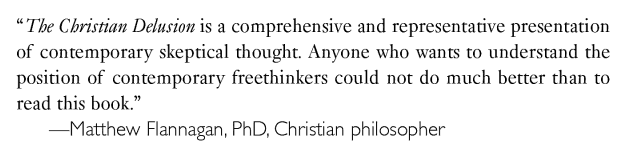
    On the list of blurbs just inside the cover of The Christian Delusion: Why Faith Fails, edited by John W. Loftus (Amherst, NY: Prometheus Books) 2010, the following appears:

    The Christian Delusion Blurb by Matthew Flannagan

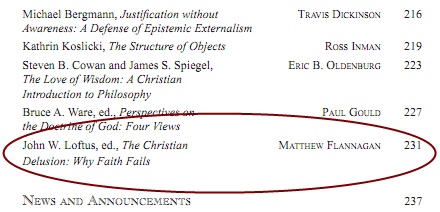
    As a result of being published on the blurb of the book, the current edition of Philosphia Christi, Vol. 13, no. 1 – Summer 2011, shows the following in the table of contents under “Book Reviews”:

    Philosophia Christi Table of ContentsThe Editor of Philosophia Christi has kindly granted Matt permission to reproduce his review of The Christian Delusion: Why Faith Fails here on MandM.

    A Review of The Christian Delusion: Why Faith Fails

    by Matthew Flannagan

    In The Christian Delusion John Loftus brings together a series of articles by contemporary free thinkers all focused around a common epistemological critique. It is the sequel to Loftus’s Why I Became an Atheist: A Former Preacher Rejects Christianity.

    The book is divided into five parts, each addressing a different aspect of Christianity. Part 1 is entitled “Why Faith Fails” and comprises four chapters. In chapter 1, David Eller argues that religions both deeply influence and are deeply influenced by culture; he argues that different cultural contexts lead to different forms of Christianity. In chapter 2, Vallerie Tarico draws on cognitive science to offer naturalistic explanations for why people believe in God. In chapter 3, Jason Long explains how people believe in Christianity despite its obvious absurdity by documenting how humans frequently engage in certain fallacies, have certain biases, believe things that are comfortable and resist changing their minds.

    By themselves it is hard to discern how these chapters provide arguments against Christianity. They appear to assume Christianity is false and provide naturalistic explanations as to why people believe such falsehoods. The relevance is explained in chapter 4, where John Loftus uses them to defend what he calls the Outsider Test for Faith (“OTF”). Loftus argues that a rational person should adopt the same skeptical stance towards her own religious beliefs that she does towards religions she rejects. The OTF (more…)

  • Is God a Moral Monster? A Review of Paul Copan’s Book

    On 11 September 2001 Islamic terrorists flew two planes into the World Trade Centre, killing thousands of innocent people. Ostensibly they did this because they believed God commanded them to do so. This event has reinvigorated a fear that has been latent in Western psyche since the 17th century when religious wars tore Europe apart. The fear of religious fanaticism, of people willing to murder hundreds in the name of God, has been whipped up by the new atheists–Richard Dawkins, Sam Harris, Christopher Hitchens, et al.

    The phenomenon is not just limited to the popular atheological literature. These fears went centre stage recently at a conference entitled “My Ways Are Not Your Ways” which was put on by the Centre for Philosophy of Religion at the University of Notre Dame. Sceptics presenting at the conference argued passionately that the God of the Bible issues commands which are at odds with modern understandings of morality; adultery is punished with death, God is portrayed as commanding the killing of non-combatants in “holy wars” against the Canaanites, God commanded Abraham to sacrifice his son, the Bible appears to approve of slavery and polygamy, and so forth.

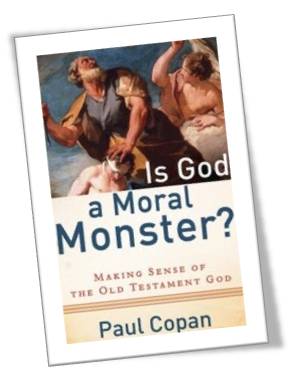
    Is God a Moral Monster?In Is God a Moral Monster? Paul Copan attempts to address some of these concerns. What’s novel about Copan’s approach is that, unlike many standard philosophical responses to the above problems, Copan draws on recent conservative Old Testament scholarship by people like Gordon Wenham, Tremper Longman, Christopher Wright, Walter Kaiser, Richard Hess and numerous others. This is novel as much of what has been going on in evangelical discussions of Old Testament ethics for decades has been done almost in isolation from contemporary philosophy of religion and vice versa. Copan, who has degrees both in Philosophy and in Biblical Studies, brings this material together in an accessible manner.

    There is no point in hiding the fact that I am a fan of Copan’s book. In a few places Copan cites my own writings as sources of ideas and in other places the overlap with my own thoughts on these issues is considerable. I have recommended it to my son who intends to read it as soon as he has finished William Lane Craig’s On Guard. However, this review will not simply be an exercise in cheer-leading; I will attempt to both summarise Copan’s work and add critical comments.

    The Review
    Is God a Moral Monster? opens with a discussion on the new atheism in general. In chapters 3 and 4 Copan addresses the charge that God in the Old-Testament is both jealous and egocentrically demands worship. Then in chapter 5 he turns to the binding of Isaac. I will touch briefly on this (more…)

  • Free eBook “Is Christianity True?”

    Not so long ago Apologetics 315 ran an essay series on the topic Is Christianity True? Twenty-three apologist bloggers contributed, Matt’s essay “Showing Christianity is True” was selected to be the concluding essay in the series, before Brian Auten’s conclusion.

    23 Essays Exploring the Truth of Christianity

    At the time, an audio version of each essay was created and the series was turned into a podcast. Now, Apologetics 315 have made the series available as a free ebook entitled, “23 Essays Exploring the Truth of Christianity.”

    Kindle Version | Mobi | ePub| PDF.

    Chris Reese – Foreword
    Brian Auten – Introduction
    Tawa Anderson – Does God Exist?
    Jim Wallace – The Best Explanation
    Wes Widner – Coherent, Consistent & Livable
    Richard Gerhardt – The Failure of Naturalism
    Bob Perry – Defrocking the Priests of Scientism
    Peter Grice – Orthogonal Complexity
    Chad Gross – Cumulative Reasons for Christianity
    Shelby Cade – Prophecy and Resurrection
    Luke Nix – Making Sense of the Resurrection
    Aaron Brake – The Facts of the Resurrection
    Amy Hall – The Historical Event of the Resurrection
    James Patrick Holding – The Impossible Faith
    Stephen J. Bedard – Christianity and Other Ancient Religions
    Anthony Horvath – Christianity Proved by the Nature of the Jewish Nation
    Mariano Grinbank – The Euthyphro Dichotomy
    Marcus McElhaney – Christianity is Objectively True
    Vocab Malone / Paul D. Adams – The Gospels Tell Me So
    Glenn Hendrickson – Christianity Explains Logic
    Brian Colón – Atheism: A Falsified Hypothesis
    Kyle Deming – Testing Christianity’s Core Truth Claims
    Matthew Flannagan – Showing Christianity is True
    Brian Auten – The Wise Man Seeks God

    H/T: Thinking Matters

  • Inter-Continental Developments: Matt to Speak in the US

    When Matt wrote his blog series Joshua and the Genocide of the Canaanites Part I and Part II he had no idea just how far clicking the ‘publish’ button would end up taking him. It turns out that it will be taking him quite far;  half-way around the world from Auckland, New Zealand to Atlanta, Georgia in the United States to be precise.

    What’s in Georgia? Well it is this years location for the annual conferences and meetings of the  Evangelical Theological Society (ETS), the Evangelical Philosophical Society (EPS) and the Society of Biblical Literature (SBL). Each organisation’s events dove-tail the others so that they all run between 17-23 November 2010 in pretty much the same location.

    Anyway, in addition to the  Canaanite blog series being the catalyst to Matt’s receiving invitations to co-author chapters in edited books with Philosophers of Religion and Old Testament Ethicists  working at the top of the international field on the subject of Old Testament Ethics (see the upcoming publication list on Matt’s profile page) Matt will also be speaking on this topic in Atlanta.

    At the EPS Apologetics Conference, Matt will speak on “God and the Genocide of the Canaanites” (full details here). The following day he will join Palm Beach Atlantic University Professor of Philosophy  and Ethics and EPS President Paul Copan, Denver Seminary Professor of Old Testament and Semitic Languages Richard Hess and Taylor University Associate Professor of Historical Theology Randal Rauser at the SBL Annual Meeting for a panel discussion entitled “Navigating Old Testament Ethics” (full details here). He’ll also be attending bits of the ETS conference too.

    This is an incredible opportunity for Matt. Not only does he get to go somewhere where most of the Philosophers and Theologians at the top of his field will all be gathered in one place and meet them all but he gets to present his work to them and speak alongside them. The potential for Matt to obtain more research and speaking opportunities coupled with the fact that attending the EPS is seen in the evangelical academic world as one of the best ways to obtain employment makes this an opportunity that we are determined for Matt to take up.

    The problem is cost. Almost every other speaker in attendance has institutional backing. Financially this translates to their respective academic departments funding most of their attendance. Matt does not have institutional backing. EPS President Paul Copan, who personally invited Matt to take up these speaking opportunities, is aware of this and has generously offered to help Matt out with accommodation and to and fro conference travel. This brings the total cost down considerably but we are still chasing a total of $2,481.55 NZD ($1746.52USD) to get Matt there.

    From simply talking to friends about this opportunity we are aware that people who are able to would like to help Matt get to these conferences so we have decided to take a step of faith by accepting the speaking offers and purchasing the tickets. Given our employment woes and battle with ACC over my injury compensation being wrongfully discontinued, this has made things rather tight but we have faith we will get through.

    If you would like to help, our support page has various donation options. We would also greatly appreciate the word being spread, so if you are a blogger or you have website, please consider linking to this page.