Category: Professional

  • Contra Mundum: The Judgmental Jesus

    Few things are thought to be more morally pernicious than the practice of judging others. Sometimes this is given a theological spin with people citing the Sermon on the Mount “Do not judge, or you too will be judged. For in the same way you judge others, you will be judged, and with the measure you use, it will be measured to you.” (Matthew 7:1-2).

    It is common for this imperative statement to be used as a kind of rhetorical club to silence moral critique of various cultural practices. When a particular practice is subjected to such critique those who engage in the practice will complain they are being “judged.” If the alleged judgers are Christian, the claim that “judging is contrary to what Christ taught” is typically added to the charge.

    I think this is a misrepresentation of the passage and an affront to common sense. I will address the latter point first. The claim that it is wrong to judge other people is problematic; it is so problematic that it is amazing that anyone gives it credence. For example, if it is wrong to judge other people then since Hitler was another person, it is wrong to say that what he did was wrong. To claim that his actions were wrong is to make a judgment about them and if judging is wrong then it is wrong to judge Hitler. Similarly, Martin Luther King Junior was wrong to criticise racism and doing so judged the actions of racists and William Wilberforce was wrong to make moral judgments about the slave trade as in doing so he was judging slave owners. Taken consistently, the claim that “it is wrong to judge” entails that we should have no legal system, no laws and no courts as all these things involve judging others by deeming certain conduct as wrong.

    The problems with this interpretation of Matthew 7:1-2 do not stop there. A little reflection will demonstrate that the claim that it is wrong to judge other people is incoherent. To claim that it is wrong to judge others is to make a moral judgment; in making the statement one is judging that a particular action is wrong. Moreover, when a person announces this to other people he or she is implicitly making a judgment about other people’s actions. To utter that it is wrong to judge others is to engage in judging others. This kind of thinking can easily induce a kind of intellectual vertigo, it is analogous to the person who states, in English, “I can’t speak a word of English” or a person who tries to convince you of the truth of the claim “there is no truth.”

    Fortunately, one does not need to attribute to Jesus such absurd, incoherent, platitudes because it is doubtful that Jesus meant anything quite so stupid. Several factors bear this conclusion out. First, one should note that the claim, “do not judge, or you too will be judged,” occurs as part of the Sermon on the Mount. In this Sermon, Jesus regularly used hyperbole to vividly illustrate a point. One should note that interpreting these hyperboles too literalistically leads to obvious absurdities. For example, Jesus states, when referring to the act of looking at another person’s spouse with lust, “If your right eye causes you to sin, gouge it out and throw it away” (Matthew 5:9). It is evident that Jesus is not advocating self-mutilation but simply making his point about not lusting in a vivid, hyperbolic fashion. Similarly, he commands people to, “do good deeds before men,” (Matthew 5:16) but a few verses later he tells us, “not to do good deeds before men.” (Matthew 6:1). Taken in a strictly literalistic sense this is a contradiction. However, a reading of the context shows these apparently opposing statements are simply vivid illustrations of the same point; one’s good deeds should be motivated by a desire to honour God, to do the right thing and not by a desire to advance one’s own reputation. In light of such contexts the phrase, “do not judge,” should be seen for what it is, a hyperbolic statement illustrating the point elaborated in the surrounding verses.

    Second, when one seeks out this context one can see quite clearly the point being made. The phrase translated in the NIV as, “do not judge, or you too will be judged,” was originally written by Matthew in Koine (a Greek dialect). The Interlinear Bible gives the literal translation here as, “do not judge that you be judged.” In other words, do not judge others in a way that leads one to put oneself under judgement. The surrounding words support this conclusion,

    For in the same way you judge others, you will be judged, and with the measure you use, it will be measured to you. ″Why do you look at the speck of sawdust in your brother’s eye and pay no attention to the plank in your own eye? How can you say to your brother, ‘Let me take the speck out of your eye,’ when all the time there is a plank in your own eye? You hypocrite, first take the plank out of your own eye, and then you will see clearly to remove the speck from your brother’s eye.″ Do not give dogs what is sacred; do not throw your pearls to pigs. If you do, they may trample them under their feet, and then turn and tear you to pieces. (Matthew 7:2-6)

    Here the qualifications are evident. One is not to judge in a way that brings judgment on oneself. The reason for this (“for”) is that the standard one uses to judge others is the standard that one’s own behaviour will be measured by. Jesus goes on to illustrate, with a sarcastic example, precisely what he is talking about; a person who nit-picks or censures the minor faults of others (taking the speck out of their brothers eye) who ignores the serious, grave, moral faults in their own life (the log in one’s own eye). His point is that such faults actually blind the person’s ability to be able to make competent moral judgments. This suggests that Jesus is focusing on a certain type of judging and not the making of judgments per se.

    In fact, the conclusion that Jesus does not mean to condemn all judging of others is evident from the proceeding sentences in the above quote. Rather than engaging in the kind of judgment Jesus has condemned one should “first take the plank out of your own eye, and then you will see clearly to remove the speck from your brother’s eye.” In other words one should try to rectify the serious moral flaws in one’s own life precisely so one can assist others with theirs. One needs to avoid hypocrisy in order to make constructive and effective moral judgments about others. This would make no sense if Jesus meant to condemn all judging by this passage.

    The reference to “pigs and dogs” in verse 6 further bears this out. Dogs and pigs, to Jews, were unclean animals and the term was frequently used to designate people considered to be of low moral character who were “unclean” before God. In this verse Jesus is simply repeating the Old Testament teaching to “not rebuke a mocker or he will hate you: rebuke a wise man and he will love you” (Proverbs 9:8). The implication, again, is that one should try to make constructive judgments rather than simply provoking anger. Constructive judgments involve making judgments.

    Just in case I have not belaboured the point enough, my interpretation is further reinforced by what follows after these passages. While reading a passage in its context is not the strength of many popular critics of Christianity, immediately after the cited passage Jesus goes on to warn about the dangers of religious charlatans, which he, rather judgmentally, refers to as “ferocious wolves” in “sheep’s clothing” (Matthew 7:15). In the age of Osama Bin Laden, David Koresh and Jim Jones the danger of such charlatans needs little further elaboration.

    In exhorting the requisite discernment, Jesus actually instructs his disciples to make moral judgments about others. He tells his disciples to judge whether a person is a false prophet or not by their “fruit.” Anyone familiar with Old Testament prophetic literature, as Jesus’ hearers were, would know that “fruit” is a metaphor for character. Isaiah’s use of the metaphor is paradigmatic; Isaiah famously described Israel as a vineyard that did not bear fruit. In the metaphor, fruit quite clearly referred to such things as right conduct, justice, morality, etc. Paul uses the same metaphor when he states that “the fruit of the Spirit is love, joy, peace, patience, kindness, goodness, faithfulness, gentleness and self-control” (Galatians 5:22-23a). Jesus makes it clear that he is utilising this metaphor. He goes on to stress that in this context the fruit of a prophet is whether he or she “does the will of my Father” and is not an “evil doer.” It is clear then that Jesus here is exhorting his disciples to make moral judgment about other people, to critically evaluate other people’s lives, choices and actions and to make judgments about their spiritual authenticity based on this evaluation. All of this would be very odd if Jesus thought it was wrong to judge.

    Moral judgment of religious leaders, of oneself, of the organisations one is contemplating joining, of people one considers associating with, of the political leaders one supports at the ballot box and broader issues in wider culture is a task essential to both authentic spirituality and the competent navigation of everyday life.

    I write a monthly column for Investigate Magazine entitled Contra Mundum. This blog post was published in the February 10 issue and is reproduced here with permission. Contra Mundum is Latin for ‘against the world;’ the phrase is usually attributed to Athanasius who was exiled for defending Christian orthodoxy.

    Letters to the editor should be sent to: editorial@investigatemagazine.DELETE.com

    RELATED POSTS:
    Contra Mundum: What’s Wrong with Imposing your Beliefs onto Others?
    Contra Mundum: God, Proof and Faith
    Contra Mundum: “Bigoted Fundamentalist” as Orwellian Double-Speak
    Contra Mundum: The Flat-Earth Myth
    Contra Mundum: Confessions of an Anti-Choice Fanatic
  • John Loftus’ The Christian Delusion: Why Faith Fails

    John Loftus will soon release his new book The Christian Delusion: Why Faith Fails. As many readers will be aware John Loftus and the authors of this blog are not strangers to one another so it may not be much of a surprise to discover that the blurbs page of Loftus’ new book features very short reviews from a range of international scholars including Matt:

    Dr. Matthew Flannagan, Christian philosopher and Adjunct Lecturer in Philosophy for Laidlaw College and Bethlehem Tertiary Institute.

    The Christian Delusion is a comprehensive and representative presentation of contemporary skeptical thought. Anyone who wants to understand the position of contemporary free thinkers could not do much better than to read this book.

    Matt intends to write a more thorough review which we will submit for publication both nationally and internationally.

  • Can State Appropriation of Minerals in Privately Held Land be Justified? Resources Needed

    I am currently undertaking my second-to-last paper in pursuit of my Bachelor of Law (LLB).  Due to a complicated bunch of factors involving the potential staleness of my papers, if I do not apply to the New Zealand Council of Legal Education for a completion certificate with an LLB and a Professional Legal Studies certificate in hand prior to 31 Dec 2010, combined with limitations of my ability to do much more than one paper at the time due to my neck injury and chronic pain issues and due to the fact that with only two papers to go I need to submit three opinion papers (only one of which can be substituted with voluntary community legal service), I had little choice but to choose a summer school paper that had the option of an opinion credit. This set of circumstances has seen me engaged in the project for which I now hope some of our readers can help me with.

    My paper is Mining and Natural Resource Law (there is not much choice at Summer School). As an opinion topic we were allowed to take our budding legal specialty and apply it to any of the topics on the course outline. I like to take a philosophical rights and freedoms approach to most of what I research and write within the field of law so I have submitted and had approved a topic with a bit of a jurisprudential twist. I intend to analyse the justifications given for the state appropriation of minerals in the sub-soil of privately owned property.

    Most articles I have found on state appropriation so far seem to tacitly assume that if the state has legislated that it owns the minerals in the sub-soil of privately owned land then the state’s action is justified or the author simply does not question this, even if he or she acknowledges that a few private property owners had an issue with this at the time, which is not helpful as I intend to question the justification.

    New Zealand philosophical writings from the perspective of classical liberal/pro-property rights/limited state angles are fairly difficult to find. Further international writings on this subject are not commonly cited in New Zealand so they too are hard to find. If any of our readers can point me to any good sources that might help me in the project or even if you can just leave your thoughts in the comments section (if I use your ideas in the work I promise to attribute them back to you) that would be most helpful.

    The following is the gist of the direction I hope to take.

    Since at least the 16th century, the maxim cujus est solum, ejus est usque ad coelum et ad inferos (Latin for for whoever owns the soil, it is theirs up to heaven and down to hell) meant that at common law, minerals in the sub-soil of land belonged to land owner. Such minerals were assumed to be conveyed along with the land on its change of ownership unless wording in the conveyance instrument specified otherwise. Until fairly recently, the last century or so, the only minerals not subject to this rule were gold and silver. The Case of Mines found “that by the law all mines of gold and silver within the realm, whether they be in the lands of the Queen, or of subjects, belong to the Queen by prerogative”. According to Dr Robyn Anderson,[1]

    The Court of Exchequer found in Case of Mines, that base metals – tin, lead, iron, copper, and non-precious minerals – belonged to the owner of the soil, but that the right to gold, silver, and their ores and admixtures, lay with the Crown. That right was not an incident of ownership of the soil, but rather, an attribute of the monarchy. The Elizabethan assertion of the prerogative reflected the pragmatic needs of the developing English state to control the coinage, and finance an army … [1]

    The argument that back in the 16th century the Monarch needed to be able to protect the realm by using coinage to raise an army (there was no standing army) and weapons to arm it, seems, prima facie, a reasonable justification for the state appropriation of gold and silver. However, in the last century or so many of the base metals and minerals deemed non-precious in the Case of Mines are now included in statutory reservations to the crown. This has reached the point in 2010 where, with few exceptions, the state currently owns almost all minerals in territorial New Zealand and has exclusive right to alienate (or grant a licence to alienate) most of those minerals from even those lands held in private ownership. Further, in many circumstances, land owners cannot even refuse consent for prospective, exploration and mining to occur on their land.

    The New Zealand government owns all naturally occurring petroleum (including both oil and gas), radioactive minerals, and gold and silver in New Zealand. Any individual or company wanting to prospect, explore or mine these substances must obtain a permit under the Crown Minerals Act 1991 and pay the specified fees and royalties [to the state]. The same rules apply to coal and all other metallic and non-metallic minerals and aggregates on Crown-owned land.

    Mining of minerals and aggregates other than petroleum, radioactive minerals and gold and silver on privately owned land requires the consent of the landowner together with resource consents from local authorities granted under provisions of the Resource Management Act. [Emphasis added] [2]

    The current state of mineral rights in New Zealand seems to me, prima facie, to be a violation of ad coelum et ad inferos (the right of land ownership “down to hell” or in sub-soil), so the question I want to ask in my opinion is: what is the basis for the state’s appropriation of sub-soil minerals from the lands of private property owners and is it justified? The New Zealand army is not armed with gold and silver these days, further,  I cannot see any legitimate argument for why the state needs to own petroleum and “Nuclear Free New Zealand” does not have a nuclear weapons program (and are,  just a guess here,  highly unlikely to in the future) so what is with the state ownership of radioactive resources?

    Obviously 3,000 words will not give me a lot of space to develop this topic so I will try to keep the topic to more of a general overview but I need resources and fast both directly on this topic and on property rights generally so if you have any thoughts…


    [1] Robyn Anderson Goldmining: Policy, Legislation, and Administration (Rangahaua Whanui Report, Waitangi Tribunal, Dec 1996) RANGAHAUA Whanui NATIONAL Theme N: GOLDMINING: Policy, Legislation, and Administration (Robyn Anderson ed., 1996) 1.
    [2] Simon Nathan “Mining and underground resources – Mining regulation and education” Te Ara – the Encyclopedia of New Zealand, updated 2-Mar-09.

  • Of Papers, Jobs, Weddings and TV Shows

    We have had, and are in for, an interesting few weeks.

    Last week I finished my studies for 2009 with my Legal Ethics exam and enrolled to complete the final two papers of my LLB (bachelor of law) in 2010. This week Matt handed in his final piece of assessment for his post graduate diploma in teaching and I re-entered the workforce! … Kinda.

    My pre-car-accident (neck injury) employer phoned me out of the blue last week to offer me a small job. They have a project that needs doing, they don’t have anyone spare who can do it and so they thought of me.

    So cool!

    🙂

    They have set it up so there is no need for me to do the drive into work (which can be a good hour or more at the wrong time of the day) I can work from home. They have supplied me with a lap-top so I can work in my bean bag. Its all flexi-hours to get around the bad pain days/parts of the day. It basically works that as long as I finish the project by the specified date I can break the hours down into manageable chunks.

    So I have been thoroughly enjoying myself this week working! The whole thing will be over by Dec 10 but hey it beats sitting around being unproductive!

    In other news I am apparently appearing on a TV panel tonight to discuss parental notification/consent on abortion with Dr Paul Hutchison – MP for Hunua, Bev Adair – Spoke person for Family First, the Principal of either Tangaroa College or Kelston High and the Rev. Tavale Mataia. The show will apparently air on Triangle TV on Tuesday night at 7.30pm also on Wednesday nights at 8pm on Sky Digital channel 89 and on Freeview channel 21.

    Then of course tomorrow Matt will give his paper “Abortion, Harm and Eschatology” to the STAANZ conference. On Sunday I am not only attending Filia Day‘s wedding but I am doing the makeup for her 4 bridesmaids and then the weekend after that Matt and I are flying to wellington to attend the Wellington Bloggers Drinks and to speak at the All for Life Conference.

  • My Story: Lousy ACC Cover and Thoughts on the Proposed Changes

    Yesterday I applied for and got a one week extension on my research project as I couldn’t keep up with the necessary pace to finish it by Friday – I was getting too sore. This means that open mic week(s) needs to continue a little longer so please bear with us and do submit a guest post.

    Whilst we are trying to have blinkers on in terms of anything but study and essential day to day life, there have been some issues that have come up that we really want to blog on but lack the time. One in particular really has me going – the proposed changes to ACC.

    There is not point in repeating what most bloggers of my political persuasion have already opined, I’ll just throw down a few thoughts from my own perspective as an ACC client.

    My first point is that ACC is not welfare. It is an Accident Compensation Scheme. Accident compensation is about restoring a victim of an accident that was not their fault to as close as possible the state they were in pre-accident. Tort law is the area of law that, in the absence of state interference, covers injury caused by people’s negligence – what we call “accidents” here in New Zealand. Tort law says that you must take your victim as you find them; restoration, assessment of harm, is not to be based on the average person but on that person, the victim.

    My next point that I’d like you to keep in mind as you read this is that I think that ACC should be private and fault based. This is my ideal. My ideal is not reality as in New Zealand, accident compensation is state run. While it remains state funded, while the option to sue my injurer remains unavailable to me by statute, it must function as a just and fair accident compensation scheme, run in line with tort jurisprudence.

    “The assessor ACC sent around told me, get this, that my 8 and 9 year olds should be doing all the washing, vacuuming, dishes, etc! Unbelievable! I would, justifiably, have CYF on my doorstep if took that advice.”

    I have some criticisms of the proposed changes based on that fundamental premise ACC is built on, that it is supposed to be an accident compensation scheme. I reiterate, I support moves in the direction of privatisation e.g. rebates for those who take out private accident insurance. I agree that it should not be available to those who get hurt participating in crime. I think it should not be available to those who self-harm when they have refused treatment and are culpable for the self-harm (I think self-harm is not as cut and dried as people think). I also think, given how bankrupt ACC is, that it is only realistic that the money come from somewhere, increased levies are inevitable as is some threshold or excess level. However, that is about as far as I’ll go with the government on this one. Getting it right as to what should be cut and what must be left is crucial and ACC and the new proposals FAIL miserably on this score.

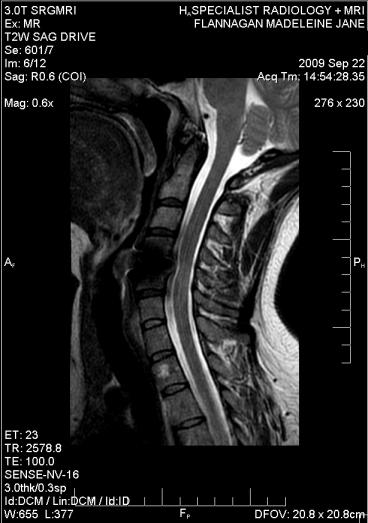
    People say that ACC is “excellent cover” and a “great scheme” but I disagree. I have lived on it for the past year and half since a car accident required the big black thing, in the middle of the below MRI scan of my neck, to be inserted into my neck. See how it is making a bulge into my spinal cord (the long dark gray thing in the middle)?

    My MRI

    Anyway, having set out my premises, disclosed my bias and established that I am, in fact, injured, now judge for yourself if you think my cover is excellent or great or even adequate.

    Pre-accident I was the main bread-winner for our family which comprises 4 children and two adults. I worked for a generous company that gave regular pay rises, gifts and outings to its staff and sometimes their families. I had access to discounted (sometimes free) cereal products and sandwich spreads which helped a lot with the family grocery bill. The company paid for my university fees, my text books and for me to attend lectures so I could complete my law degree. I had a career path set out in front of me, there was a ladder to climb. Matt worked part-time/fixed-term jobs within academia as he has struggled to find full time work as an academic within New Zealand. That worked for us as someone had to be home with the kids, though we would have preferred it the other way around, Matt full-time as an academic and me part-time but you know, life’s like that sometimes and as a family you make the best of it.

    In March 08, whilst I was lawfully stopped at traffic lights, having left work heading for Uni, a woman drove into the back of my car, smashed me into the car in front, writing off my car and destroying two of the discs in my neck which led to disc replacement surgery in Dec 08. She was never charged, I was never given an explanation as to what happened, oh and, she never even had the decency to come over to my car and see if I was alright – other people, passers by and the occupants of the car in front, called the ambulance and stayed with me. As far as I know she got to go back to her life with only her own car insurance claim to worry about and she doesn’t have a clue about what happened to me (my injuries were initially mis-diagnosed as mild whiplash).

    My employer got put through hell. All sorts of ACC nightmares ( I was officially on the clock) that took managers out of their normal jobs. My managers had to put up with temp after temp who couldn’t quite do my job because they didn’t have my institutional knowledge of the company. Nevertheless work sent me flowers, phoned me and held my job far longer than they legally had to. Eventually, when it became apparent I was not going to be fit for work for a very long time, if ever, they let me go but threw me a big party and gave me a leaving present.

    ACC’s treatment of me was a different story.

    We live on 80% of the full-time salary I was earning two years ago. No pay rises, no perks, no discounted household products or entertainment. No uni fees, no text books… So in reality it is not 80% of the income I was on as part of that income was not not salary, it is less than 80%.

    How would you and your household  cope with a 20%+ drop in your income?

    Then there are the extra costs that ACC do not cover:

    Because I cannot just go to the chemist and get my pain medications without a prescription, I have to pay $20 a pop to my GP every 6 weeks to get the piece of paper that says I can get my pain meds. I tell the GP what drugs I want, how many and the GP rubber stamps it.

    Every 12 weeks my specialist wants an x-ray. These cost me $35 a pop.

    We have to purchase a tube of deep heat every week – it’s $8-10 depending on supermarket specials.

    Then there is the petrol spent driving to the GP, pharmacy and specialist (his office is a decent drive). There is also the removal of Matt from whatever work or study he is doing to attend these appointments as I often cannot drive to them. Then there is the babysitting to get rid of the kids so I can attend these.

    Add in the random stuff, MRI scans, visits to pain clinics and you get a more of these costs.

    The expensive supportive bed we had to purchase so I could sleep cost a couple of grand.

    Then there is the $200 pillow – it is a neck injury that I have afterall.

    We recently purchased a monster bean bag so I have something supportive I can sit in, it is excellent for recovering after I have overdone it and it will be vital for exams and for having something portable when I want/need to go out – I can now spend a weekend-day at the beach with my kids for example. It cost $150.

    Then there is Osteo treatment. Osteo treatment reduces the level of pain drugs I need to take by almost half. It is a very effective form of treatment. I am in less pain, I have improved function as a result of less pain, I can get more out of my life and I take less drugs. Osteo is GOOD. This costs me $35 per week. (Physio is free but physio is not effective for this injury – I have seen half a dozen different physios and none can produce the results anything like what osteo treatment can). As a family we made the sacrifices necessary to find that $35 a week. Until last week when my Osteo informed me that ACC had declined to fund their part of the treatment. I now owe my Osteo $75 for the 3 treatments that  I had after ACC decided they were not going to keep funding treatment but didn’t bother to tell me or the Osteo. If I want to continue Osteo I have to find $60 a week now.

    But see above, I don’t have $60 spare a week. ACC does not even come close to restoring me to what I had before I was the victim of an accident.

    So it is back to being a curled up ball of pain with no life or being completely fuzzed out on drugs.

    Did I mention that continually taking the drugs (before I discovered osteo) irritated my stomach and caused so much pain to my stomach that I was admitted to hospital last year?

    Apparently this decision makes sense to someone in ACC.

    How does one quantify the mental costs? The stress, the cost to my family, my children not having me able to  actively participate in the physical aspects of their lives, knowing I will probably never be able to do the sport I love again?

    But that’s not all. Then there are the battles with ACC.

    They are trying to get me off their books. Now I get that. People bludge, make claims they are not entitled to and ACC needs to work out who should be on their books and who should not. However, when you have someone on your books who is in the constant, intense pain I am in, who has their life as altered as mine is, who has doctors and specialists and osteos and physios and everyone who has examined them singing the same tune, that should tell you something. That should tell you that paying a consultant to come around to that person’s house and spend two hours plus with them and then go away and write up a report stating what potential jobs that person could do if they went back to work is a tad premature. Especially when that person is but 2 papers away from having a law degree as obtaining the law degree dramatically changes the types of jobs that person will be able to do. But no, after ACC did this they then sent me to their own specialist, just yesterday, to get him to agree that I could do said recommended jobs.

    They told me that if he said I could work 35 hours (30 hours under the new changes) then I would lose the 80% of my wage that ACC pay me and if in fact I couldn’t work that I would get sickness benefit instead (considerably less than 80% of my wage). Thankfully, the specialist on meeting with me agreed that it was extremely premature for me to be seeing him to discuss work options given the pain levels and almost seemed embarrassed at having been put in this position by ACC when it was so obvious – I have an outstanding MRI result that I have the scans for but not the result, that may or may not rule out more surgery and the pain clinic has just accepted me for their program but I am yet to do it – that I am a long way away from being able to work.

    The taxpayer footed the bill for all of the above and it was not only unnecessary but extremely worrying for us. An example of ACC working to a time-formula rather than on the file facts.

    Even more worrying is that under the proposed new changes ACC will not have to factor in my former salary level.  In the meeting with the consultant who looked at my job skill set, the fact I knew how to make coffee and run a restaurant meant that things like waitressing, barista work, etc came up. I knew how to do these things from the crap jobs that one picks up when one is a student or is going through rough patch but I hated those jobs. I absolutely never want to have to do though sorts of jobs again. I worked hard and gained skill sets and then gained a job that I loved that was using those new skills precisely so that I did not have to do, what I viewed as, crap jobs. Further it is not my fault that I lost that job. Thankfully a policy existed that meant that ACC could only push me towards jobs that paid within the ball-park of my previous job and used my skill-set so the risk of having to take a crap job in the event I recovered was minimised.

    However that policy is about to be axed.

    Amongst National’s proposed changes to ACC is the removal of that policy, if passed it will mean that if ACC find you a crap job using the skills obtained from you old after school job you have to take it, even if your pre-accident job was something much better paid and more prestigious and fulfilling. That is just not ok. It is not adequate compensation at all. If I was on unemployment benefit I would take any job I could get – in fact being unemployed is precisely how I came to get cafe and restaurant experience in the first place, I did take any job I could get. But this is different. I am not on welfare, I am on ACC.

    Then there is the home help thing. We have 4 kids. Two of our kids, our boys, have disabilities (Aspergers Syndrome and as-yet-undiagnosed-but-diabolically-behaved). Matt has this  year gone off to teachers training college so he can get a post-grad diploma in teaching (more state bollocks but that’s another post) so he can improve his chances of obtaining full-time work and get our family back above the bread-line – so he is not  home much. Mon-Fri I am at home with our 8 and 9 year olds who are homeschooled largely because of the undiagnosed condition of the youngest. I cannot do dishes, washing (we do 1-2 loads per day), vaccuming, mopping, picking up, etc. Matt and Sherry (17 year old at Uni) get home frequently, after dinner, and then have assignments and study to do as well as helping as much as they can with housework.

    ACC were giving me 6 hours a week home help to stay on top of those day-time things which meant that if Matt and Sherry got stuck into the rest around their studies we could keep on top of our housework. ACC mysteriously slashed my home help, to 2 hours a week. When I protested it I got given a review. The reviewer was really harsh. She kept saying that ACC will only pay for washing to be done once a week, vacuuming once a week, etc – though no policy proving that was shown to me and when I asked “well how did I used to get 6 hours a week, has been a policy change?” this was dodged. She kept saying other people cope, you have a husband and two teenagers they should be helping. When I pointed out that they are, that they are permanently exhausted from all they do and I feel like a bad mother for the amount Sherry helps with yet my house is still a mess as they are leaving the house at 6.30am and coming home after 6pm with assignments and doing what they can but it is not enough, also that  our 14 year old has Aspergers Syndrome and just panics and goes loopy if he is asked to do much more than a batch of dishes, he has a mental condition, it is not reasonable to expect too much from him.  In response to this, the assessor ACC sent around told me, get this, that my 8 and 9 year olds should be doing all the washing, vacuuming, dishes, etc! Unbelievable! I would, justifiably, have CYF on my doorstep if took that advice. I’m all for encouraging the kids to help out – it is part of being a family, it is how one learns to do these things for adult life but pulling the slack left by an adult incapable of running the house is going beyond too far for most, let alone 8 and 9 year olds!

    Once I am free of exam and research I am going to do a massive appeal over this, a heap of energy expended fighting for something I shouldn’t have to fight for, but in the mean-time don’t visit because my house is a tip – I am horribly embarrassed by it but short of hurting myself or treating my young children like slaves or having Matt and Sherry give up sleep – they are both exhausted – there is not much I can do about it. It is again ridiculous and another example of lousy cover. There were no medical indicators to support their decision to slash my home help, my specialist, the specialist ACC  sent me to yesterday and my GP agree that I need a good 4-6  hours a week home help but ACC will not listen to them.

    If you think I am starting to sound like a bludger who wants to get picky whilst resting on the taxpayer I remind you that ACC is not welfare, it is compensation, it is supposed to restore me to my pre-accident life because, due to no fault of my own, I was a victim of someone else’s negligence.  This policy will fall well short of that goal. If I am made to go waitressing our family will have to take a $30,000+ drop in pay and I’ll be stuck with a mind-numbing, dead-end job. Why? because I lawfully stopped at a traffic light and the state has set up the law so that the person who injured me was allowed to just walk away, I cannot sue and we are all penalised so hard via taxation that only the wealthy can afford to pay twice and get private accident insurance? How is that just?

    I am not saying that I don’t think I should have to go back to work, when/if I am recovered and able to unless I have a job every bit as excellent as the job I had before the accident (that is probably unrealistic as I had it very good) but it is reasonable to want something close surely? To want something at least in the ball-park pay wise and with a future attached it it? Is that asking too much given that several years of pain-hell will have passed before I ever/if I ever get to that point?

    If ACC cannot provide good support and restore people to something at least resembling the victim of an accident’s pre-injury life then it needs to be axed and handed over to the private sector. It cannot, see above, so axe it now.

    To those of you insisting it remain state owned and protesting raises in levies ask yourself, how would you cope if you  were injured and were in my situation? Your career cut-off, your income slashed, the treatment options that were working now just out of reach and your future bleak? Is it worth the socialist-joy of knowing that “we own it”?

    A better question, if you had to pay for accident compensation and you had the money to do so would you choose a company who gave the cover as outlined above or would shop around?

  • News, Weather and Sports at MandM

    It is that time of the year for those of us engaged in study; deadlines are imminent, exams loom, stress abounds and tunnel vision sets in.

    For us here are MandM this directly affects 3 members of our family, Matt, Sheridan and myself, all engaged in tertiary study and to a lesser degree, Christian in his first year of NCEA.

    Regular readers will recall that I undertook a somewhat pivotal supervised research paper this semester that has the potential to make or break me. I have refined my research topic to attacking the notion that neutrality, within the context of pluralistic liberal democracies must always = secularity.

    While most who write in this area look at the role of the citizen, I am examining the jurisprudence. My thesis is that the doctrine of religious restraint is present in the dominant tests for religious freedom (Coercion, Endorsement and Lemon) and that this unjustly places a burden on a religious citizen, regardless of his or her role within society, that is not placed on a secular citizen. This asymmetry undercuts the notions of freedom, equality and state neutrality central to standard conceptions of liberal democracy.

    Anyway, feel free to offer your thought on my topic, the deadline is less than two weeks away 23 Oct at 4pm 12pm Fri 30 Oct (extension) and Matt, starting Monday, has to do a 5 day stint in Tauranga in the midst of it leaving me, injured and living with chronic pain remember, to run things at home and blogwise whilst completing my 10,000 word paper that could open doors or slam them forever, so if your clever comment piques my interest enough they may make it to a footnote in my research which I do intend to seek publication, within New Zealand, for. I am this stage up to 5656 words.

    To pique your interest I will quote from Stephen Carter, Professor of Law at Yale University,

    One good way to end a conversation – or start an argument – is to tell a group of well educated professionals that you hold a political position (preferably a controversial one such as being against abortion or pornography) because it is required by your understanding of God’s will. In the unlikely event that anyone hangs around to talk with you about it, chances are that you will be challenged on the ground that you are intent on imposing your religious beliefs on other people. And in contemporary political and legal culture, nothing is worse.

    That awful phrase – “imposing religious belief” – conjures up images of the religious right, the reverend Jerry Falwell’s Moral Majority, the Reverand Pat Robertson’s Presidential campaign, the 1992 Repubulican Convention, and the rest comes out in a jumble of post-enlightenment angst: we live in a secular culture, devoted to sweet reason. We separate church and state. We believe in tolerance. We aren’t superstitious. Taking religion seriously is something only those wild-eyed zealots do: Operation Rescue, blocking the entrances to abortion clinics… you know who we mean, those Christian fundamentalists… the evangelicals… the folks who want classroom prayer in public schools, but think that God doesn’t hear the prayers of Jews… you know, those television preachers… those snake charming faith healers… and John Cardinal O’Connor… and the “scientific” creationists… Southern Baptists, for goodness sake! The labels often seem to run together this way with no particular logic to them, and, to be sure,  without any context either. (Trying to explain, for example, that Christian fundamentalists and Christian evangelicals are not the same usually just confuses matters more) But there is a message in this miasma, and the message is that people who take their religioun seriously, who rely on their understanding of God for motive force in their public and political personalities – well, they are scary people. [1]

    Also if anyone wants to submit a guest post for the Sunday Study, Matt, who is preaching tomorrow at Riverhead Presbyterian Church, on top of everything else, would greatly appreciate it.

    The point of this post is to explain our somewhat distracted attention from blogging.


    [1] Stephen Carter The Culture of Disbelief: How American Law and Politics Trivialise Religious Devotion (Basic Books, New York, 1993) 23-24.

  • Published – Three Strikes: Proportion and Protection

    The editor of the New Zealand Law Students Association (NZLSA) publication LEX has just advised me that she has published my article “Three Strikes: Proportion and Protection.”

    In it I argue that the objections to the The Sentencing and Parole Reform Bill (a.k.a the “Three Strikes Bill”) on the basis that it affronts the proportionality doctrine, which stems from the Bill of Rights, is flawed. I argue that criticisms of the Bill along these lines confuse appropriate force for punishment with defensive force.

    UPDATE:
    Not to be outdone, Matt just came in from the supermarket with the October edition of Investigate Magazine, which of course, features his regular Contra Mundum article – this month entitled, “God, Proof and Faith” complete with pullquote “the sceptic’s position eats its own tail … [it] is incoherent” and photo of Richard Dawkins labeled “delusional?” (you gotta love editor Ian Wishart). We’ll have a full copy of this article available on this blog at the end of the month; the editor prefers us to penalise those of you who don’t buy his magazine by making you wait.