Category: Bad Reasoning

  • On alleged Victim’s of Church abuse… “Can you blame them?”…. “Yes I can”

    Can you blame them? This was the rhetorical question I heard recently, posed by a speaker at a Conference of religious studies teachers that I attended.  The answer to the question was supposed to be No, and most of the audience seemed to take this to be the correct answer. Nor is this atypical It’s not the first time I have heard the same sort of rhetorical methods employed nor is it the first time I have seen this response.

    No doubt readers will wonder what this question was in response to so let me spell out the context. The speaker was articulating various demographics about the growth of religious belief and practise in contemporary Australia. While doing so he told the following story:  A woman and her family had been actively involved in a church for many years, however later in her life, her marriage ended in divorce. When this happened the woman was told she was no longer welcome in the church. Her family left. The speaker then passionately told us how her children all now are emphatic that organised religion does more harm than good. After relaying this story he then fired off the rhetorical question ” And who can blame them?”

    Had I been less polite I would have stated: “I can”. I think I can blame them. I have heard similar stories over the years from various speakers and must admit to being less than keen on the enthusiastic apologetic self-flagellation that Christian’s often engage in over such stories. Here is why

    First, is a matter of facts and evidence. One thing I have learnt is that when people have had an acrimonious dispute one should always be hesitant to jump to judgement. In any dispute, especially one involving divorce, parties on both sides will have conflicting stories. Both will claim to be unjustly aggrieved, and sorting out what happened isn’t always easy. In this context, I am reminded of a conversation I had with a family law judge once over dinner. The judge talked about both parties in a dispute expressing “their truth”. Piquing my interest, we got into a discussion about whether he believed the truth was relative. On clarification, however, it became apparent the judge wasn’t affirming relativism instead he was expressing a fact he had observed from years on the bench. When emotions run high and loyalties are betrayed or tested people tend to rationalise, deceive themselves, to minimise their own behaviour and maximise that of others. His point was that the different parties often sincerely believe their own stories. They are convinced what they say is true. Despite the fact that it can’t be. It’s the truth as they see it, even if we might see that it is selective with the facts and distorted.  I don’t doubt the judge’s observation that this is common.  In light of this, I think we need to be very careful before we judge that a church or church leadership group has acted appallingly in such a dispute. This isn’t to say Churches never act in inappropriate ways, or make pastoral or theological howlers. It’s just the point that, even though they do, we shouldn’t immediately accept as credible every accusation that they have the as unvarnished truth. Before we rush to judgement, we should try and work out whether the claim is credible.

    In this particular case there are many questions one would need to ask, for example, how did the divorce occur? Did one spouse commit adultery, was there violence or desertion, and from which spouse? Moreover, if the woman was a member of the church isn’t it at least likely that her husband is as well?

     In light of these questions, one can immediately see the situation could be more nuanced than it appears. Suppose the woman had committed adultery, deserted her husband, the church was offering pastoral support to her devastated husband. She was turning up every Sunday with the new man and refusing to acknowledge a problem. In this sort of situation, one can easily sympathise with the churches decision. On the other hand, if the man was a womanising wife beater and the pastoral team were taking his side because “wives should submit to their husbands” the picture is different. The point is I’d want to know more about the picture  before I rushed to judgement and said: “who can blame them?”

     It shouldn’t need to be said. But it’s simply not true that every time some angry person tells a story about their disputes with a church are that the church is in the wrong and the disputant is in the right. Sometimes it’s the case, and sometimes it isn’t. We owe church leaders more respect and justice than to simply believe without question every single accusation made against them, and to join in sympathetic outrage with every accusation. If we rush to judgement, it’s actually us who are behaving appallingly. So while I am quite sure that church leaders can and sometimes do act in bad ways, accusations still need to be substantiated.

    But let’s suppose the story is accurate. The church leadership did behave badly and kicked someone out unjustly. I still think we must answer the speaker’s rhetorical question in the affirmative.  Here is why: Note what the speaker said, he said that upon being treated this way the family concluded that organised religion does more harm than good. They didn’t want to be associated with an institution that behaves this way. So they will have nothing more to do with “religion”.

    But hang on! Can’t a person be legitimately questioned for drawing this kind of conclusion? What has happened is that one church has done one hurtful or offensive thing on one occasion. How can a person justifiably extrapolate from this that religion does more harm than good? Or even that this is normal or typical for churches per se.  To do this, a person would need to look at a representative sample of actions performed by various religious organisations over history. Looking at all the hurtful things religious institutions have done over the centuries and all the beneficial things they have done. There would need to be some weighing of these against one another. And only when this was done could one justifiably conclude that religion causes more harm than good.

    To suggest that because an organisation has hurt you and your family, you can, therefore, make a judgement about all religious institutions and their total effect on society and history is, frankly, absurd. It is obviously a bad inference. Moreover, this type of judgment is one we would out rightly condemn as stereotypical or bigoted if it occurred in a different context.

    Here is an example: suppose a woman’s husband was in the world trade tower on September 11, 2001. As a result of the attack that morning he is killed, and she is overcome with grief. We would feel justified empathy with her,  situation, it’s awful, and she has clearly been wronged, unjustifiably widowed by someone else’s criminal conduct. Does it follow however that we can now justifiably go along with her families claim that all Muslims are terrorists and complicit in such behaviour? Obviously not, to do this would, in fact, to sanction stereotyping and to put it bluntly bigotry.

    Or, to use another example, suppose someone is walking home and is attacked by an African American male. He is beaten and hospitalised and dies from the mugging. The victim’s family are angry in a fit of rage they declare that African American males are a scourge and want nothing to do with any African American men they do more harm than good? What would we say?  “Can you blame them?” I think we can and would; we would call this racial prejudice.  I think we would understand the anger and sympathise with their pain, but we would also recognise that this pain and anger has twisted or warped their perspective so that they are promoting, without evidence, harmful generalisations about others. And we would want to challenge those generalisations.  Of course, this may need to be done in a sensitive and tactful way. But the fact we are sensitive and tactful doesn’t mean we grant what they say is justified. It isn’t. They have allowed their rage and anger to become pathological and bigoted and this isn’t blameless.

    One might wonder why I am harping on about an anecdotal story I have heard in a talk. Here is why: the story I heard and the response I witnessed to it is, I think, representative of something common. Throughout many years at Bible college, University, and witnessing general culture I have often seen people react this way to claims about abuse on the part of religious leaders, and it bothers me that people react this way.

    My studies have taught me that there are in popular culture false narratives about religious people and religious institutions.  Some of these narratives are so notorious historians have given them names The black legend, the myth of a dark ages, the Whig view of history, the conflict thesis, myths about the Crusades in their own way these different narratives are deep in popular psychology and they tell a narrative about the role of religious institutions in our society and history. These narratives are also false. But, their falsity isn’t often appreciated in popular culture. It’s also worth noting these narratives can be harmful. A few years ago I studied the terror that occurred during the French revolution, and it was eye opening how some of these sorts of narratives were used to murder people. The idea of religion as an institution which inevitably oppresses the downtrodden was a well-known Marxist trophe[1]and it was used to justify the slaughter of thousands.  Obviously, not everyone who believes these things is going to kill, but we need to call a spade a spade. A false narrative based on selective and stereotypical reasoning is still a false narrative, and if such a narrative can and has been harmful, we need to be candid about this, it can be used this way. Sticks and stones break bones and names can hurt you.

    So when the speaker asks, “can we blame them” I answer “yes we can” In all walks of life people suffer, have disputes and can be unjustly treated, does this justify them in generalising about whole groups of people? No, it doesn’t. The fact the topic is religion doesn’t change this fact.


    [1] Compare for example Karl Marx’s “religion is the opium of the people’ Mao Tse Tung’s “Religion is Poison” and  the title of Christopher Hitchen’s  bestselling “God is not Great How Religion Poison’s Everything” (emphasis mine)

  • Divine Command Theory and The Masked Man Fallacy

    In almost every talk I give on divine command theory someone in the audience inevitably will interpret me as saying that atheists can’t believe in moral requirements and will cite the fact unbelievers can know what’s right and wrong as a reason to reject the theory. This happens even when I have spent some time pointing out that this isn’t the case. I am not alone in this experience. In the book “Is Goodness without God is good enough” this objection is raised by Paul Kurtz to Craig and is pressed by Walter Sinnott-Armstrong, amongst others. I recently addressed a paper by Richard Carrier where he defends this kind of claim.

    Outside of philosophy departments, probably the most well-known response to this objection is that given by Willaim Lane Craig. Craig responds to this objection in his debates by noting it confuses moral ontology with moral epistemology. This is correct I think, however many sceptics outside philosophy departments don’t really grasp these terms or distinctions and think it’s a kind of philosophical triviality.

    Perhaps a more straightforward response is to point out that this argument seems to commit the “Masked Man” fallacy ( a fallacy you can find mentioned interestingly on some sceptic websites on critical thinking)zorro1

    Consider the paradigmatic example of the fallacy:

    1.I know who my father is

    2. I don’t know who the masked man is

    Therefore

    3. The masked man is not my father.

    Or another less used example:

    1. Lois Lane knows that Superman can fly

    2. Lois Lane doesn’t know Clark Kent can fly

    Therefore:

    3. Superman is not Clark Kent

    The mistake in each case is assuming that because A and B are identical and I know something about A, it follows I also know it about B.

    Now compare these fallacious inferences with the following one:

    1 Atheists know that right and wrong exist

    2. Atheists don’t know that Gods commands and prohibitions exist

    Therefore

    3. Moral rightness and wrongness are not Gods commands and prohibitions.

    It seems to me this is an analogous inference, with the same form as the fallacious ones. If I am correct this provides a simpler way of providing a response to the objection that moral requirements can’t be divine commands because atheists have moral knowledge than attempting to explain the difference between ontology and epistemology. One doesn’t need to do this, one needs only to point out it commits a well-known fallacy.

  • An Interesting Comparison

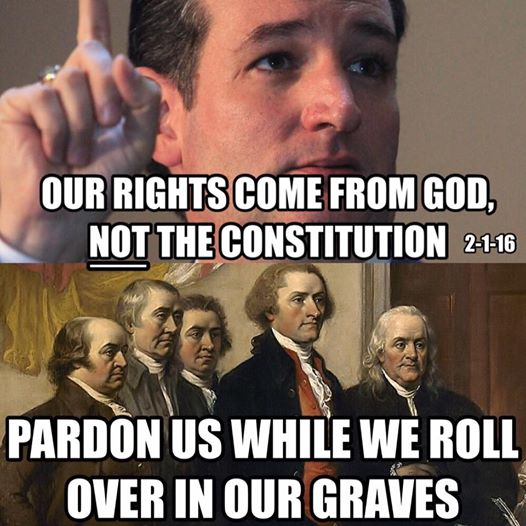
    This from Occupy Democrats:

    12647129_1058653647561022_4746717199189857381_n

    This from the Unites States Founding Fathers:

    When in the Course of human events, it becomes necessary for one people to dissolve the political bands which have connected them with another, and to assume among the powers of the earth, the separate and equal station to which the Laws of Nature and of Nature’s God entitle them, a decent respect to the opinions of mankind requires that they should declare the causes which impel them to the separation.

    We hold these truths to be self-evident, that all men are created equal, that they are endowed by their Creator with certain unalienable Rights, that among these are Life, Liberty and the pursuit of Happiness.–That to secure these rights, Governments are instituted among Men, deriving their just powers from the consent of the governed, –That whenever any Form of Government becomes destructive of these ends, it is the Right of the People to alter or to abolish it, and to institute new Government, laying its foundation on such principles and organizing its powers in such form, as to them shall seem most likely to effect their Safety and Happiness. Prudence, indeed, will dictate that Governments long established should not be changed for light and transient causes; and accordingly all experience hath shewn, that mankind are more disposed to suffer, while evils are sufferable, than to right themselves by abolishing the forms to which they are accustomed. But when a long train of abuses and usurpations, pursuing invariably the same Object evinces a design to reduce them under absolute Despotism, it is their right, it is their duty, to throw off such Government, and to provide new Guards for their future security…

    We, therefore, the Representatives of the united States of America, in General Congress, Assembled, appealing to the Supreme Judge of the world for the rectitude of our intentions, do, in the Name, and by Authority of the good People of these Colonies, solemnly publish and declare, That these United Colonies are, and of Right ought to be Free and Independent States; that they are Absolved from all Allegiance to the British Crown, and that all political connection between them and the State of Great Britain, is and ought to be totally dissolved; and that as Free and Independent States, they have full Power to levy War, conclude Peace, contract Alliances, establish Commerce, and to do all other Acts and Things which Independent States may of right do. And for the support of this Declaration, with a firm reliance on the protection of divine Providence, we mutually pledge to each other our Lives, our Fortunes and our sacred Honor. (emphasis mine)

    Oceania is at war with Eastasia. Oceania has always been at war with Eastasia.

  • Is a Divine Command Theory Psychotic? Sam Harris on Divine Commands Part III

    William Lane Craig v Sam HarrisIn Sam Harris on Divine Commands Part I I criticised Harris’ characterisation of divine command meta-ethics. I refuted Harris’ contention a divine command theory is pscyopathic in Is a Divine Command Theory Pscyopathic? Sam Harris on Divine Commands: Part II. In this last post in this series, I will address Harris’s contention that a divine command theory reflects a “psychotic moral attitude”. Harris says a divine command theory is “psychotic because this is completely delusional. There’s no reason to believe that we live in a universe ruled by an invisible monster called Yahweh.”

    Harris’s argument in this regard seems to involve four premises. [1] A person can accept a divine command theory only if her or she believes in the existence of an invisible monster called Yahweh (which Harris earlier identifed as an “iron age God of war”); [2] there is no evidence for an invisible monster called Yahweh; [3] to believe something without evidence is delusional; [4] to be delusional is to be psyhcotic.

    Turning to [1], a divine command theorist holds that the most plausible account of the nature of moral obligations is that moral obligations are constituted by, or are identical with, God’s commands. God is understood by the theorist to be a being worthy of worship, a necessarily existent, essentially loving and just, omniscient, omnipotent, personal being who created, sustains and providentially guides the universe. Holding this position does not commit one to believing in an invisible monster or a stone-age God of war for two reasons.

    First, a divine command theory is compatible with being an athiest. Plantinga has noted that a person could argue that moral obligations are best accounted for in terms of God’s commands and then conclude from this that if God does not exist then moral obligations do not exist either. In this sense a divine command theory could be a premise in an atheistic argument for nihilism. Interestingly, when I was a grad student in the 90’s I attended a conference where one of the presenters offered an argument for nihilism very much along these lines.

    Second, most divine command theorists accept the existence of moral obligations. Most would accept, for example, that moral claims such as that it is wrong to torture children purely for entertainment are true, and that, the action of torturing children in this way actually has the property of being wrong, further, that it does so independently of whether we or our society believe that it does.

    A divine command theorist does not have to identify this God with Yahweh. Obviously, divine command theorists who are Jews or Christians will do this, but that’s in virtue of their Judaism or Christianity, it is not in virtue of their belief in divine command meta-ethics. Strictly speaking a divine command theorist could reject the identification and still maintain that moral obligations are best identified with the commands of God.

    Third, even if one does identify God with Yawheh, it is evident that such an identification would rule out construing God as “an invisible monster” who is, according to Harris, ” a stone-age God of war”. If Yahweh is identified as a loving and just, invisible person, then he is neither an invisible monster or a stone-age God of war. Of course, a person who held this view might grant that at one piont in history, perhaps in the late Bronze Age or early Iron Age, various people groups believed that Yahweh was a God of war, but by identifying God as Yahweh, such a person is explictly rejecting this conception. The fact that people once concieved of something a certain way tells us nothing about whether that thing is, in fact, that way. Harris may as well castigate contemporary atomic theory by pointing out that ancient greek atomists held scientifically indefensible understandings of an atom.

    So Harris’ [1], the contention that a person can accept a divine command theory only if they believe in the existence of an invisible monster is false.

    Turning then to [2], the contention that there is no evidence for the existence of an invisible monster called Yahweh. Harris’s argument is circular. Suppose, for the sake of argument, (more…)

  • Ad Hominens, Special Pleading, Straw Men & Red Herrings: John Loftus’ Response to MandM

    John Loftus has written a response to my post “There Probably are no Duties. Now Stop Worrying and Enjoy Your Life!” Before turning to Loftus’ critique, let me recap my argument. While my post was satirical, it was intended to make a serious point. This being that many common and influential critiques of theism are incoherent.

    To establish this I argued three things.

    [1] That many critiques atheists offer of theism are moral critiques. Atheists argue that historically theism has been intricately linked with various forms of social oppression and/or the sacred texts of theistic religions condone oppressive practices.

    [2] That such critiques presuppose or assume the existence of moral duties. The critic has to assume that these practices are wrong even though the religious believers condone them.

    [3] That if one accepts the standard arguments atheists use against theism then the presupposition that there are moral duties is unjustifiable because precisely analogous arguments can be used to show there are no moral duties.

    Now if these three contentions are true then there is a fundamental incoherence in many common critiques of theism. If Loftus is going to provide a rebuttal of these contentions then he needs to provide reasons for thinking one of these three contentions is false.

    Unfortunately, instead of engaging the argument, Loftus ignored it and attacked a string of red herrings.

    John LoftusLoftus’ first argument in Do You Want to Be a Christian Apologist? Part 10 was to assert that I am “intellectually dishonest”, although somewhat charitably he states I am probably not aware I am dishonest – presumably I suffer from profound self-deception. Apparently the truth of this claim is blatantly obvious to “us” [by which he apparently means the atheist community].

    Unfortunately, simply stating that I am self-deceived and asserting with great confidence that I am wrong is not actually tantamout to offering a reason for questioning [1], [2] or [3] above. If it did then one could easily demonstrate that Loftus’ own work is substandard, I could just assert that it is and that everyone knows I am right and hey presto there’s my proof .

    Clearly, this is not a method by which one can reliably establish the truth or falsity of the matter.

    Loftus second argument begins with him drawing from my preamble:

    “Some atheists offer moral critiques of theism; their claim is not just that belief in God is false or unjustified, it is that such irrational beliefs are intricately linked with immoral and oppressive practices. Moral outrage often motivates the critiques offered – one only needs to read the condemnation of religious wars, religiously motivated terrorism, inquisitions, witch hunts, the suppression of science, sexism, homophobia, and so on, which is so prevalent in many free thought writings. Similarly, one needs only to read the accusations, regularly repeated in popular atheist literature, that the Bible condones slavery, or genocide, or stoning cheeky children, or rape, to observe this.

    Note that behind this critique is the presupposition that there are moral duties. People have a duty to not engage in wars or acts of terrorism, religious people who promote sexist or homophobic practices are wrong for doing so. I think this is nonsense as it assumes there is such a thing as a moral duty, it assumes things religious people do can be wrong. This is false and here is why.”

    After citing me Loftus rejoins:

    “Note the diversion here? Instead of providing answers to skeptical arguments he’s asking how anyone can have a moral critique of the Bible who doesn’t believe it’s the inspired word of God. He’s special pleading. No one else, given the rules of his game, can offer a moral critique of the Bible. Not a Hindu, nor a Muslim, nor a Buddhist, nor even liberals like the late John Hick or Thom Stark, or process theologians….. Do they? Do pantheists have a moral basis for critiquing the Bible? Flannagan would also have to reject the Natural Law Ethics (NLE) of the Catholic church, for if Natural Law Ethics obtains then even atheists have a basis for their moral critiques of the Bible. …”

    Unfortunately this rejoinder has little rational merit at all.

    First, I do address the sceptical arguments in question. By defending [3] I argue that analogues of these arguments entail an obvious false conclusion and therefore they cannot be sound. This is clear from reading the section of the original post which Loftus does not cite.

    Second, contrary to what (more…)

  • Is a Divine Command Theory Pscyopathic? Sam Harris on Divine Commands: Part II

    William Lane Craig v Sam HarrisIn my last post, Sam Harris on Divine Commands: Part I, I criticised Sam Harris’ characterisation of divine command meta-ethics.  In this post I want to turn to his second line of criticism of a Divine Command Theory. In Harris’ debate with William Lane Craig at Notre Dame, transcript here, Harris stated:

    “I’m glad he raised the issue of psychopathy—we are being offered a psychopathic and psychotic moral attitude. It’s psychotic because this is completely delusional. There’s no reason to believe that we live in a universe ruled by an invisible monster Yahweh. But it is, it is psychopathic because this is a total detachment from the, from the well-being of human beings. It, this so easily rationalizes the slaughter of children. Ok, just think about the Muslims at this moment who are blowing themselves up, convinced that they are agents of God’s will. There is absolutely nothing that Dr. Craig can s—can say against their behavior, in moral terms, apart from his own faith-based claim that they’re praying to the wrong God. If they had the right God, what they were doing would be good, on Divine Command theory.”

    Here, Harris suggests a Divine Command Theory expresses both a psychopathic and a psychotic moral attitude. I will address the charge of a Divine Command Theory being “psychotic” in a later post. Here, I want to address what I think is Harris’ main concern: a Divine Command Theory is psychopathic. It involves a “total detachment … from the well-being of human beings” and “so easily rationalizes the slaughter of children”. Why does Harris think this? “Because, at this moment Islamic terrorists are blowing themselves up convinced they are agents of God’s will, and a divine command theory can say nothing against their behavior in moral terms except the faith based claim that they are praying to the wrong God.”

    A lot could be said about this argument. First, note that even if it were sound, it does not show the Divine Command Theory is false. Harris is, in fact, offering pragmatic arguments against the theory: it is dangerous, or is easily misused – but there are many things which are dangerous and easily misused that are nevertheless true.

    More importantly, the argument is unsound. A Divine Command Theory contends that an action is obligatory if God actually commands that action. It does not contend that an action is obligatory if someone claims, or believes that God commands it. Obviously, simply believing something is the case does not mean that it is true. Harris, as an atheist, surely recognises this; many people believe and are convinced God exists yet Harris thinks they are mistaken.

    Hence, the mere fact an Islamic terrorist believes God has commanded him or her to “blow themselves up” does not commit the divine command theorist to supporting terrorism. All a divine command theorist needs to say in response to Islamic terrorists is that (more…)