Category: Bad Reasoning

  • Turning the Tables

    “The gentleman in the red shirt” shows us a simple lesson in why you should think through what your argument entails before you state it on national television and in front of a live audience.

    Too often we get tied up in knots trying to answer all the objections hurled at us, especially the specious ones. The tactic of turning the argument back on your opponent, holding them to the very standard they have laid down, is very simple and very powerful.

  • What Atheists Could Learn from Legal Interpretation 101

    At the beginning of each semester my lecturers would remind students of the fire policy, “if the alarm sounds leave the lecture theatre immediately through the nearest exit and reassemble outside the Davis law library.” Now if during class one day my lecturer had said to me, “Madeleine, do not leave class today until you have spoken with me about your brilliant essay which simply must be included in my upcoming book” [what? it is a thought experiment ok? It could’ve happened…] but then half-way through class the fire alarm rang and the smell of smoke wafted into the lecture theatre – would anyone seriously expect me to remain in my seat? Should I be paralysed with confusion by the contradictions – did my lecturer mean me to be burned alive or overwhelmed by smoke inhalation because he told me to not leave class that day until I had spoken to him or should I follow his earlier instruction to exit the classroom on hearing a fire alarm and go to the area outside the Davis Law Library? What should I do? Oh the confusion! Perhaps I should simply conclude that due to the contradictions inherent in trying to read both sets of instructions together that my lecturer, in fact, does not exist.

    Is anyone buying this? I mean, clearly what I should do is leave with the rest of the class and talk to my lecturer later. [Doh!]

    Illustrations of this sort are often used in conflict of laws or legal interpretation classes to show that what prima facie appears to be a contradiction between two pieces of legislation actually is not. This is because imperatives occur in contexts where commonly accepted qualifications, riders, priorities, idioms, etc are assumed to be understood; implicit background beliefs are in play.

    We can see this clearly in the example above. I know it is unlikely my lecturer wants his students to obey his instructions to the extent that they burn to death. I know this because I know something of his purposes and of his character. I know him to be fairly decent, humane and not one to issue arbitrary, irrational commands. I know also something of the weights involved in the issues. For example, I know the fire policy is university policy and it concerns the issue of safety – both the physical safety of students as well as its own, it does not want to be sued or prosecuted or subject to critical public scrutiny. I know that the lecturer’s authority is derived from university authority and so his instructions cannot contradict or override it. I also know that the reason he gave the instruction for me to stay behind in class was because he wanted to work with me in the future to ensure the sales of his book make the top 10 list. So from all of this I can safely conclude that he did not mean for me to follow his instructions on pain of death today.

    Of course if I already believed my lecturer to be a petty, arbitrary, narcissistic, cruel bully, capable of anything who routinely issued commands with the purpose of harming, maiming and destroying students (and if I suspected he wanted to take my essay and publish it as his own so as to keep all the book royalties for himself) I might take a different approach as to how I read his instructions together. But it would be uncharitable of me in excelsis to adopt this assumption of his character as the default one to reason from.

    Taking these contextual factors together, along with a basic grasp of the English language, its idioms and a dose of common sense it is not that hard to navigate apparently conflicting instructions.

    I raise this because a site ironically called “Common Sense Atheism” recently put up a short post entitled 6 Questions with which to Stump Conservative Christians. I was extremely underwhelmed by the questions and was left wondering if the author had actually read any Christian works above Sunday School level on Christian ethics, biblical interpretation and so on (and clearly had not read very far into this blog) but I found one of the questions stood out en stupidus maximus (that’s a legal latin maxim meaning it was so stupid it had to be taken out). Question 4 asks,

    “The Bible says to worship God (obviously) and to obey your mother and father, but what do you do if your parents tell you to worship other gods?”

    Here, the atheist is trying to establish a contradiction in the commands God issues and from this contradiction we are presumably supposed to concede that Christians are irrational or that God does not exist or some such thing (and, of course, any Christian reading it is supposed to be “stumped”).

    No Christian I know would be even momentarily stumped by this because the answer is obvious: in such a case you should disobey your parents and worship God; end of. I find it no more paralysing than the issue of whether I should leave class when the fire alarm sounds or stay to talk to my lecturer. In both cases, I understand that the command cannot sensibly be understood as an absolutely unqualified imperative. I doubt very much that God, out of allegiance to Him, wants us to give up allegiance to Him.

    Of course if one wanted to make God look silly and arbitrary one could interpret it this way, just as you could attribute silly interpretations of what my lecturer meant such as intepreting his instructions as a command to wait for him even if I get burned alive in a fire or that my lecturer does not exist, but why would you?

    If you think I am just picking on one unfortunate atheist’s example I beg to differ. When Matt was an undergrad at the University of Waikato a leader of the campus rationalist society confronted him with Isaiah 30:26,

    The moon will shine like the sun, and the sunlight will be seven times brighter, like the light of seven full days, when the LORD binds up the bruises of his people and heals the wounds he inflicted.

    The rationalist then informed Matt as to what the temperature of the sun was. He multiplied that number by seven and then noted that if it were to become that hot then world would burn to a crisp. He concluded that the Bible taught that heaven was hotter than hell. Matt’s initial inclination was to laugh and asked the guy if the exchange had “brightened up his day and warmed his heart.” It turned out that the example came from a highly regarded book by a scientist critiquing creationism, ironically entitled “Telling Lies for God: Reason vs Creationism” [scientists really really shouldn’t pontificate on theology]. The book had recieved endorsements from leading Australian Clergy. [I am reminded of Rob Muldoon’s position on Australians]

    Then there was a discussion I had on Debunking Christianity’s “Madeleine Flannagan is Happy to be Treated as Women Were in the Bible!” where John Loftus pointed to Deuteronomy,

    “Deuteronomy 22:23 If a man happens to meet in a town a virgin pledged to be married and he sleeps with her, 24 you shall take both of them to the gate of that town and stone them to death—the girl because she was in a town and did not scream for help, and the man because he violated another man’s wife. You must purge the evil from among you.

    Deuteronomy 22:28 If a man happens to meet a virgin who is not pledged to be married and rapes her and they are discovered, 29 he shall pay the girl’s father fifty shekels of silver. [c] He must marry the girl, for he has violated her. He can never divorce her as long as he lives.”

    Now Matt had written several posts on this atheist chestnut which saw me get embroiled in an exchange with both Loftus and Stephen Carr. Carr surmised that,

    “If a woman is threatened with a knife, told she will be killed if she screams out, and does not scream out, there will always be a Christian to say , and I quote ‘isn’t she a part of the problem’?”

    Apparently the non-offensive-to-God way to rape a woman is to simply render her incapable of screaming because God’s issue is with the screaming and not the raping…

    Apparently when the bible lays down case laws, it cannot simply lay down a paradigm. It must spell out every possible nuance, qualification, exception, situation, application to analogous situations and so on.

    Apparently if it does not do this then it is denying opposition to the act – now even modern case law precedents do not function like this and legislation is never drafted this way but apparently this is the way to read Biblical law.

    Seriously.

    Perhaps Carr is a too easy a target. Atheist philosopher Michael Martin makes a similar interpretation of Deuteronomy,

    “it is assumed that in all cases that a rape victim could cry for help and if she did, she would be heard and rescued. Both of these assumptions are very dubious and sensitive to the contextual aspects of rape.”

    I am at a loss to understand why atheists insist on reading these texts like a lawyer with Aspergers Syndrome in search of a convincing technicality by way to circumvent the spirit and intendment of the law? I mean why? We can all handle instructions that conflict with fire alarms going off, we don’t interpret modern laws like this, so why do atheists (and some Christians) switch to such silly anachronistic readings when the instructions are attributed to God?

    I suspect the issue is the background factors I mention above. Many atheists believe God is a petty, arbitrary, narcissistic, cruel bully, capable of anything who routinely issues commands with the purpose of harming, maiming and destroying people. They believe that the bible is obviously silly, irrational, oppressive and supports contradictory absolutism in the family, is anti-women (and so obviously supports rape) is full of scientific absurdities (and so Isaiah was talking about cosmology) and so on.

    When you have a pre-conceived notion as to what you want the text to mean – be it an uncharitable reading or what you think or have heard that the text teaches – I suppose the silly reading is congenial. What this tells us is that the reading of the text is not what leads atheists (and some Christians) to their conclusions, rather it is their conclusions lead them to read the text this way.

  • Contra Mundum: Selling Atheism

    New Zealand motorists will have noticed a new genre of advertising billboards, those attempting to sell the concept that there is probably no God. These billboards are the collective efforts of the New Zealand Atheist Campaign, The Humanist Society and the New Zealand Association of Rationalist Humanists. Like all advertising campaigns, these billboards offer clever-sounding slogans, which are indicative of the philosophy of the seller – in this case three variants of popular ‘new-atheist’ arguments. Like any consumer, I want to read the product labelling a little deeper before I consider buying. So here I intend to unpack the slogans and take a look at the implicit reasoning behind each.

    Each billboard has the tagline “There’s probably no God. Now stop worrying and enjoy your life.” My first thought on seeing this was that authors must find atheism psychologically liberating. We do not have to worry that there is a God and that means that we can enjoy ourselves but why would the existence of God be something to worry about? Is it the moral accountability that goes with it? If God exists then we might have to worry that He has seen what we have done in secret, and being free from this worry enables us to enjoy our lives. If this is so then prima facie this suggests that guilt is a major motivation behind, at least some peoples, atheism.

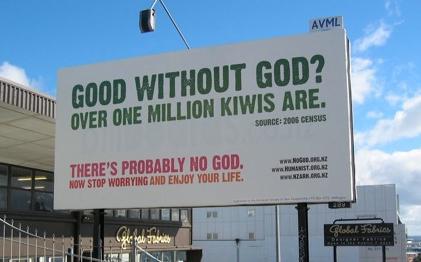
    The tagline aside, let’s look at the three slogans currently affronting us as we navigate our cities. The billboard on Auckland’s Newton Rd states, “Good without God? Over One Million Kiwis Are. Source:2006 Census.”

    Good without god?

    Here we are told that one million kiwis are good without God because the census says so. Now a lot could be said about the appeal to the census here, I don’t recall a question on it asking me if I was good and even if it did I am not sure that we should take too much from self-reported assessments of people’s own integrity. Let’s assume, however, that the billboard makes a fair claim. The inference is still is fallacious. What the census shows is not that one million kiwis are good without God, rather, it shows that one million kiwis are good without believing in the existence of God. But to say that one can be good without believing in God is not the same as saying that one can be good without God. Many people throughout history have been able to live and breath without believing in the existence of hydrogen and oxygen atoms yet it does not follow that they could live without hydrogen and oxygen.

    I am still left wondering how the fact that people do not need to believe in something to do good deeds renders the belief false? For centuries people have done good deeds and lived good lives without believing in heliocentricism or quantum mechanics, should we conclude that these theories are therefore ‘probably false’? Surely we are not being asked to buy that the basis of our beliefs should be what is useful or helpful as opposed to what is true?

    Perhaps the sellers mean to convey something else. Some Christian thinkers such as William Lane Craig, Robert Adams, Stephen Layman, Alvin Plantinga, John Hare and Philip Quinn have argued that moral properties such as right and wrong depend on God for their existence. Atheist writers such as Paul Kurtz and Christopher Hitchens retort that this claim is falsified by the existence of morally upright atheists. I suspect something like this is meant by the slogan on the billboard, it repeats Hitchens’ and Kurtz’s retorts as though they said something insightful or clever.

    This retort misses the point. Craig, Adams, et al are not claiming that one needs to believe in God to be good – a point made several times in the literature (and particularly made so many times to Kurtz that it beggars belief that he keeps repeating it) rather, their claim is that moral properties, such as right and wrong, depend on God for their existence. This is not the same thing, we know that water depends for its existence on the existence of hydrogen and oxygen, this does not mean, however, that we need to believe in the existence of hydrogen and oxygen in order to effectively recognise and use water. Ancient and medieval people were drinking, washing in, swimming in and sailing on water centuries before the discovery of contemporary atomic theory.

    This is a fairly basic and elementary distinction in the literature. How exactly expressing a common philosophical confusion counts as reason for thinking “there probably is no God” is hard to see.

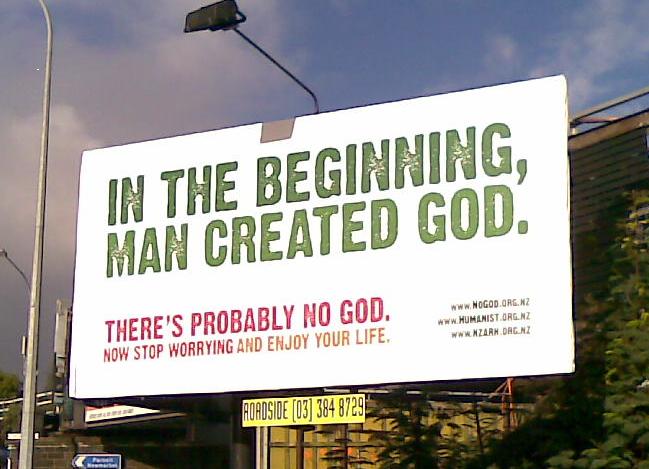
    Parnell Rise’s billboard informs us “In the Beginning Man Created God.”

    In the beginning man created god

    This one asserts that man created God. Now if one takes this statement in an absurdly literal manner (the way many sceptical organisations approach parables, hyperbole and poetry in the Bible) we find that atheists are telling us that God actually exists. I have no issue with the slogan at this juncture, however, the idea that God was created by human beings is clearly absurd. God is typically defined as an all-powerful, all-knowing, immaterial, necessarily-existent being who created the world and who sustains everything in it. Now if one is going to claim that humans actually created an all-powerful, all-knowing, immaterial, necessarily-existent who created and sustains the world, then they are contradicting themselves. Humans are part of the world and therefore cannot have created the being that created the world – otherwise humans would have to exist prior to their own existence.

    Of course to interpret this billboard in this way would be uncharitable. The authors of this billboard probably do not mean to say that humans actually created God, they do not think He exists after all. Their claim is that humans created the idea or concept of God and developed it. This is undoubtedly true. Of course, humans also invented the idea or concept of atoms as well – ancient Greek philosophers came up with the basics of this concept millennia ago – but this fact tells us nothing about whether or not the idea or concept humans developed actually corresponds to anything in reality. To assume that it tells us something about whether the idea or concept is true is a fairly obvious case of what logicians call the genetic fallacy.

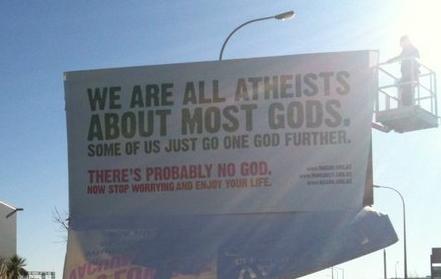
    The last one is my favourite, “We Are All Atheists About Most Gods. Some of Us Just Go One God Further.”

    We are all atheistsTo see the problems with this slogan take out the term “God” in the sign and replace it with some other term such as “non-Christian perspective.” When we do this we get: “We all reject most non-Christian perspectives, some of us just reject one more.” This argument has true premises, do we now have, a knock-down argument for Christianity?

    Similarly, an analogous argument form with true premises gives us an argument for nihilism, the denial that humans have moral duties, the total denial of the existence of morality. “We are all nihilists about some conceptions of morality, some of us are just nihilistic about one more.”

    The same argument for also furnishes a refutation of secularism, “we all reject some secular perspectives on reality, some of us just reject one more.” I could go on.

    Taking a stand on any issue of philosophical substance, whether by affirming, denying or simply being sceptical of it, is to put oneself in opposition to any number of other people and groups who take a contrary stance. That’s life. Such pluralism hardly provides a reason for thinking “there probably is no God” any more than it gives us a reason to doubt any other perspective on the world.

    So what do the atheist billboards do? Well the first one tells us that some atheist groups conflate basic philosophical distinctions and do not really understand the debate they are contributing to. The second shows us that these groups think contradictions and obvious fallacies are some how savvy and smart. The last shows us that they think that invalid argument forms, forms from which you could infer the denial of anything and everything by substituting one true premise with another, are avant-garde. All in all, pretty accurate advertising for these groups.

    I write a monthly column for Investigate Magazine entitled Contra Mundum. This blog post was published in the Sept 10 issue and is reproduced here with permission. Contra Mundum is Latin for ‘against the world;’ the phrase is usually attributed to Athanasius who was exiled for defending Christian orthodoxy.

    Letters to the editor should be sent to:
    editorial@investigatemagazine.DELETE.com

    RELATED POSTS:
    Contra Mundum: Did God Command Genocide in the Old Testament?
    Contra Mundum: Fairies, Leprechauns, Golden Tea Cups & Spaghetti Monsters
    Contra Mundum: Secularism and Public Life
    Contra Mundum: Richard Dawkins and Open Mindedness
    Contra Mundum: Slavery and the Old Testament

    Contra Mundum: Secular Smoke Screens and Plato’s Euthyphro

    Contra Mundum: What’s Wrong with Imposing your Beliefs onto Others?
    Contra Mundum: God, Proof and Faith
    Contra Mundum: “Bigoted Fundamentalist” as Orwellian Double-Speak
    Contra Mundum: The Flat-Earth Myth
    Contra Mundum: Confessions of an Anti-Choice Fanatic
    Contra Mundum: The Judgmental Jesus

  • Recycling The Dawkins Delusion

    Browsing the archives this morning I stumbled accross this gem, The Dawkins Delusion, which Matt originally published here some three years ago back before we had much of a readership so a lot you may have missed it. It is seriously clever and funny – go see!

  • Gary Gutting on Richard Dawkins’ Atheism

    The New York Times has an accessible and excellent critique of Richard Dawkins’ argument for the non- existence of God, written by University of Notre Dame Philosopher Gary Gutting entitled, “On Dawkins’s Atheism: A Response.”

    Enjoy.

    RELATED POSTS:
    Fairies Leprechauns, Golden Tea Cups and Spaghetti Monsters
    Richard Dawkins and Open Mindedness

  • There’s Probably No God? Fisking Atheist Billboards

    On the way back from Bloggers drinks we drove past one of the controversial atheist advertising billboards, put up by NZ Atheist Campaign, The Humanist Society and NZARH, which have appeared around Auckland. This appears to have come on the back of the Richard Dawkins inspired bus advertising that made headlines earlier this year. It is worth fisking them a bit.

    Here is a pic of the first one.

    Good Without God? Over One Million Kiwis Are.

    Here we are told one million kiwis are good without God because the census says so. This, however, is fallacious. What the census shows is not that one million kiwis are good without God, it shows that one million kiwis are good (although this is granting a lot for the sake of argument) without believing in the existence God. But to say one can be good without believing in God is not the same as saying one can be good without God. Many people throughout history have been able to live and breath without believing in the existence of hydrogen and oxygen atoms, it does not follow that they could live without water.

    Moreover, it is hard to tell what the point of this sociological fact is anyway. Why does the fact that people do not need to believe in something to do good deeds mean that the belief is false? For centuries people have done good deeds and lived good lives without believing in evolutionary theory or quantum mechanics, should we conclude that these theories are therefore ‘probably false’? Surely these atheists are not suggesting that our beliefs should be based on what is useful or helpful as opposed to what is true or false?

    Perhaps the atheists here mean to convey something else. Some Christian thinkers such as William Lane Craig, Robert Adams, Stephen Layman, Alvin Plantinga, John Hare, Philip Quinn have argued that moral properties such as right and wrong depend on God for their existence. Atheist writers such as Paul Kurtz and Christopher Hitchens retort that this claim is falsified by the existence of morally upright atheists. I suspect something like this is behind the slogan on the billboard, it repeats Hitchens and Kurtz’s retorts as though they said something insightful or clever.

    The problem is, as any one familiar with this discussion should know, this retort misses the point (as I pointed out in On a Common Equivocation). Craig, Adams, et al are not claiming that one needs to believe in God to be good (a point made several times in the literature and particularly made so many times to Kurtz that it beggars belief that he keeps repeating it) rather their claim is that moral properties, such as right and wrong, depend on God for their existence.

    This is a fairly basic and elementary distinction in the literature. How exactly expressing a common philosophical confusion counts as reason for thinking “there probably is no God” is hard to see.

    Let’s look at the next one.

    In the Beginning, Man Created God.

    What is asserted here? That man created God. This, however, is clearly absurd. God is typically defined as an all-powerful, all-knowing, immaterial, necessarily-existent being who created the world. Now if one is going to claim that humans actually created an all-powerful, all-knowing, immaterial, necessarily-existent who created the world, then they are contradicting themselves.

    Humans are part of the world and therefore cannot have created the being that created the world – otherwise humans would have to exist prior to their own existence.

    Similarly, one cannot create a necessary being, this would entail it is possible for a necessary being to not exist, in which case it would not be a necessary being. Taken in a straight-forward, literal manner (the way freethinkers are so fond of taking every passage in the Bible) this billboard simply asserts contradictions.

    Of course, the authors of this billboard probably do not mean to say humans actually created God, they do not think he exists after all. Their claim is that humans created the idea or concept of God and developed it. This is undoubtedly true. Of course, humans also invented the idea or concept of atoms as well, ancient Greek philosophers came up the basics of this concept millennium ago. This trivial fact tells us nothing about whether or not the idea or concept humans developed actually corresponds to anything in reality. To assume that it tells us something about whether the idea or concept is true or false is a fairly obvious case of the genetic fallacy.

    So the second billboard either asserts a contradiction or it is a clear case of a logical fallacy.

    The last one is my favourite.

    We are all atheists about most gods. Some of us just go one god further.

    I am inclined to think the argument on this sign is invalid. To see why let’s take out the term “God” in the sign and replace it with some other term such as “non-Christian perspective.” When we do this we get: “We all reject most non-Christian perspectives, some of us just reject one more.” This argument has true premises, do we now have, a knock-down argument for Christianity?

    Similarly, an analogous argument form with true premises gives us an argument for nihilism, the total denial of the existence of morality. “We are all nihilists about some conceptions of morality, some of us are just nihilistic about one more.”

    The same argument for also furnishes a refutation of secularism, “we all reject some secular perspectives on reality, some of us just reject one more.” I could go on.

    Taking a stand on any issue of philosophical substance, whether by affirming, denying or simply being sceptical of it, is to put oneself in opposition to any number of other people and groups who take a contrary stance. That is life. Such pluralism hardly provides a reason for thinking “there probably is no God” any more than it gives us a reason to doubt any other perspective on the world.

    So what do the atheist billboards do? Well the first one tells us that some atheist groups conflate basic philosophical distinctions and don’t really understand the debate they are contributing to. The second shows us that these groups think contradictions and obvious fallacies are some how savvy and smart. The last shows us that they think that invalid argument forms, forms from which you could infer the denial of anything and everything by substituting one true premise with another, are avant-garde.

    All in all, pretty accurate advertising for these groups.

    Hat tip: MCAS