Category: Philosophy of Religion

  • Peter Singer on Human Dignity and Infanticide: Part One

    This is the first section of the paper I presented to the the Evangelical Philosophical Society Annual Meeting in Milwaukee two weeks ago. Several people have asked me to post it on MandM. It will appear as a two-part post series.

    Christian theism has traditionally taught that human beings have equal dignity and worth, a moral status that separates them from non-human animals. Peter Singer has famously rejected this teaching, holding that human beings are not any more special than animals and doctrines of human dignity are indefensible.  He contends that killing a new-born infant is, in and of itself, no more problematic than killing a non-human animal such as a cow or a pig and defends the permissibly of infanticide under certain conditions.

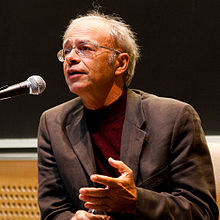
    Peter SingerThis paper will critically assess one important part of Singer’s position: his understanding of why it is wrong to kill.  In I I will sketch Singer’s “desire account” of killing and its relationship to his own preference utilitarianism and project of animal equality. Following Don Marquis, I will argue in II, that this “desire account” is subject to important counter examples. In III I note Singer’s attempts to modify his position so as to avoid these counter examples and suggest that these modifications are problematic. In IV, I will suggest that, despite this, there is an important truth in Singer’s critique, one that Christian thinkers can appropriate in developing moral arguments for Christian theism.

    I. Preference Utilitarianism and the desire account of the wrongness of killing
    Classical Utilitarianism conjoins three theses. First, the maximisation thesis; an action is right if and only if it maximises overall net benefit:  net benefit being the total amount of  benefit accruing to individuals as a consequence of the action, minus any harms resulting. An action maximises net benefit when the consequences of performing it constitute a higher net benefit than that associated with any alternative action.

    Second, , the thesis of equal consideration: a benefit or harm to any one individual is counted as having equal weight to a similar sized benefit or harm to any other individual.

    Third, the thesis of hedonism: on this account, benefits and harms are understood in terms of pleasure and pain. Something benefits an individual or is good if it causes him pleasure and harms him if it causes pain.

    Peter Singer is a preference utilitarian. Preference utilitarians accept both the maximisation and equal consideration theses however reject hedonism in favour of a desire fulfillment or preference satisfaction view of the good. Something is good for an individual if he desires or prefers it, and it is bad if contrary to his preferences or desires.

    Singer uses preference utilitarianism to reject the doctrine that human beings have equal dignity and worth, a moral status that separates them from non-human animals.  Sentient animals clearly have desires; they can suffer and feel pain and desire not to. The equal considerations thesis entails that in so far as these desires are similar to those of human beings the suffering of an animal must be considered equal with that of a human being.

    However, in terms of actual as opposed to potential psychological capacities, some human beings have a comparable mental life to that of animals.   A new born human infant’s psychology is primitive. David Boonin notes “by any plausible measure dogs, and cats, cows and pigs, chickens and ducks are more intellectually developed than a new born infant.” [1]  This means that the desires of a new born infant are similar to those of other animals.

    Singer illustrates this point in a discussion of animal experimentation. (more…)

  • Back from the USA

    The CrowdMadeleine and I flew back to New Zealand from Milwaukee on Tuesday having both attended the Evangelical Philosophical Society Annual Meeting, the Annual Meeting of the Evangelical Theological Society, and the Evangelical Philosophical Society’s Apologetics Conference. Prior to that I had spent three weeks based in Charlotte, North Carolina. I will speak about the  conferences later in this post but first I will summarise what I did in Charlotte.

    Charlotte
    My work in North Carolina can be divided into several categories.

    First, and this was the bulk of what I did, I did a bit of speaking on a lecture circuit at various campuses in North Carolina on issues relating to God and Morality for Ratio Christi. Formally, this involved, driving to a campus, delivering a lecture and then taking a Q&A.

    Speaking at UNC CharlotteI learned very quickly that there was a lot more to what I was doing than the formal activity of giving lectures; in fact, most of the more important work was the informal stuff that went on behind the scenes.  In addition to presenting lectures, there was often an equally important informal component. Often I would meet with students before the lecture  and discuss the challenges they were facing as Christian students in a secular campus. I would offer advice, counsel, support, etc. On other occasions I would, in addition to giving the lectures, meet with the supporters and financiers of the people running student ministries and discuss with them the importance of Apologetics and of developing an intellectually robust faith among students.  I found that the most important and constructive engagement and interaction with people typically occurred in these informal contexts.

    Speaking at Appalachian State UniversitySecond, in addition to my major task of giving lectures, on the weekends I gave instruction in churches. After my first week I was part of a missions team that spent a weekend teaching at a church in a nearby Cherokee Reservation.  The weekend after that I taught an adult education class in a Community Fellowship Church of North Carolina. The  following weekend I preached from the pulpit.  One Sunday evening I attended a service at a Slavic Baptist church where almost the entire service was in Russian and we needed a translator to follow what was being said. After the service I was one of a team of people who spoke to the youth group; I spent several hours fielding their very astute and intelligent questions about the Christian faith.

    This work was very challenging. It is one thing to give lectures at a university when one has, as I have, spent years studying and working in universities. It is quite another speaking to Cherokee Native American Indians one week, Southern Americans the next and youth from Slavic Immigrant Families the next – especially when my own culture is Kiwi!

    Third, and finally, I worked with the students at Southern Evangelical Seminary. One night when I was not lecturing, I presented an academic paper to students and graduates from the seminary, which was followed by a discussion. Another night I travelled to Belmont Abbey, a Catholic Liberal Arts College to dialogue with a Catholic theologian about the relative strengths of Natural Law Theory verses Divine Command Meta- Ethics.

    Both events were focused on seminary students, to get them to be presented with new or different material to what they were familiar with so they could ask questions and be stretched in their intellectual development.  I found the work over those three weeks very taxing physically, yet I enjoyed it immensely. I was giving lectures at universities, back to back, almost every day; I was often travelling for hours to and from the university in question and sometimes I would have to stay overnight with billets. As noted above the diversity of what I did stretched me.

    Lecturing on campuses to potentially hostile audiences is challenging enough, particularly when one throws in a Q&A. It becomes more so when there are obvious cultural barriers such as my indecipherable New Zealand accident and tendency to speaK too quickly because of the speed of my thoughts!  But, in addition to this, I was required to  give a talk to theology students, to Slavic youth, adult congregants, North American Indians on Reservations, and people from a country not my own in general – these contexts forced me to adapt my material fairly quickly to these new contexts with very little prep time.

    Milwaukee
    Madeleine, Bill Craig and IThe business end of my trip however was the conference in Milwaukee. On Wednesday 16 November 2012. Both Madeleine and I presented papers at the Evangelical Philosophical Society’s Annual Meeting. In the morning I presented my paper “Peter Singer, Human Dignity and Infanticide”; this was a critical look at Peter Singer’s account of the wrongness of killing and some of his attempts to revise his position in light of criticisms by Don Marquis.

    EPS Panel DiscussionIn the afternoon, Madeleine and I were on a panel discussing the  book Being Good: Christian Virtues for Everyday Life along with Mary Jo Sharp, Cristian Mihut and the book’s Editors, Michael W Austin and Doug Geivett. Madeleine offered a response and critique of the chapter on “Courage” by Rebecca Konyndyk DeYoung and I offered a criticism of Charles Taliaferro’s chapter on “Love”.

    Madeleine did extremely well, you would never have guessed, unless you knew to look for things like how she gripped the podium, that she had flown into Milwaukee at 12.05 am the night before, had been living with a pain disability aggravated by sitting for the past 4 years which was on high alert due to almost 24 hours travelling, and that she was completely shattered from working insane hours to be able to leave her litigation schedule and our children, whilst functioning on NZ time. In her typical style she spoke in a clear, articulate and forthright manner, her content was good, and I doubt anyone present could have been aware of the fact that she alone was the only speaker on the panel with no formal philosophy qualifications without reading her bio.

    Panel on Protestant PurgatoryIn addition to our own presentations, we attended a number of sessions such as Mike Austin’s talk on “Analytic Moral Theology”, Frank Beckwith’s response to the recent  “After Birth Abortion” paper published in the Journal of Medicine and Ethics, Paul Copan’s discussion on Acts 17, Charles Taliaferro’s Lecture on Environmentalism, a very stimulating panel discussion on Jerry Wall’s new book which offers a Protestant Defense of Purgatory, among various other presentations including sessions on religious pluralism and the Evangelical Theological Society’s panel discussion on environmentalism.

    Me, Frank Beckwith, MadeleineBy the time the EPS Apologetics conference started both Madeleine and I were knackered. Despite this we attended sessions on God and Morality by Frank Beckwith, Jeremy Evans’ session on Theism and the Meaning and Purpose of Life, David Baggett’s discussion of Moral Scepticism, Mike Austin’s talk on “Evangelical Blogging”, Angus Menuge, the new Evangelical Philosophical Society President’s talk on Religious Language, Gary Habermas’ talk on the Resurrection, and Mary Jo Sharp’s very useful session on effective public speaking.

    Paul Copan, Madeleine and IIn addition to the papers and sessions there was a lot of general networking going on. Paul Copan, Madeleine and I and met with a prospective publisher about co-writing a book on the moral issues surrounding the conquest narrative; it looks likely that Baker Books will accept our proposal, I will keep readers posted. I signed my publishing contract with Baker for an earlier publication. Madeleine had an interesting experience with Lee Strobel, Mary Jo Sharp, Mark Mittelberg and Chad Meister dialoguing with a prospective seeker. Mary Jo Sharp and Madeleine plotted prospective joint debate projects. Frank Beckwith and Madeleine discussed their shared religion in public life/philosophy meets law interests; Frank and I discussed possible joint projects on the abortion issue. Discussions were had with Craig Hazen about the Biola Faculty, Mark Mittelberg, Mary Jo Sharp and William Lane Craig about the possibility of their visiting New Zealand. We also met with Ratio Christi regarding the possibility of  a New Zealand chapter being formed.

    Mary Jo Sharp and Madeleine

    Since we got back, I have been following up on several potential employment opportunities that have arisen from the trip, a couple in New Zealand, a couple overseas, as well as possibility of 3 further books, one co-written with Madeleine, and various other potential projects involving ministry writing and speaking.

    In addition to the scholarly stuff, I got to see the Atlantic Ocean for the first time,  I saw the New York sky line, the Statue of Liberty and the New World Trade Centre. I visited a Nascar Centre, was present in the US during the re-election of Barack Obama and Cyclone Sandy. We discovered Wisconsin Cheese, Wisconsin Frozen Custard and Madeleine got to indulge in her favourite lollie flavours (candy to the US readers): cinnamon and root beer (she is happy to receive donations of either or both via post).

    Needless to say we arrived home on Tuesday extremely tired but extremely grateful to everyone who supported us in making this trip from those who donated – we love you all – through to people like Simon Brace who organised the Charlotte leg, Paul Copan who shared his hotel room with us, Ratio Christi who shouted us meals, our eldest daughter Sheridan who took on the task of primary caregiver to her younger siblings – no mean task given the severe Autistic Spectrum Disorder and Anxiety issues of our youngest child – Mike Austin and Doug Geivett who invited Madeleine and I to speak on their Book Panel, among others (this is by no means an exhaustive list!).
  • Contra Mundum: Dawkins and Secular Hypocrisy

    Richard DawkinsWhen I was a non-Christian I was forever hearing about how Christians are hypocrites. When I converted to Christianity at 17, one thing that struck me is how often these charges were often a case of the pot calling the kettle black. While there is undoubtedly some hypocrisy within the church, it is also pervasive outside it. Secular culture often contains absurd ironies and hypocrisy which are conveniently ignored.

    A great example was the media fiasco over William Lane Craig’s visit to the United Kingdom last year. Craig is distinguished philosopher known professionally for his work in philosophy of time and philosophy of religion. Alongside his scholarly work, he has also developed a reputation as a prolific public speaker and debater, debating many of the world’s leading sceptics. His combination of scholarly ability and effective debating skills has earned him a reputation as one of the world’s foremost Christian apologists.

    “Apparently, having two PhD’s, authoring over 100 papers, and writing 30 books on a topic makes you unqualified to speak on it, but being the star of the 80’s TV series “Growing Pains” does.”

    Craig’s visit to the UK attracted media attention when Richard Dawkins, author of the best selling “God Delusion”, publically and resolutely refused to debate him. Dawkins publically stated earlier of his critics that “he did not care” who they were, he would “dialogue” with them and “win the argument”. He also had publically debated numerous critics significantly less qualified than Craig, notably Ted Haggard. These facts, alongside Dawkins implausible and inconsistent reasons lead to accusations of cowardice and hypocrisy from other academics such as Daniel Came a philosophy professor at St Hugh’s College Oxford.

    In the UK newspaper the Guardian Dawkin’s gave two reasons for his refusal. According to Dawkins, Craig “parades himself as a philosopher, but none of the professors of philosophy whom I consulted had heard his name”. Dawkins omitted to mention that this was not the first time he had publicly denigrated Craig’s scholarly credentials. On a previous occasion  Daniel Came,  had e-mailed him stating:

    “Professor Craig has a PhD in philosophy and a PhD in theology. He is Research Professor in Philosophy at Talbot University. He has published more than thirty books and over a hundred papers in reputable peer-reviewed journal. Given your passionate and unconditional commitment to truth, I can only think that you were not aware of Professor Craig’s credentials when you made the above reference.”

    So Dawkins claim that no philosopher he had consulted had ever heard of Craig was less than honest. A less charitable person might describe this as simply slander.

    Dawkins concern about Craig’s alleged lack of scholarly credentials also seems odd seeing that he (Dawkins) had earlier accepted an invitation to debate actor Kirk Cameron.  Apparently, having two PhD’s, authoring over 100 papers, and writing 30 books on a topic makes you unqualified to speak on it but being the star of the 80’s TV series “Growing Pains” does qualify you. It’s also ironic that Dawkins would accuse Craig of lacking scholarly credentials on the matter given that he (Dawkins) is a biologist and not a philosopher of religion.

    Dawkins next excuse was that Craig is “morally unfit” to debate him.  To substantiate this he cites not from any of Craig’s scholarly writings. But two blog posts Craig had written on with the conquest of Canaan. At face value  the early chapters of the book of Joshua portrays God as commanding the killing of every man women and child in Canaan. I say “appears”, here because latter sections of the book of Joshua and its sequel in judges proceed on the assumption this never occurred, and studies into ancient conquest accounts of this genre have noted the widespread use of literary hyperbole whereby victories are described in sweeping rhetoric of killing absolutely everyone when in reality they were (more…)

  • Singer on Matthew Flannagan in “Peter Singer Under Fire: The Moral Iconoclast Faces His Critics”

    Yesterday Matt went the library and did a little reading for his upcoming Evangelical Philosophical Society paper “Peter Singer, Human Dignity, and Infanticide“ and he discovered that email exchange he’d had with Peter Singer in 2006 had resulted in a few paragraphs in Singer’s book Peter Singer Under Fire: The Moral Iconoclast Faces His Critics.

    Here is a screen shot of what one sees when one uses the “search inside this book” function:

    Peter Singer Under Fire: The Moral Iconoclast Faces His Critics

    Matt does not feel that Singer accurately portrayed his counter example but the substance Singer presents of it is correct. Singer’s response to Matt seems to be that Matt is right in principle but in practice it would never be an issue.

  • Madeleine and Matt to speak on “Being Good: Christian Virtues for Everyday Life” at the 2012 Evangelical Philosophical Society Meeting in Milwaukee

    Evangelical Philosophical Society

    I have had to revise my earlier statements about not going to the November 2012 academic conferences in Milwaukee on the grounds that when you are personally invited to participate in a panel discussion by Doug Geivett and Mike Austin at the Evangelical Philosophical Society (“EPS”) you do not say no 🙂

    (If I said “no” I think Andrew would throw things at me and André Z would egg him on)

    Matt has been invited to speak on the same panel too.

    Here is what we know so far:

    Being Good: Christian Virtues for Everyday LifeMike and Doug co-edited a book entitled Being Good: Christian Virtues for Everyday Life.  At the EPS meeting in Milwaukee in November 2012 there will be a panel discussion in one of the sessions offering critical discussion of the book and it’s themes. Matt and I are now scheduled to be participants in that panel.

    The panel will discuss different aspects of the book, such as, an analysis of a virtue in the book that a participant disagrees with by giving an extension of the book’s discussion of character in some way.

    Matt was already going anyway as his paper on Singer and Infanticide got through the blind review process and was accepted.

    I had thought I might not go as we in the process of radically changing how I earn money. I am about to swap my regular weekly income for a contract for services that will see me retain most of the money I make my firm but pay my own expenses (and still be supervised and under the umbrella of a firm as all baby-lawyers should be under the law). So this is both exciting as I will have more control over what I earn but it is also scary as there are no guarantees that I will earn consistently; imminent changes to how legal aid is to be paid make that even scarier. The theory is that in the long run I will make more than I was on my very low baby-lawyer income but it is yet to be tested. As I am the primary earner in our house there is a lot riding on this, including the extension to our mortgage to purchase this opportunity. Going to America is not a cheap exercise from New Zealand but we have providentially managed to find a way the last two years with a lot of help from our friends so I am going to stop worrying and focus on trusting in God to whom I am  grateful for this opportunity.

  • Matt to speak on Singer and Infanticide at 2012 Evangelical Philosophical Society Meeting in Milwaukee

    Every November there is about a two week period in America where a number of professional academic conferences are held where the best of the best in the field gather. For the last two years Matt has been either accepted or invited to speak at them (I was accepted to speak at them last year too but had a visa problem at the last minute so Matt went without me). Anyway, this year they are all being held in Milwaukee and I am happy to announce that Matt received this email last week:

    Evangelical Philosophical SocietyCongratulations!  Your paper proposal for the 2012 Evangelical Philosophical Society meeting in Milwaukee (14-16 November) has been accepted for presentation.

    …

    Since there were nearly twice as many proposals as spaces, many fine papers had to be rejected.  If for any reason you will not be able to present your paper after all, please inform the EPS program committee as soon as possible so that we can allow one of the alternates to fill the vacated slot.

    Again, congratulations, and we look forward to hearing your paper in Milwaukee!

    Sincerely in Christ,

    The EPS program committee

    Yay – so proud of him! The abstract he submitted for blind review was as follows:

    Peter Singer, Human Dignity, and Infanticide

    Christian theism has traditionally taught that human beings have equal dignity and worth, a moral status that separates them from other non-human animals. Peter Singer has famously argued that this teaching is problematic; human beings are not any more special than animals and doctrines of human dignity are indefensible.  He contend that killing a new-born infant is, in and of itself, no more problematic than killing a non-human animal such as a cow or a pig, and he defends the permissibility of infanticide.

    This paper will critically assess one important part of Singer’s position: his understanding of why it is wrong to kill.  In part 1 I will sketch Singer’s “desire account” of killing and its relationship to his own preference utilitarianism and project of animal equality. Following Don Marquis, I will argue that this “desire account” is subject to important counter examples. In part 2, I will note Singer’s attempts to modify his position so as to avoid these counter examples and suggest that these modifications undercut his arguments for animal equality. In part 3, I will suggest that, despite this, there is an important truth in Singer’s critique, one that Christian thinkers can appropriate in developing moral arguments for Christian theism.

    Matt did not apply for any other of the conferences this year, although he was invited to give a paper at the Society for Biblical Literature but the session got cancelled. He and I are contemplating applying to Notre Dame’s annual conference on the week before, it’s theme this year is Justice so both of us could, and I still have enough time on my US Visa to go, but I am not sure if I have time to write a paper as my case-load is insane, so it might be just Matt. Anyway – yay Matt!

    Update
    Wow, already in receipt of donation offers to help get him there! We love you guys 🙂 We have just over $1.5k left over from blog donations and fundraising last time which constitutes the refunds from my aborted-lack-of-visa trip. I will price Auckland to Milwaukee and put up a fundraising widget in the sidebar soon – as with previous years accommodation options will be needed so Milwaukee readers if you have a couch talk to me 🙂

  • Mark Murphy Reviews Walter Sinnott-Armstrong.

    Those who have followed my recent discussions of Walter Sinnott-Armstrong’s writings on God and Morality. Might be interested in this review of Armstrong’s book “Morality without God”  by Mark Murphy in Notre Dame Philosophical Reviews. Mark  is a lecturer in moral philosophy at Georgetown University. He is is one of the leading critics of divine command ethics writing today.

    Interestingly, there is some overlap in his comments and mine, particularly the issues regarding “social obligations” and how moral obligations constitute reasons for action.

    Enjoy