Category: Philosophy of Religion

  • Is a Divine Command Theory Psychotic? Sam Harris on Divine Commands Part III

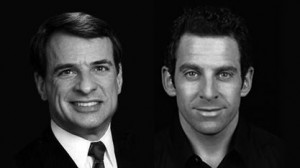
    William Lane Craig v Sam HarrisIn Sam Harris on Divine Commands Part I I criticised Harris’ characterisation of divine command meta-ethics. I refuted Harris’ contention a divine command theory is pscyopathic in Is a Divine Command Theory Pscyopathic? Sam Harris on Divine Commands: Part II. In this last post in this series, I will address Harris’s contention that a divine command theory reflects a “psychotic moral attitude”. Harris says a divine command theory is “psychotic because this is completely delusional. There’s no reason to believe that we live in a universe ruled by an invisible monster called Yahweh.”

    Harris’s argument in this regard seems to involve four premises. [1] A person can accept a divine command theory only if her or she believes in the existence of an invisible monster called Yahweh (which Harris earlier identifed as an “iron age God of war”); [2] there is no evidence for an invisible monster called Yahweh; [3] to believe something without evidence is delusional; [4] to be delusional is to be psyhcotic.

    Turning to [1], a divine command theorist holds that the most plausible account of the nature of moral obligations is that moral obligations are constituted by, or are identical with, God’s commands. God is understood by the theorist to be a being worthy of worship, a necessarily existent, essentially loving and just, omniscient, omnipotent, personal being who created, sustains and providentially guides the universe. Holding this position does not commit one to believing in an invisible monster or a stone-age God of war for two reasons.

    First, a divine command theory is compatible with being an athiest. Plantinga has noted that a person could argue that moral obligations are best accounted for in terms of God’s commands and then conclude from this that if God does not exist then moral obligations do not exist either. In this sense a divine command theory could be a premise in an atheistic argument for nihilism. Interestingly, when I was a grad student in the 90’s I attended a conference where one of the presenters offered an argument for nihilism very much along these lines.

    Second, most divine command theorists accept the existence of moral obligations. Most would accept, for example, that moral claims such as that it is wrong to torture children purely for entertainment are true, and that, the action of torturing children in this way actually has the property of being wrong, further, that it does so independently of whether we or our society believe that it does.

    A divine command theorist does not have to identify this God with Yahweh. Obviously, divine command theorists who are Jews or Christians will do this, but that’s in virtue of their Judaism or Christianity, it is not in virtue of their belief in divine command meta-ethics. Strictly speaking a divine command theorist could reject the identification and still maintain that moral obligations are best identified with the commands of God.

    Third, even if one does identify God with Yawheh, it is evident that such an identification would rule out construing God as “an invisible monster” who is, according to Harris, ” a stone-age God of war”. If Yahweh is identified as a loving and just, invisible person, then he is neither an invisible monster or a stone-age God of war. Of course, a person who held this view might grant that at one piont in history, perhaps in the late Bronze Age or early Iron Age, various people groups believed that Yahweh was a God of war, but by identifying God as Yahweh, such a person is explictly rejecting this conception. The fact that people once concieved of something a certain way tells us nothing about whether that thing is, in fact, that way. Harris may as well castigate contemporary atomic theory by pointing out that ancient greek atomists held scientifically indefensible understandings of an atom.

    So Harris’ [1], the contention that a person can accept a divine command theory only if they believe in the existence of an invisible monster is false.

    Turning then to [2], the contention that there is no evidence for the existence of an invisible monster called Yahweh. Harris’s argument is circular. Suppose, for the sake of argument, (more…)
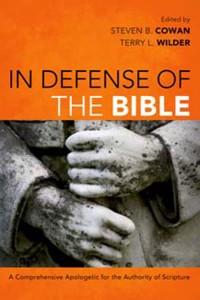
  • In Defense of the Bible: A Comprehensive Apologetic for the Authority of Scripture

    In Defense of the Bible: A Comprehensive Apologetic for the Authority of Scripture

    In Defense of the Bible: A Comprehensive Apologetic for the Authority of Scripture

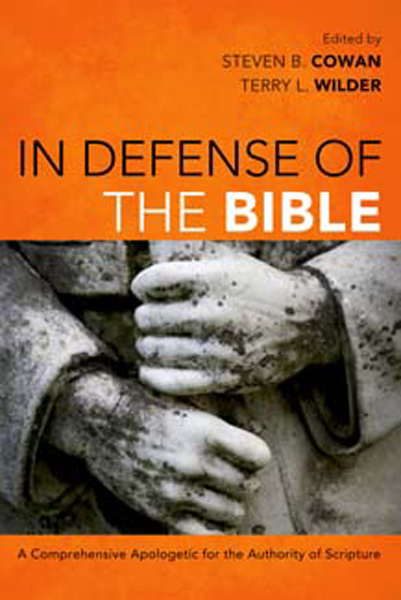
    Another of the books Matt has contributed to arrived from the publisher’s today. In Defense of the Bible: A Comprehensive Apologetic for the Authority of Scripture addresses and responds to the major contemporary challenges to the divine inspiration and authority of Scripture. It is edited by Steven B Cowan and Terry L Wilder and published by B&H Academic.

    The blurb from the publishers:

    In Defense of the Bible begins by looking at philosophical and methodological challenges to the Bible—questions about whether or not it is logically possible for God to communicate verbally with human beings; what it means to say the Bible is true in response to postmodern concerns about the nature of truth; defending the clarity of Scripture against historical skepticism and relativism.

    Contributors also explore textual and historical challenges—charges made by Muslims, Mormons, and skeptics that the Bible has been corrupted beyond repair; questions about the authorship of certain biblical books; allegations that the Bible borrows from pagan myths; the historical reliability of the Old and New Testaments.

    Final chapters take on ethical, scientific, and theological challenges— demonstrating the Bible’s moral integrity regarding the topics of slavery and sexism; harmonizing exegetical and theological conclusions with the findings of science; addressing accusations that the Christian canon is the result of political and theological manipulation; ultimately defending the Bible as not simply historically reliable and consistent, but in fact the Word of God.

    Contributors include R Douglas Geivett, William A Dembski, Mary Jo Sharp, Darrell L Bock and Paul Copan, with whom Matt co-authored a chapter entitled “Does the Bible Condone Genocide?”

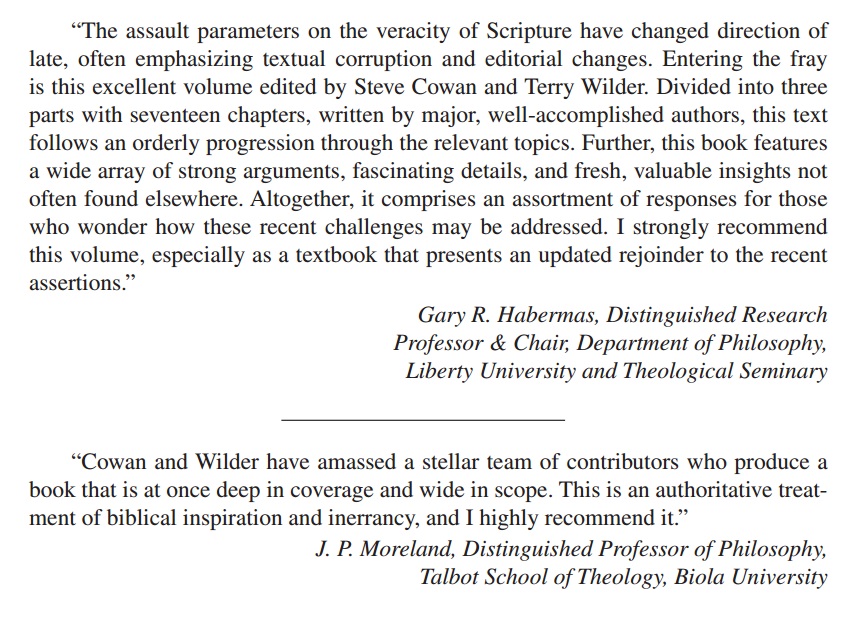
    A couple of endorsements:

    Endorsements

    In Defense of the Bible is available in both Kindle and Paperback formats. Get your copy from Amazon or Book Depository or wherever you like.

  • Matt’s Latest Publication: Virtues in Action – New Essays in Applied Virtue Ethics

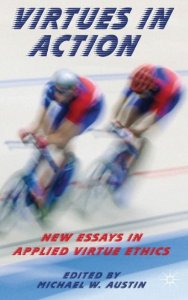
    Matt’s lastest publication in a book arrived by courier today. The book is Virtues in Action: New Essays in Applied Virtue Ethics; it is an an edited collection of new work in applied virtue ethics.

    Virtues in Action: New Essays in Applied Virtue EthicsVirtues in Action is edited by Michael W. Austin, who is Professor of Philosophy at Eastern Kentucky University, a specialist in ethics and philosophy of religion, author of Conceptions of Parenthood (2007), and editor or co-editor of several works, including The Philosophy of the Olympics (2012) and Being Good: Christian Virtues for Everyday Life (2012) – Being Good was the book Matt and each gave a paper on at the 2012 Evangelical Philosophy Society’s Annual Meeting in Milwaukee. Mike blogs at Ethics for Everyone.

    The chapter Matt wrote is called “Some Critical Reflections on Abortion and Virtue Theory.”

    From the Publisher:

    “In recent decades, many philosophers have considered the strengths and weaknesses of a virtue-centered approach to moral theory. Much less attention has been given to how such an approach bears on issues in applied ethics. The essays in this volume apply a virtue-centered perspective to a variety of contemporary moral issues, and in so doing offer a fresh and illuminating perspective. Some of the essays focus on a particular virtue and its application to one or more realms of applied ethics, such as temperance and sex or humility and environmental ethics. Other chapters focus on an issue in applied ethics and bring several virtues into a discussion of that issue or realm of life, such as sport, education, and business. Finally, several of the chapters engage relevant psychological research as well as current neuroscience, which enhances the strength of the philosophical arguments.”

    Table of contents:

    Introduction
    PART I: PROFESSIONAL VIRTUE
    1. Virtue-Centered Approaches to Education: Prospects and Pitfalls; Gregory Bassham
    2. The Virtues of Honorable Business Executives; Dan Demetriou
    3. Sport as a Moral Practice: An Aristotelian Approach; Michael W. Austin
    PART II: SOCIAL VIRTUE
    4. Sex, Temperance, and Virtue; Stan van Hooft
    5. Extend Your Benevolence: Kindness and Generosity in the Family and Beyond; Heidi Giebel
    6. A Virtue Ethical Case for Pacifism; Franco V. Trivigno
    7. Some Critical Reflections on Abortion and Virtue Theory; Matthew Flannagan
    PART III: ENVIRONMENTAL VIRTUE
    8. Environmental Degradation, Environmental Justice, and the Compassionate Agent; Chris Frakes
    9. Humility and Environmental Virtue Ethics; Matthew Pianalto
    PART IV: INTELLECTUAL VIRTUE
    10. Hope as an Intellectual Virtue; Nancy E. Snow
    11. Virtue Ethics and Moral Failure: Lessons from Neuroscientific Moral Psychology; Lisa Tessman
    12. Getting Our Minds Out of the Gutter: Fallacies that Foul Our Discourse (and Virtues that Clean it Up); Robert K. Garcia and Nathan L. King

    Get your copy from Amazon.

  • Is it Arrogant to Claim Jesus is the Only Way?

    Last week I spoke at Massey Presbyterian Church on the topic “Is it arrogant to claim Jesus is the only way?” The following is an abridged version of the talk I gave.

    ArrogantI was recently on a panel at Auckland University where an audience member raised the issue during the Q&A of religious pluralism. The issue is commonly raised as a rhetorical challenge, “isn’t it arrogant to believe Jesus is the only way?” In a world where there exists widespread religious pluralism, where there are people who are just as intelligent, educated, and ostensibly as sincere as we are who hold to and pratice a different religion to Christianity or no religion at all, how can a Christain maintain that she is right and everyone else is wrong. Isn’t believing that Jesus is the only way simply arrogant?
    In addressing this question I will first make three preliminary comments to identify what the issues are. Then, I will sketch three lines of response.

    First some prelimaries. As a matter of logic, if you affirm some proposition then you must reject the negation or denial of that proposition. Contradictory claims cannot both be true. It follows from this that in so far as one accepts the teachings of a religion like Christianity are true, as opposed to accepting the teachings for purely pragmatic reasons, one is rationally commited to rejecting claims that contradict this teaching. If one accepts God exists then it follows that one will believe that atheism, the denial of God’s existence, is false. If God created the world then the claim the world is not created is false. If Jesus died by crucifixition then the claim he did not exist or he died some other way is false.If there will be a final ressurection from the dead where people are judged for their actions then the claim there is no afterlife is false. So, if one accepts Christianity is true then one has to believe that other religions and perspectives that contradict Christianity are false; failure to believe this would be irrational.

    Second, accepting Christianity is true does not commit one to holding that there is no truth or value or good in other religions but it does commit one to the claim that these religions are mistaken where their teachings contradict the teachings of Christianity. This is signifcant as there are many issues on which different religions agree with Christianity, which makes them compatible with Christian teaching.

    Consider, for example Islam. Muslims believe there is only one God whom they call Allah. Allah is the Arabic word for God and was used by Christians to refer to God before the time of Mohamed. Muslims also believe that God is the creator and sustainer of the world. They believe God is all powerful, all knowing and has certain traits such as being just and merciful. Muslims believe God will judge all people and there will be a general ressurection of the dead. In all these things, Christians agree with them.

    Similarly, there are issues where Islam teaches about the way we should live that are perfectly compatible with Christian teachings, and which are arguably admirable given the standard Christian teachings on the same things. Muslims believe that one should give a third of one’s income to the poor, that one should pray five times a day.

    On the other hand, Islamic theology teaches things that are incompatible with central Christian doctrines. Muslim’s deny the Trinity, deny that Jesus was the son of God, deny that Jesus was crucified and that he rose from the dead. They affirm that Mohamaded is the final and ultimate prophet of Allah. Accepting Christianity commits one to denying these claims but not the former ones.

    What this shows is that Christians can accept that other religions and beliefs, and philosophers and theologians from within those traditions, can gain and appropriate genuine insight into the nature of God and his will for human kind. In fact, the Christian scriptures affirm this. In the first chapter of Romans the Apostle Paul states that “since the creation of the world God’s invisible qualities—his eternal power and divine nature—have been clearly seen, being understood from what has been made, so that people are without excuse.” Paul goes on to observe that this knowledge has been corrupted by Greco-Roman society but the point is that even behind such distortions is geniune insight of which the Pagans are (more…)

  • Ad Hominens, Special Pleading, Straw Men & Red Herrings: John Loftus’ Response to MandM

    John Loftus has written a response to my post “There Probably are no Duties. Now Stop Worrying and Enjoy Your Life!” Before turning to Loftus’ critique, let me recap my argument. While my post was satirical, it was intended to make a serious point. This being that many common and influential critiques of theism are incoherent.

    To establish this I argued three things.

    [1] That many critiques atheists offer of theism are moral critiques. Atheists argue that historically theism has been intricately linked with various forms of social oppression and/or the sacred texts of theistic religions condone oppressive practices.

    [2] That such critiques presuppose or assume the existence of moral duties. The critic has to assume that these practices are wrong even though the religious believers condone them.

    [3] That if one accepts the standard arguments atheists use against theism then the presupposition that there are moral duties is unjustifiable because precisely analogous arguments can be used to show there are no moral duties.

    Now if these three contentions are true then there is a fundamental incoherence in many common critiques of theism. If Loftus is going to provide a rebuttal of these contentions then he needs to provide reasons for thinking one of these three contentions is false.

    Unfortunately, instead of engaging the argument, Loftus ignored it and attacked a string of red herrings.

    John LoftusLoftus’ first argument in Do You Want to Be a Christian Apologist? Part 10 was to assert that I am “intellectually dishonest”, although somewhat charitably he states I am probably not aware I am dishonest – presumably I suffer from profound self-deception. Apparently the truth of this claim is blatantly obvious to “us” [by which he apparently means the atheist community].

    Unfortunately, simply stating that I am self-deceived and asserting with great confidence that I am wrong is not actually tantamout to offering a reason for questioning [1], [2] or [3] above. If it did then one could easily demonstrate that Loftus’ own work is substandard, I could just assert that it is and that everyone knows I am right and hey presto there’s my proof .

    Clearly, this is not a method by which one can reliably establish the truth or falsity of the matter.

    Loftus second argument begins with him drawing from my preamble:

    “Some atheists offer moral critiques of theism; their claim is not just that belief in God is false or unjustified, it is that such irrational beliefs are intricately linked with immoral and oppressive practices. Moral outrage often motivates the critiques offered – one only needs to read the condemnation of religious wars, religiously motivated terrorism, inquisitions, witch hunts, the suppression of science, sexism, homophobia, and so on, which is so prevalent in many free thought writings. Similarly, one needs only to read the accusations, regularly repeated in popular atheist literature, that the Bible condones slavery, or genocide, or stoning cheeky children, or rape, to observe this.

    Note that behind this critique is the presupposition that there are moral duties. People have a duty to not engage in wars or acts of terrorism, religious people who promote sexist or homophobic practices are wrong for doing so. I think this is nonsense as it assumes there is such a thing as a moral duty, it assumes things religious people do can be wrong. This is false and here is why.”

    After citing me Loftus rejoins:

    “Note the diversion here? Instead of providing answers to skeptical arguments he’s asking how anyone can have a moral critique of the Bible who doesn’t believe it’s the inspired word of God. He’s special pleading. No one else, given the rules of his game, can offer a moral critique of the Bible. Not a Hindu, nor a Muslim, nor a Buddhist, nor even liberals like the late John Hick or Thom Stark, or process theologians….. Do they? Do pantheists have a moral basis for critiquing the Bible? Flannagan would also have to reject the Natural Law Ethics (NLE) of the Catholic church, for if Natural Law Ethics obtains then even atheists have a basis for their moral critiques of the Bible. …”

    Unfortunately this rejoinder has little rational merit at all.

    First, I do address the sceptical arguments in question. By defending [3] I argue that analogues of these arguments entail an obvious false conclusion and therefore they cannot be sound. This is clear from reading the section of the original post which Loftus does not cite.

    Second, contrary to what (more…)

  • Matt to speak at the 2013 Evangelical Philosophical Society in Baltimore on Divine Commands re Abraham and Isaac

    This blog’s Matthew Flannagan has had his paper “Divine Commands and Biblical Authority: The Problem of Gen 22” accepted for the National Annual Meeting of the Evangelical Philosophical Society (“EPS”). The abstract for Matt’s paper is as follows:

    Evangelical Philosophical Society“One perennial objection to divine command meta-ethics is the possibility that God might command something abhorrent. Divine command theorists have responded that God is essentially good, as such, it is impossible for him to issue an abhorrent command. One challenge to this response, for those divine command theorists who accept a robust view of biblical authority, is the story of the binding of Isaac in Genesis 22. In this story God is said to have commanded human sacrifice; given that human sacrifice is abhorrent, and it is impossible for God to command the abhorrent, Biblical authority seems incompatible with the acceptance of a divine command theory.

    This paper responds to this challenge. First, I will argue that a careful reading of Genesis 22 in its literary context suggests God issued the command in a particular context. Second, drawing from discussions of the problem by Robert Adams Immanuel Kant, and Philip Quinn, I will discuss the circumstances under which a divine command theorist can rationally and coherently attribute a seemingly immoral command to an essentially loving and just God. I will argue that the context of God’s command in Genesis 22 is such that a divine command theorist can defensibly attribute it to an essentially good God without abandoning a robust view of biblical authority; the story of the binding of Isaac does not provide a divine command theorist with a defeater for belief in biblical authority.”

    The conference theme will be “Revelation and Authority.” The Plenary Speaker is Richard Swinburne of Oxford University. The draft copy of the ETS-EPS program is available here.

    Matt has also had a paper accepted for the Evangelical Theological Society’s Annual Meeting which is also in Baltimore around the same time – see Matt to speak at the 2013 Evangelical Theological Society in Baltimore on Feticide.

    As with previous years we will be fundraising to raise the $2,500 NZD to get him there . Donations greatly appreciated.

  • Matt to speak at the 2013 Evangelical Theological Society in Baltimore on Feticide

    This blog’s Matthew Flannagan has had his paper “Boonin’s Defense of the Sentience Criterion: A Critique” accepted for the 65th Annual Meeting of the Evangelical Theological Society (“ETS”). The abstract for Matt’s paper is as follows:

    Abstract
    “Defenders of the permissibility of feticide commonly argue that killing an organism is not homicide unless the organism’s brain has developed enough for it to acquire sentience: the capacity for consciousness and the ability to perceive pleasure and pain. In this paper I critique one of the more sophisticated versions of this argument, proposed by David Boonin in
     A Defense of Abortion. First, I sketch some prima facie problems faced by any appeal to sentience. Second, I examine Boonin’s attempt to defend an appeal to sentience against these problems by constructing a modified future like ours (FLO) account of the wrongness of killing. I argue that Boonin’s modified FLO defence of sentience fails. Both his argument for the modified FLO account and his application of this account to feticide rest on ad hoc arbitrary manoeuvres, manoeuvres which mean that the modified FLO account is a plausible criteria for the right to life only if one already grants that feticide is not homicide.”

    Matt’s ETS paper will be based on his article “Boonin’s Defense of the Sentience Criterion: A Critique” which was published in Ethics and Medicine – An International Journal of Bioethics Vol 25:2 (Summer 2009) 95-106. (You can download this article here).

    This year’s Annual Meeting will be held in Baltimore, Maryland, USA from 19-21 November 2013.

    ETS Annual Meeting Flyer

    This year’s theme is “Evangelicalism, Inerrancy, and the Evangelical Theological Society: Retrospect and Prospect”. Plenary speakers for this year’s meeting are Dr Donald A Carson (Research Professor at Trinity Evangelical Divinity School), Dr John M Frame (Professor of Systematic Theology and Philosophy at Reformed Theological Seminary), and Ben Witherington III (Jean R Amos Professor of New Testament at Asbury Theological Seminary).

    Matt has also had a paper accepted for the Evangelical Philosophical Society’s Annual Meeting which is also in Baltimore around the same time – see Matt to speak at the 2013 Evangelical Philosophical Society in Baltimore on Divine Commands re Abraham and Isaac.

    As with previous years we will be fundraising to raise the $2,500 NZD to get him there . Donations greatly appreciated.