Category: Philosophy of Religion

  • Back from San Francisco: A Belated Report

    MandM has been quite of late, this is because Madeleine and I have been very busy.  With moving house in the midst of Christmas and New Years and Madeleine working part-time in a law firm and so on, we’ve had little time to blog. We are now set up, to some extent, and so this post will be a belated comment on my recent trip to San Francisco.

    In November I flew to San Francisco where I attended I attended the  Meeting of the Evangelical Theological Society (ETS), The Annual Meeting of the Evangelical Philosophical Society (EPS), The Evangelical Philosophical Society Apologetics Conference and The Annual Meeting of the Society for Biblical Literature (SBL) and American academy of religion.(AAR). While I would love to give detailed commentary on each session, to do so would require several blog posts of inordinate length, instead I will simply summarise what went down.

    I arrived in San Francisco at around 4pm  on the 15th. I presented my first paper at 8:30am the next morning. My paper was a critique of Walter Sinnott Armstrong’s arguments against divine command theory meta-ethics. Armstrong contends that the nature of moral obligation is best explained by identifying moral obligations with the natural property of harming others without justification, and, focusing largely on Craig’s work, argues this is superior to divine command ethics. I argued: (a) his argument fails to note the conditional nature of Craig’s (his main target’s) contention that if theism is true moral obligations are best explained as divinecommands (b) Armstrong’s does not provide a better account of moral objectivity (c) Armstrong’s account is not more economical than a divine command theory. (d) Even if it were an economical account, it does not explain various features of obligation such as (i) the social nature of moral obligations (ii) the fact that moral obligations constitute a decisive reason for acting and (iii) the specific moral content of obligations; as well as a divine command theory. All in around 30 minutes!!! The paper was very well received, with several people asking me to forward them a copy. I plan to get it published later this year.

    The rest of the morning was filled with me hearing various papers on moral theory and philosophy of religion all of which were interesting and stimulating. These panellists all shared similar perspectives yet were astutely critical of each other’s arguments. Particularly interesting was the dialogue between Baggett and Craig. Some of the issues here were technical and deserve further discussion so I plan to blog on this dialogue in more detail in the future. But in sum: Craig has defended a counterfactual: if God did not exist then moral obligations would not exist. Baggett  argued for various reasons that this is too strong; if God, the creator and sustainer of the universe, did not exist, the universe would not exist. To make sense, Craig’s claim needs to envisage a compossible world, which is like the actual world in all respects except that God does not exist, if it’s like the world in all other respects however, then it has all the features of the world God has created – and hence the resources for something like moral obligations to exist. Instead, Baggett contended, one should argue that a world with God provides a better explanation of the nature and existence of moral obligations than a world without God does. This means the theist does not have to argue, with Craig, that there is no adequate secular account of the existence of moral obligations, only that a divine command theory is more plausible than such accounts. Both Craig and Baggett made telling points which I will have to elaborate on some other time. highlight of Wednesday was the afternoon session. A panel discussion of David Baggett and Jerry Wall’s new book “Good God: The Theistic Foundations of Morality”. This book is the latest defence of divine command theory ethics, recently published by Oxford University Press. Baggett and Walls sketched briefly the content of the book and Paul Copan and William Lane Craig offered critical commentary, to which Baggett and Walls responded.

    Thursday started with an excellent critique of evolutionary (more…)

  • More Mistakes: A Rejoinder to Randal Rauser

    For those who aren’t aware, there has been something of a “debate”, but what I’d prefer to refer to as an “in house discussion” between Randal Rauser (Professor of Historical Theology at Taylor Seminary) and myself.

    The discussion so far can be found here:

    My initial article was Randal Rauser’s Mistake: A Defense of Calvin’s Doctrine of Election

    Rauser’s response: Calvinism and the Arbitrary Camp Director Revisited: A Response to Andrew

    Andrew and CalvinBefore I begin, I should point out that I have been on the Kapiti coast for the last week at a TSCF (Tertiary Student Christian Fellowship, a cousin of Inter-Varsity) retreat where I was without internet. Hence it’s only in the last day that I’ve learned that Professor Rauser has kindly taken the time to respond to my initial article. So I apologize for my delayed response.

    I would also like to point out that while my intention was to provoke Rauser’s response, it was not to be rude, and I apologize if that’s the impression he has received. I have a great deal of respect for Rauser, particularly given (as I pointed out in my last article) that he is a Professor of Historical Theology with an obvious background in analytic philosophy, while I am a mere undergrad with far more ambition than actual ability. The last thing that I want is for this discussion to devolve into the kind of vitriol that plagues almost all other web based discussions of the philosophy of religion and/or theology. I say this, largely because I fear (from the tone of his response) that he has received the impression of ill intent on my part.

    Secondly, I appreciate that Rauser took the time to respond to my article, and I appreciate that he also took the time to counter my personal testimony with that of his own.

    Randal Rauser and ArminiusBut now to specifics: How does Rauser respond to my claim that the arbitrariness objection (at least if it is to be an objection) begs the question against Calvin’s doctrine of election? On the face of it, he doesn’t seem to challenge my point that God may not be acting unjustly if we are undeserving of salvation. To the contrary, Rauser seems to admit for the possibility that the tortures may be justly deserved. But if that’s the case, then, as I tried to point out in my first post, there’s no real injustice or immoral state of affairs that obtains if God so desires to instantiate those punishments. Paradoxically though, Rauser refers to my theology as “brutal” and “morally incoherent”. Both of these terms, emotionally provocative as they are, seem to suggest that there is something nasty, horrible, evil (whatever negative adjective your heart desires) about a God that selects some for salvation while selecting others for damnation. But if, as Rauser seems to allow, the tortures are justly deserved, then none of those adjectives can rightly be said to stick. After all, if the tortures are justly deserved, and God decides to carry out those tortures, then God can only be said to be doing what the demands of morality and/or justice require. So wherein does the moral incoherence obtain?


    But according to Rauser, I would still be missing the point. After all, he (Rauser) says, the Camp Director Analogy was not intended to show that God, given Calvinism, is “unjust”, but rather that He cannot be seen as “maximally loving”. I see no real reason to deny Rauser the liberty to make this distinction, but its relevance is, at best, unclear.

    Thankfully, Rauser does seem to hint at one possible way in which we could interpret this as an objection. He seems to engage in something of a pair-wise comparison between two possible scenarios that are supposed to be relevantly similar to the Arminian and Calvinist conceptions of election respectively.

    • Scenario 1: The director arbitrarily selects some children for beatings and others for loving rehabilitation.
    • Scenario 2: The director selects all children for loving rehabilitation.

    According to Rauser, were God to bring about scenario 2, we would state that He is more loving were he to bring about scenario 1. There are three things that I have to say to this (more…)

  • Comparing the Old & New Teleological Arguments

    Robin Collins

    The “New Teleological Argument” is a theistic argument which attempts to show that theism is more probable than the postulate of an “atheistic single universe”[i]. There are number of reasons why this argument is termed the “New” teleological argument. Chief among these reasons is that its explanandum i.e. the incredible fine tuning of the laws and constants of physics have only been discovered in the past 20-30 years[ii] [iii]. By contrast, the explanandum of “Old Teleological Arguments” has long since been available to theologians and philosophers of religion. Of course the relatively recent origin of the “New” Teleological argument is not the only feature which distinguishes it from its historical counterpart. Whereas historical versions of design arguments (such as Paley’s famous watchmaker argument) rest on an argument from analogy, contemporary versions of the argument rest on what the philosopher of biology Elliot Sober calls the “Likelihood Principle”[iv] [v]. In other words, rather than relying on an analogy between the explanandum and some obviously contrived entity such as (in Paley’s case) a watch, contemporary versions of the teleological argument argue that the explanandum (the fine tuning of the laws and constants of physics) is more probable given the hypothesis of theism as opposed to the postulate of an atheistic single universe[vi].

    The Conditions of Success
    Throughout the rest of this post, I hope to argue that, on purely philosophical grounds, there is little which will allow us to say which version of the argument (be it contemporary or historical) is more or less plausible. In this respect, it seems only fair that we should assess the strength of David Hume’s critiques, since they are popularly regarded as decisive refutations of teleological arguments.[vii] [viii] It’s important to note also, that while the failure of the Humean critiques would not guarantee the conclusion that the design arguments are equally plausible, it is suggestive thereof. After all, if the joint failure of natural theological and atheological arguments should suggest that it’s impossible to arbitrate (on the evidence) between theism and atheism, then similarly, the failure of stock arguments against either of the design arguments should lead us to think that it’s impossible to arbitrate between them.  In spite of the fact that both contemporary and historical versions of the design argument are equally plausible, I will argue that the contemporary version of the argument has a number of key dialectic advantages which may warrant us in thinking that it is “dialectically speaking”, more successful than its historical counterpart. More precisely, I am saying that the relative success of the new teleological argument is a function of the fact that it does not turn on premises that are as deeply controversial as the commitments required by the historical version.

    The Contemporary Version of the Argument
    The most prolific contemporary defender of the design argument is Robin Collins who, rather than arguing from facts about biology, argues from recent discoveries in physics[ix]. As we noted earlier, this is one of the main reasons why it is termed the “New” teleological argument. Collins frames his rendition of the argument as follows:

    (1)     The existence of fine tuning is not improbable under theism[x]

    (2)     The existence of fine tuning is very improbable under the atheistic single-universe hypothesis[xi]

    Therefore, given the prime principle of confirmation[1] [xii],

    (3)     The existence of fine tuning is evidence for theism over the atheistic single-universe hypothesis[xiii]

    By “fine tuning”, I mean the very precise arrangement of the fundamental laws and constants of physics that must be met in order for our Universe to fall into the very narrow life permitting range.[xiv] [xv] According to contemporary physics, these conditions seem to be arranged in such a way that, were they to vary by even the tiniest amount, life (or more precisely, sentient life) would not be a physical possibility. For example, as P.C.W. Davies points out, a change in “the weak force”[2] by only 1 part in 100100 would make the Universe uninhabitable.[xvi] Similarly, if the cosmological constant[3] were just a fraction faster, matter would spread apart so quickly that even relatively small clumps of matter would have insufficient time to form[xvii].

    The Plausibility of the Premises
    Premise (1) amounts to the claim that if God exists, then it is entirely within His creative capability to create the universe finely tuned as it is. Hence the observation that there is a universe which exhibits teleo-functional properties is not surprising given the postulate of theism. Considering that the traditional conception of God holds that He is an omnipotent being, this is a fairly straightforward premise that we should accept.

    Premise (2) amounts to the claim that if God does not exist and if the single universe hypothesis is true, then the apparent fine tuning of the universe is a very surprising fact. After all, the fundamental laws and constants of physics seem to be arranged in such a way that their placement seems guided. But if God doesn’t exist, it doesn’t seem likely that there would be any intelligent, guiding mind such that it could plausibly account for this apparent fine tuning. Hence premise (2) seems (more…)

  • Contra Mundum: When Scientists Make Bad Ethicists

    One thing I find particularly frustrating is reading commentary on theology and philosophy written by scientists. To be fair, some scientists I have read are informed and do offer astute and insightful comments; commonly, however, one finds a person who is undoubtedly brilliant in their own field, writing with confident gusto, articles that fail to understand the most basic theological and philosophical distinctions.

    Jerry CoyneA good example can be seen in a recent USA Today article by influential biologist Jerry Coyne entitled, As atheists know, you can be good without God. Coyne, an outspoken atheist, is disturbed that many Americans, including some prominent scientists, believe that our instinctive sense of right and wrong is “strong evidence for [God’s] existence.” He ventures into moral philosophy to explain why this is clearly mistaken.
    From the get-go Coyne demonstrates he does not understand the issues.

    It is necessary to accurately understand the position Coyne is criticising before we look at the paucity of his critique. The argument that our instinctive sense of right and wrong “is strong evidence for [God’s] existence” found its most important formulation in a 1979 article by Yale Philosopher Robert Adams. In it, Adams noted that we instinctively grasp that certain actions, like torturing children for fun, are wrong; hence, he reasoned, we are intuitively aware of the existence of moral obligations. According to Adams, the best account of the nature of such obligations is that they are commands issued by a loving and just God. Identifying obligations with God’s commands can explain all the features of moral obligation better than any secular alternative. Consequently, the existence of moral obligations provides evidence for God’s existence.

    It is important to note what Adams did not claim. Central to Adams’ argument, and to pretty much every author who follows him, is a vital distinction; this is the distinction between the claim that moral obligations are, in fact, divine commands and the claim that one cannot recognise what our moral obligations are unless one believes in divine commands or some form of divine revelation. Adams illustrates this distinction with the example of H20 and water.

    Contemporary chemistry tells us that the best account of the nature of water is that water is, in fact, H20 molecules. This, of course, means that water cannot exist unless H20 does. However, it does not mean that people who do not know about or believe in the existence of H20 cannot recognise water when they see it. For centuries people recognised, swam in, sailed on and drank water before they knew anything about modern chemistry.

    This distinction has important implications. The claim that moral obligations are, in fact, commands issued by God does not entail that people must believe that God exists and has issued commands in order to be able to recognise right and wrong. These are separate and logically distinct claims.

    Coyne conflates this distinction from the outset. After noting that some people believe that moral obligations provide strong evidence for God’s existence, he claims that this is an oft-heard argument, “‘Evolution,’ many argue, ‘could never have given us feelings of kindness, altruism and morality…’;” to this he rejoins that, “scientists studying our primate relatives, such as chimpanzees, see evolutionary rudiments of morality: behaviours that look for all the world like altruism, sympathy, moral disapproval, sharing — even notions of fairness.”

    This is confused. Apart from the fact that no one who cites morality as evidence for God actually makes the argument about evolution that Coyne sets out, the claim that moral obligations cannot exist independently of God is not the claim that without God people would not have moral feelings. Feeling that one has an obligation to do something and actually having an obligation to do it are clearly different things. People can feel that they have a certain obligation without it actually being the case that they do.

    Coyne makes a similar mistake when he argues that secular European countries like Sweden and Denmark “are full of well-behaved and well-meaning citizens, not criminals and sociopaths running amok.” This  (more…)

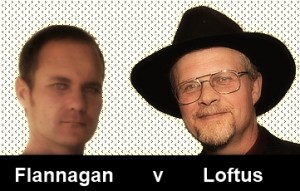
  • Want to see Matthew Flannagan debate John W. Loftus in America?

    Dr Matthew Flannagan v John W LoftusAs you all know, Matt and I are going to the US to speak at 4 conferences in November. John W. Loftus is aware of this and in a comment on this blog has suggested a debate between himself and Matt during the 3 days we have spare between conferences – ideally for us 14 Nov. We have had some email discussion with him about this including agreeing that the topic for debate will be something around Loftus’ Outsider Test for Faith, maybe, “Is Christianity True?” or something like that.

    A couple of groups within the Christian Apologetics Alliance have indicated keeness to see it happen, we have even had small pledges of money towards helping it happen, but so far no one has been able to say “yes, we will organise it” and we need that to happen asap or we are just going to run out of time. So, can you organise it can you offer support towards anyone organising it? Do you want to see it happen? (If it happens it will be videoed)

  • Hear Matthew Flannagan speak on Moral Relativism, Get a Feed and Watch the All Blacks take on Argentina this Sunday

    Matt will be speaking on Moral Relativism this Sunday as part of Massey Presbyterian Church’s (“MPC”) night service. His talk will look at what it is, what reasons people have for adopting it and why we should be concerned about its pervasiveness in society. The style of talk is interactive so bring your questions.

    After the service, MPC will screen the quarter final rugby match between the All Blacks and Argentina. Game snacks will be available for purchase; the proceeds will go towards our impending trip to America. Before the service, the MPC cafe will offer cheap meals (like mains around $3, desserts $1). So come along and make a night of it!

    When: Cafe meals from 6.30pm – service starts 7pm, Sunday 9 October
    Where: Massey Presbyterian Church, 510 Don Bucks Rd, Massey, Auckland
    Cost: Free (unless you are purchasing food)

    Facebook has an event page you can use to RSVP and invite others.

  • Skepticule Extra – A Podcast on the Euthyphro Dilemma Feat. Matthew Flannagan

    Recently Matt did a podcast on Divine Command Theory and the Euthyphro Dilemma for Skepticule Extra,  aka the “Pauls to the Power of Three Podcast” hosted by Paul Baird, Paul Thompson (“Sinbad”)  and Paul S. Jenkins.

    Click to Listen to Matthew Flannagan on Divine Command Theory and the Euthyphro DilemmaYou can listen to that podcast here.

    Visit Skepticule for more listening options.