Category: Philosophers

  • Religion, Science, 9/11 and the Moon: Dawkins’ Response to Copan

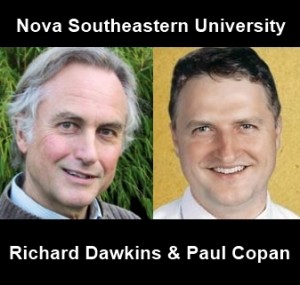
    Richard Dawkins and Paul CopanParchment and Pen, has an audio of a brief exchange between Paul Copan and Richard Dawkins who was speaking in Ft. Lauderdale at Nova Southeastern University on “The Fact of Evolution.” (The following week, Paul Copan spoke on “The Fact of God” at Nova Southeastern and gave a direct response to Dawkins.) This MP3 of Paul Copan and Richard Dawkins’ exchange is from the Q&A of Dawkins’ talk.

    In it Paul alludes to an argument advanced by C S Lewis, Alvin Plantinga, Michael Rea, Victor Reppert and also alluded to by Patrica Churchland, Thomas Nagel, William Whewell and Friedrich Nietzche. The argument is that if our cognitive faculties evolved by natural selection, unguided by God, then our cognitive faculties cannot be rationally relied on to give us truth. The literature on this argument is interesting but I won’t comment on that here.

    What interests me is the comment Dawkins made in the MP3 which got the applause of the audience. Dawkins appears to not grasp the point of the argument and takes it to be asking for a reason why he supports “scientific rationalism”. He said he believes in scientific rationalism because it “works”. He then provided an example of how it “works”, it is that “science flies us to the moon, while religion flies planes into buildings.”

    Much could be said here but I want to limit myself to a single point, the evidence Dawkins cites that science works and religion does not. Dawkins offers that science has done good things such as getting us to the moon; religion has done bad things like destroying the World Trade Centre on 9/11. In other words, the positive things science does commends it as a something we should trust whereas the negative things religious does commends it as some thing which we should not trust.

    So let’s look at the claim Dawkins made that “science” got us to the moon. Now how does a subject, get us to the moon? Presumably what he means is that it was through science that we developed the rocket propulsion technology which enabled us to get to the moon.

    But here is the problem. If the fact that science developed the propulsion technology that got us to the moon means that science is responsible for the flight to the moon, and can take credit for it, then science must be responsible for the flight into the World Trade Centre; science developed the propulsion technology of aeroplanes, hence, it should be science not religion that is blamed.

    Moreover, rockets are used for other things apart from space and air travel (more…)

  • The Sceptic and the Scientist: Ed Feser on Richard Dawkins and PZ Myers

    String TheoryHe is not one to pull punches and true to form, in To a Louse, Ed Feser holds a mirror up to the kind of reasoning that is all too common amongst Dawkins and Myers fans with this fictional dialogue between a scientist and a science sceptic;

    Skeptic: Science is BS. Physicists believe in these things called “quarks,” which are little flavored particles that spin around and work like magic charms. Their evidence is that they read about them in a James Joyce novel. Some of them think the universe is made up of tiny shoelaces tied together, though they admit that they have no evidence for this and have to take it on faith. Einstein said morality is all relative – which is why he stole his ideas from this guy who worked in a patent office, and why Richard Feynman stole atomic secrets during WWII. Meanwhile, the chemists contradict the physicists and believe instead in little colored balls held together by sticks. Biologists believe monkeys can give birth to human beings. What a bunch of crap! It’s child abuse to teach kids about this stuff in schools.

    Scientist: Are you joking? If not, I suggest that you actually read some science before criticizing it.

    Skeptic: I’ve already read a lot about it, in blog comboxes like this one. And why should I waste my time reading anything else? I already know it’s all BS! Didn’t you hear the examples I just gave?

    Scientist: No, you’re missing my point. You’ve completely distorted what scientists actually say. It’s not remotely as silly as you think it is. In fact it’s not silly at all. But you need to actually read the stuff to see that.

    Skeptic: So you deny that physicists believe in quarks? What flavor are your quarks, chocolate or vanilla? Do you deny that they think we came from monkeys? Which monkey was your mother?

    Scientist: No one says that monkeys gave birth to humans. That’s a ridiculous caricature. And of course I don’t deny that physicists believe in quarks, but you’re badly misunderstanding what they mean when they attribute “flavor” to them. They don’t mean that literally…

    Skeptic: Oh so it’s just empty verbiage, then. See, you’re just proving my point for me.

    Scientist: No, it’s not empty verbiage. It’s technical terminology.

    Skeptic: I see, like magic spells. That’s why (more…)

  • Abortion and the Morality of Feticide: Part II

    In my last post, Abortion and the Morality of Feticide: Part I, I briefly sketched an argument against feticide,

    [1] It is wrong to kill a human being without justification;

    [2] A fetus is a human being;

    [3] In the case of feticide (at least in the majority of cases) insufficient or no justification is forthcoming.

    I argued that defenders of feticide cannot rationally reject this argument unless they reject one of the premises. I argued further that attempts to refute [3] are successful only if one assumes that a fetus is not a human being. It follows then that defenders of abortion laws cannot rationally avoid the question of whether [2] is correct, whether a fetus is a human.

    Is the Fetus a Human Being?

    Big MacThe first thing to note is that the claim that feticide is homicide has considerable prima facie plausibility. Consider this, a hunter is in the woods and notices some rustling in the bushes. Looking through his scope he sees a six-foot high, bi-pedal being with brown hair, blue eyes, wearing a red and black swanndri. He refrains from shooting. Here, the hunter makes the sensible and reasonable judgement that in firing he would risk engaging in homicide. He bases this on what the target looks like. In the absence of reasons for thinking otherwise, he has good grounds for this claim.

    This example has application to the status of the fetus; “[there is] a general consensus that the fetus is recognisably human after six weeks, and certainly after eight”[1] This fact, conjoined with the above illustration, entails that, in the absence of good reasons to the contrary, there are good grounds for thinking that feticide is homicide.

    The second thing to note is is that good reasons for thinking the fetus does not have human status are not forthcoming. Here I will focus on four common examples: viability, sentience, birth and person-hood.

    Viability
    A common argument contends that a fetus is not a human because it is not viable. Susan Sherwin argues that feticide differs from killing children because a fetus “is wholly dependent on her [the mother’s] unique contribution to its maintenance, while a newborn is physically separate, though still in need of a lot of care”.[2]

    There are several problems with this position.

    The fact that a fetus cannot survive independently of its mother does not mean it is not a human being. Fetal viability is contingent upon the medical technology of a given culture. A fetus that is not viable in (more…)

  • John Lennox on the “Religion v Science” Myth

    John Lennox will arrive in Auckland in less than two weeks for his New Zealand tour.

    If you are not familiar with Lennox watch this video “The “Religion v Science” Myth.” In it Lennox examines the historically ignorant myth that religion is and always has been at odds with science.

    Details of Lennox’s upcoming New Zealand tour are here: Hear John Lennox in New Zealand.

    Hat tip: Glenn Peoples

  • Hear John Lennox in New Zealand UPDATED

    John LennoxProfessor John Lennox of the University of Oxford will arrive in New Zealand in a fortnight for a brief public speaking tour in the centres of Auckland, Wellington and Christchurch.

    His New Zealand speaking itinerary of public events is below; all public events are free.

    Auckland

    Sunday 27 February

    9:30 – 11:00am Preaching at Howick Baptist Church on the corner of Picton and Wellington Streets, Howick, Auckland. Facebook Event Page.

    1:00 – 3:00pm Science and Religion Q&A at the Salvation Army East City Corps, 37-45 Wellington Street, Howick Auckland. Facebook Event Page.

    7:00 – 9:00pm Preaching at Greenlane Christian Centre, 17 Marewa Rd, Greenlane, Auckland.

    Monday 28 February

    7:00 – 9:00pm “Christ Among the Philosophers” at St Paul’s Church, Symonds St, Auckland. Facebook Event Page.

    Organised by Compass, “Dr Lennox will address questions such as, is faith delusional? Is it reasonable? How can we live faithfully in the public square? How might one engage faithfully as a Christian in the academy?”

    Tuesday 1 March

    12:00 – 1:00pm (this talk will be repeated in the same room from 1:00-2:00pm) “Has Science Buried God?” Public lecture at Auckland University at the Cap and Gown Lounge (Bar), Level 3, Students Union, Auckland University Campus. Facebook Event Page.

    Organised by TSCF: “Science and reason seem to be claiming to have disposed of our need of God. But have they? Prof John Lennox, author of “God’s Undertaker”, engages with the issues in an accessible, thoroughgoing and scientifically sound way. As a world renowned academic mathematician and the only Christian academic that Richard Dawkins has been happy to engage in public debate, John brings illumination, humour and challenge (as well as a cool accent) into this tense and controversial area.”

    7:30 – 9:30pm “So you want to change the world?” Student Meeting TSCF Offices, 441 Queen Street.

    Wellington

    Wednesday 2 March

    7:00 – 9:00pm “Why God Loves Richard Dawkins?” or “God and Stephen Hawking” at St Michael’s, Upland Road, Kelburn, Wellington. Facebook Event Page.

    “Hawking’s book argues that invoking God is not necessary to explain the origins of the universe, and that the big bang is the consequence of the laws of physics alone. Hawking has said, “One can’t prove that God doesn’t exist, but science makes God unnecessary”. Professor Lennox will discuss the flaws in Stephen Hawking’s logic and demonstrate that, far from disproving a creator, Hawking’s argument make the existence of God far more probable.”

    Christchurch

    Sunday 6 March

    9:00 – 10.30am Speaking at Spreydon Baptist Church, Corner Lyttelton & Cobham StreetsSpreydon,Christchurch

    Biography

    God's Undertaker: Has Science Buried God?Dr John Lennox is a Professor of Mathematics at the University of Oxford, a Fellow in Mathematics and the Philosophy of Science and (more…)

  • Understanding the Abortion Debate with Francis Beckwith

    Those who have been following Matt’s series Abortion and the Morality of Feticide might enjoy this video featuring Francis Beckwith of Baylor University’s Philosophy faculty speaking to the Summit Ministries Interns on the topic “Understanding the Abortion Debate“. Beckwith is arguably one of best contemporary philosophers writing from the pro-life position. He is a clear and entertaining speaker who can break his work down into a form that anyone can follow.

    In this talk Beckwith poses the question, who and what are we? He goes on to discuss current bio-ethical issues such as cloning and stem cell research as well as the nature of the fetus. He also critiques common arguments for abortion.

    Click to View "Understanding the Abortion Debate"


  • Abortion and the Morality of Feticide: Part I

    Is it morally permissible to commit feticide? The abortion debate swirls around this question, a lot of rhetoric, emotion and anger gets spent on debating this question or avoiding it.

    In this series I will examine this question. First I will sketch an argument against feticide: the killing of a fetus. Then I will examine three common ways of criticising this argument and respond to them.

    The Argument Against Feticide

    Implicit, if not overtly explicit, in much historic Christian moral reflection on feticide is a simple three-premise position. Firstly, that there is a divine law prohibiting homicide – the killing of a human being without adequate justification; secondly, a fetus is a human being; and thirdly, that in all or most cases of feticide, justification for homicide is not forthcoming. This argument can be summarised as follows:

    [1] It is wrong to kill a human being without justification;

    [2] A fetus is a human being;

    [3] In the case of feticide (at least in the majority of cases) insufficient or no justification is forthcoming.

    This argument is formally valid. These three premises jointly entail that feticide is wrong; premises [1] and [2] entail that it is wrong to kill a fetus without justification, this conclusion, conjoined with [3], entails that feticide is wrong in at least the majority of cases. Given the argument is formally valid, any critique of this argument must call into question the truth of either of the premises. [For more on validity see Assessing Arguments]

    Avoidance Tactics
    FetusNotwithstanding this, the most common response to this argument is some tactic seeking avoidance of the issue. It is not unusual to see attempts to denounce, insult, caricature or defame the character of those who oppose feticide. If current commentary is to be believed opposition to legal abortion comes from misogynist fundamentalist fanatics who want to impose their religious mores onto others.

    Of course, these strings of pejorative terms fail to address the argument above. Suppose everything that is said of such people is true – people who oppose feticide do have the bad character traits or motives claimed – the soundness of the argument remains untouched. A good argument does not cease to be a good argument just because someone has personal flaws or dubious motives. It is only unsound if (more…)